AI Generated Exam Paper
O Level Physics Practice Paper 3
Free O Level Physics Practice Paper 3, HY3 AI version, with questions, answers, and O Level-style practice for Singapore students.
These static practice materials are generated from the site's syllabus and paper-generation workflow, with source and model context shown so students and parents can evaluate the material before use.
Questions
TuitionGoWhere Practice Paper - Physics O-Level
TuitionGoWhere Practice Paper (AI) — Version 3 of 5
Subject: Physics
Level: O-Level
Paper: Practice Paper (Topic: Electricity & Magnetism)
Duration: 1 hour
Total Marks: 40
Name: ______________________
Class: _________
Date: ___________
Instructions:
- This practice paper contains 20 questions on Electricity & Magnetism.
- Answer all questions in the spaces provided.
- Show your working clearly where calculations are required.
- Use the correct units for all final answers.
- Marks for each question are shown in brackets [ ].
Section A: Basic Concepts and Calculations (Questions 1–10) — 20 marks
1. State what is meant by conventional current direction in a circuit. [1]
2. A resistor of 20 Ω is connected to a 6 V battery. Calculate the current flowing through the resistor. [2]
3. Two resistors, R1=30 Ω and R2=60 Ω, are connected in series. Calculate the total resistance. [1]
4. The same two resistors in Q3 are now connected in parallel. Calculate the combined resistance. [2]
5. Define electromotive force (e.m.f.) of a cell. [1]
6. A lamp is rated 12 V,24 W. Calculate its resistance when operating normally. [2]
7. Name the instrument used to measure current and state how it must be connected in a circuit. [2]
8. A circuit contains a 9 V battery and two resistors in series: RA=10 Ω, RB=20 Ω. Calculate the potential difference across RB. [2]
9. State Lenz’s law of electromagnetic induction in one sentence. [1]
10. A magnet is moved quickly into a coil connected to a galvanometer. What happens to the induced current if the magnet is moved faster? [1]
Section B: Diagram and Data Interpretation (Questions 11–15) — 10 marks
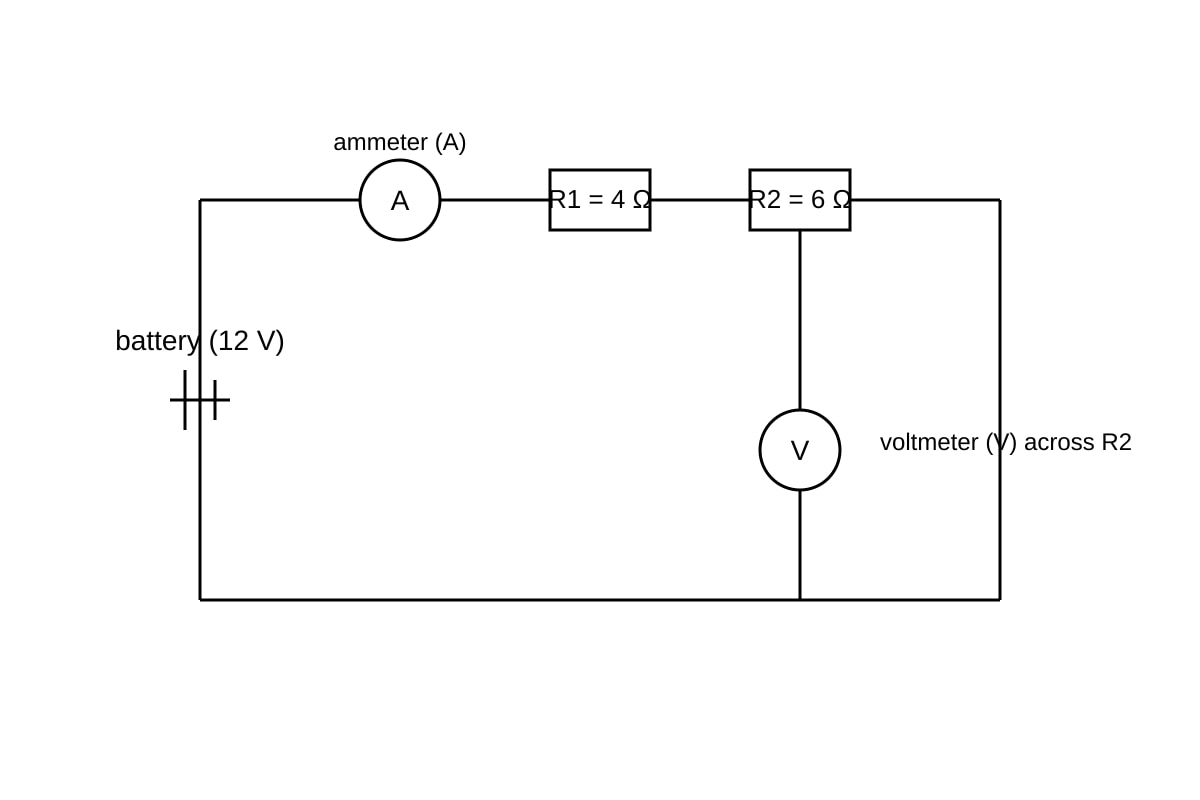
11. The diagram below shows a simple series circuit.
Image pending generation: diagram for Q11.
Calculate the reading on the ammeter. [2]
12. Using the same circuit in Q11, calculate the voltmeter reading across the 6 Ω resistor. [2]
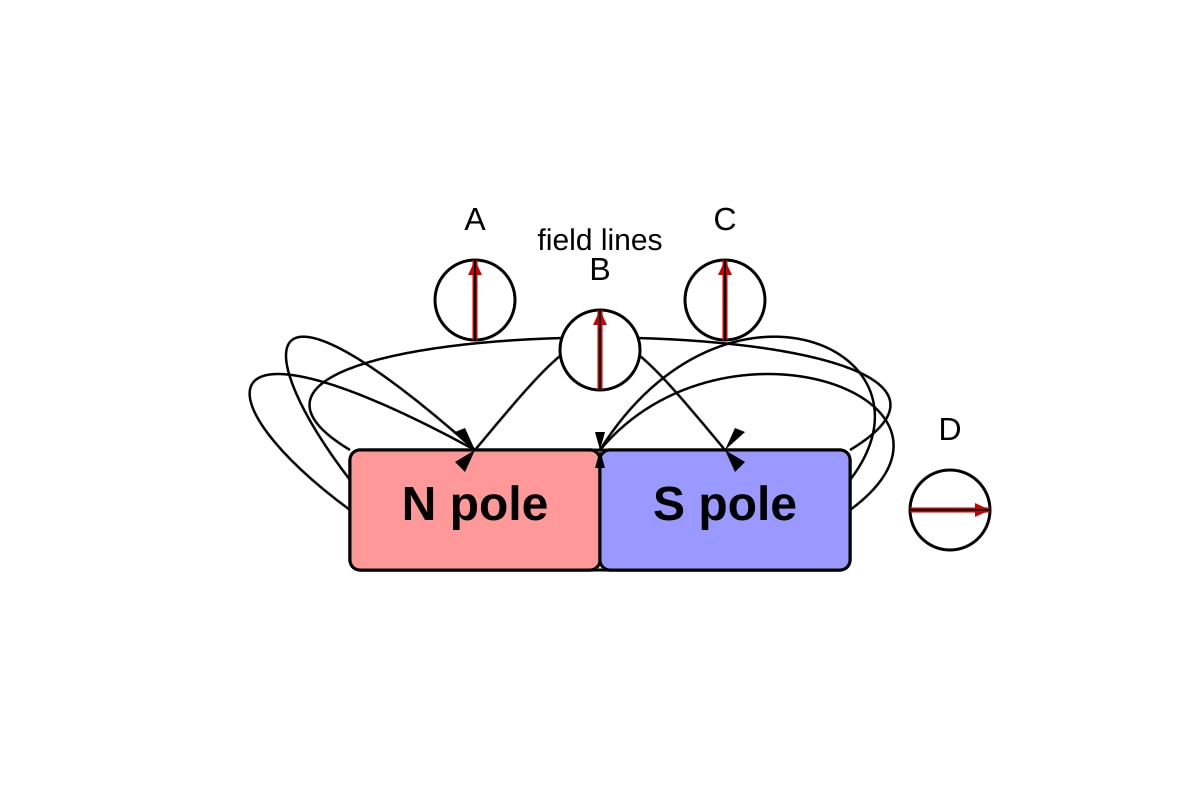
13. The diagram shows a magnetic field pattern around a bar magnet.
Image pending generation: diagram for Q13.
State the direction a compass needle at point B would point. [1]
14. A student plots a graph of current vs voltage for a fixed resistor and obtains a straight line. What does this show about the resistor? [1]
15. The table shows resistance of a thermistor at different temperatures.
| Temperature (°C) | Resistance (kΩ) |
|---|---|
| 20 | 10 |
| 40 | 5 |
| 60 | 2.5 |
State how the resistance changes with increasing temperature. [1]
(Additional 3 marks from Q11–Q15 interpretation below in total: Q11[2], Q12[2], Q13[1], Q14[1], Q15[1], Q16[2], Q17[1] — see Section C for 16–20)
Section C: Structured Response and Applications (Questions 16–20) — 10 marks
16. A 12 V battery is connected to a 100 Ω resistor and a thermistor in series. At 20∘C the thermistor resistance is 200 Ω. Calculate the current at 20∘C. [2]
17. State one practical use of an electromagnet. [1]
18. Explain how a bicycle dynamo uses electromagnetic induction to light a lamp. [3]
19. A transformer has 100 primary turns and 400 secondary turns. The primary voltage is 6 V. Calculate the secondary voltage. [2]
20. State two factors that increase the strength of an electromagnet. [1]
Total Marks: 40
Answers
TuitionGoWhere Practice Paper — Answer Key (Version 3)
Subject: Physics
Level: O-Level
Topic: Electricity & Magnetism
Total Marks: 40
Section A Answers
Q1 [1] Conventional current direction is the direction in which positive charges would flow: from the positive terminal of the battery, through the external circuit, to the negative terminal.
Teaching note: Real electrons flow opposite, but conventional current is defined as positive flow.
Q2 [2]
Given: V=6 V,R=20 Ω
Using Ohm’s law: I=RV=206=0.3 A
Answer: 0.3 A
Q3 [1]
Series: Rtotal=R1+R2=30+60=90 Ω
Answer: 90 Ω
Q4 [2]
Parallel: Req1=301+601=602+1=603
Req=20 Ω
Answer: 20 Ω
Q5 [1] E.m.f. is the energy supplied by a cell per unit charge passing through it (E=QW), measured in volts.
Q6 [2]
R=PV2=24122=24144=6 Ω
Answer: 6 Ω
Q7 [2] Ammeter; connected in series with the component whose current is to be measured. (1 mark each)
Q8 [2]
Total R=10+20=30 Ω
I=309=0.3 A
VB=I×RB=0.3×20=6 V
Answer: 6 V
Q9 [1] Lenz’s law: the direction of induced current is such that it opposes the change in magnetic flux that produced it.
Q10 [1] The induced current increases (greater rate of flux change → larger induced e.m.f. and current).
Section B Answers
Q11 [2]
Total R=4+6=10 Ω
I=1012=1.2 A
Ammeter reads 1.2 A.
Q12 [2]
V6Ω=I×6=1.2×6=7.2 V
Voltmeter reads 7.2 V.
Q13 [1] At B (between poles, top), needle points from N to S (left to right horizontally).
From image: field lines go from N (left) to S (right) above magnet.
Q14 [1] The resistor obeys Ohm’s law (constant resistance, ohmic).
Q15 [1] Resistance decreases as temperature increases (halves every 20 °C rise).
Section C Answers
Q16 [2]
Rtotal=100+200=300 Ω
I=30012=0.04 A
Answer: 0.04 A
Q17 [1] e.g., electric bell, relay, crane lifting scrap metal, door lock. (any one)
Q18 [3]
- A dynamo has a coil and a magnet.
- Pedaling rotates the magnet (or coil), changing magnetic flux through coil.
- By electromagnetic induction, this induces an e.m.f. that drives current through the lamp.
(Marking: 1 for rotation/flux change, 1 for induction principle, 1 for lighting effect)
Q19 [2]
VpVs=NpNs⇒Vs=6×100400=24 V
Answer: 24 V
Q20 [1] Increase current in coil; increase number of turns; use soft iron core. (any two stated as factors — 1 mark total)
Total Marks Check: 20 + 10 + 10 = 40 ✓
Free quiz and exam paper access
Enter your details to view this paper
Your access is remembered on this device.