AI Generated Exam Paper
O Level Physics Practice Paper 2
Free O Level Physics Practice Paper 2, HY3 AI version, with questions, answers, and O Level-style practice for Singapore students.
These static practice materials are generated from the site's syllabus and paper-generation workflow, with source and model context shown so students and parents can evaluate the material before use.
Questions
TuitionGoWhere Practice Paper - Physics O-Level
TuitionGoWhere Practice Paper (AI) — Version 2 of 5
Subject: Physics
Level: O-Level
Paper: Practice Paper (AI-Generated, Syllabus-Aligned)
Duration: 1 hour 15 minutes
Total Marks: 60
Name: ________________________
Class: ________________________
Date: ________________________
Instructions:
- Answer all questions in the spaces provided.
- Show all working clearly where calculation is required.
- Use SI units and appropriate symbols.
- Marks allocated are shown at the end of each question.
- This practice paper is generated from syllabus-first templates and is not derived from any specific past-year exam.
Section A: Multiple-Choice and Short Structured (Marks: 20)
1. A wire carries a current of 2.0 A for 10 s. What is the total charge that flows through the wire? [1]
A. 0.20 C
B. 5.0 C
C. 20 C
D. 200 C
2. State the direction of the magnetic field produced by a straight current-carrying wire. [1]
3. Calculate the resistance of a lamp if a voltage of 6.0 V across it produces a current of 0.50 A. [2]
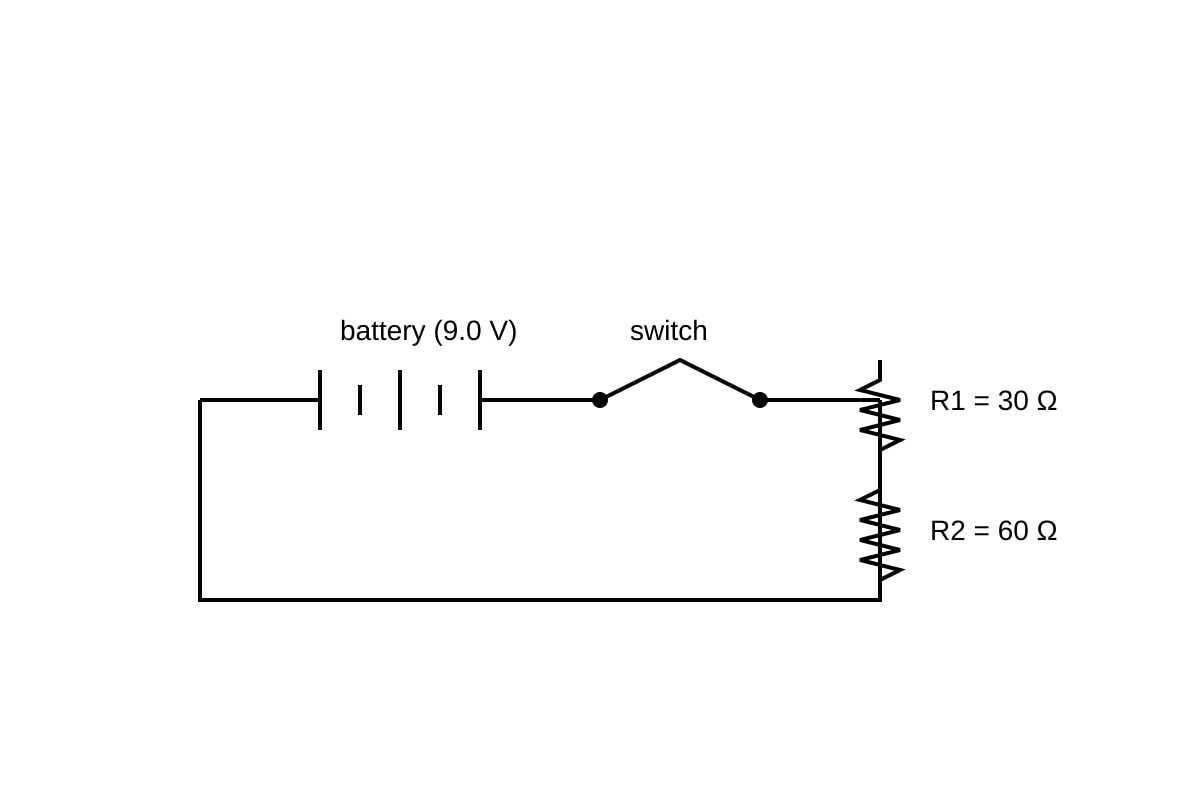
4. The diagram shows a simple circuit with a 9.0 V battery and two resistors.
Image pending generation: diagram for Q4.
Calculate the total resistance of the circuit. [2]
5. A student says: "If I connect two identical resistors in parallel, the total resistance is double that of one resistor." Explain why this statement is wrong. [2]
6. A voltmeter is connected across a 40 Ω resistor in a circuit and reads 8.0 V. What is the current through the resistor? [2]
7. Name the device that uses electromagnetic induction to convert kinetic energy to electrical energy. [1]
8. State Lenz's law in one sentence. [1]
9. A transformer has 100 primary turns and 400 secondary turns. The primary voltage is 12 V. Calculate the secondary voltage assuming 100% efficiency. [2]
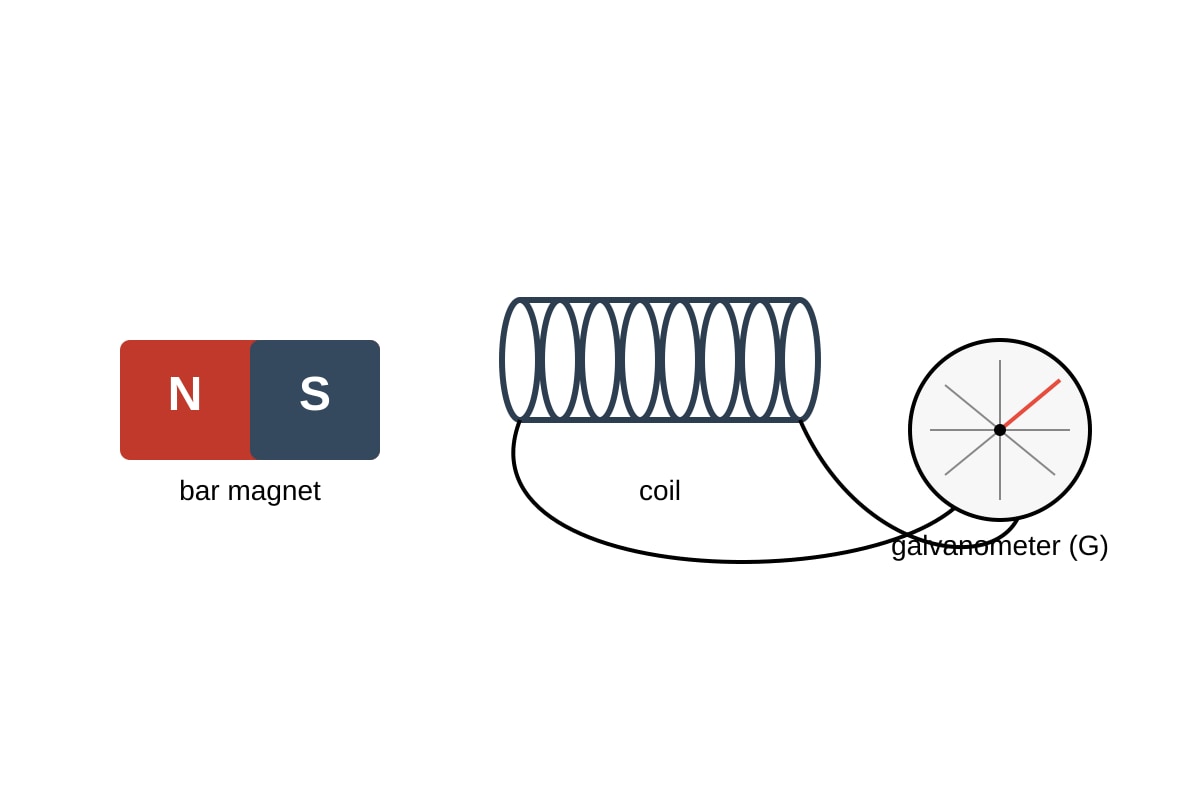
10. The diagram shows a bar magnet placed near a coil connected to a galvanometer.
Image pending generation: diagram for Q10.
Describe what happens to the galvanometer reading as the magnet is moved quickly into the coil. [2]
Section B: Structured Response and Calculations (Marks: 24)
11. A circuit contains a 12 V battery, a fixed resistor of 100 Ω, and a thermistor in series. At 20 °C the thermistor resistance is 200 Ω; at 60 °C it drops to 50 Ω.
(a) Calculate the current at 20 °C. [2]
(b) Calculate the current at 60 °C. [2]
(c) Explain why a lamp in the circuit becomes brighter at higher temperature. [2]
12. A voltmeter across a resistance wire reads the same as a voltmeter across a 80 Ω resistor in the same series circuit. The total resistance of the circuit is 240 Ω. Calculate the resistance of the wire. [3]
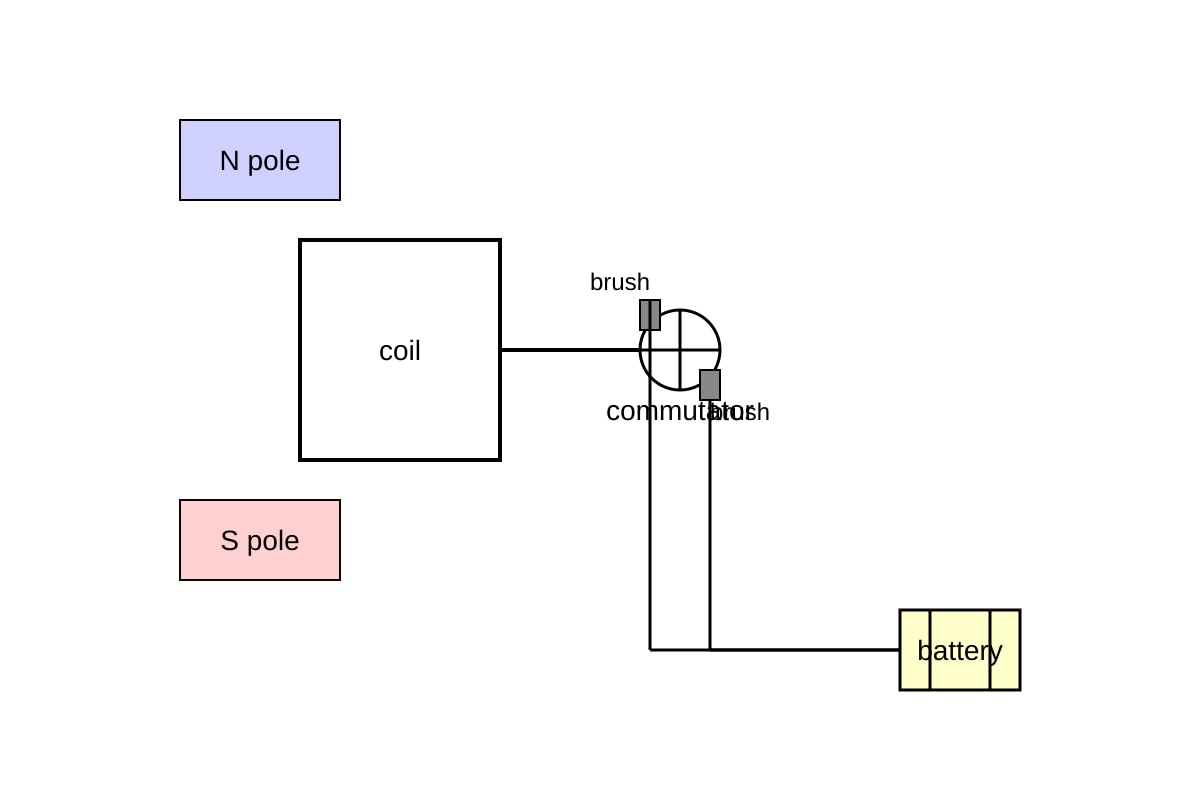
13. The diagram shows a DC motor.
Image pending generation: diagram for Q13.
(a) State the energy transformation in the motor. [1]
(b) Explain the role of the commutator. [2]
(c) Suggest one way to increase the motor's speed. [1]
14. A bicycle dynamo generates electricity by electromagnetic induction.
(a) Explain how pedalling faster increases the output voltage. [3]
(b) State two factors, other than speed, that affect the magnitude of induced EMF. [2]
15. A household circuit has a 230 V supply and a heater of resistance 46 Ω.
(a) Calculate the current through the heater. [2]
(b) Calculate the power dissipated by the heater. [2]
(c) State one safety feature required in practical electricity and its purpose. [2]
Section C: Extended Application (Marks: 16)
16. A student builds a circuit with a 6.0 V battery, a 20 Ω resistor and a light-dependent resistor (LDR) in series. In darkness the LDR has resistance 100 Ω; in bright light it drops to 20 Ω.
(a) Calculate the total current in darkness. [2]
(b) Calculate the total current in bright light. [2]
(c) The student connects a buzzer that activates when current exceeds 0.20 A. State whether the buzzer sounds in bright light and explain. [2]
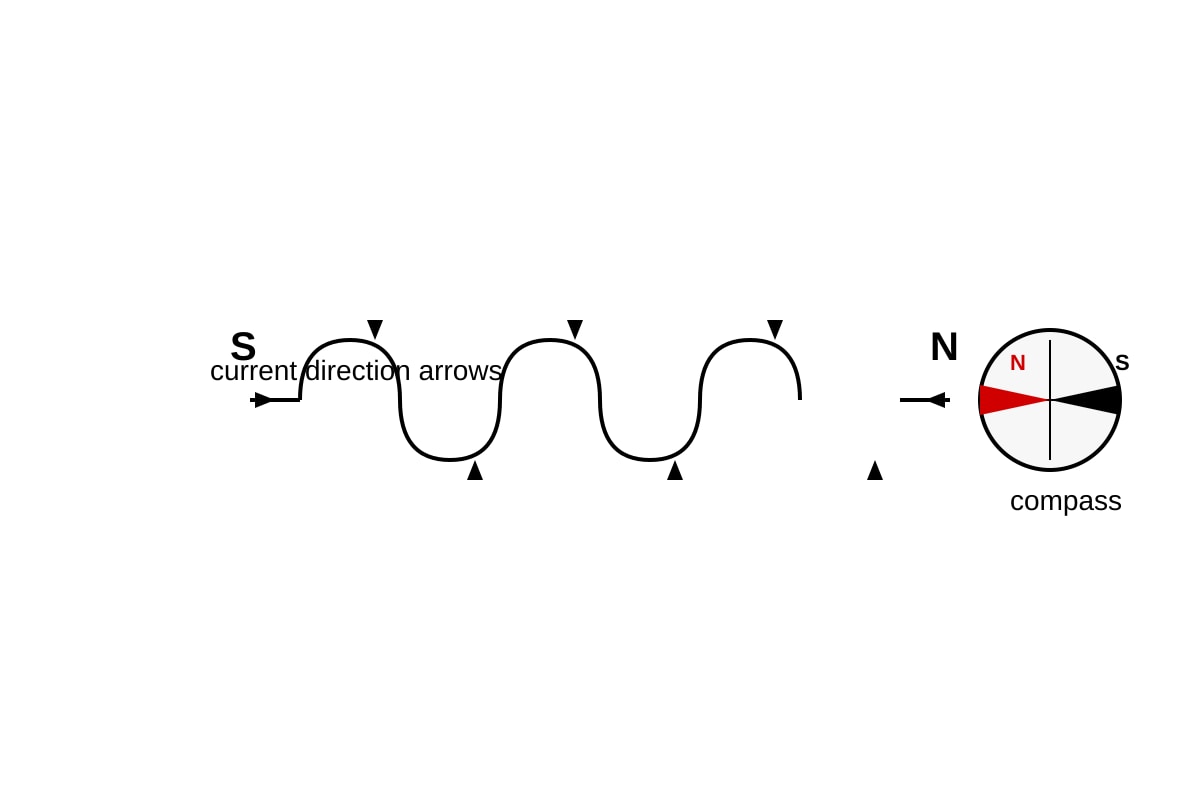
17. The diagram shows a solenoid with current flowing.
Image pending generation: diagram for Q17.
(a) State the polarity at the end where the compass is placed. [1]
(b) Explain how you determined the polarity using the right-hand grip rule. [2]
(c) Describe what happens to the magnetic field if the current is reversed. [1]
18. A transmission line uses a step-up transformer (input 2.0 kV, output 20 kV) and a step-down transformer at the consumer end.
(a) Explain why step-up transformers are used for long-distance transmission. [3]
(b) If the transmitted power is 10 kW and line resistance is 5.0 Ω, calculate the power loss at 2.0 kV (no step-up). [3]
(c) Calculate the power loss at 20 kV (with step-up). [2]
19. A magnet is dropped through a vertical copper pipe.
(a) Explain why it falls slower than a non-magnetic object. [3]
(b) State one factor that would increase the slowing effect. [1]
20. Design a simple electromagnetic relay circuit to switch on a lamp when a door opens.
(a) List the components needed. [2]
(b) Explain the operation using electromagnetism principles. [3]
End of Practice Paper
Answers
TuitionGoWhere Practice Paper - Physics O-Level (Answers)
Version 2 of 5 — Answer Key with Teaching Notes
Section A Answers
1. C [1]
Charge Q=I×t=2.0×10=20 C.
Teaching: Current is rate of flow of charge; 1 A=1 C/s. Common mistake: dividing instead of multiplying.
2. [1] Around the wire in concentric circles (given by right-hand grip rule: thumb in current direction, fingers curl in field direction).
Teaching: Magnetic field lines never start/end; they form closed loops.
3. [2]
R=IV=0.506.0=12 Ω.
Marks: 1 for formula, 1 for answer with unit.
4. [2]
Rtotal=R1+R2=30+60=90 Ω.
Marks: 1 formula, 1 answer. Series adds directly.
5. [2]
Parallel total resistance is less than the smallest individual resistor. For two identical R, Req=R/2. So it is halved, not doubled.
Marks: 1 for correct concept, 1 for example/calculation.
6. [2]
I=RV=408.0=0.20 A.
Marks: 1 formula, 1 answer.
7. [1] Generator (or dynamo).
8. [1] The direction of induced current opposes the change producing it.
9. [2]
VpVs=NpNs⇒Vs=12×100400=48 V.
Marks: 1 ratio, 1 answer.
10. [2]
Galvanometer deflects (shows current) as magnet enters; larger deflection with faster movement.
Marks: 1 for deflection observed, 1 for link to changing flux.
Section B Answers
11.
(a) [2] Rtot=100+200=300 Ω; I=12/300=0.040 A.
(b) [2] Rtot=100+50=150 Ω; I=12/150=0.080 A.
(c) [2] Higher temp → lower thermistor R → lower total R → higher I → lamp brighter.
Marks: 2 for clear causal chain.
12. [3]
Same voltmeter reading → equal voltage share. In series, V∝R.
Let wire = Rw, other resistor = 80 Ω, total = 240 Ω.
Since voltages equal: Rw=80 Ω (because equal share in series means equal resistance).
Check: 80+80+Rrest=240⇒Rrest=80 Ω; consistent.
Resistance of wire = 80 Ω.
Marks: 1 equal V implies equal R, 2 calculation/reasoning.
13.
(a) [1] Electrical → kinetic (rotational) energy.
(b) [2] Reverses current direction every half-turn to keep coil rotating same way.
(c) [1] Increase voltage, stronger magnet, more turns.
14.
(a) [3] Faster pedalling → faster magnet rotation → quicker flux change in coil → greater induced EMF (Faraday's law).
(b) [2] Number of coil turns; magnetic field strength.
15.
(a) [2] I=230/46=5.0 A.
(b) [2] P=VI=230×5.0=1150 W (or I2R=25×46=1150 W).
(c) [2] Earth wire: prevents shock if live touches casing; fuse: cuts off excess current.
Section C Answers
16.
(a) [2] Rtot=20+100=120 Ω; I=6/120=0.050 A.
(b) [2] Rtot=20+20=40 Ω; I=6/40=0.15 A.
(c) [2] No, because 0.15 A < 0.20 A threshold; buzzer stays off.
17.
(a) [1] North (if compass shows N pointing to that end).
(b) [2] Right-hand grip: fingers curl current direction, thumb points N pole.
(c) [1] Field reverses polarity.
18.
(a) [3] Step-up increases voltage, reduces current for same power → Ploss=I2R reduced → less energy wasted.
(b) [3] I=P/V=10000/2000=5.0 A; Ploss=52×5=125 W.
(c) [2] I=10000/20000=0.50 A; Ploss=0.25×5=1.25 W.
19.
(a) [3] Falling magnet changes flux in pipe → induced currents (eddy) oppose motion (Lenz) → magnetic drag slows fall.
(b) [1] Stronger magnet / longer pipe.
20.
(a) [2] Battery, coil (electromagnet), iron armature, spring, lamp, switch (door).
(b) [3] Door opens → circuit completes → coil magnetises → pulls armature → closes lamp contacts → lamp on.
Total Marks: 60 — verified additive across sections (20+24+16).
Free quiz and exam paper access
Enter your details to view this paper
Your access is remembered on this device.