AI Generated Exam Paper
O Level Physics Practice Paper 1
Free O Level Physics Practice Paper 1, HY3 AI version, with questions, answers, and O Level-style practice for Singapore students.
These static practice materials are generated from the site's syllabus and paper-generation workflow, with source and model context shown so students and parents can evaluate the material before use.
Questions
TuitionGoWhere Practice Paper - Physics O-Level
TuitionGoWhere Practice Paper (AI) — Version 1
Subject: Physics
Level: O-Level
Paper: Practice Paper (Electricity & Magnetism)
Duration: 1 hour 15 minutes
Total Marks: 60
Name: ________________________
Class: ________________________
Date: ________________________
Instructions:
- This practice paper contains 20 questions on Electricity & Magnetism.
- Section A: 10 short questions (2 marks each = 20 marks)
- Section B: 6 structured questions (3–4 marks each = 24 marks)
- Section C: 4 extended questions (4 marks each = 16 marks)
- Total = 60 marks.
- Show all working clearly. Use SI units.
- Calculators are allowed.
Section A (20 marks)
Answer all questions. 2 marks each.
1. A wire has resistance R1=30 Ω and is connected in parallel with a resistor R2=60 Ω. Calculate the equivalent resistance of the combination.
2. State the direction of the force on a current-carrying wire placed in a magnetic field directed into the page, if the current flows to the right.
3. A voltmeter is connected across a 40 Ω resistor and reads 8 V. What is the current through the resistor?
4. Name the device that uses electromagnetic induction to convert kinetic energy to electrical energy.
5. The resistance of a thermistor decreases when temperature increases. In a series circuit with a fixed resistor, what happens to the current when the thermistor is heated?
6. A coil is placed near a magnet. State one factor that increases the magnitude of induced EMF when the magnet moves.
7. Calculate the total resistance of two resistors, RA=15 Ω and RB=25 Ω, connected in series.
8. A lamp is marked 12 V,6 W. Calculate its resistance when operating normally.
9. State Lenz’s law in one sentence.
10. A transformer has 100 primary turns and 200 secondary turns. If input voltage is 12 V, what is the output voltage (ideal)?
Section B (24 marks)
Answer all questions. Marks shown per question.
11. (4 marks) A circuit contains a 12 V battery, a 100 Ω fixed resistor, and a thermistor in series. At 20∘C the thermistor resistance is 200 Ω; at 60∘C it drops to 50 Ω. (a) Calculate the current at 20∘C. (b) Calculate the current at 60∘C. (c) Explain what happens to a connected LED as temperature rises.
12. (3 marks) A voltmeter across a resistance wire reads the same as a voltmeter across a 80 Ω resistor in the same parallel branch. If the combined resistance of the wire and resistor is 48 Ω, calculate the resistance of the wire.
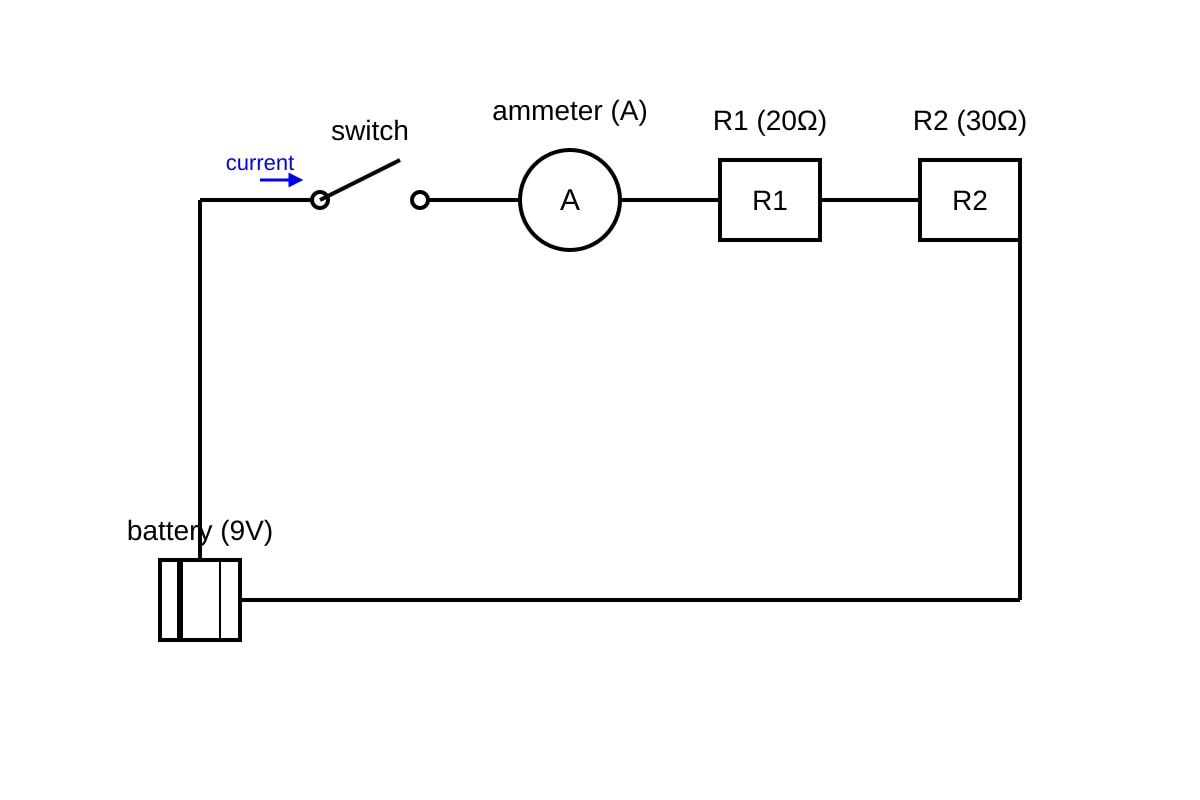
13. (4 marks)
Image pending generation: diagram for 13.
Using the diagram, calculate: (a) total resistance, (b) current from the battery.
14. (4 marks) A bicycle dynamo generates electricity by electromagnetic induction. (a) Explain how pedalling faster increases output voltage. (b) State two factors, other than speed, that affect induced EMF magnitude.
15. (4 marks) A lamp is connected to a 6 V supply and draws 0.5 A. (a) Calculate the lamp’s resistance. (b) Calculate the power dissipated by the lamp.
16. (5 marks) A hydraulic system is not used here; instead consider a parallel circuit with three branches: R1=10 Ω, R2=20 Ω, R3=30 Ω, supplied by 24 V. (a) Calculate equivalent resistance. (b) Calculate total current. (c) Compare current in R1 with R3 and explain using Ohm’s law.
Section C (16 marks)
Answer all questions. 4 marks each.
17. A student says: “If I connect a thermistor and a fixed resistor in parallel, heating the thermistor will increase the total circuit current from a fixed battery.” Explain whether this is correct, using resistance and current principles.
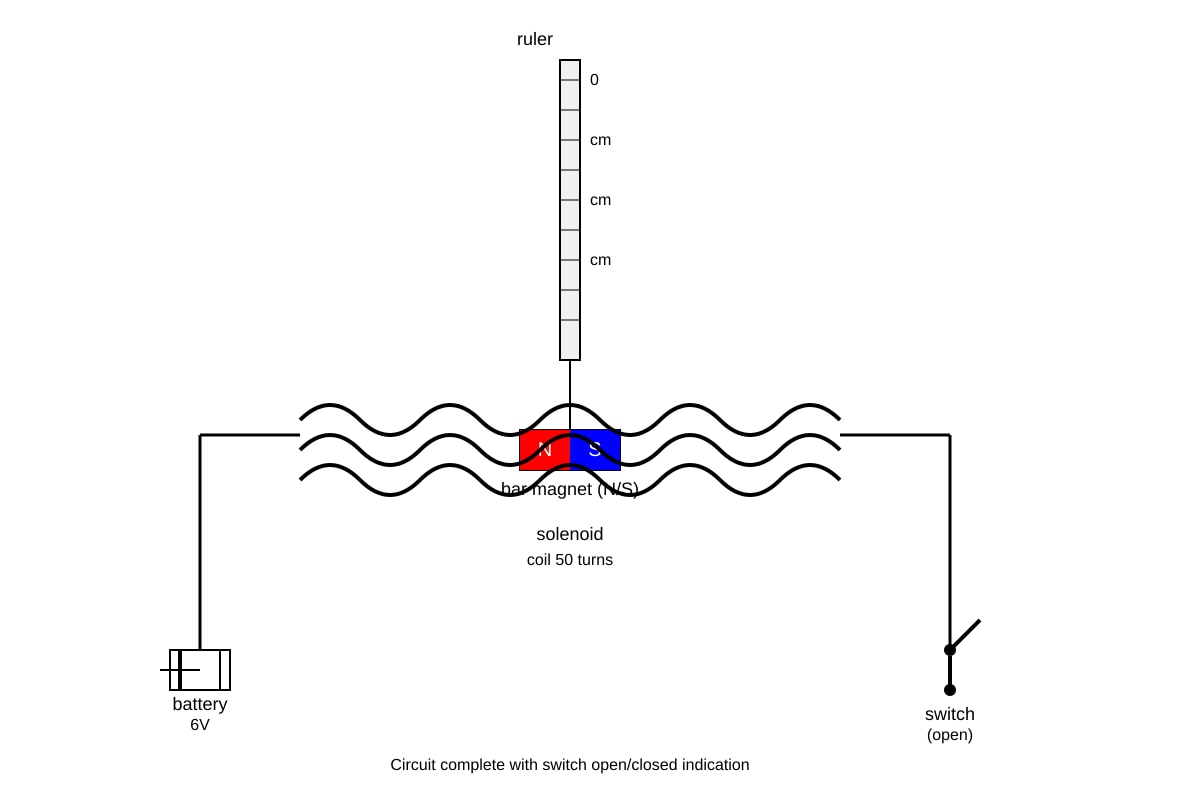
18.
Image pending generation: experimental_setup for 18.
Describe how to demonstrate electromagnetic induction using the setup shown. State the observation and the physics principle.
19. A transformer is used to step down 240 V to 12 V. Primary turns = 400. (a) Calculate secondary turns. (b) Explain energy conservation in an ideal transformer. (c) State one real-world application.
20. Compare the operation of a DC motor and an AC generator. Include the role of magnetic field, coil, and induced/forces in your answer.
Answers
TuitionGoWhere Practice Paper - Physics O-Level (Answers)
Version 1 — Electricity & Magnetism
Section A Answers
1. (2 marks)
Equivalent resistance for parallel:
Req1=301+601=602+1=603=201
Req=20 Ω.
Teaching note: Parallel resistors always give smaller total than smallest. Common mistake: adding directly (series formula).
2. (2 marks)
Using Fleming’s left-hand rule: Field into page (middle finger in), current right (first finger?), force is upwards (thumb).
Note: Conventional current to right, field into page → force up.
3. (2 marks)
I=RV=408=0.2 A.
Teaching: Voltmeter reads potential difference across resistor; Ohm’s law gives current.
4. (2 marks)
Generator (or dynamo).
Teaching: Electromagnetic induction converts motion to electricity.
5. (2 marks)
Current increases.
Reason: Total series resistance decreases, so I=V/Rtotal increases.
6. (2 marks)
Any one: faster movement, stronger magnet, more coil turns.
Teaching: Faraday’s law: EMF ∝ rate of flux change.
7. (2 marks)
Rtotal=15+25=40 Ω.
Series formula.
8. (2 marks)
R=PV2=6122=6144=24 Ω.
9. (2 marks)
Lenz’s law: induced current flows in a direction that opposes the change producing it.
10. (2 marks)
VpVs=NpNs⇒Vs=12×100200=24 V.
Section B Answers
11. (4 marks)
(a) Rtot=100+200=300 Ω; I=12/300=0.04 A (1m)
(b) Rtot=100+50=150 Ω; I=12/150=0.08 A (1m)
(c) LED brighter because current doubles (2m: current increase + brightness link).
12. (3 marks)
Same voltmeter reading → equal voltage across parallel items.
Let wire = Rw, resistor = 80 Ω, combined = 48 Ω.
Parallel: 481=Rw1+801⇒Rw1=481−801=2405−3=2402=1201
Rw=120 Ω (3m total: 1 setup, 2 calc).
13. (4 marks)
(a) Rtot=20+30=50 Ω (2m)
(b) I=9/50=0.18 A (2m)
14. (4 marks)
(a) Faster pedalling → magnet rotates faster → faster flux change → higher induced EMF (2m)
(b) Stronger magnetic field, more coil turns (2m: 1 each).
15. (4 marks)
(a) R=V/I=6/0.5=12 Ω (2m)
(b) P=VI=6×0.5=3 W (2m)
16. (5 marks)
(a) Req1=101+201+301=606+3+2=6011⇒Req=5.45 Ω (2m)
(b) Itot=24/5.45≈4.40 A (1m)
(c) I1=24/10=2.4 A, I3=24/30=0.8 A; I1 is 3× I3 because lower resistance draws more current at same V (2m).
Section C Answers
17. (4 marks)
Correct: heating thermistor lowers its R; in parallel, total R decreases (1m). With fixed battery V, total current I=V/Rtot increases (2m). Explanation shows Ohm’s law application (1m).
18. (4 marks)
Move magnet in/out of coil with switch closed (1m). Observation: current induced only during motion (1m). Principle: electromagnetic induction / Faraday’s law (2m).
19. (4 marks)
(a) Ns=400×24012=20 turns (2m)
(b) Ideal: input power = output power, VpIp=VsIs (1m)
(c) e.g., mobile charger, power adapter (1m).
20. (4 marks)
DC motor: battery supplies current to coil in magnetic field → force (Fleming left) rotates coil (2m). AC generator: coil rotated in field → induction produces AC (2m). Both use magnetic field and coil but motor uses force, generator uses induction.
Free quiz and exam paper access
Enter your details to view this paper
Your access is remembered on this device.