AI Generated Exam Paper
O Level Physics Practice Paper 1
Free O Level Physics Practice Paper 1, DeepSeek AI version, with questions, answers, and O Level-style practice for Singapore students.
These static practice materials are generated from the site's syllabus and paper-generation workflow, with source and model context shown so students and parents can evaluate the material before use.
Questions
Free quiz and exam paper access
Enter your details to view this paper
Your access is remembered on this device.
Answers
TuitionGoWhere Practice Paper - Physics O-Level
Answer Key and Marking Scheme
Paper: Practice Paper 1 (Electricity & Magnetism) Version: 1 of 5 Total Marks: 80
Section A: Structured Questions (20 marks)
1. (a) Explain why the polythene rod becomes negatively charged. [2]
Answer: When the polythene rod is rubbed with the woollen cloth, electrons are transferred from the cloth to the rod [1]. The rod gains electrons and therefore becomes negatively charged [1].
1. (b) Explain why the uncharged aluminium foil is attracted to the charged rod. [2]
Answer: The negatively charged rod repels electrons in the aluminium foil to the far side of the foil [1]. The side of the foil nearest the rod becomes positively charged by induction. Since opposite charges attract, the foil is attracted to the rod [1].
2. (a) Calculate the total resistance of the circuit. [2]
Answer: Using Ohm's law: R = V / I [1] R_total = 12 / 0.8 = 15 Ω [1]
2. (b) Determine the value of the unknown resistor R. [2]
Answer: For series circuit: R_total = R₁ + R₂ [1] 15 = 6 + R R = 15 - 6 = 9 Ω [1]
3. (a) Draw field lines between parallel plates. [2]
Answer:
- Straight, parallel, equally spaced lines drawn between the plates [1]
- Arrows pointing from positive plate to negative plate [1]
3. (b) Compare the electric force at X and Y. [2]
Answer: The electric force is the same at both points [1]. The electric field between parallel plates is uniform, so the field strength (and therefore the force on a given charge) is constant everywhere between the plates [1].
4. (a) Plot graph of current against voltage. [3]
Marking:
- Correct axes with labels and units [1]
- All points plotted correctly (± half small square) [1]
- Smooth curve drawn through points (not dot-to-dot) [1]
4. (b) Determine resistance at 3.0 V. [2]
Answer: From graph, at V = 3.0 V, I = 0.22 A [1] R = V / I = 3.0 / 0.22 = 13.6 Ω (accept 13 to 14 Ω) [1]
4. (c) Explain why resistance changes as voltage increases. [3]
Answer: As voltage increases, current increases and the filament gets hotter [1]. The metal filament's resistance increases with temperature [1] because the increased vibration of metal atoms makes it harder for electrons to flow through, increasing resistance [1].
Section B: Calculation and Application Questions (30 marks)
5. (a) State the type of transformer and explain. [2]
Answer: This is a step-down transformer [1] because the number of turns on the secondary coil (50) is less than the number of turns on the primary coil (500), so the output voltage is lower than the input voltage [1].
5. (b) Calculate the output voltage. [2]
Answer: V_s / V_p = N_s / N_p [1] V_s / 240 = 50 / 500 V_s = 240 × (50/500) = 24 V [1]
5. (c) Calculate the current in the primary coil. [3]
Answer: For 100% efficient transformer: V_p × I_p = V_s × I_s [1] 240 × I_p = 24 × 2.0 [1] I_p = (24 × 2.0) / 240 = 0.20 A [1]
6. (a) Calculate the magnitude of the force. [2]
Answer: F = B I L (since wire is perpendicular to field) [1] F = 0.50 × 4.0 × 0.15 = 0.30 N [1]
6. (b) State the rule for determining force direction. [1]
Answer: Fleming's left-hand rule [1].
6. (c) Explain how force changes when wire is at 30° to field. [2]
Answer: The force decreases [1]. The force on a current-carrying conductor in a magnetic field depends on the component of the magnetic field perpendicular to the current. When the wire is at 30° to the field, the perpendicular component is B sin 30° = 0.5B, so the force is halved compared to when the wire is perpendicular [1].
7. (a) Explain why galvanometer deflects when magnet moves into coil. [2]
Answer: As the magnet moves into the coil, the magnetic flux (field lines) linking the coil changes [1]. By Faraday's law, a changing magnetic flux induces an e.m.f. in the coil, causing a current to flow, which deflects the galvanometer [1].
7. (b) (i) Magnet held stationary inside coil. [2]
Answer: The galvanometer shows zero deflection / returns to zero [1]. When the magnet is stationary, there is no change in magnetic flux linking the coil, so no e.m.f. is induced [1].
7. (b) (ii) Magnet pulled out quickly. [2]
Answer: The galvanometer deflects to the left / in the opposite direction [1]. The magnetic flux linking the coil is decreasing, and by Lenz's law, the induced e.m.f. opposes the change, so the induced current flows in the opposite direction [1].
7. (c) State two ways to increase induced e.m.f. [2]
Answer: Any two from:
- Move the magnet faster [1]
- Use a stronger magnet [1]
- Use a coil with more turns [1]
- Insert a soft iron core into the coil [1]
8. (a) Calculate the current drawn by the kettle. [2]
Answer: P = V × I [1] I = P / V = 2000 / 240 = 8.33 A [1]
8. (b) Calculate the resistance of the heating element. [2]
Answer: R = V / I or R = V² / P [1] R = 240 / 8.33 = 28.8 Ω (or R = 240² / 2000 = 28.8 Ω) [1]
8. (c) (i) Calculate energy required to heat the water. [2]
Answer: E = m × c × Δθ [1] E = 1.5 × 4200 × (100 - 25) E = 1.5 × 4200 × 75 = 472,500 J [1]
8. (c) (ii) Calculate time taken to heat water (80% efficiency). [2]
Answer: Efficiency = Useful energy output / Total energy input 0.80 = 472,500 / (P × t) [1] t = 472,500 / (0.80 × 2000) = 472,500 / 1600 = 295.3 s ≈ 295 s (or 4 min 55 s) [1]
Section C: Data Analysis and Extended Response (30 marks)
9. (a) Describe relationship between temperature and resistance. [2]
Answer: As temperature increases, the resistance of the thermistor decreases [1]. The decrease is non-linear; resistance drops more rapidly at lower temperatures and the rate of decrease reduces at higher temperatures [1].
9. (b) State type of thermistor and explain. [2]
Answer: This is a negative temperature coefficient (NTC) thermistor [1] because its resistance decreases as temperature increases [1].
9. (c) (i) Draw circuit diagram for potential divider. [2]
Answer:
- Correct circuit symbols for battery, thermistor, and fixed resistor [1]
- Thermistor and fixed resistor in series, output voltage labelled across fixed resistor [1]
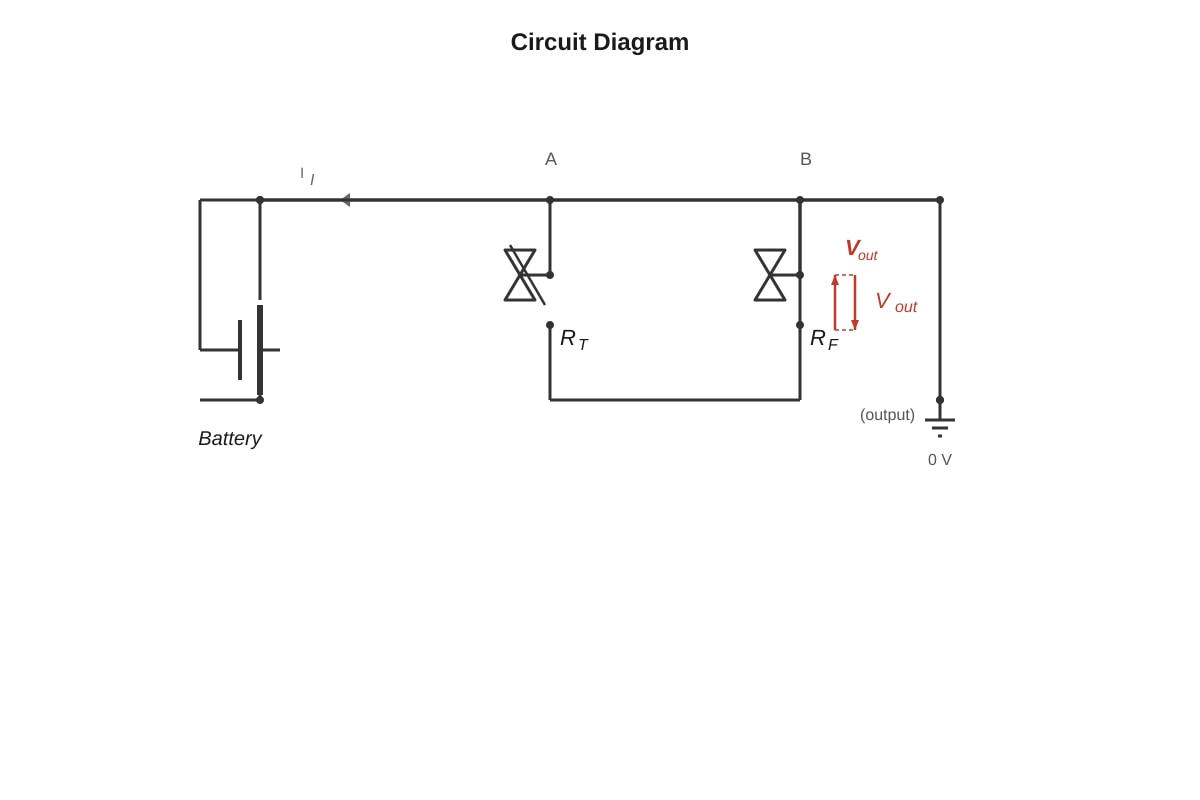
Generated diagram for this question.
9. (c) (ii) Calculate output voltage at 40 °C. [3]
Answer: At 40 °C, R_thermistor = 5.2 kΩ [1] Total resistance = 5.2 + 2.0 = 7.2 kΩ [1] V_out = (R_fixed / R_total) × V_supply = (2.0 / 7.2) × 6.0 = 1.67 V [1]
9. (c) (iii) Explain how output voltage changes from 20 °C to 80 °C. [3]
Answer: As temperature increases, the resistance of the thermistor decreases [1]. This means the thermistor takes a smaller share of the total voltage, so the voltage across the fixed resistor increases [1]. Therefore, the output voltage increases as temperature rises from 20 °C to 80 °C [1].
10. (a) Explain why e.m.f. is induced as magnet enters coil. [2]
Answer: As the magnet enters the coil, the magnetic flux (number of field lines) passing through the coil increases [1]. This changing magnetic flux induces an e.m.f. across the coil according to Faraday's law of electromagnetic induction [1].
10. (b) Explain why induced e.m.f. is in opposite direction when magnet leaves. [3]
Answer: When the magnet enters, the magnetic flux through the coil increases. When the magnet leaves, the magnetic flux through the coil decreases [1]. By Lenz's law, the direction of the induced e.m.f. (and current) is such that it opposes the change causing it [1]. Therefore, when flux is decreasing, the induced current flows in the opposite direction to try to maintain the flux, producing an e.m.f. in the opposite direction [1].
10. (c) Suggest why peak e.m.f. is larger when magnet leaves. [2]
Answer: The magnet accelerates as it falls due to gravity, so its speed is greater when it leaves the coil than when it enters [1]. A greater speed means a faster rate of change of magnetic flux, which induces a larger e.m.f. according to Faraday's law [1].
10. (d) Sketch graph for stronger magnet. [3]
Answer:
- Graph has same general shape (positive peak then negative peak) [1]
- Both peaks are larger in magnitude than the original graph [1]
- Peaks occur at approximately the same times (or slightly earlier) [1]
11. (a) Explain the purpose of a fuse. [2]
Answer: A fuse is a safety device that protects an electrical circuit from excessive current [1]. If the current exceeds the fuse rating, the fuse wire melts and breaks the circuit, preventing overheating of cables and potential fires [1].
11. (b) State what happens if current exceeds 13 A and explain safety feature. [3]
Answer: The fuse wire melts (or "blows") and breaks the circuit [1]. This stops current from flowing [1]. This is a safety feature because excessive current can cause cables to overheat, which could melt insulation and cause electric shocks or start a fire. Breaking the circuit prevents this danger [1].
11. (c) Determine if all three appliances can operate simultaneously. [3]
Answer: Total power = 1500 + 120 + 60 = 1680 W [1] Total current I = P / V = 1680 / 240 = 7.0 A [1] Since 7.0 A < 13 A, all three appliances can be operated simultaneously without blowing the fuse [1].
11. (d) Explain why replacing fuse with copper wire is dangerous. [2]
Answer: Copper wire has a much higher melting point than fuse wire and will not melt even at very high currents [1]. If a fault occurs causing excessive current, the copper wire will continue to conduct, allowing cables to overheat dangerously, which could cause insulation to melt and potentially start a fire [1].
END OF ANSWER KEY
Marking notes: Award marks for correct method even if final answer contains arithmetic error (error carried forward). Deduct 1 mark per question for missing or incorrect units in final answers. Accept alternative valid explanations that demonstrate correct physics understanding.