From Real Exams Exam Paper
O Level Physics Practice Paper 5
Free O Level Physics Practice Paper 5, HY3 Exam version, with questions, answers, and O Level-style practice for Singapore students.
These static practice materials are generated from the site's syllabus and paper-generation workflow, with source and model context shown so students and parents can evaluate the material before use.
Questions
TuitionGoWhere Practice Paper - Physics O-Level
TuitionGoWhere Exam Practice (AI)
Subject: Physics
Level: O-Level
Paper: Practice Paper (Version 5 of 5)
Duration: 1 hour 15 minutes
Total Marks: 60
Name: ________________________
Class: ________________________
Date: ________________________
Instructions
- Answer all questions in the spaces provided.
- Show your working clearly where calculation is required.
- Use appropriate units in your final answers.
- The total marks for this paper are 60.
Section A: Multiple Choice and Short Answer (Questions 1–8) [16 marks]
1. A wire carries a current of 2.0 A. What is the charge flowing through a point in the wire in 5.0 s? [1]
A. 0.40 C
B. 2.5 C
C. 10.0 C
D. 20.0 C
2. State the direction of the magnetic field inside a solenoid when the current flows clockwise at the south end. [1]
3. Calculate the resistance of a resistor that has 6.0 V across it and carries a current of 0.50 A. [2]
4. A bar magnet is pushed into a coil connected to a galvanometer. Describe what happens to the galvanometer needle and explain why. [2]
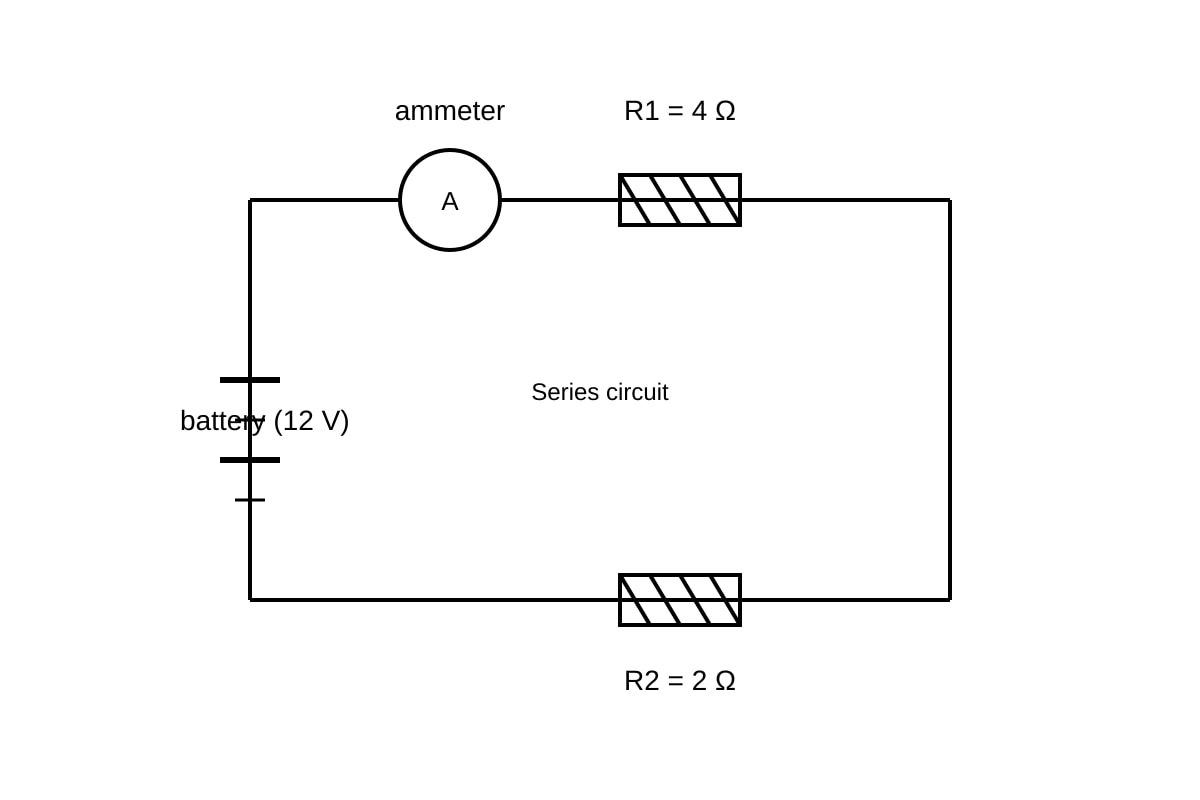
5.
Image pending generation: diagram for Q5.
Using the circuit in the diagram, calculate the current shown by the ammeter. [2]
6. Give one application of electromagnetic induction in daily life. [1]
7. Two parallel wires carry currents in the same direction. State the force between them. [1]
8. A lamp is marked 12 V, 24 W. Calculate its resistance when operating normally. [2]
Section B: Structured Response and Calculations (Questions 9–15) [28 marks]
9. A student connects three resistors: 3 Ω, 6 Ω and 9 Ω. The 3 Ω and 6 Ω are in parallel, and this combination is in series with the 9 Ω. Calculate the equivalent resistance of the whole circuit. [3]
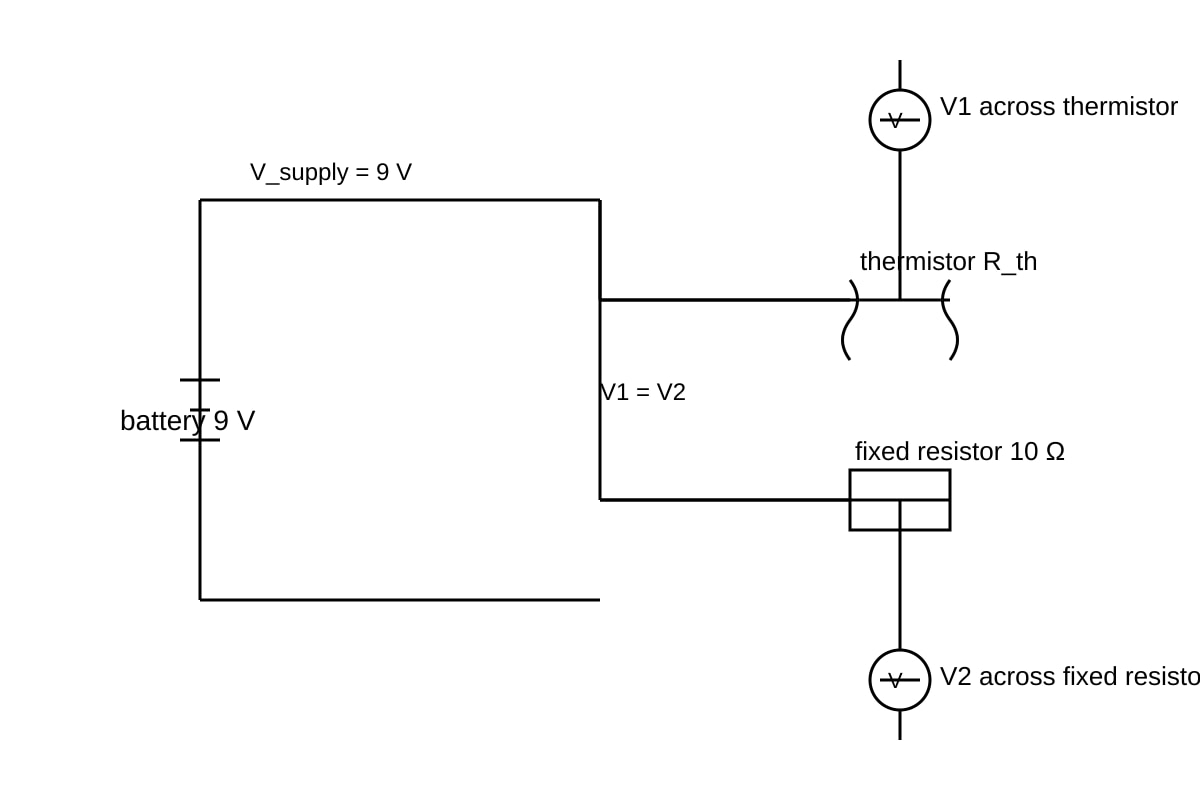
10.
Image pending generation: circuit for Q10.
A voltmeter across the thermistor reads the same as a voltmeter across the 10 Ω resistor. Calculate the combined resistance of the thermistor and the 10 Ω resistor. [3]
11. Explain how a direct current motor rotates continuously, using the roles of the commutator and split-ring. [4]
12. A coil of wire is moved downwards through a horizontal magnetic field. Using Faraday’s law and Lenz’s law, explain the direction of the induced current if the north pole of the magnet is below the coil. [4]
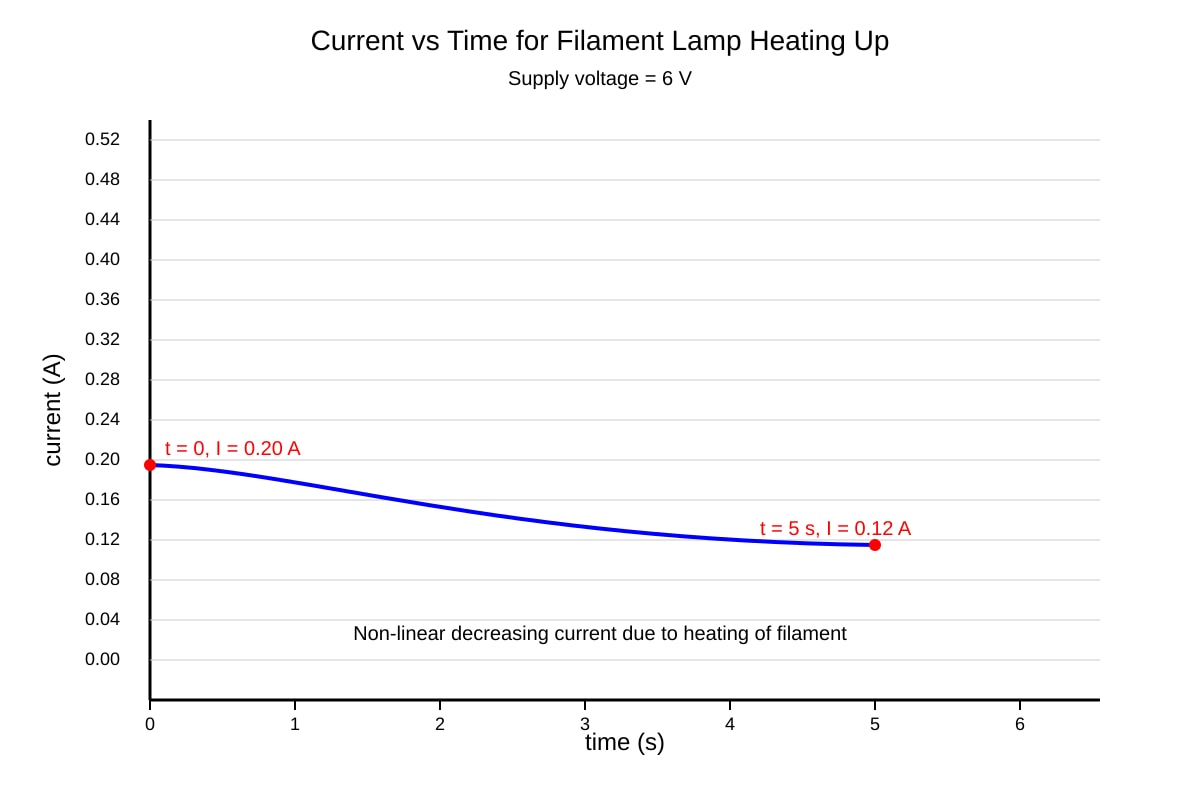
13.
Image pending generation: graph for Q13.
Using the graph, calculate the resistance of the lamp at t = 5 s and explain why it is higher than at t = 0. [3]
14. A transformer has 200 turns on the primary and 50 turns on the secondary. The primary is connected to 240 V a.c. Calculate the secondary voltage and state one reason why energy is lost in a real transformer. [3]
15. A household circuit has a 2.0 kW heater operating at 230 V. Calculate the current drawn and the suitable fuse rating from 5 A, 10 A, 13 A. [3]
Section C: Extended Application (Questions 16–20) [16 marks]
16. Compare the current in a circuit where a 10 Ω resistor is replaced by a 5 Ω resistor, with supply unchanged. Show the relationship using Ohm’s law. [3]
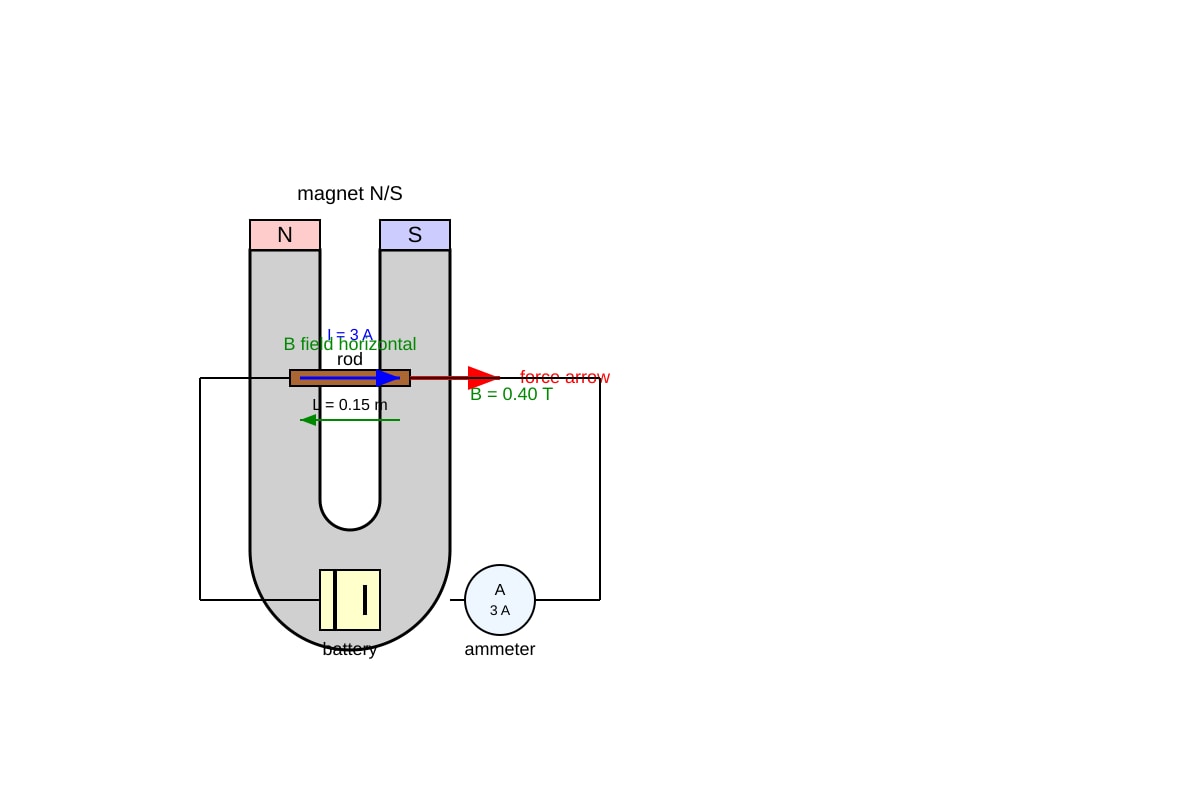
17.
Image pending generation: experimental_setup for Q17.
A rod carries 3.0 A perpendicular to a 0.40 T field, length 0.15 m. Calculate the force on the rod and state the direction using Fleming’s left-hand rule. [3]
18. Explain the difference between a.c. and d.c. with one example each from Singapore’s power system. [3]
19. A circuit uses a relay to switch on a lamp with a low-current switch. Describe how electromagnetism allows this, and give one safety advantage. [3]
20. A power station transmits 100 kW at 10 kV. Calculate the transmission current. If the voltage is stepped up to 100 kV, calculate the new current and state why this reduces heat loss. [4]
Answers
TuitionGoWhere Practice Paper - Physics O-Level (Version 5) Answer Key
Total Marks: 60
Section A Answers (16 marks)
Q1 [1]
Answer: C (10.0 C)
Working: Q=I×t=2.0×5.0=10.0 C.
Teaching note: Charge = current × time. 1 A for 1 s = 1 C.
Q2 [1]
Answer: From south to north inside the solenoid (field lines enter south, exit north).
Teaching note: Inside a solenoid, field direction is from S end to N end.
Q3 [2]
Answer: R=12 Ω
Working: R=IV=0.506.0=12 Ω.
Marking: 1 mark formula, 1 mark answer with unit.
Q4 [2]
Answer: Needle deflects (one side); due to induced emf from changing magnetic flux as magnet moves.
Teaching note: Moving magnet changes flux linkage → emf → current → deflection. 1 mark observation, 1 mark reason.
Q5 [2]
Answer: 2.0 A
Working: Rtotal=4+2=6 Ω; I=612=2.0 A.
Expected visual: series circuit as described; ammeter reads total current.
Q6 [1]
Answer: Any one: bicycle dynamo, transformer, induction cooker, power generator.
Q7 [1]
Answer: Attractive force (they attract).
Teaching note: Same-direction currents in parallel wires attract.
Q8 [2]
Answer: R=6 Ω
Working: R=PV2=24122=24144=6 Ω.
Section B Answers (28 marks)
Q9 [3]
Answer: 12 Ω
Working:
Parallel part: Rp1=31+61=62+1=63=21⇒Rp=2 Ω.
Series: Req=2+9=11 Ω.
Wait — correction: Rp=2 Ω, total = 2+9=11 Ω. (Marks: 2 for parallel, 1 for series total.)
Final: 11 Ω.
Q10 [3]
Answer: Combined = 5 Ω (if thermistor = 10 Ω from equal V in parallel).
Working: Equal voltmeter readings → equal voltage across parallel branches. For parallel, if V same and supply fixed, R_th = 10 Ω (same as fixed to give same V drop only if identical in parallel with same node; here equal V means they are directly parallel across same nodes, so combined R=10+1010×10=5 Ω).
Marks: 1 identify R_th=10 Ω, 2 combined calc.
Q11 [4]
Answer: Commutator reverses current direction every half-turn so torque always same direction; split-ring connects to supply.
Marking: 2 for commutator role, 2 for continuous rotation explanation.
Q12 [4]
Answer: Induced current opposes motion (Lenz); flux increases as coil nears N → current direction gives repelling pole.
Marks: 2 Faraday/Lenz, 2 direction reasoning.
Q13 [3]
Answer: At 5 s, R=0.126=50 Ω; higher than at 0 s (30 Ω) because filament heats, resistance rises.
Marks: 1 calc, 2 explanation.
Q14 [3]
Answer: Vs=60 V; loss: heating in core (eddy currents) or flux leakage.
Working: VpVs=NpNs⇒Vs=240×20050=60 V.
Q15 [3]
Answer: I=2302000=8.7 A; fuse = 13 A.
Marks: 2 calc, 1 choice.
Section C Answers (16 marks)
Q16 [3]
Answer: Current doubles. I1=V/10, I2=V/5=2I1.
Marks: 1 state, 2 working.
Q17 [3]
Answer: F=BIL=0.40×3.0×0.15=0.18 N; direction per left-hand rule (force perpendicular to field and current).
Marks: 2 calc, 1 direction.
Q18 [3]
Answer: a.c. changes direction (SP power 50 Hz); d.c. one direction (battery). 1.5 + 1.5 marks.
Q19 [3]
Answer: Small current energises coil → magnetic field pulls relay contact → switches lamp; safety: isolates user from high current.
Marks: 2 operation, 1 advantage.
Q20 [4]
Answer: I1=10000100000=10 A; I2=100000100000=1 A; lower I → Ploss=I2R smaller.
Marks: 1 each calc, 2 explanation.
Free quiz and exam paper access
Enter your details to view this paper
Your access is remembered on this device.