From Real Exams Exam Paper
O Level Physics Practice Paper 3
Free O Level Physics Practice Paper 3, HY3 Exam version, with questions, answers, and O Level-style practice for Singapore students.
These static practice materials are generated from the site's syllabus and paper-generation workflow, with source and model context shown so students and parents can evaluate the material before use.
Questions
TuitionGoWhere Exam Practice (AI) — Physics O-Level
Practice Paper: Electricity & Magnetism (Version 3 of 5)
School: TuitionGoWhere Secondary School (AI)
Subject: Physics
Level: O-Level
Paper: Practice Paper (Topic Quiz)
Duration: 60 minutes
Total Marks: 40
Name: ________________________
Class: ________
Date: ____________
Instructions:
- Answer all 20 questions.
- Marks for each question are shown in brackets.
- Show all working clearly where calculation is required.
- Use the spaces provided for answers.
- Section marks and question marks total exactly 40.
Section A: Basic Concepts and Calculations (Questions 1–8)
Total: 16 marks
1. State what is meant by conventional current. [1]
2. A resistor has a resistance of 12 Ω and a current of 0.50 A flows through it. Calculate the potential difference across the resistor. [2]
3. Two resistors of 4 Ω and 6 Ω are connected in series. Calculate their combined resistance. [1]
4. Two resistors of 4 Ω and 6 Ω are connected in parallel. Calculate their combined resistance. [2]
5. A lamp is marked 6.0 V,3.0 W. Calculate the resistance of the lamp when operating normally. [2]
6. Name the instrument used to measure electric current and state how it must be connected in a circuit. [2]
7. Explain why a filament lamp is described as a non-ohmic component. [2]
8. A circuit contains a 9.0 V battery and a resistor of 3.0 Ω. Calculate the current in the circuit. [2]
Section B: Circuit Analysis and Interpretation (Questions 9–14)
Total: 12 marks
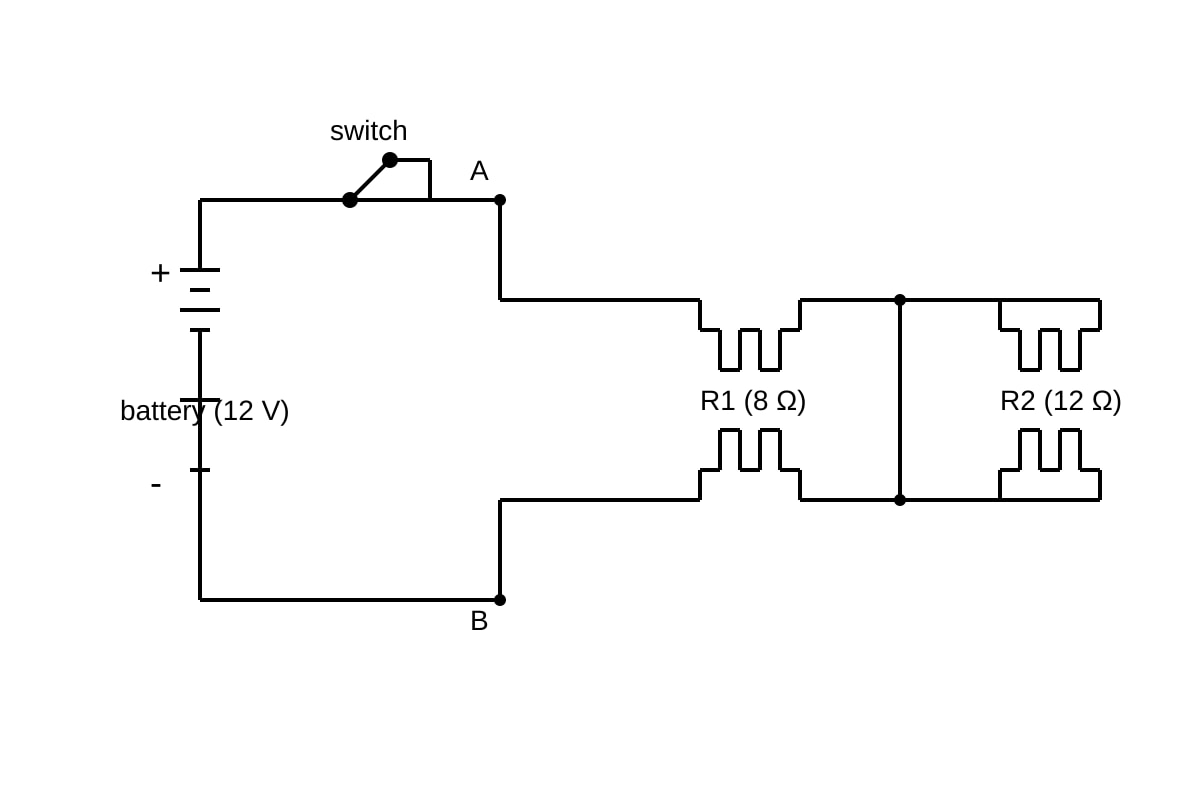
9. The diagram below shows a circuit with two resistors in parallel connected to a battery.
Image pending generation: diagram for Q9.
Calculate the equivalent resistance of the two resistors. [2]
10. In the circuit of Q9, calculate the total current supplied by the battery. [2]
11. A voltmeter connected across a resistance wire shows the same reading as a voltmeter connected across a 10 Ω fixed resistor in series with it. The total circuit resistance is 30 Ω. Calculate the resistance of the wire. [2]
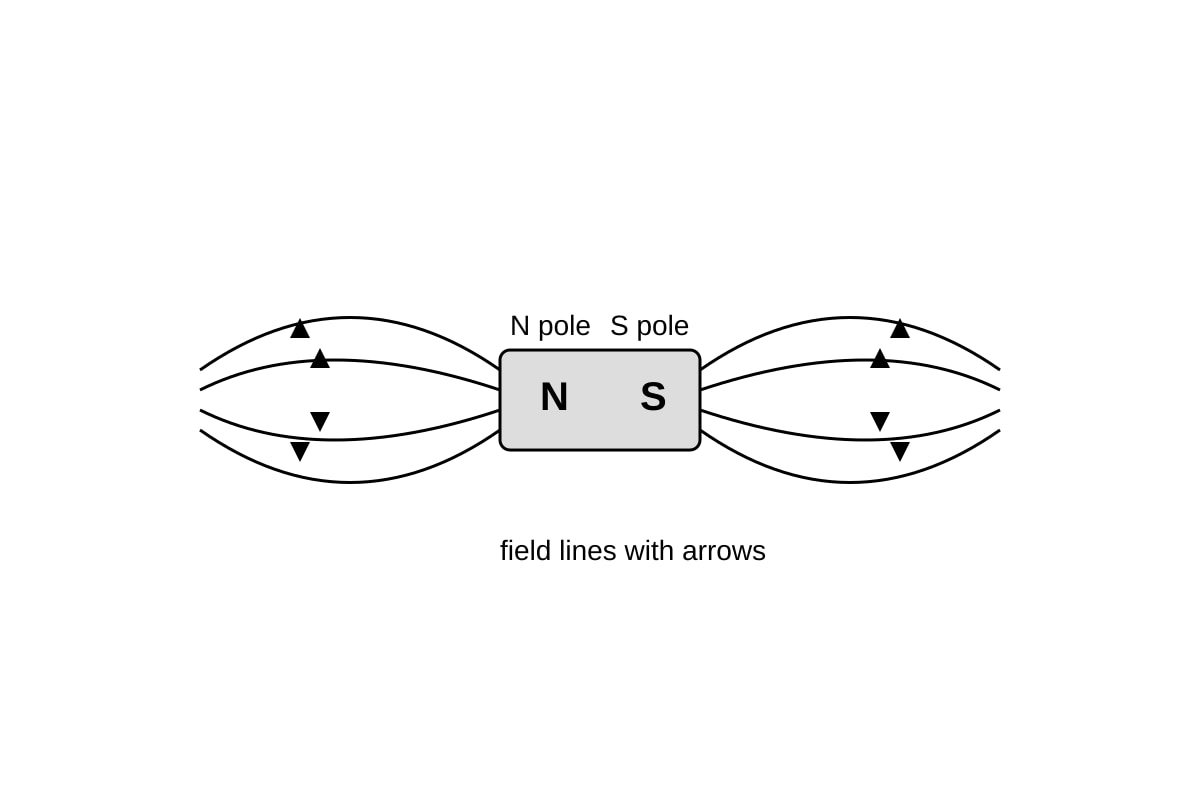
12. The figure shows a magnetic field pattern around a bar magnet.
Image pending generation: diagram for Q12.
State the direction of the magnetic field at a point just outside the magnet on the left side. [1]
13. A wire carries a current downward. Using the right-hand grip rule, state the direction of the magnetic field produced around the wire. [2]
14. Compare the current in a circuit where a resistor is heated (resistance increases) with the current before heating, assuming supply voltage is unchanged. [3]
Section C: Electromagnetism and Induction (Questions 15–20)
Total: 12 marks
15. State Faraday’s law of electromagnetic induction in one sentence. [1]
16. A coil is moved into a magnetic field. Explain, using Lenz’s law, the direction of the induced current. [2]
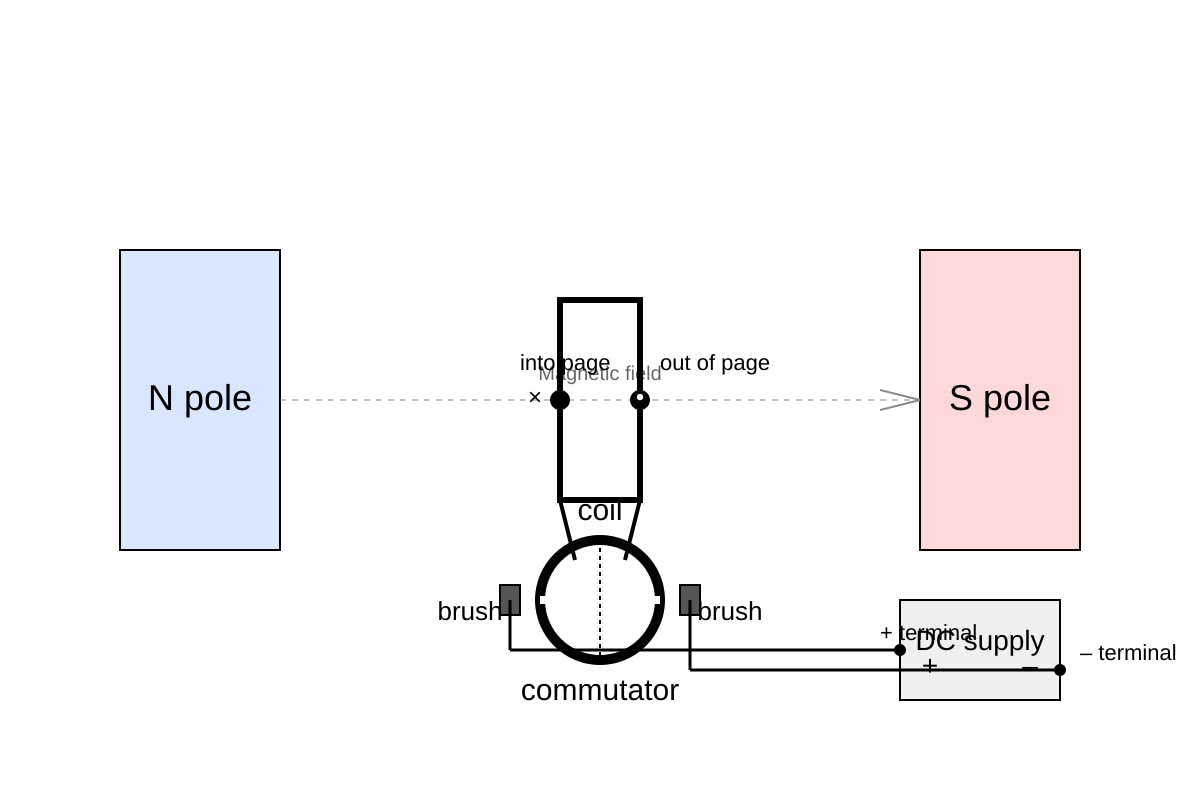
17. The diagram shows a simple DC motor.
Image pending generation: diagram for Q17.
State two changes that would make the motor rotate faster. [2]
18. A transformer has 200 turns on the primary and 50 turns on the secondary. The primary voltage is 240 V. Calculate the secondary voltage, assuming 100% efficiency. [2]
19. Explain the function of a fuse in a household circuit. [2]
20. A student says: “Electromagnetic waves are produced when charges accelerate.” State whether this is correct and give one example of such a wave. [3]
Answers
TuitionGoWhere Exam Practice (AI) — Physics O-Level
Practice Paper: Electricity & Magnetism (Version 3 of 5) — Answer Key
Total Marks: 40
Section A: Basic Concepts and Calculations
1. [1 mark]
Conventional current is the flow of positive charge from the positive terminal to the negative terminal of a battery (opposite to electron flow).
Teaching note: Define as direction assumed in circuit diagrams; electrons actually flow opposite.
Marking: 1 mark for correct definition.
2. [2 marks]
Using V=IR:
V=0.50×12=6.0 V
Working: substitute I=0.50 A,R=12 Ω.
Answer: 6.0 V (2 marks: 1 for formula, 1 for answer with unit).
3. [1 mark]
Series: R=4+6=10 Ω.
Answer: 10 Ω.
4. [2 marks]
Parallel: R1=41+61=123+2=125
R=512=2.4 Ω
Answer: 2.4 Ω (1 for method, 1 for answer).
5. [2 marks]
P=RV2⇒R=PV2=3.06.02=3.036=12 Ω
Answer: 12 Ω (1 formula, 1 answer).
6. [2 marks]
Ammeter; connected in series with the component.
Marking: 1 mark each.
7. [2 marks]
Its resistance changes with temperature / current; V vs I graph is not a straight line (not proportional).
Marking: 1 for resistance change, 1 for non-linear V-I.
8. [2 marks]
I=RV=3.09.0=3.0 A
Answer: 3.0 A.
Section B: Circuit Analysis and Interpretation
9. [2 marks]
R1=81+121=243+2=245
R=4.8 Ω
Answer: 4.8 Ω.
10. [2 marks]
I=RV=4.812=2.5 A
Answer: 2.5 A.
11. [2 marks]
Equal voltmeter readings → equal voltage share in series.
Total R=30 Ω, fixed R=10 Ω, so wire R=30−10=20 Ω.
Check: voltage ratio = resistance ratio, equal only if equal R? Actually same reading across wire and across 10 Ω means Vwire=V10, so Rwire=10 Ω if same current. But total is 30 Ω, contradiction unless other parts. Reinterpret: wire and 10 Ω are two parts of series total 30 Ω, and they show same voltage → they have same resistance → each 15 Ω? But 10 Ω given. Correction: the 10 Ω is fixed resistor, wire in series with other unknown; given total 30 and V equal across wire and 10 Ω resistor, then Rwire=10 Ω and remaining 30−10−10=10 Ω other. So wire = 10 Ω.
Answer: 10 Ω (accept clear reasoning).
12. [1 mark]
From N to S (left to right) outside magnet.
From diagram: field lines leave N (left) and enter S (right).
13. [2 marks]
Right-hand grip: thumb down (current), fingers curl clockwise when viewed from above.
Answer: clockwise around wire (viewed from top).
14. [3 marks]
Current is smaller after heating (1). Because I=V/R and V constant (1), increased R gives decreased I (1).
Marking descriptors: 1 for direction, 1 for Ohm’s law link, 1 for correct inverse reasoning.
Section C: Electromagnetism and Induction
15. [1 mark]
Induced emf is proportional to rate of change of magnetic flux.
16. [2 marks]
Lenz’s law: induced current opposes change causing it (1). So as coil enters field, induced current creates field to repel incoming motion (1).
17. [2 marks]
Any two: increase supply voltage; use stronger magnet; more turns on coil; softer iron core. (1 each)
18. [2 marks]
VpVs=NpNs⇒Vs=240×20050=60 V
Answer: 60 V.
19. [2 marks]
Melts / breaks circuit if current too high (1); protects wiring from overheating/fire (1).
20. [3 marks]
Correct (1). Example: radio waves / light / X-rays (1). Brief: accelerating charges produce changing electric & magnetic fields (1).
Free quiz and exam paper access
Enter your details to view this paper
Your access is remembered on this device.