AI Generated Quiz
O Level History Source Based Skills Quiz
Free O Level History Source Based Skills quiz, Qwen3.7 AI version, with questions, answers, and O Level-style practice for Singapore students.
These static practice materials are generated from the site's syllabus and paper-generation workflow, with source and model context shown so students and parents can evaluate the material before use.
Questions
Free quiz and exam paper access
Enter your details to view this paper
Your access is remembered on this device.
Answers
O-Level History Quiz - Source Based Skills (Answer Key)
Section A: The Cold War in Europe (1945–1955)
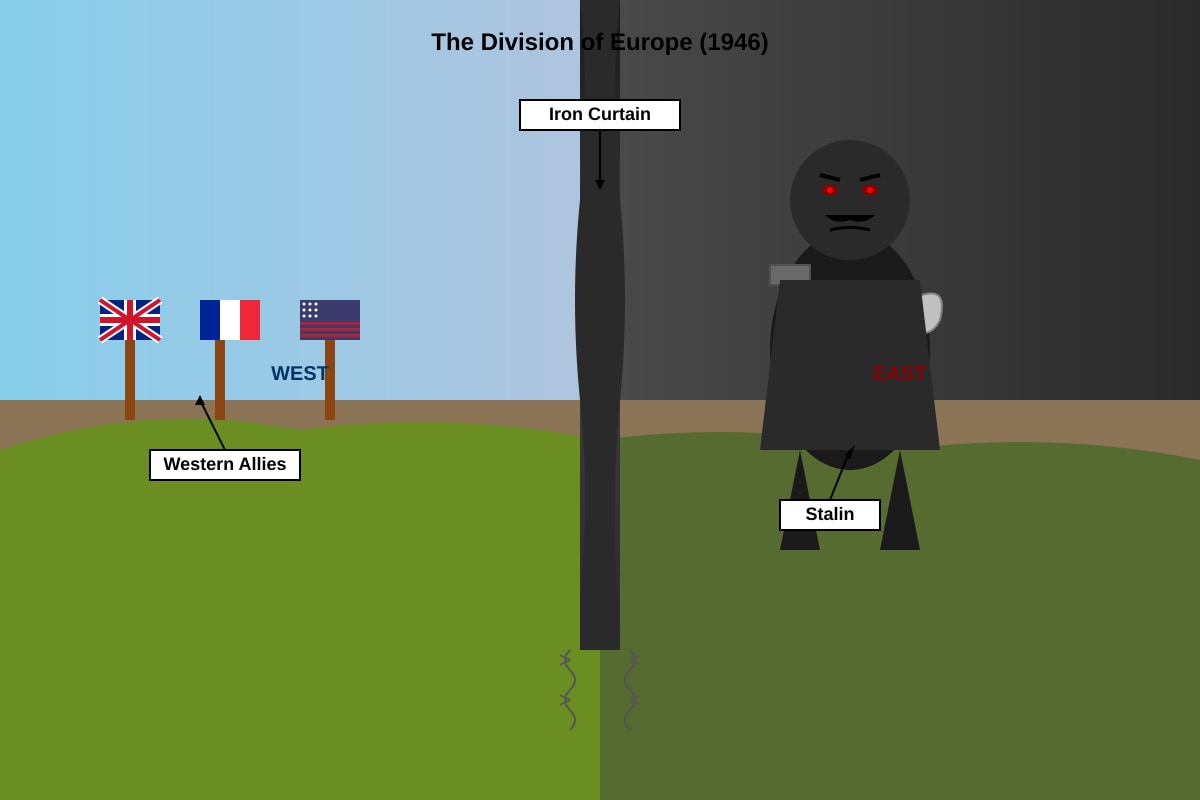
1. Study Source A. What is the message of this cartoon? Explain your answer using details of the source and your knowledge. [4]
- Answer: The message is that the Soviet Union, under Stalin, is aggressively dividing Europe and threatening the West.
- Explanation:
- Source Detail: The "Iron Curtain" is shown as a heavy, dark barrier separating the bright, free West from the dark, shadowy East. Stalin is depicted as a large, menacing figure holding a hammer and sickle, symbolizing communist control.
- Knowledge: This reflects Churchill’s 1946 speech warning of Soviet expansionism and the imposition of communist regimes in Eastern Europe. The cartoonist supports the Western view that the USSR is a threat to democracy.
- Marking: 2 marks for message (Soviet threat/division), 2 marks for explanation using source details and knowledge.
2. Study Source B. Why did President Truman make this speech? Explain your answer. [5]
- Answer: Truman made this speech to justify US intervention in Greece and Turkey and to establish the policy of Containment.
- Explanation:
- Source Detail: He speaks of supporting "free peoples" against "armed minorities" (communists) and "outside pressures" (USSR). He emphasizes "economic and financial aid."
- Knowledge: In 1947, Britain could no longer afford to support Greece against communist rebels. Truman wanted Congress to approve $400 million in aid. This speech marked the start of the Truman Doctrine, aiming to stop the spread of communism globally.
- Marking: 2 marks for purpose (justify aid/Containment), 3 marks for explanation linking source to historical context (Greece/Turkey, Truman Doctrine).
3. Study Source C. How useful is Source C to a historian studying American motives for the Marshall Plan? Explain your answer. [6]
- Answer: It is useful for understanding the Soviet perspective and propaganda against the Marshall Plan, but limited for understanding actual US motives.
- Explanation:
- Usefulness (Content): It shows how the USSR portrayed the Marshall Plan as "dollar imperialism" or a trap to exploit Europe (Uncle Sam with a hook). This helps historians understand why Eastern European countries rejected the aid.
- Limitations (Provenance/Purpose): It is a Soviet propaganda poster, so it is biased and intended to demonize the USA. It does not reflect the genuine US motive of economic recovery and preventing communism through stability. It tells us more about Soviet fears/propaganda than US intent.
- Marking: 2 marks for utility (Soviet view), 2 marks for limitation (bias/propaganda), 2 marks for overall judgment on usefulness regarding US motives.
4. Study Sources B and C. Do these two sources agree about the nature of American aid to Europe? Explain your answer using the sources. [5]
- Answer: No, they disagree fundamentally.
- Explanation:
- Source B (US View): Truman describes aid as benevolent support for "free peoples" to ensure "economic stability" and "political processes." It is portrayed as helpful and defensive.
- Source C (Soviet View): The poster depicts aid as a predatory trap. Uncle Sam is a greedy capitalist using money to hook and control European nations. It is portrayed as exploitative and aggressive.
- Comparison: One sees aid as liberation/support; the other sees it as imperialism/control.
- Marking: 1 mark for clear disagreement, 2 marks for explaining Source B's view, 2 marks for explaining Source C's view.
5. Study Source D. What does this source tell you about the impact of the Marshall Plan on Western Europe? Explain your answer. [4]
- Answer: It shows significant economic recovery and industrial growth in Western Europe after 1947.
- Explanation:
- Source Detail: Industrial production indices rose steadily. For example, West Germany rose from 55 in 1947 to 110 in 1950 (doubling). France and Italy also showed consistent growth.
- Inference: This suggests that the financial injection from the Marshall Plan (started 1948) helped rebuild industries and stabilize economies, supporting the US claim of aiding recovery.
- Marking: 2 marks for identifying growth/recovery, 2 marks for using specific data from the table to support the point.
6. Study Sources A, B, C and D. "The main cause of tension in Europe between 1945 and 1950 was Soviet expansionism." How far do the sources support this statement? Explain your answer using all four sources. [8]
- Answer: The sources largely support the view that Soviet actions caused tension, but also suggest US economic dominance was a factor.
- Explanation:
- Support for Soviet Expansionism: Source A depicts Stalin as menacing and dividing Europe. Source B refers to "armed minorities" and "outside pressures" (USSR) threatening free peoples. These suggest Soviet aggression was the primary driver.
- Alternative View (US Economic Imperialism): Source C suggests tension was caused by US economic manipulation (Marshall Plan as a trap). This implies US actions also provoked Soviet defensiveness.
- Nuance: Source D shows the success of US aid, which might have increased Soviet fear of a strong, US-aligned Western Europe, thus contributing to tension.
- Conclusion: While Sources A and B strongly blame the USSR, Source C reminds us that Soviet propaganda viewed US economic power as a threat. Therefore, tension was mutual, but the sources lean towards viewing Soviet political/military expansion as the initial spark, countered by US economic expansion.
- Marking: 2 marks for using Source A, 2 marks for Source B, 2 marks for Source C, 2 marks for Source D/Synthesis. Must address "How far" (mostly support but with nuance).
7. Study Source A. What is the cartoonist’s opinion of Stalin? Support your answer with details from the source. [3]
- Answer: The cartoonist views Stalin as a threat, aggressive, and oppressive.
- Explanation: Stalin is drawn as a large, shadowy figure, looming over Europe. He holds the hammer and sickle (symbols of communism) like weapons. The "Iron Curtain" he controls is dark and barred, implying imprisonment of Eastern Europe.
- Marking: 1 mark for opinion (negative/threat), 2 marks for supporting details.
8. Study Source B. What is meant by "armed minorities" in this context? [2]
- Answer: It refers to local communist parties or guerrilla groups within countries like Greece and Turkey.
- Explanation: These groups were supported by the Soviet Union and sought to overthrow existing governments through force, rather than representing the majority will of the people.
- Marking: 2 marks for identifying communist insurgents/groups supported by USSR.
9. Study Source C. Who is the intended audience of this poster? Explain your answer. [3]
- Answer: The intended audience is the people of Eastern Europe and the Soviet Union.
- Explanation: The poster is in a style typical of Soviet propaganda. It aims to discourage Eastern Europeans from accepting Marshall Aid by portraying it as dangerous. It reinforces loyalty to the USSR by depicting the US as an enemy.
- Marking: 1 mark for audience, 2 marks for explanation of purpose.
10. Study Source D. Why might a historian need to be cautious when using this table as evidence for the success of the Marshall Plan? [3]
- Answer: Correlation does not equal causation; other factors contributed to recovery.
- Explanation: The table shows growth after 1947, but it does not prove the Marshall Plan caused it. Other factors like the natural post-war reconstruction cycle, domestic policies, or the Korean War boom (1950) could have influenced these figures. Also, the UK was already above 1938 levels in 1946, before significant Marshall aid arrived.
- Marking: 3 marks for identifying alternative factors or the limitation of statistical evidence without context.
Section B: The Vietnam War (1954–1975)
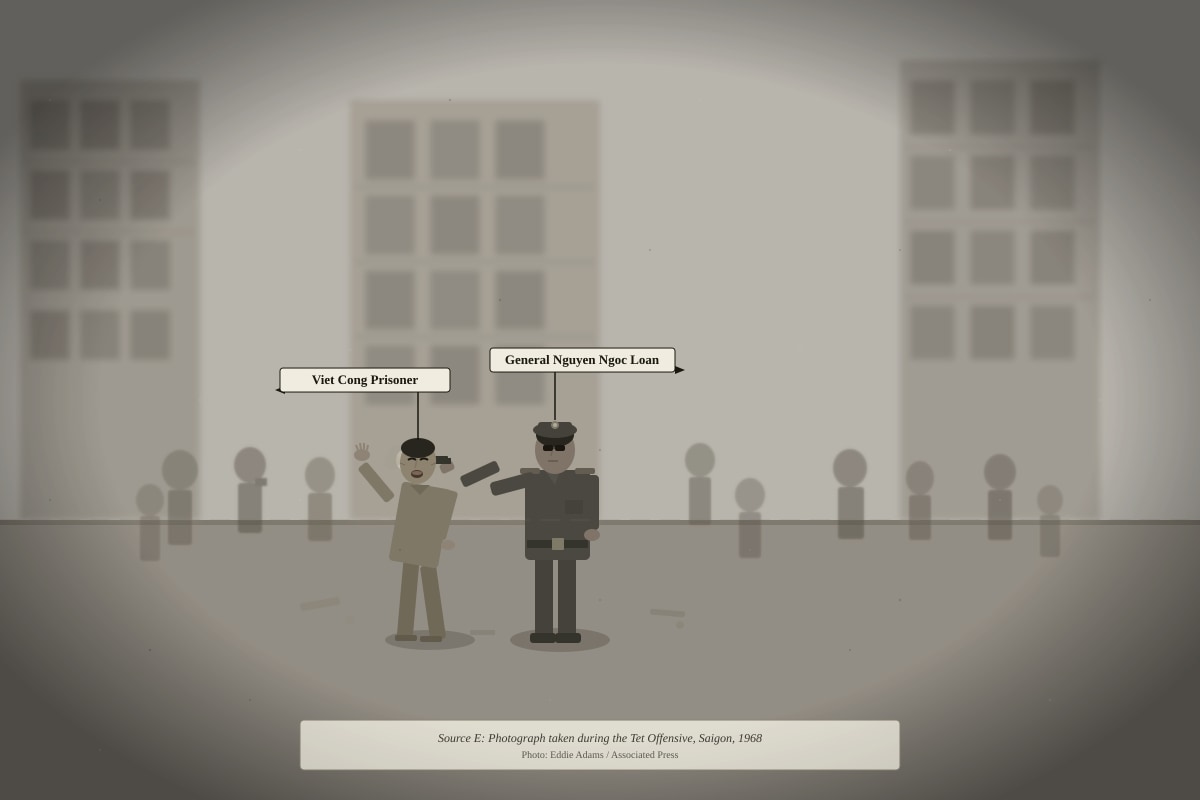
11. Study Source E. What is the impression given by this photograph? Explain your answer using details of the source. [4]
- Answer: The impression is one of brutality, chaos, and moral ambiguity.
- Explanation:
- Source Detail: The image captures a summary execution in public. The general’s cold demeanor contrasts with the prisoner’s pain. The grainy, black-and-white nature adds to the stark, shocking reality.
- Impact: It shocks the viewer by showing an ally (South Vietnamese General) committing a violent act, challenging the narrative of the "good guys" vs. "bad guys."
- Marking: 2 marks for impression (brutality/shock), 2 marks for details.
12. Study Source F. Why did President Johnson make this speech? Explain your answer. [5]
- Answer: To justify increased US military involvement and maintain domestic/international support.
- Explanation:
- Source Detail: He emphasizes "defending independence" and "confidence in American promise." He frames the war as a moral duty to protect a "small, brave nation."
- Knowledge: In 1965, the US was escalating troop numbers. Johnson needed to convince the American public and Congress that the war was necessary to stop communist aggression (Domino Theory) and uphold US credibility.
- Marking: 2 marks for purpose (justify escalation), 3 marks for explanation linking to credibility/Domino Theory.
13. Study Source G. How useful is Source G to a historian studying the morale of US troops in Vietnam? Explain your answer. [6]
- Answer: It is very useful for understanding the personal, emotional decline in morale and the confusion of soldiers.
- Explanation:
- Usefulness (Content): It reveals feelings of guilt ("feel sick"), confusion about the enemy ("don’t know who the enemy is"), and disillusionment ("feel like we are the bad guys"). It shows the psychological toll of guerrilla warfare.
- Limitations (Provenance): It is a single personal letter, so it may not represent all soldiers. It is subjective and emotional. However, it provides authentic, contemporary evidence of the ground-level experience that official reports might miss.
- Marking: 2 marks for utility (personal morale/guilt), 2 marks for limitations (subjective/single source), 2 marks for overall judgment (highly useful for emotional context).
14. Study Sources E and G. Do these two sources suggest similar reasons for the unpopularity of the war? Explain your answer using the sources. [5]
- Answer: Yes, both suggest that the brutality and moral confusion of the war contributed to its unpopularity.
- Explanation:
- Source E: Shows visible brutality (execution) that shocked the public, making the war seem immoral.
- Source G: Describes the internal moral conflict of soldiers ("burned huts in anger," "feel like we are the bad guys").
- Link: Both sources highlight that the war was not a clean, heroic conflict but involved violence against individuals and civilians, which eroded support.
- Marking: 1 mark for agreement, 2 marks for Source E analysis, 2 marks for Source G analysis.
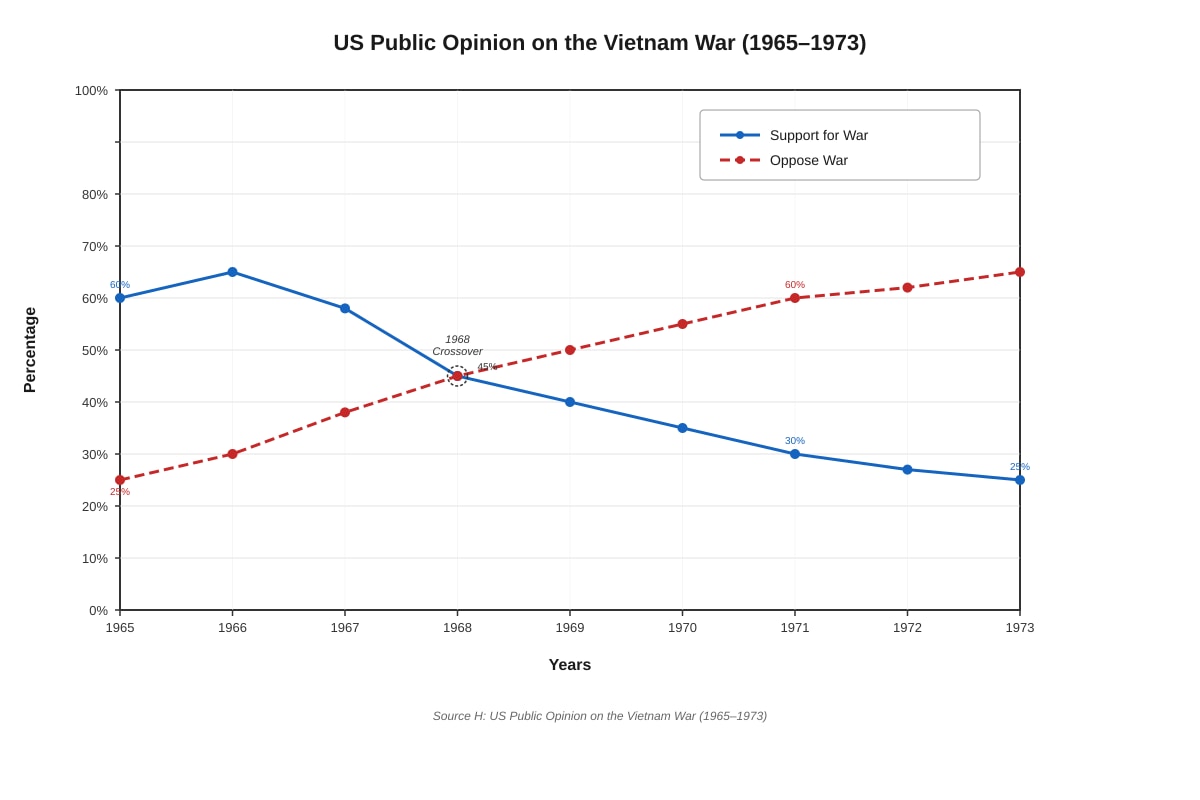
15. Study Source H. What trend does this graph show about US public opinion between 1965 and 1973? Explain your answer. [4]
- Answer: Support for the war declined steadily, while opposition rose, with opinion turning against the war around 1968.
- Explanation:
- Source Detail: In 1965, 60% supported the war. By 1968, support and opposition were equal (45%). By 1971, opposition (60%) was double the support (30%).
- Trend: A clear shift from majority support to majority opposition over the period.
- Marking: 2 marks for identifying the trend (decline support/rise oppose), 2 marks for using data points (1968 crossover).
16. Study Sources E, F, G and H. "The US failed in Vietnam because it lost the support of the American people." How far do the sources support this statement? Explain your answer using all four sources. [8]
- Answer: The sources strongly support the idea that loss of support was a key factor, but they also hint at military/moral difficulties.
- Explanation:
- Support for Loss of Support: Source H explicitly shows the collapse of public support. Source E (photo) explains why support dropped (shock at brutality). Source G shows soldiers losing faith, which feeds back to families at home.
- Other Factors: Source F shows the government’s attempt to maintain support through ideology (credibility), implying that the failure was partly due to the inability to sustain this narrative against the reality shown in E and G.
- Nuance: The sources suggest a cycle: Brutality (E) and Confusion (G) led to Loss of Support (H), which made the war politically unsustainable, leading to failure. It wasn't just loss of support, but the reasons for it (moral/military quagmire).
- Marking: 2 marks for each source used effectively in the argument. Must conclude on "How far" (Strongly supports, as loss of support made continuation impossible).
17. Study Source E. Why might this photograph have been censored by the US military at the time? [3]
- Answer: To prevent damage to morale and public support.
- Explanation: The image shows an ally (South Vietnam) committing a war crime. Releasing it could turn public opinion against the South Vietnamese government and the US war effort, as it contradicted the image of fighting for "freedom" and "justice."
- Marking: 3 marks for explaining the political/morale risk.
18. Study Source F. What is the "Domino Theory" implied in this speech? [2]
- Answer: The belief that if one country falls to communism, neighboring countries will also fall.
- Explanation: Johnson implies that if Vietnam falls ("driven from the field"), other nations will lose confidence in US protection, leading to further communist expansion in the region.
- Marking: 2 marks for defining the theory in context.
19. Study Source G. What does this source reveal about the nature of guerrilla warfare in Vietnam? [3]
- Answer: It was confusing, indiscriminate, and blurred the lines between combatants and civilians.
- Explanation: The soldier says, "They look just like the villagers." This highlights the difficulty of identifying the enemy, leading to frustration and indiscriminate violence (burning huts), which is characteristic of guerrilla warfare.
- Marking: 3 marks for identifying confusion/civilian-combatant blur.
20. Study Source H. Suggest one historical event in 1968 that might explain the change in public opinion shown in the graph. [3]
- Answer: The Tet Offensive.
- Explanation: Although a military defeat for the Viet Cong, the Tet Offensive showed the American public that the enemy was still strong and capable of attacking major cities, contradicting government claims that the war was being won. This led to a crisis of confidence and rising opposition. (Alternative: My Lai Massacre revelations, though widely known later, started in 1968).
- Marking: 1 mark for event, 2 marks for explanation of impact on opinion.