AI Generated Quiz
O Level History Singapore Southeast Asia Quiz
Free O Level History Singapore SEA quiz, Qwen3.7 AI version, with questions, answers, and O Level-style practice for Singapore students.
These static practice materials are generated from the site's syllabus and paper-generation workflow, with source and model context shown so students and parents can evaluate the material before use.
Questions
Free quiz and exam paper access
Enter your details to view this paper
Your access is remembered on this device.
Answers
O-Level History Quiz - Singapore Southeast Asia: Answer Key
Total Marks: 40
Marking Note: For essay questions (Q14, Q15, Q20), marks are awarded based on the Levels of Response marking scheme. For Source-Based questions (Q11-13), marks are awarded for inference, explanation, and comparison. For short structured questions (Q16-19), marks are awarded for accuracy and relevance.
Section A: Knowledge and Understanding (10 Marks)
1. People’s Action Party (PAP) [1]
Teaching Note: Formed in 1954, the PAP was a centre-left party that sought self-government through constitutional means.
2. 1959 [1]
Teaching Note: Singapore achieved full internal self-government in 1959, with the PAP winning the general election. Defence and foreign affairs remained under British control.
3. David Marshall [1]
Teaching Note: David Marshall was the first Chief Minister after the 1955 Rendel Constitution elections. He resigned after failing to secure full independence in London talks.
4. All-Party Mission [1]
Teaching Note: Led by David Marshall in 1956, this mission failed because the British insisted on retaining control over internal security to combat communism.
5. Any one of the following: [1]
- Fear of communist influence/takeover in Singapore.
- Strategic military importance of Singapore to the British Empire.
- Belief that Singapore was not yet ready for full independence due to racial and political instability.
Teaching Note: The British were primarily concerned about the strong communist presence in Singapore’s trade unions and student groups.
6. Lim Chin Siong [1]
Teaching Note: Lim Chin Siong was a popular left-wing leader who split from the PAP to form the Barisan Sosialis in 1961, opposing the merger terms.
7. Option A (Merger on the terms proposed by the government) won the majority of votes. [1]
Teaching Note: The referendum had three options, but Option A was the only one that led to merger. Options B and C were designed to be less attractive or impractical.
8. Malaysia Agreement (1963) [1]
Teaching Note: Signed in London in July 1963, it set the terms for the formation of Malaysia on 16 September 1963.
9. Any one of the following: [1]
- To create a common market (free trade) for Singapore’s goods.
- To attract foreign investment by having a larger hinterland.
- To solve unemployment through industrialization supported by Malaya’s resources.
Teaching Note: Singapore lacked natural resources and a hinterland, making economic survival difficult without merger.
10. 9 August 1965 [1]
Teaching Note: Singapore was expelled from Malaysia and became an independent sovereign nation on this date.
Section B: Source-Based Case Study (15 Marks)
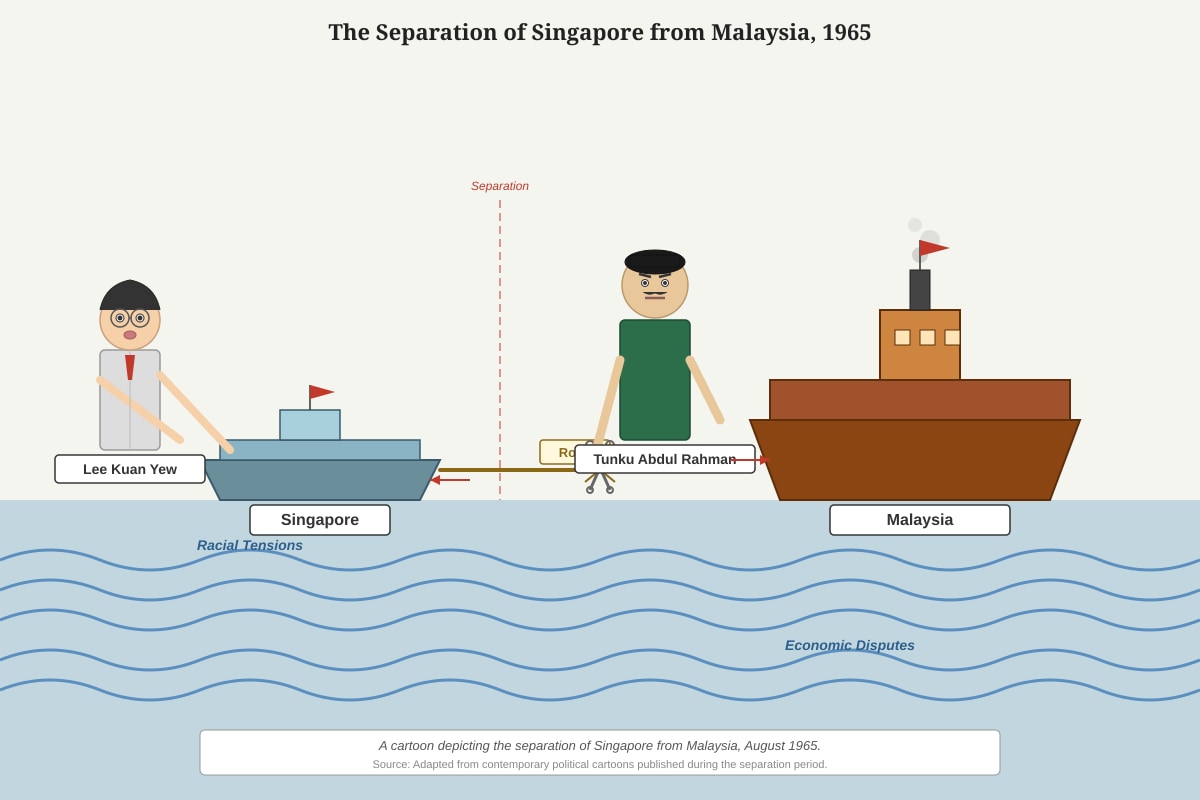
11. Study Source A. What is the cartoonist’s message about the separation of Singapore from Malaysia? Explain your answer using details from the source and your own knowledge. [5]
- Level 3 (4-5 marks): Clear inference of the message with detailed explanation using source details and own knowledge.
- Answer: The cartoonist suggests that separation was inevitable due to deep-rooted conflicts, specifically racial and economic tensions. The "rough sea" labelled "Racial Tensions" and "Economic Disputes" shows that these issues were destabilizing the union. The Tunku cutting the rope indicates that the Malaysian leadership made the decisive move to separate to preserve stability. Lee Kuan Yew’s surprise but relief suggests that while separation was sudden, it might have been a relief from the constant friction. Own knowledge: The concept of "Malaysian Malaysia" vs. Malay special rights caused major racial political friction.
- Level 2 (2-3 marks): Partial inference with some explanation.
- Answer: The message is that Singapore and Malaysia separated because of problems. The waves show tensions. The Tunku cut the rope, meaning he ended the merger.
- Level 1 (1 mark): Simple observation without explanation.
- Answer: The cartoon shows Lee Kuan Yew and Tunku Abdul Rahman separating.
12. Study Source B. Why was the Proclamation of Singapore issued? Explain your answer using details from the source and your own knowledge. [5]
- Level 3 (4-5 marks): Clear explanation of purpose using source and own knowledge.
- Answer: The Proclamation was issued to formally declare Singapore’s independence and sovereignty after its expulsion from Malaysia. The source states that "separation... has become inevitable," indicating that the merger had failed. It aims to reassure citizens and the world that Singapore will be a "sovereign democratic and independent nation" based on "liberty and justice." Own knowledge: This was necessary to establish Singapore’s legal status internationally and to calm domestic fears after the sudden separation. It marked the birth of a new nation.
- Level 2 (2-3 marks): Partial explanation.
- Answer: It was issued because Singapore separated from Malaysia. It says Singapore is now independent and free. It wants to seek welfare for its people.
- Level 1 (1 mark): Simple statement from the source.
- Answer: To say Singapore is independent.
13. Study Sources B and C. How far does Source C support Source B? Explain your answer. [5]
- Level 3 (4-5 marks): Detailed comparison showing support and/or contradiction.
- Answer: Source C supports Source B to a large extent regarding the inevitability of separation. Source B states separation "has become inevitable," and Source C explains why: "differences... are so deep-rooted that they cannot be resolved." Source C supports the idea that separation was necessary to avoid "bloodshed," which aligns with Source B’s tone of establishing a new, stable future. However, Source C places the blame on the PAP’s "Malaysian Malaysia" concept challenging Malay rights, whereas Source B is neutral and focuses on the right to be free. Source C provides the political reasoning (racial/political ideology) behind the "inevitability" mentioned in Source B.
- Level 2 (2-3 marks): Some comparison with limited detail.
- Answer: Source C supports Source B because both talk about separation. Source C says it was to avoid bloodshed, which supports Source B saying it was inevitable. But Source C blames the PAP, while Source B does not.
- Level 1 (1 mark): Simple statement of similarity or difference.
- Answer: They both talk about Singapore leaving Malaysia.
Section C: Structured Essay Questions (15 Marks)
14. "The main reason for the merger of Singapore with Malaya in 1963 was to achieve independence from the British." How far do you agree? [15]
-
Marking Scheme (Levels of Response):
- Level 4 (13-15 marks): Balanced argument with detailed knowledge. Evaluates the relative importance of independence vs. other factors (economic, security). Clear judgment.
- Level 3 (10-12 marks): Explains both sides but may lack balance or detailed evaluation. Good knowledge of factors.
- Level 2 (5-9 marks): Descriptive answer focusing on one factor only, or lacks explanation of why it was a reason.
- Level 1 (1-4 marks): Simple statements or irrelevant information.
-
Indicative Content:
- Agree (Independence): The British made it clear they would not grant full independence to Singapore alone due to the communist threat. Merger was the only constitutional path to end colonial rule. The 1956 and 1957 constitutional talks failed because the British refused to hand over internal security.
- Disagree (Economic Reasons): Singapore lacked a hinterland and natural resources. A common market with Malaya was essential for industrialization and solving unemployment. The economic survival of Singapore was a critical driver.
- Disagree (Internal Security): The PAP government feared a communist takeover. Merger would allow the federal government in Kuala Lumpur to handle internal security, helping the PAP crack down on communist elements like the Barisan Sosialis.
- Conclusion: While independence was a major goal, it was inextricably linked to security and economics. One could argue security was the primary driver for the British, while economics was the primary driver for Singapore's long-term viability.
15. "Racial tensions were the most significant cause of Singapore’s separation from Malaysia in 1965." How far do you agree? [15]
-
Marking Scheme (Levels of Response):
- Level 4 (13-15 marks): Balanced argument evaluating racial tensions against political and economic causes. Clear judgment.
- Level 3 (10-12 marks): Explains racial tensions well but may underplay other factors.
- Level 2 (5-9 marks): Descriptive answer focusing on one aspect.
- Level 1 (1-4 marks): Simple statements.
-
Indicative Content:
- Agree (Racial Tensions): The ideological clash between PAP’s "Malaysian Malaysia" (equality for all) and UMNO’s pro-Malay policies created deep distrust. The 1964 racial riots in Singapore heightened fears of further violence. Tunku Abdul Rahman feared that PAP’s multiracial approach would upset the racial balance in Malaysia.
- Disagree (Political Differences): The PAP’s decision to contest elections in Malaya (1964) was seen as a direct challenge to UMNO’s authority. This political rivalry made cooperation impossible.
- Disagree (Economic Disagreements): Singapore felt betrayed by the lack of a common market. Disputes over tax contributions (Singapore asked to pay 40% instead of 60%) and the closure of banks by the federal government exacerbated tensions.
- Conclusion: Racial tensions were the visible cause, but they were fueled by political rivalry and economic disputes. The Tunku likely used racial tension as the justification for a separation driven by political incompatibility.
16. Explain two reasons why the British introduced the Rendel Constitution in 1955. [4]
- Reason 1: To address growing local demand for self-government and reduce anti-colonial sentiment. [2]
- Reason 2: To create a more representative government while retaining British control over key areas like internal security and defence to combat communism. [2]
- Marking Note: 2 marks for each well-explained reason.
17. Describe the role of the Hock Lee Bus Riots (1955) in Singapore’s political history. [3]
- Answer: The riots highlighted the strength of communist influence in trade unions and student groups. [1] They caused the British and moderate politicians to fear that without merger or stronger security measures, Singapore could fall to communism. [1] It also weakened the position of Chief Minister David Marshall, showing the instability of the coalition government. [1]
18. State two terms of the merger agreement regarding Singapore’s autonomy. [2]
- Term 1: Singapore would have autonomy in education and labour matters. [1]
- Term 2: The federal government in Kuala Lumpur would retain control over internal security and defence. [1]
19. Identify one immediate economic challenge Singapore faced after separation in 1965. [1]
- Answer: Loss of the common market with Malaya. [1]
(Acceptable alternatives: Withdrawal of British military spending/jobs; Lack of natural resources/hinterland.)
20. Explain why the concept of 'Malaysian Malaysia' was opposed by UMNO leaders. [5]
- Level 3 (4-5 marks): Detailed explanation of political and racial implications.
- Answer: UMNO leaders opposed 'Malaysian Malaysia' because it challenged the special position of the Malays enshrined in the Malaysian Constitution. [1] They believed that affirmative action for Malays was necessary to correct economic imbalances. [1] The PAP’s call for equal rights for all races was seen as a threat to Malay political dominance and the social contract. [1] Furthermore, UMNO viewed the PAP’s campaign as an intrusion into Malayan politics, undermining UMNO’s authority. [1] It was seen as a radical, leftist ideology that could destabilize the racial harmony UMNO sought to maintain through Malay supremacy. [1]
- Level 2 (2-3 marks): Partial explanation.
- Answer: It opposed Malay special rights. UMNO wanted to protect Malays. PAP wanted equality which UMNO thought was dangerous.
- Level 1 (1 mark): Simple statement.
- Answer: UMNO did not like it because it was different from their ideas.