AI Generated Quiz
O Level History Singapore Southeast Asia Quiz
Free O Level History Singapore SEA quiz, HY3 AI version, with questions, answers, and O Level-style practice for Singapore students.
These static practice materials are generated from the site's syllabus and paper-generation workflow, with source and model context shown so students and parents can evaluate the material before use.
Questions
Free quiz and exam paper access
Enter your details to view this paper
Your access is remembered on this device.
Answers
O-Level History Quiz - Singapore Southeast Asia: Answer Key
Total Marks: 40
Topic: Singapore Southeast Asia (O-Level History)
Section A: Source-Based Questions (Q1–Q8)
Q1. [5 marks]
- British wanted to protect Singapore and Straits Settlements before 1870 mainly to safeguard trade (1 mark).
- Source A states they aimed "to protect trade, not to control the Malay states directly" (1 mark: use of source).
- Singapore's location was vital for shipping routes between India and China (1 mark: contextual knowledge).
- The 1824 Anglo-Dutch Treaty kept Dutch away, giving Britain free hand in Singapore (1 mark: contextual link).
- Therefore, protection was for economic security, not territorial conquest (1 mark: conclusion).
- Teaching note: Students should see that early British policy was "informal empire" — profit not land.
Q2. [5 marks]
- Source B says they came "to protect our merchants and keep the peace" (1 mark: quote).
- The Larut Wars threatened tin trade, so intervention was justified as protection (1 mark: context).
- The officer claims "not to conquer" but to protect (1 mark: inference of stated motive).
- This shows British used trade threats as reason for Resident (1 mark: link to Pangkor).
- However, this is a colonial record, possibly biased to seem noble (1 mark: caveat).
- Common mistake: Writing British wanted to conquer; source says protect.
Q3. [6 marks]
- Both sources suggest trade was a reason: A says "protect trade", B says "protect our merchants" (2 marks: both identified).
- They agree British acted for economic reasons not pure conquest (1 mark: similarity).
- But A is textbook (neutral), B is colonial record (may hide real control motive) (1 mark: provenance difference).
- B shows they accepted Resident, A shows earlier non-control policy — slight difference in degree (1 mark: nuance).
- Conclusion: They mostly agree trade was key, but B shows shift to control (1 mark).
- Marking: 2 for evidence, 2 for comparison, 2 for judgement.
Q4. [5 marks]
- Useful because it is a modern textbook summarising policy clearly (1 mark: provenance).
- It gives date and treaty context (1 mark: content).
- But it is secondary, so lacks original detail (1 mark: limitation).
- Does not show Malay view (1 mark: bias/limit).
- Overall partially useful for basic policy but needs primary sources for depth (1 mark: conclusion).
Q5. [4 marks]
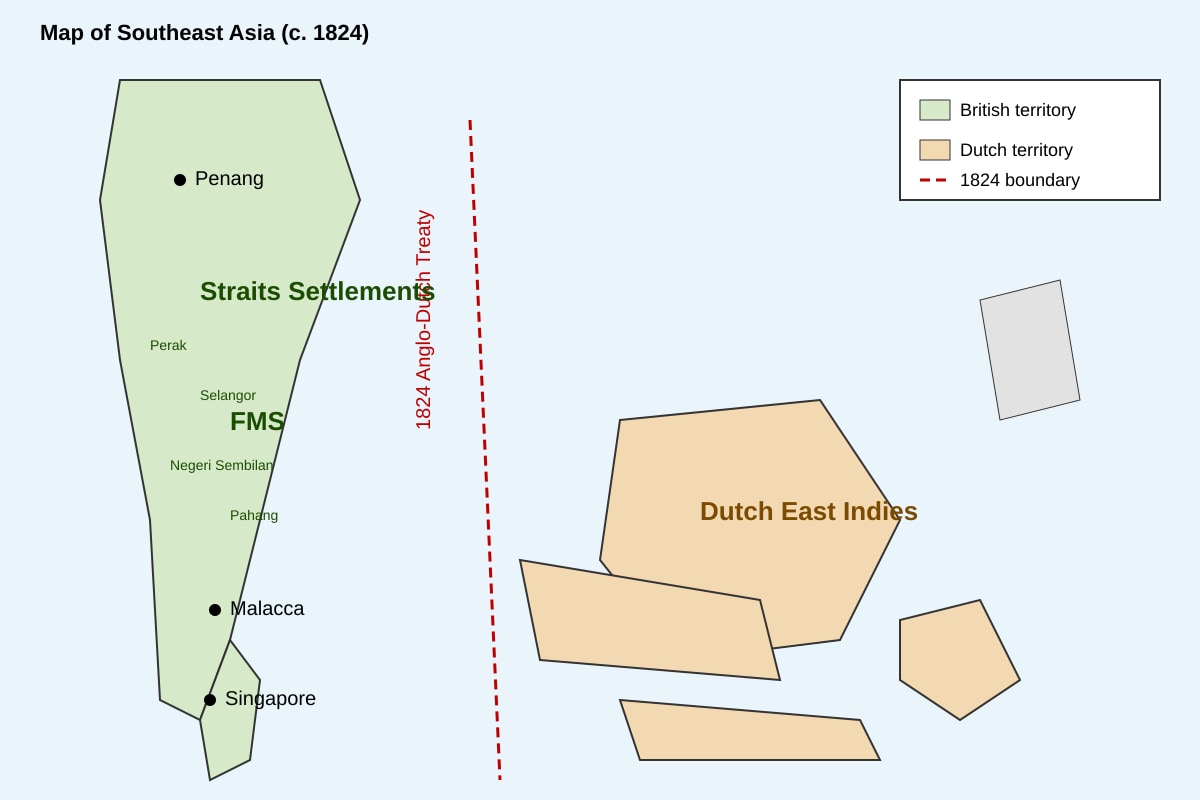
- Map shows 1824 line separated British (north) and Dutch (south) zones (1 mark).
- British got Singapore, Penang, Malacca free of Dutch claim (1 mark).
- Dutch kept East Indies, away from Malaya (1 mark).
- This secured British trade route and prevented conflict (1 mark: significance).
- Image note: Expected map shows shaded zones and labelled treaty line.
Q6. [5 marks]
- Residential System meant British Residents advised rulers (1 mark).
- Source C quote: "we no longer decide" shows loss of power (1 mark: source).
- Rulers kept ceremony but lost real control (1 mark).
- Economic boom in tin/rubber under British (1 mark).
- Social change: local chief felt opened but powerless (1 mark).
Q7. [5 marks]
- B (1875) shows British as protectors, positive tone (1 mark).
- C (1900) shows negative view: loss of Malay decision (1 mark).
- B is colonial officer, C is local chief — different perspectives (1 mark).
- B sees benefit (peace), C sees cost (independence lost) (1 mark).
- Thus they differ: one justifies, one criticises (1 mark: conclusion).
Q8. [5 marks]
- Sources show some benefits: peace, trade (A, B) (1 mark).
- But C shows loss of independence, "no longer decide" (1 mark).
- Source A says not direct control early; later control grew (1 mark).
- Knowledge: plural society, economic change but political loss (1 mark).
- Sources do NOT fully support "only benefits" — C contradicts (1 mark: judgement).
Section B: Short Answer Knowledge (Q9–Q14)
Q9. [3 marks] Penang, Singapore, Malacca (1 mark each).
Q10. [2 marks] 1824 (1 mark); to divide spheres between British and Dutch in SEA (1 mark).
Q11. [2 marks] Any two: succession dispute, tin mine conflicts, Chinese secret society fights, threat to trade (1 mark each).
Q12. [2 marks] Agreement in 1874 where Sultan of Perak accepted British Resident (1 mark); marked start of formal British control (1 mark).
Q13. [2 marks] Rubber, tin (or palm oil, coconut) (1 mark each).
Q14. [2 marks] Society with different ethnic groups (Chinese, Malay, Indian) living separately but dependent on each other economically (2 marks).
Section C: Structured and Extended (Q15–Q20)
Q15. [4 marks]
- Reason 1: Larut Wars threatened tin trade and British merchants (2 marks).
- Reason 2: Need for raw materials, empire competition (2 marks).
- Teaching: Link to shift from informal to formal control.
Q16. [4 marks]
- Residents appointed in states (1 mark).
- FMS formed 1895: Perak, Selangor, NS, Pahang (1 mark).
- Centralised British control, rulers lost power (1 mark).
- Unfederated states later 1909 (1 mark).
Q17. [6 marks]
- Agree: FMS centralised, Resident controlled (2 marks).
- Agree: Malay rulers lost independence (2 marks).
- Disagree: some infrastructure, peace (1 mark).
- Judgement: overall increased control, reduced independence (1 mark).
- Descriptors: 5–6 balanced with evidence; 3–4 partial; 1–2 simple.
Q18. [4 marks]
- Social: plural society, townships (2 marks).
- Economic: export economy, tin/rubber (2 marks).
Q19. [3 marks]
- 1824: defined spheres, no direct rule (1 mark).
- 1874: Resident, indirect control (1 mark).
- 1895: FMS, full central control (1 mark).
Q20. [6 marks]
- Agree: trade, tin, rubber, treaty (2 marks).
- Other reasons: strategic, rivalry with Dutch (2 marks).
- Conclusion: trade key but not only reason (2 marks).
- Marking: 5–6 evaluative; 3–4 descriptive; 1–2 list.