AI Generated Quiz
O Level History Ancient Civilisations Quiz
Free O Level History Ancient Civilisations quiz, HY3 AI version, with questions, answers, and O Level-style practice for Singapore students.
These static practice materials are generated from the site's syllabus and paper-generation workflow, with source and model context shown so students and parents can evaluate the material before use.
Questions
Free quiz and exam paper access
Enter your details to view this paper
Your access is remembered on this device.
Answers
O-Level History Quiz - Ancient Civilisations (Answer Key)
Total Marks: 40
Topic: Ancient Civilisations (syllabus-first; not past-year derived)
Section A: Knowledge and Recall (1 mark each)
Q1. Nile Valley (or River Nile).
Teaching note: Ancient Egyptian civilisation grew along the Nile because of fertile floodplains. Accept "Nile" only.
Q2. Pakistan (also accept India for wider Indus region).
Teaching note: Indus Valley sites like Harappa are in modern Pakistan.
Q3. Cuneiform (or Pictograph).
Teaching note: Mesopotamians used cuneiform impressed on clay. Pictographs were earlier.
Q4. Papyrus.
Teaching note: Made from papyrus reed, not paper as we know it.
Q5. Indus Valley Civilisation.
Teaching note: Mohenjo-daro was a major Indus city.
Q6. Mesopotamia (Babylonian).
Teaching note: Hammurabi was a Babylonian king; Babylon is in Mesopotamia.
Q7. Pyramids.
Teaching note: Built as royal tombs, e.g., Giza pyramids.
Q8. Greek (or Ancient Greek).
Teaching note: Athens developed direct democracy in city-states.
Q9. Chinese (or Yellow River civilisation).
Teaching note: Early Chinese states formed along the Yellow River.
Q10. Religious/temple purposes (to honour gods or as shrine).
Teaching note: Ziggurats were step temples, not tombs.
Section B: Source-Based (marks as per question)
Q11. [2 marks]
- Temples acted as economic centres (1) — they received and distributed barley (1).
Teaching note: Source A shows temple archive recording rations; thus temples managed resources.
Q12. [3 marks]
- Useful because it is a contemporary artifact from c. 3000 BCE (1).
- Shows writing used for administration (1).
- Limitation: only one tablet, may not represent all uses of writing (1).
Teaching note: Provenance (clay tablet, Uruk, dated) supports authenticity; but single source limits breadth.
Q13. [2 marks]
(i) Well-planned drainage system (1)
(ii) Standardized baked bricks (1)
Teaching note: Directly from Source B text.
Q14. [2 marks]
- It is a modern secondary source, not contemporary (1).
- May reflect author's interpretation, not direct evidence (1).
Teaching note: Textbook is useful but not primary; caution needed for bias/modern view.
Q15. [3 marks]
- Both show farming was important (1).
- Source C shows supervised wheat harvest; D says land worked by men and women (1).
- They agree farming was labour-based but D adds gender detail not in C (1).
Teaching note: Agreement on farming life; differences in specifics.
Q16. [4 marks]
- Source C more reliable as contemporary painting from Egypt (2: provenance + date).
- Shows actual activity visually (1).
- Source D is Greek visitor, outsider, later century, may be generalised (1).
Teaching note: Primary near-time source beats external account for daily life.
Section C: Extended (marks as per question)
Q17. [3 marks]
- Rivers provided water for crops (1).
- Floods left fertile soil (1).
- Enabled surplus food and population growth (1).
Teaching note: Explains foundation of settled civilisation.
Q18. [3 marks]
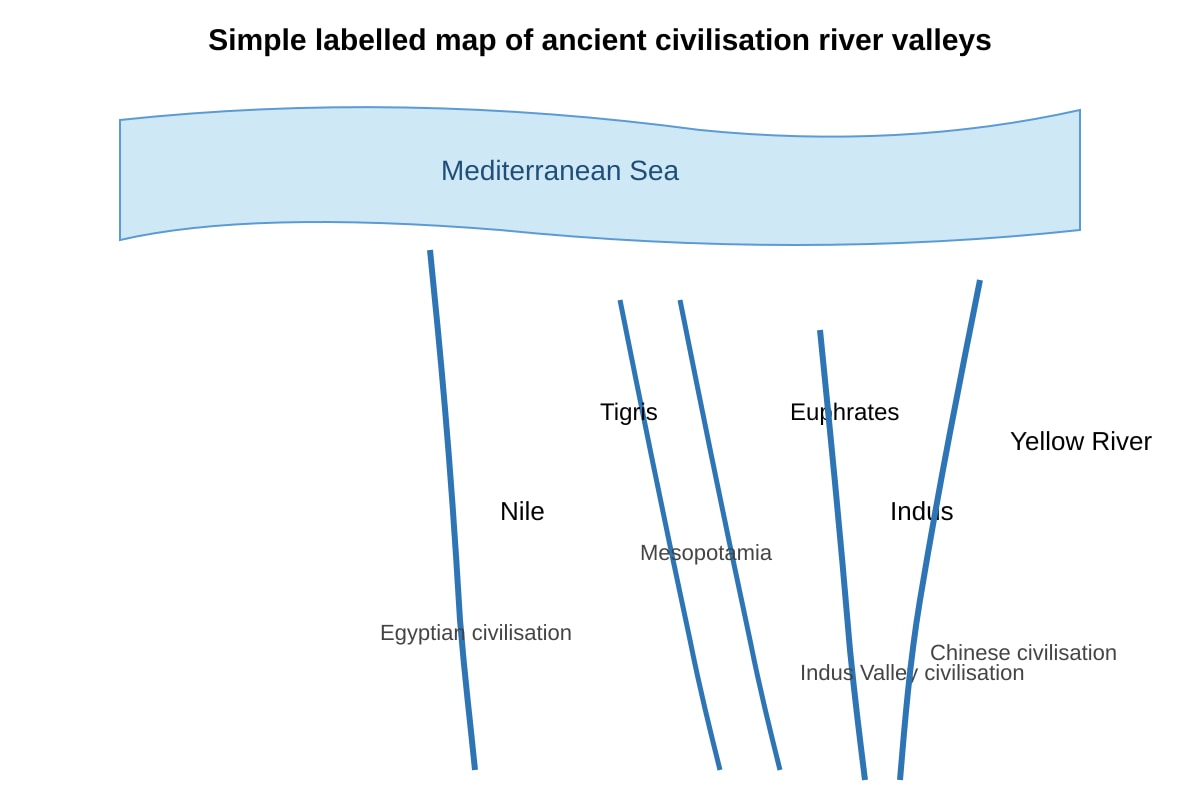
- Tigris and Euphrates (2: 1 each).
- Egyptian civilisation near Nile (1).
Teaching note: Map must show Mesopotamia between Tigris/Euphrates; Egypt on Nile.
Q19. [4 marks]
- Agree: writing (Source A) allowed administration, record-keeping (2).
- Disagree: rivers, government (Q17, Q20) also vital; Source C/D show farming/society without writing focus (2).
Teaching note: Balanced judgement using sources and knowledge.
Q20. [4 marks]
(i) Central authority (e.g., pharaoh, king) made laws — Code of Hammurabi (2).
(ii) Public works / urban planning — Indus drainage (2).
Teaching note: Shows structured state, not just villages.