From Real Exams Quiz
O Level History Ancient Civilisations Quiz
Free O Level History Ancient Civilisations quiz, Qwen3.7 Exam version, with questions, answers, and O Level-style practice for Singapore students.
These static practice materials are generated from the site's syllabus and paper-generation workflow, with source and model context shown so students and parents can evaluate the material before use.
Questions
Free quiz and exam paper access
Enter your details to view this paper
Your access is remembered on this device.
Answers
O-Level History Quiz - Ancient Civilisations: Answer Key
Total Marks: 40
Section A: Knowledge and Understanding
1. B [1]
- Reasoning: Both civilisations emerged in river valleys (Tigris/Euphrates and Nile). The rivers provided water for irrigation and deposited fertile silt during floods, which was essential for agriculture in arid regions.
2. Cuneiform [1]
- Reasoning: Cuneiform is the wedge-shaped script developed by the Sumerians. It is one of the earliest known systems of writing.
3. B [1]
- Reasoning: The Code of Hammurabi was a legal code intended to standardize laws across the Babylonian empire, establishing clear penalties for specific crimes to maintain order.
4. B [1]
- Reasoning: The Vizier (chief minister) and High Priests were the highest officials who assisted the Pharaoh in administration and religious duties. Farmers and slaves were at the bottom.
5. To serve as a temple complex dedicated to the city's patron god/goddess. [1]
- Reasoning: Ziggurats were not tombs (like pyramids) but massive stepped structures topped with a shrine. They were the religious center of the city-state.
6. Polytheism is the belief in or worship of multiple gods. [2]
- Reasoning: Ancient Mesopotamians and Egyptians both believed in many gods who controlled different aspects of nature (e.g., sun, rain, Nile). 1 mark for "belief in many gods," 1 mark for context or example.
7. The plow OR Irrigation canals/dikes. [1]
- Reasoning: These innovations allowed farmers to cultivate larger areas of land and control water supply, leading to food surpluses that supported urbanization.
8. The Nile flooded at the same time every year (summer/autumn) due to predictable seasonal rains in the Ethiopian highlands, whereas the Tigris and Euphrates flooded unpredictably and often violently. [2]
- Reasoning: 1 mark for identifying the Nile's regularity/predictability. 1 mark for contrasting it with the unpredictable/violent nature of Mesopotamian rivers.
Section B: Source-Based Analysis
9. The punishment depends on the social class of the victim. [3]
- Marking Scheme:
- 1 mark: If the victim is an equal/noble, the punishment is physical retaliation ("eye for an eye").
- 1 mark: If the victim is a commoner, the punishment is a monetary fine.
- 1 mark: If the victim is a slave, the fine is lower (half the slave's price), indicating slaves were viewed as property with less value than free men.
10. It suggests that society was hierarchical and unequal. [2]
- Reasoning: The law values the bodies of nobles more than commoners, and commoners more than slaves. Justice was not blind; it was determined by social status. 1 mark for identifying hierarchy/inequality, 1 mark for elaboration using evidence from the source.
11. To demonstrate the King's authority and ensure the laws were known to all. [4]
- Marking Scheme:
- 1 mark: To show that the laws came from the King (authority/legitimacy).
- 1 mark: To prevent people from claiming they did not know the law (public awareness).
- 1 mark: To create a sense of permanent, unchangeable order (stone lasts longer than clay/papyrus).
- 1 mark: To unify the empire under a single legal standard.
- Note: Answers must infer intent beyond just "to write it down."
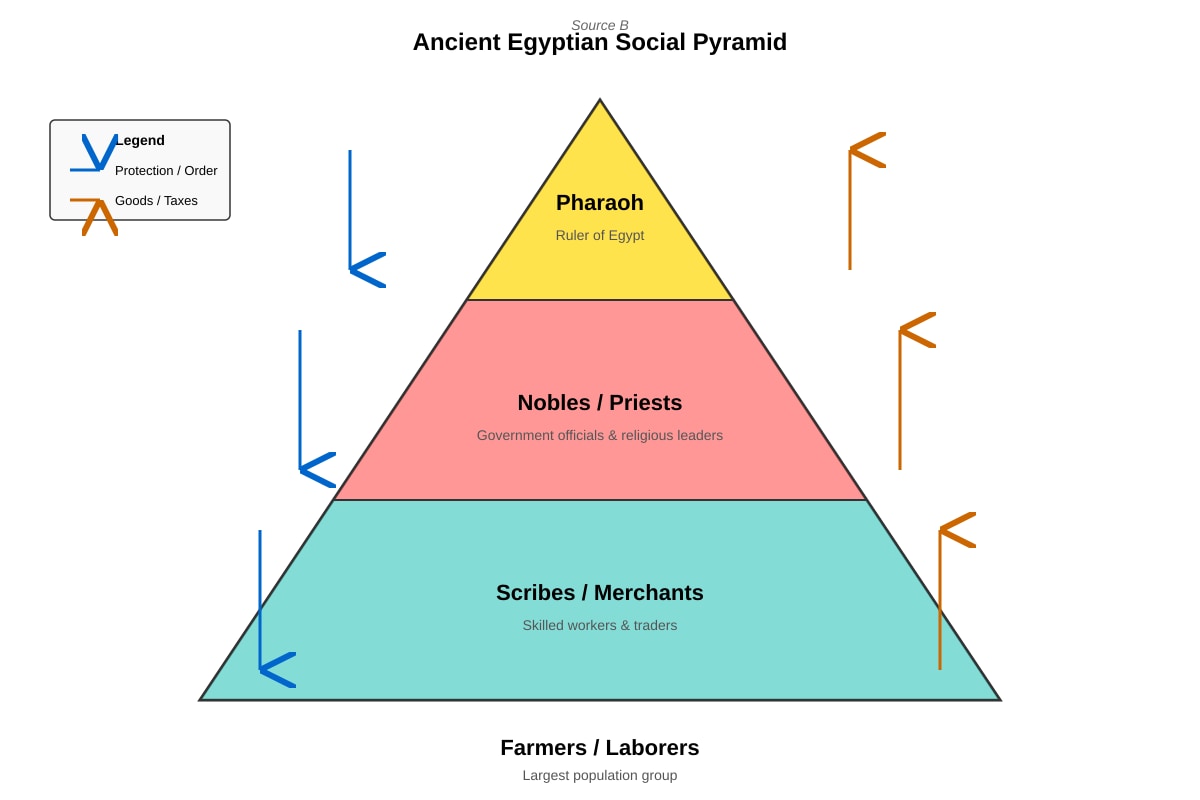
12. Egyptian society was structured as a hierarchy with a small elite at the top and a large workforce at the bottom. [2]
- Reasoning: 1 mark for identifying the Pharaoh at the top. 1 mark for identifying the broad base of farmers/laborers. The source shows a clear tiered structure.
13. The narrow top represents the small number of people with absolute power (Pharaoh), while the wide base represents the large majority who had little power but supported the state through labor and taxes. [4]
- Marking Scheme:
- 1 mark: The shape shows inequality in numbers (few rulers, many subjects).
- 1 mark: The Pharaoh at the apex symbolizes total control/centralization.
- 1 mark: The broad base indicates the economic foundation relied on the masses.
- 1 mark: The structure implies stability depends on the base supporting the top (flow of resources up, order down).
Section C: Structured Response and Essay Planning
14. Two reasons for vulnerability: [4]
- Reason 1: Lack of natural barriers. Mesopotamia is a flat plain with no mountains or deserts to block invaders from the north or east. (2 marks: 1 for point, 1 for explanation).
- Reason 2: Wealth and resources. The agricultural surplus and cities attracted neighboring nomadic tribes and rival city-states who wanted to plunder their wealth. (2 marks: 1 for point, 1 for explanation).
15. Essay Planning: "The invention of writing was the most significant development..." [6]
- Marking Guidelines:
- Level 3 (5-6 marks): Balanced argument comparing writing to another factor. Clear judgment.
- Level 2 (3-4 marks): Describes importance of writing but lacks comparison or depth.
- Level 1 (1-2 marks): Simple statement of opinion without support.
- Sample Answer Points:
- For Writing: Allowed for record-keeping (taxes, trade), codification of laws (Hammurabi), and preservation of knowledge/culture across generations. It enabled complex administration.
- For Alternative (e.g., Irrigation): Without irrigation, there would be no food surplus. Without surplus, there would be no cities, no specialists (scribes), and no civilization to write. Therefore, irrigation is more fundamental.
- Conclusion: While writing is crucial for complex administration, irrigation is the foundation of survival. Students may argue either way if supported.
16. Comparison of Religion in Governance: [5]
- Marking Scheme:
- Egypt (2 marks): The Pharaoh was considered a god-king (divine). Religion and state were identical. The Pharaoh's word was divine law.
- Mesopotamia (2 marks): Kings were seen as agents or representatives of the gods, not gods themselves. They had to please the gods to ensure favorable floods/harvests. Priests held significant independent power.
- Comparison (1 mark): Both used religion to legitimize rule, but Egypt had a theocratic monarchy (god-king), while Mesopotamia had a divine mandate system (king serving gods).
17. Ma'at represented truth, balance, order, and justice. [3]
- Reasoning:
- 1 mark: Definition of Ma'at (order/truth/justice).
- 1 mark: The Pharaoh's duty was to uphold Ma'at to prevent chaos (Isfet).
- 1 mark: This justified their rule as they maintained cosmic and social order through laws and rituals.
18. It contained the same text in three scripts: Greek, Demotic, and Hieroglyphs. [2]
- Reasoning:
- 1 mark: Identification of the three scripts.
- 1 mark: Scholars used the known Greek text to decipher the unknown Hieroglyphs, unlocking the ability to read Ancient Egyptian records.
19. Similarity and Difference in Political Structures: [4]
- Similarity (2 marks): Both were ruled by monarchs who claimed divine authority or connection to the gods to legitimize their power.
- Difference (2 marks): Egypt was a unified kingdom under one Pharaoh, whereas Sumer was divided into independent city-states (like Ur and Uruk) that often fought each other.
20. Water was scarce and essential for survival in an arid climate. [3]
- Reasoning:
- 1 mark: Agriculture depended entirely on irrigation from the rivers.
- 1 mark: City-states upstream could control or divert water flow, threatening downstream cities.
- 1 mark: This competition for a vital resource led to frequent wars and the need for defensive walls.