From Real Exams Quiz
O Level History Ancient Civilisations Quiz
Free O Level History Ancient Civilisations quiz, Exam version, with questions, answers, and O Level-style practice for Singapore students.
These static practice materials are generated from the site's syllabus and paper-generation workflow, with source and model context shown so students and parents can evaluate the material before use.
Questions
Free quiz and exam paper access
Enter your details to view this paper
Your access is remembered on this device.
Answers
O-Level History Quiz - Ancient Civilisations: Answer Key
Total Marks: 40
Section A: Source-Based Questions (Q1–Q5, 15 marks)
Q1. Study Source A. Why did the Roman official write this letter? Explain your answer. [3]
Answer: The Roman official wrote this letter to report on the situation in Britain and to explain the purpose of the wall being built. He wanted to inform his superiors in Rome about the raids by tribes beyond the wall and to justify the Emperor's decision to build it. The letter also serves to reassure Rome that the wall would secure the province.
Marking Notes:
- 1 mark: Identifies that the letter is a report to superiors in Rome.
- 1 mark: Explains that the official wanted to inform Rome about the raids/instability.
- 1 mark: Explains that the letter justifies the building of the wall as a defensive measure.
Teaching Note: When asked "why" a source was created, consider the author's purpose and audience. The official is writing to his superiors, so he is reporting and justifying actions. He describes the raids to show why the wall is necessary. This is a common pattern in source-based questions — always link the content of the source to the author's motive.
Q2. Study Source B. How useful is this source as evidence of the purpose of Hadrian's Wall? Explain your answer. [3]
Answer: Source B is useful because it is written by a modern historian who has the benefit of hindsight and access to a wide range of evidence. It provides a balanced interpretation, suggesting the wall was not just a military defence but also a political statement and a customs post. However, it is limited because it is a secondary source — the historian was not present at the time and is interpreting events from a modern perspective. It may also lack specific details about the daily life of soldiers on the wall.
Marking Notes:
- 1 mark: States a clear judgement on usefulness (e.g., useful, partially useful).
- 1 mark: Explains why it is useful (modern historian, balanced view, hindsight).
- 1 mark: Explains a limitation (secondary source, modern interpretation, lacks specific detail).
Teaching Note: For "usefulness" questions, always assess both the strengths and limitations of the source. Consider provenance (who wrote it, when, why) and content (what it says, what it omits). A modern historian's account is useful for its balanced analysis but limited because it is an interpretation, not a firsthand account.
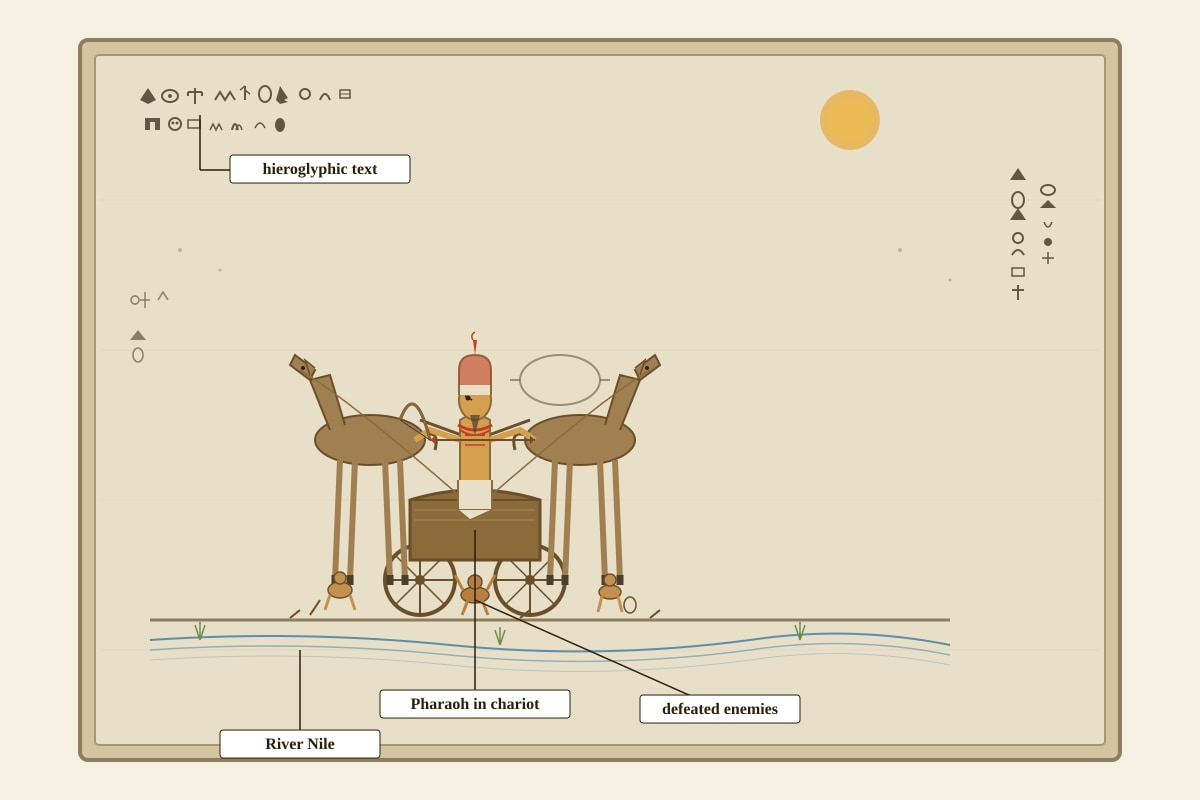
Q3. Study Source C. What does this source suggest about the power of the Egyptian pharaoh? Explain your answer. [3]
Answer: Source C suggests that the pharaoh was a powerful military leader. The carving shows him in a chariot with a bow, indicating his role as a warrior. The defeated enemies beneath the horses show his dominance over his foes. The pharaoh is depicted larger than other figures, which was a common artistic convention to show his importance and divine status. The hieroglyphic text likely records his victories, further emphasising his power.
Marking Notes:
- 1 mark: Identifies that the pharaoh is shown as a military leader/warrior.
- 1 mark: Explains that the defeated enemies show his dominance/victory.
- 1 mark: Explains that the larger size of the pharaoh and hieroglyphs emphasise his importance/divine status.
Teaching Note: When interpreting visual sources, look at the details: the actions shown, the relative size of figures, and any text. In Egyptian art, the pharaoh was often shown larger than others to convey his supreme power. The presence of defeated enemies reinforces the message of military strength.
Q4. Study Sources A and B. How far do these two sources agree about the purpose of Hadrian's Wall? Explain your answer. [3]
Answer: The sources agree that the wall was built for defence. Source A describes it as a way to "keep these barbarians out," while Source B acknowledges it was a "military defence." However, they differ in scope. Source A presents the wall primarily as a defensive structure, while Source B adds that it was also a "political statement" and a "customs post" for trade and revenue. Therefore, they agree on the basic defensive purpose but Source B offers a more multi-faceted interpretation.
Marking Notes:
- 1 mark: Identifies a point of agreement (defensive purpose).
- 1 mark: Identifies a point of difference (Source B adds political/economic purposes).
- 1 mark: Concludes with a judgement on the extent of agreement (e.g., they agree on the basic purpose but differ on the range of functions).
Teaching Note: For comparison questions, first extract the main claim from each source. Then identify where they overlap and where they diverge. Finally, make a judgement on the extent of agreement. Sources can agree on one aspect but disagree on others — your answer should reflect this nuance.
Q5. Study all the sources. 'The main purpose of ancient monuments was to demonstrate the power of the ruler.' How far do these sources support this view? Use the sources and your own knowledge to explain your answer. [3]
Answer: The sources provide partial support for this view. Source C strongly supports it, as the carving shows the pharaoh's military power and dominance. Source A also supports it to some extent, as the wall was built on the Emperor's orders to project Roman authority. However, Source B suggests that Hadrian's Wall had multiple purposes, including economic functions like customs collection, not just demonstrating power. My own knowledge also shows that monuments like the pyramids served religious purposes, as tombs for the pharaoh's journey to the afterlife, and that the Nile's flooding was managed for agriculture, not just for show. Therefore, while demonstrating power was important, it was not the only purpose.
Marking Notes:
- 1 mark: Uses at least two sources to support or challenge the statement.
- 1 mark: Provides own knowledge to support or challenge the statement.
- 1 mark: Makes a balanced judgement on the extent to which the statement is supported.
Teaching Note: For the final source-based question, you must synthesise all sources and add your own knowledge. Do not simply list what each source says — group them into those that support the statement and those that challenge it. Then use your own knowledge to add depth. Conclude with a clear judgement.
Section B: Short Answer Questions (Q6–Q15, 15 marks)
Q6. State two reasons why the Nile River was important to the development of Ancient Egyptian civilisation. [2]
Answer:
- The Nile provided water for irrigation, enabling agriculture in an otherwise arid region.
- The annual flooding of the Nile deposited fertile silt (black land) on the fields, which enriched the soil and produced abundant crops.
Marking Notes:
- 1 mark for each correct reason (max 2).
Teaching Note: The Nile was the lifeblood of Egypt. Its predictable flooding allowed for surplus food production, which supported a large population and the development of a complex civilisation. Other acceptable answers include: it provided a transportation route for trade and communication, and it provided fish and other resources.
Q7. Name the system of writing developed by the Ancient Sumerians. [1]
Answer: Cuneiform.
Marking Notes:
- 1 mark for the correct answer.
Teaching Note: Cuneiform was one of the earliest systems of writing, developed around 3200 BC in Mesopotamia. It involved making wedge-shaped marks on clay tablets. This is a key fact about the Sumerian civilisation.
Q8. Identify two key features of the city of Mohenjo-Daro in the Indus Valley Civilisation. [2]
Answer:
- Advanced urban planning with a grid layout of streets.
- A sophisticated drainage and sanitation system, with covered drains and toilets connected to a central sewer system.
Marking Notes:
- 1 mark for each correct feature (max 2).
Teaching Note: Mohenjo-Daro was one of the major cities of the Indus Valley Civilisation (c. 2500 BC). Its advanced urban planning and sanitation were remarkable for the time. Other acceptable answers include: the Great Bath, a citadel, uniform brick sizes, and a granary.
Q9. What was the main purpose of the pyramids built in Ancient Egypt? [1]
Answer: To serve as tombs for the pharaohs, protecting their bodies and possessions for the afterlife.
Marking Notes:
- 1 mark for the correct answer.
Teaching Note: The pyramids were monumental tombs. The Egyptians believed in an afterlife, and the pharaoh's body was mummified and buried with goods he would need in the next life. The pyramid's size and grandeur also demonstrated the pharaoh's power and divine status.
Q10. State two ways in which the geography of Ancient Greece influenced the development of its city-states. [2]
Answer:
- The mountainous terrain divided the land, leading to the development of independent, isolated city-states (poleis) rather than a unified empire.
- The long coastline and proximity to the sea encouraged maritime trade and the establishment of colonies.
Marking Notes:
- 1 mark for each correct way (max 2).
Teaching Note: Greece's geography was a major factor in its political development. The mountains made land travel difficult, so communities developed independently. The sea became a vital highway for trade and communication, connecting the Greek world and spreading its culture.
Q11. Name the ruler of the Babylonian Empire who created one of the earliest known written law codes. [1]
Answer: Hammurabi.
Marking Notes:
- 1 mark for the correct answer.
Teaching Note: Hammurabi ruled Babylon around 1792–1750 BC. His law code, inscribed on a stele, is one of the oldest and most complete written legal codes in history. It is famous for its principle of "an eye for an eye."
Q12. What was the significance of the invention of writing for ancient civilisations? Give two points. [2]
Answer:
- It allowed for the recording of laws, treaties, and administrative records, which helped govern complex societies.
- It enabled the preservation and transmission of knowledge, literature, and religious texts across generations.
Marking Notes:
- 1 mark for each correct point (max 2).
Teaching Note: Writing was a revolutionary development. It allowed for more complex administration, the codification of laws, and the accumulation of knowledge. It also helped create a shared cultural identity through written literature and religious texts.
Q13. Identify two achievements of the Ancient Chinese civilisation during the Shang Dynasty. [2]
Answer:
- The development of a sophisticated bronze-working industry, creating ritual vessels and weapons.
- The development of a system of writing using oracle bones for divination.
Marking Notes:
- 1 mark for each correct achievement (max 2).
Teaching Note: The Shang Dynasty (c. 1600–1046 BC) was the first historically verified dynasty in China. Its bronze casting was highly advanced, and its writing system is the direct ancestor of modern Chinese characters.
Q14. What was the role of the pharaoh in Ancient Egyptian society? Give one point. [1]
Answer: The pharaoh was the absolute ruler of Egypt, considered a living god and the intermediary between the gods and the people. He was responsible for maintaining order (Ma'at) and leading the army.
Marking Notes:
- 1 mark for a correct point.
Teaching Note: The pharaoh was not just a king; he was a divine figure. His authority was absolute, and he was responsible for the religious, political, and military well-being of Egypt. This divine status justified his power and the construction of monuments like the pyramids.
Q15. State one reason why the location of Rome was advantageous for the growth of the Roman Empire. [1]
Answer: Rome was located on the Italian peninsula, which was centrally located in the Mediterranean Sea, allowing for easy trade and military expansion. It was also built on seven hills, providing natural defences.
Marking Notes:
- 1 mark for a correct reason.
Teaching Note: Rome's location was crucial to its success. The central position in the Mediterranean allowed it to control trade routes and project military power. The hills provided a defensive advantage, and the nearby Tiber River offered access to the sea.
Section C: Extended Response Questions (Q16–Q20, 10 marks)
Q16. Explain two reasons why rivers were important to the development of early civilisations. [2]
Answer:
- Rivers provided a reliable source of water for drinking and irrigation, which was essential for agriculture. This allowed for surplus food production, which supported larger populations and the development of cities.
- Rivers served as natural highways for trade and communication, connecting different regions and facilitating the exchange of goods, ideas, and culture.
Marking Notes:
- 1 mark for each developed reason (max 2).
Teaching Note: Early civilisations like Egypt (Nile), Mesopotamia (Tigris and Euphrates), India (Indus), and China (Yellow River) all developed along rivers. The rivers provided the resources and connections needed for complex societies to emerge. Each reason should be explained with a clear link to the development of civilisation.
Q17. Describe two ways in which the Ancient Egyptians used the flooding of the Nile to their advantage. [2]
Answer:
- They built irrigation canals and basins to capture and distribute the floodwaters to their fields, allowing them to grow crops in the dry desert soil.
- They used the fertile silt deposited by the flood to enrich the soil, which produced abundant harvests and supported a large population.
Marking Notes:
- 1 mark for each developed way (max 2).
Teaching Note: The Nile's annual flood was predictable and reliable. The Egyptians developed a system of basin irrigation, where they would trap the floodwater in fields and let it soak in. The silt left behind was a natural fertiliser, making the land incredibly productive.
Q18. Explain two reasons why the Ancient Greeks established colonies across the Mediterranean. [2]
Answer:
- Overpopulation and a shortage of farmland in the Greek mainland drove people to seek new land for agriculture in other parts of the Mediterranean.
- Trade opportunities and the desire for access to valuable resources like metals and grain encouraged the establishment of trading posts and colonies.
Marking Notes:
- 1 mark for each developed reason (max 2).
Teaching Note: Greek colonisation (c. 800–600 BC) was driven by a combination of push and pull factors. The rocky, mountainous terrain of Greece could not support a growing population. Colonies provided new farmland and access to trade networks, spreading Greek culture across the Mediterranean.
Q19. Describe two features of the social structure of Ancient Egypt. [2]
Answer:
- The pharaoh was at the top of the social hierarchy, considered a living god with absolute power.
- Below the pharaoh were the nobles, priests, and officials, who administered the government and religion. The majority of the population were farmers, labourers, and slaves at the bottom.
Marking Notes:
- 1 mark for each developed feature (max 2).
Teaching Note: Egyptian society was a strict hierarchy, like a pyramid. The pharaoh was at the top, followed by the elite classes (nobles, priests, scribes), then merchants, artisans, and farmers, with slaves at the bottom. Social mobility was limited, but not impossible.
Q20. Explain two reasons why the Roman Empire was able to maintain control over such a large territory. [2]
Answer:
- The Romans built an extensive network of roads and used a powerful, well-organised army to quickly move troops and suppress rebellions across the empire.
- The Romans adopted a policy of assimilation, granting citizenship to conquered peoples and allowing them to maintain their local customs and religions, which reduced resistance and fostered loyalty.
Marking Notes:
- 1 mark for each developed reason (max 2).
Teaching Note: The Roman Empire's longevity was due to a combination of military might and pragmatic governance. The roads ("All roads lead to Rome") were crucial for control. The policy of "Romanisation" — offering citizenship and integrating local elites — was a key factor in maintaining stability.
END OF ANSWER KEY