AI Generated Exam Paper
O Level History Practice Paper 4
Free O Level History Practice Paper 4, HY3 AI version, with questions, answers, and O Level-style practice for Singapore students.
These static practice materials are generated from the site's syllabus and paper-generation workflow, with source and model context shown so students and parents can evaluate the material before use.
Questions
Free quiz and exam paper access
Enter your details to view this paper
Your access is remembered on this device.
Answers
TuitionGoWhere Practice Paper — Answer Key (Version 4)
Subject: History
Level: O-Level
Paper: Practice Paper (Essay Explanation)
Total Marks: 50
Section A: Explain Key Historical Concepts
1. [2 marks]
Definition: An authoritarian regime is a system where power is concentrated in a single leader or small group, with limited political freedoms and opposition suppressed.
Teaching note: In 20th-century history, Nazi Germany and militarist Japan are examples. Student must show understanding of concentrated power and lack of democracy.
Marking: 1 mark for definition, 1 mark for contextual example or elaboration.
2. [2 marks]
Cause and effect = one event leads to another. Example: British desire for tin and rubber (cause) led to intervention in Perak (effect).
Teaching note: Explain that historians link actions to outcomes.
Marking: 1 mark for concept, 1 mark for SEA example.
3. [2 marks]
"Plural society" means different ethnic groups living together but separately in economic roles. In British Malaya, Chinese in tin, Indians in plantations, Malays in villages.
Teaching note: Shows social transformation after 1874.
Marking: 1 mark concept, 1 mark application to Malaya.
4. [2 marks]
Balance of power = no single side dominates; Cold War superpowers (USA/USSR) avoided direct war by deterrence.
Marking: 1 mark definition, 1 mark Cold War context.
5. [2 marks]
Decolonisation = end of colonial rule. Example: Singapore self-governance 1959, independence 1963/1965.
Marking: 1 mark definition, 1 mark SEA example.
Section B: Cause, Effect and Significance
6. [4 marks]
Two causes: (a) Internal instability — Larut Wars and succession disputes disrupted tin trade. (b) British economic interest — needed raw materials and secure trade routes.
Teaching note: Use specific facts; explain link to policy shift in 1870s.
Marking: 2 marks each cause with explanation.
7. [3 marks]
Effect: Export-oriented economy grew; rubber and tin extraction expanded under British administration.
Marking: 1 mark identification, 2 marks explanation of economic transformation.
8. [4 marks]
Reasons: War Guilt Clause (blame), reparations (financial burden), territorial loss, demilitarisation. Each created nationalism and resentment.
Marking: 1 mark per explained point (max 4).
9. [2 marks]
Policy: Persecution of minorities (e.g., Jews). Effect: Fear, exclusion, forced emigration.
Marking: 1 mark policy, 1 mark effect.
10. [2 marks]
Vietnam War = proxy conflict; USA vs USSR/China supporting opposing sides, showing global Cold War reach.
Marking: 1 mark proxy, 1 mark outside Europe.
Section C: Essay Explanation Structures
11. [2 marks]
Description lists facts; explanation shows why/how with reasoning.
Marking: 1 mark each.
12. [2 marks]
Balanced explanation must give both benefits (e.g., employment) and harms (e.g., persecution), then judge.
Marking: 1 mark for counter-view, 1 mark for judgement.
13. [2 marks]
Knowledge gives facts; sources give evidence of perspectives. Together they support reasoned explanation.
Marking: 1 mark each.
14. [2 marks]
Conclusion sums judgement on "how far" based on evidence.
Marking: 1 mark purpose, 1 mark link to question.
15. [2 marks]
Mistake: Only agreeing without contrary evidence.
Marking: 1 mark mistake, 1 mark explanation.
Section D: Applied Essay Explanation
16. [3 marks]
Use as counter to "force only" view; show economic and local factors. Balanced essay includes both.
Marking: 1 mark use as nuance, 2 marks explanation of balance.
17. [4 marks]
Limits: (a) No army — could not enforce decisions. (b) USA absent — reduced power.
Marking: 2 marks each with explanation.
18. [3 marks]
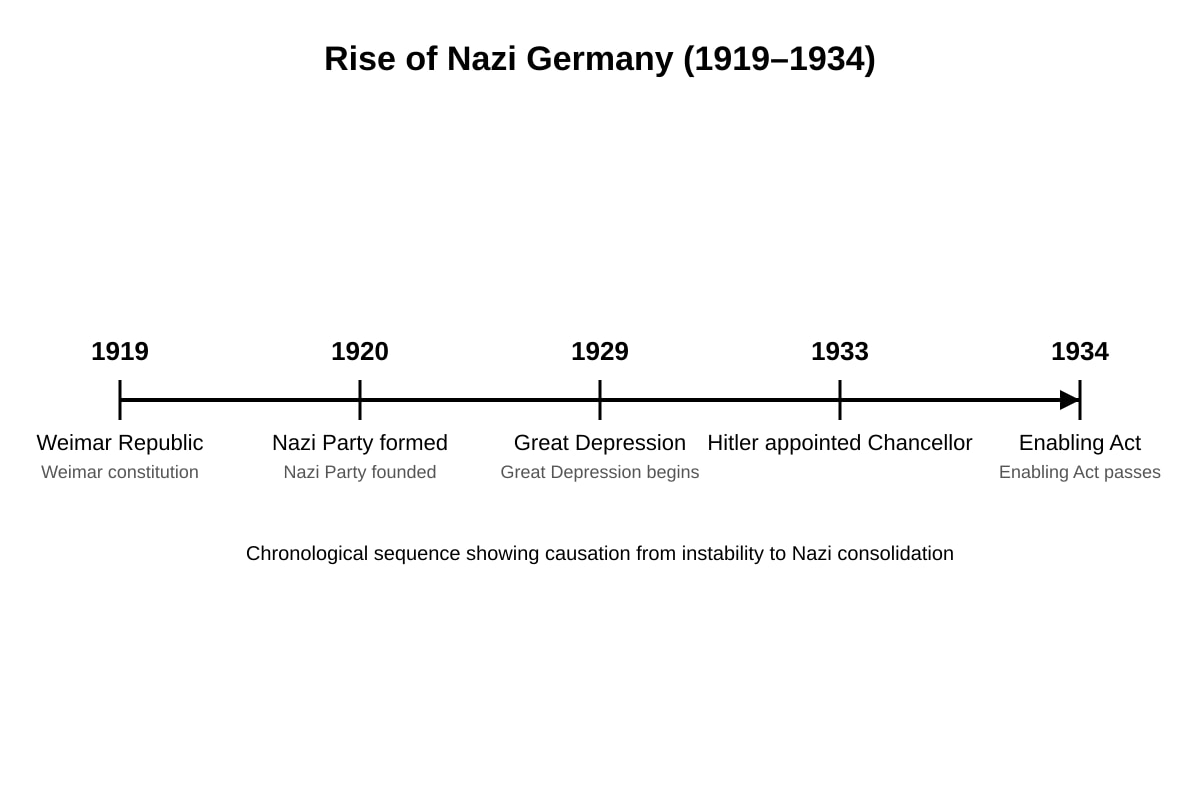
Timeline shows 1929 crisis → 1933 Chancellor → 1934 Act. Economic despair increased Nazi support.
Image features needed: labelled years/events as specified.
Marking: 1 mark link crisis to support, 2 marks explanation via timeline.
19. [3 marks]
Military to defeat resistance; administrative to control taxes, education, economy.
Marking: 1.5 marks each.
20. [2 marks]
Structure: Intro (state view), Body (ideology points, distrust points), Judgement (which weighed more).
Marking: 1 mark structure, 1 mark evaluation plan.