From Real Exams Exam Paper
O Level History Practice Paper 3
Free O Level History Practice Paper 3, HY3 Exam version, with questions, answers, and O Level-style practice for Singapore students.
These static practice materials are generated from the site's syllabus and paper-generation workflow, with source and model context shown so students and parents can evaluate the material before use.
Questions
Free quiz and exam paper access
Enter your details to view this paper
Your access is remembered on this device.
Answers
TuitionGoWhere Practice Paper - History O-Level (Essay Explanation) Answer Key
Version: 3 of 5
Total Marks: 60
Section A: Explain Key Historical Concepts (15 marks)
1. [3 marks]
- Definition: An authoritarian regime is a government that concentrates power in a single leader or party, limiting political freedoms. (1)
- Context: In 1930s Europe, e.g. Nazi Germany under Hitler, the regime used propaganda, force, and one-party rule. (1)
- Explanation: It suppressed opposition and controlled society without democratic consent. (1)
Teaching note: Authoritarian = not democratic; use Nazi Germany as case. Common mistake: confusing with totalitarian (extreme form).
2. [3 marks]
- Before 1874: Malay rulers had full control. (1)
- After Residential System: British Resident advised on all matters except religion/custom. (1)
- Change: Real political power shifted to British; ruler became figurehead. (1)
Teaching note: Show continuity (religion/custom) and change (advice = control).
3. [3 marks]
- Definition: Collective security = members act together against aggression. (1)
- League method: If one attacked, others sanction or fight. (1)
- 1920s aim: Prevent war through unity. (1)
Teaching note: Link to Article 10 of League Covenant.
4. [3 marks]
- Clause blamed Germany alone for WWI. (1)
- Germans felt humiliation and injustice. (1)
- Resentment fueled revanchism and Nazi rise. (1)
Teaching note: War Guilt = Article 231.
5. [3 marks]
- Definition: Decolonisation = end of colonial rule, independence. (1)
- Example: Malaya gained independence from Britain in 1957. (1)
- Explanation: Local nationalist movements forced withdrawal. (1)
Teaching note: Avoid ancient examples; use post-1945 SEA.
Section B: Cause and Consequence Explanation (15 marks)
6. [3 marks]
- Cause 1: Demand for raw materials (tin) from Larut mines. (1.5)
- Cause 2: Need for cash crops (rubber) and stable trade. (1.5)
Teaching note: Economic = material gain, not just politics.
7. [3 marks]
- Depression = unemployment, poverty. (1)
- Nazis promised jobs, blamed others. (1)
- Voters turned to extremist party. (1)
Teaching note: Link 1929 crash to 1933 takeover.
8. [3 marks]
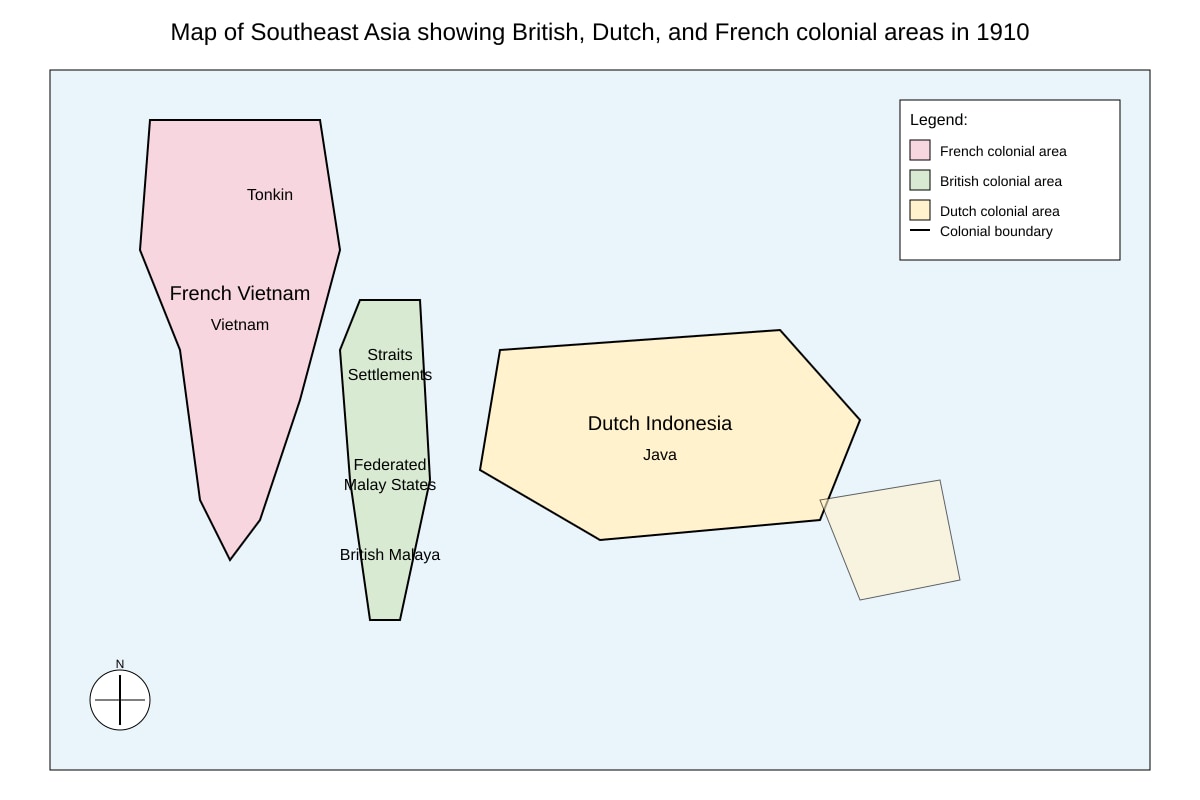
- Map shows divided spheres: British, Dutch, French. (1)
- Competition for resources/trade pushed expansion. (1)
- Treaties (e.g. 1824) formalised control. (1)
Visual needed: Boundaries labelled; student must cite map.
Teaching note: Image shows colonial split; no numbers needed.
9. [3 marks]
- Failure = aggression unstopped (e.g. Manchuria). (1)
- Consequence: WW2 more likely. (1)
- Loss of faith in collective security. (1)
10. [3 marks]
- Vietnam War = US vs communist North backed by USSR/China. (1)
- Part of containment policy. (1)
- Proxy war of superpower rivalry. (1)
Section C: Significance and Change Explanation (15 marks)
11. [3 marks]
- Treaty divided spheres: Dutch in Indonesia, British in Malaya. (1)
- Secured British trade routes. (1)
- Prevented Anglo-Dutch conflict. (1)
12. [3 marks]
- Policies: Hitler Youth, persecution of Jews. (1)
- Change: Society militarised, racist. (1)
- Women pushed to traditional roles. (1)
13. [3 marks]
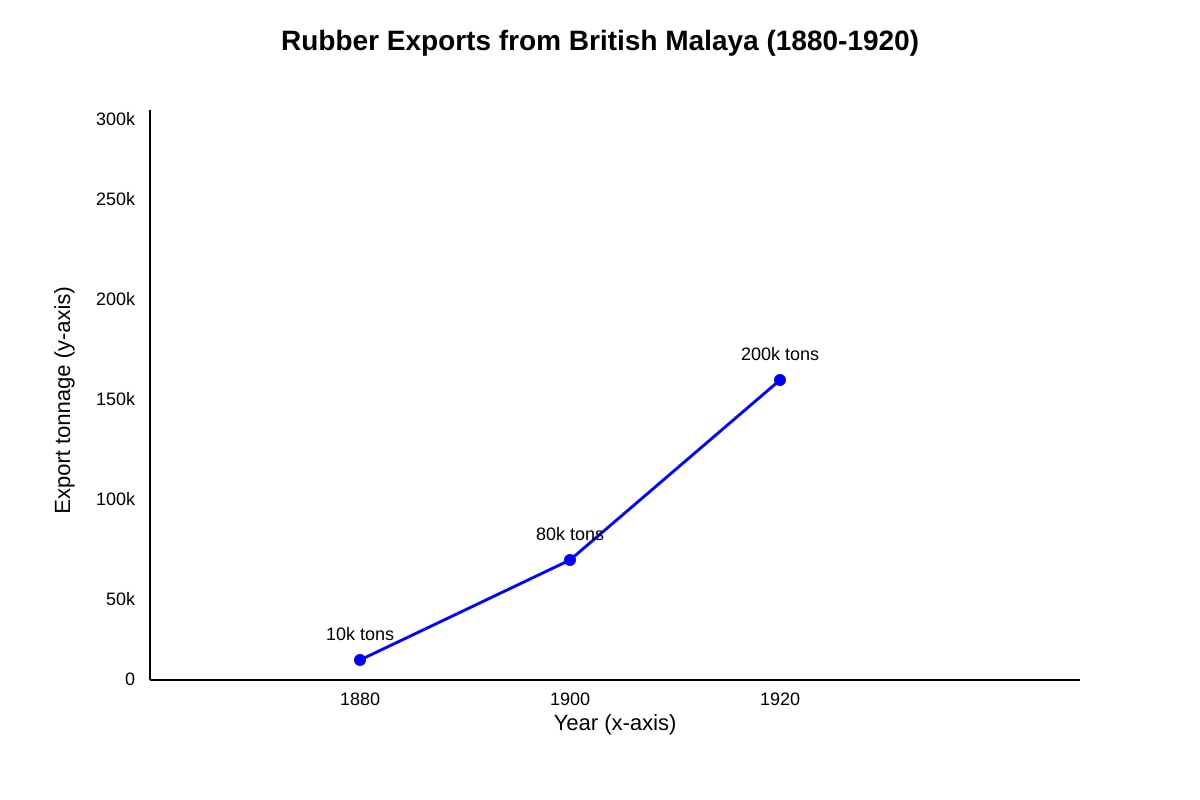
- Graph shows rubber exports rose 10k→200k tons. (1)
- Change: Malaya became export economy. (1)
- Impact: Towns, plural society grew. (1)
Visual needed: Trend line; student cites data points.
14. [3 marks]
- Conference created new states (Poland, etc.). (1)
- Based on self-determination. (1)
- Redrew map, ended empires. (1)
15. [3 marks]
- French built Western schools, landowning class. (1)
- Migration to cities. (1)
- Elites emerged, later nationalists. (1)
Section D: Evaluative Essay Explanation (15 marks)
Each 3 marks: 1 for claim, 1 for evidence, 1 for judgement.
16. [3 marks]
- Agree: jobs, autobahns. (1)
- Disagree: persecution, war prep. (1)
- Judgement: harm outweighed benefit. (1)
17. [3 marks]
- Agree: tin, rubber. (1)
- Disagree: strategic, rivalry. (1)
- Judgement: mainly economic but not only. (1)
18. [3 marks]
- Agree: US absence weakened League. (1)
- Disagree: also lack of army, unanimity. (1)
- Judgement: one factor not sole. (1)
19. [3 marks]
- Agree: lost war, cost. (1)
- Disagree: contained communism temporarily. (1)
- Judgement: mixed failure. (1)
20. [3 marks]
- Disagree: violent in Indonesia, Malaya. (1)
- Agree: some peaceful like Philippines. (1)
- Judgement: not orderly overall. (1)
End of Answer Key