From Real Exams Exam Paper
O Level History Practice Paper 2
Free O Level History Practice Paper 2, Qwen3.7 Exam version, with questions, answers, and O Level-style practice for Singapore students.
These static practice materials are generated from the site's syllabus and paper-generation workflow, with source and model context shown so students and parents can evaluate the material before use.
Questions
Free quiz and exam paper access
Enter your details to view this paper
Your access is remembered on this device.
Answers
TuitionGoWhere Practice Paper - History O-Level (Version 2)
Marking Scheme and Answer Key
SECTION A: Source-Based Case Study
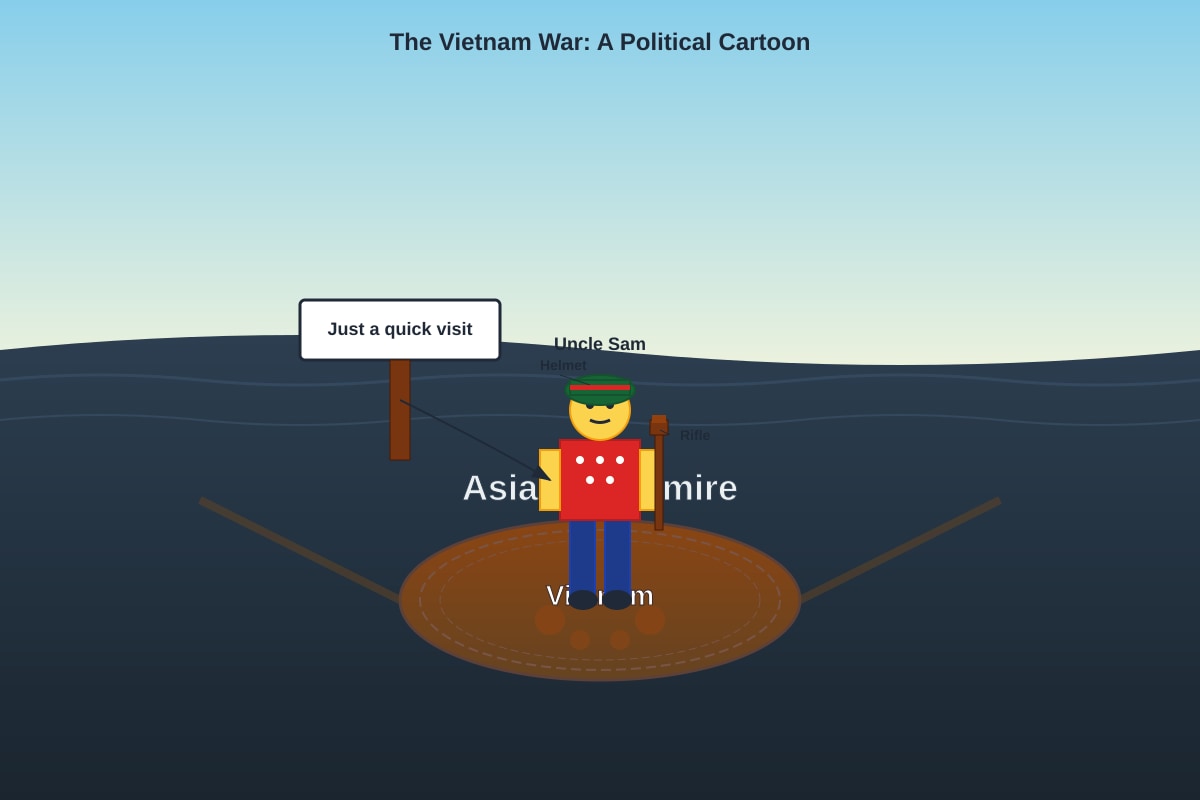
1. Study Source A. What is the cartoonist’s message about US involvement in Vietnam? Explain your answer using details from the source and your knowledge. [5]
- Message: The cartoonist is criticizing the US for underestimating the difficulty and scale of the war in Vietnam. The message is that what the US claims is a small, limited intervention ("Just a quick visit") is actually a dangerous trap that will lead to a much larger, uncontrollable conflict ("Asian Quagmire").
- Explanation:
- Source Detail: The cartoon shows Uncle Sam stepping into a puddle labeled "Vietnam" while a sign says "Just a quick visit." However, the puddle is connected to a vast, dark ocean labeled "Asian Quagmire." Uncle Sam is already sinking up to his knees, suggesting he is stuck.
- Knowledge: This reflects the historical reality of "mission creep." The US initially sent advisors and limited troops, believing the war would be short. However, the conflict escalated into a full-scale war involving hundreds of thousands of troops, becoming a "quagmire" from which it was difficult to withdraw without losing face.
- Marking:
- 1 mark for identifying the message (US underestimating the war/trap).
- 2 marks for using source details (puddle vs. ocean, sign, sinking).
- 2 marks for relevant knowledge (escalation, difficulty of withdrawal, Domino Theory context).
2. Study Source B. Why did President Johnson give this speech? Explain your answer using details from the source and your knowledge. [5]
- Purpose: Johnson gave this speech to justify US military intervention in Vietnam to the American public and the international community, and to reassure allies of US commitment.
- Explanation:
- Source Detail: Johnson states, "We are not there to conquer... We are there to help... defend their independence." He argues that retreat would damage "confidence in American promise." This shows he is trying to frame the war as a defensive, moral obligation rather than an act of aggression.
- Knowledge: In 1965, US involvement was escalating (Operation Rolling Thunder began). There was growing domestic and international criticism. Johnson needed to maintain support for the war by linking it to the broader Cold War policy of Containment and the credibility of the US as a global superpower.
- Marking:
- 1 mark for identifying the purpose (justify intervention/reassure allies).
- 2 marks for using source details (defend independence, confidence in promise).
- 2 marks for relevant knowledge (Containment, Cold War context, domestic criticism).
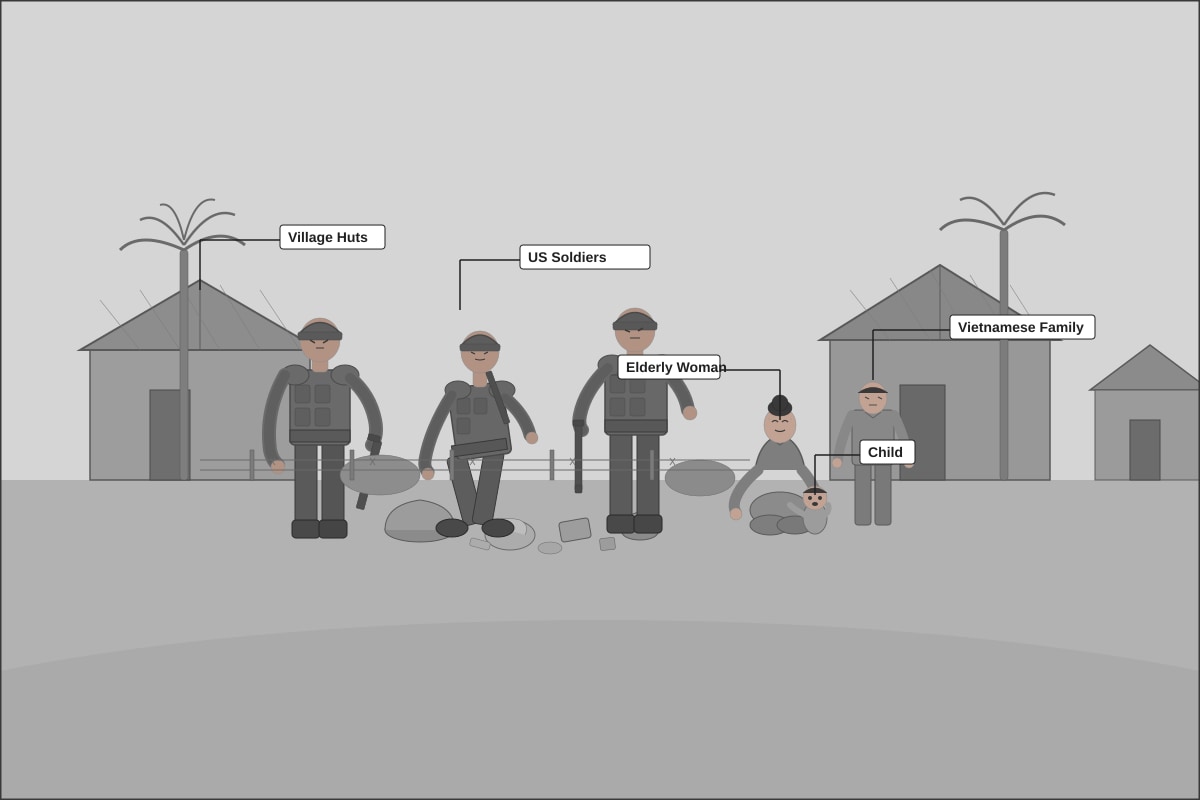
3. Study Source C. How useful is Source C to a historian studying the impact of the Vietnam War on Vietnamese civilians? Explain your answer using details from the source and your knowledge. [6]
- Usefulness: Source C is useful for showing the fear, disruption, and loss of dignity experienced by Vietnamese civilians during search operations, but it has limitations as it is a single snapshot and may be biased.
- Explanation:
- Source Detail (Pro): The photo shows US soldiers searching a family’s belongings while an elderly woman and child look distressed. This visually captures the intrusion and anxiety caused by military operations in villages.
- Source Detail (Con/Limitation): It is a photograph taken by a US military photographer. It might be staged or selected to show US soldiers as "thorough" rather than abusive. It does not show the broader impact like displacement, death, or long-term economic ruin.
- Knowledge: Historians know that "search and destroy" missions often led to the destruction of villages, civilian casualties, and resentment against the US/South Vietnamese government. This source supports the narrative of civilian suffering but needs to be cross-referenced with other sources (like refugee accounts or casualty statistics) for a complete picture.
- Marking:
- 1-2 marks for evaluating usefulness (shows civilian distress).
- 1-2 marks for using source details (soldiers searching, distressed woman).
- 1-2 marks for evaluating limitations/context (US photographer, single moment, need for broader evidence).
4. Study Sources B and D. Do these two sources agree or disagree about the reasons for US involvement in Vietnam? Explain your answer using details from both sources. [6]
- Agreement/Disagreement: The sources partially agree on the strategic goal (stopping communism) but disagree on the nature of the conflict and the validity of the US justification.
- Explanation:
- Agreement: Both imply the US was trying to stop a hostile force. Source B says "defend their independence against armed attack from the North." Source D mentions the "Domino Theory" and preventing the spread of communism.
- Disagreement: Source B presents the US view that they were helping South Vietnam defend against external aggression ("armed attack from the North"). Source D argues that the US "misunderstood the nature of the conflict," viewing it as a "war of national liberation" against foreign interference, not just a proxy war. Source D suggests the US justification in Source B was flawed or incomplete.
- Marking:
- 1 mark for stating the relationship (partially agree/disagree).
- 2 marks for using Source B (defend independence, external attack).
- 2 marks for using Source D (Domino Theory, war of national liberation, US misjudgment).
- 1 mark for clear comparison/synthesis.
5. "The main reason for the US failure in Vietnam was the strength of the Viet Cong." How far do you agree with this statement? Explain your answer using Sources A–D and your knowledge. [8]
-
Level 3 (7-8 marks): Balanced evaluation. Acknowledges Viet Cong strength but argues other factors (US tactics, domestic opposition, political nature of the war) were equally or more important. Uses sources and knowledge effectively.
-
Level 2 (4-6 marks): Explains why Viet Cong strength was important, or explains other factors, but lacks balance or depth. Uses some sources/knowledge.
-
Level 1 (1-3 marks): Simple statement of agreement/disagreement. Little use of sources or knowledge.
-
Suggested Answer Structure:
- Argument for Viet Cong Strength: The Viet Cong used guerrilla tactics (tunnels, booby traps) which neutralized US technological superiority. They had strong support from the rural population (Source C implies intrusion, which may have fueled support for VC). Source D notes it was a "war of national liberation," suggesting strong motivation.
- Argument for Other Factors (US Errors):
- Misjudgment: Source D states the US "misunderstood the nature of the conflict." They treated it as a conventional war.
- Domestic Opposition: Source A shows growing skepticism ("Quagmire"). Protests in the US weakened political will.
- Tactics: Search and destroy missions (Source C) alienated civilians, increasing support for the VC.
- Political Instability in South Vietnam: The South Vietnamese government was often corrupt and unpopular, unlike the nationalist appeal of Ho Chi Minh.
- Conclusion: While the Viet Cong were resilient, the US failure was primarily due to its own strategic errors, misunderstanding of the war's nature, and loss of domestic support, rather than just military strength of the enemy.
SECTION B: Essay Questions
6. "The policy of Appeasement was the main cause of the outbreak of the Second World War in Europe." How far do you agree with this statement? [20]
-
Marking Criteria:
- L1 (1-5 marks): Simple statements. Limited knowledge.
- L2 (6-10 marks): Descriptive account of Appeasement or other causes. Some explanation.
- L3 (11-15 marks): Explains Appeasement and other factors. Some evaluation of "main cause."
- L4 (16-20 marks): Balanced evaluation. Judgement on whether Appeasement was the main cause compared to Hitler’s aggression, failure of the League, or the Nazi-Soviet Pact.
-
Suggested Answer Points:
- Agree (Appeasement was main cause):
- Encouraged Hitler’s aggression (Remilitarization of Rhineland, Anschluss, Sudetenland).
- Showed weakness of Britain and France, convincing Hitler they would not fight.
- Munich Agreement (1938) gave Hitler confidence to invade Poland.
- Disagree (Other factors were more important):
- Hitler’s Ambition: His ideology (Lebensraum) and desire for war were the driving forces. Appeasement was a response, not the cause.
- Failure of the League of Nations: Inability to stop Japan/Italy earlier weakened collective security.
- Nazi-Soviet Pact (1939): Allowed Hitler to invade Poland without a two-front war, directly triggering the war.
- Treaty of Versailles: Created resentment in Germany, fueling Nazi rise.
- Conclusion: Appeasement was a significant contributing factor that enabled Hitler, but the main cause was Hitler’s aggressive ideology and the failure of the international system to contain him early on.
- Agree (Appeasement was main cause):
7. "The main reason for the success of the Communist Party in China by 1949 was the leadership of Mao Zedong." How far do you agree with this statement? [20]
-
Marking Criteria: Similar to Q6. Focus on evaluating Mao’s role vs. other factors.
-
Suggested Answer Points:
- Agree (Mao’s Leadership):
- Military Strategy: Guerrilla warfare tactics (Long March survival, base areas).
- Political Strategy: Land Reform won peasant support (majority of population).
- Ideology: Adapted Marxism to Chinese context (peasant-based revolution).
- Discipline: PLA was disciplined and treated civilians well, unlike KMT.
- Disagree (Other Factors):
- KMT Weaknesses: Corruption, inflation, poor leadership under Chiang Kai-shek, loss of morale.
- Japanese Invasion (1937-45): Weakened the KMT militarily and economically while CCP expanded influence in rural areas.
- US Withdrawal of Support: US lost faith in KMT due to corruption, reducing aid.
- Conclusion: Mao’s leadership was crucial in mobilizing the peasantry and military strategy, but the collapse of the KMT due to its own failures and the impact of the Japanese invasion were equally important.
- Agree (Mao’s Leadership):
8. "The most significant consequence of the Cold War for Southeast Asia was the spread of communism." How far do you agree with this statement? [20]
-
Marking Criteria: Evaluate "spread of communism" vs. other consequences (economic, political, social).
-
Suggested Answer Points:
- Agree (Spread of Communism):
- Vietnam, Laos, Cambodia became communist states.
- Fear of Domino Theory shaped regional politics.
- Internal communist insurgencies in Malaysia, Philippines, Thailand.
- Disagree (Other Consequences were more significant):
- Political Instability/Conflict: Proxy wars (Vietnam War) caused massive destruction, loss of life, and refugee crises.
- Formation of ASEAN: Created to promote regional stability and non-communist cooperation. This had a lasting positive impact on economic integration and peace.
- Economic Impact: US aid to non-communist states (Thailand, Philippines) boosted development. War devastated economies of Indochina.
- Authoritarian Regimes: Many SE Asian governments became authoritarian to suppress communism, affecting human rights and democracy.
- Conclusion: While the spread of communism changed the map, the most significant consequence was arguably the political and economic restructuring of the region, including the formation of ASEAN and the legacy of conflict, which shaped modern Southeast Asia more deeply than ideology alone.
- Agree (Spread of Communism):