AI Generated Exam Paper
O Level Higher Tamil Practice Paper 5
Free O Level Higher Tamil Practice Paper 5, LongCat AI version, with questions, answers, and O Level-style practice for Singapore students.
These static practice materials are generated from the site's syllabus and paper-generation workflow, with source and model context shown so students and parents can evaluate the material before use.
Questions
Free quiz and exam paper access
Enter your details to view this paper
Your access is remembered on this device.
Answers
TuitionGoWhere Practice Paper – Higher Tamil O-Level
Answer Key – Comprehension (Practice Paper)
Section A: Visual Text Comprehension [10 marks]
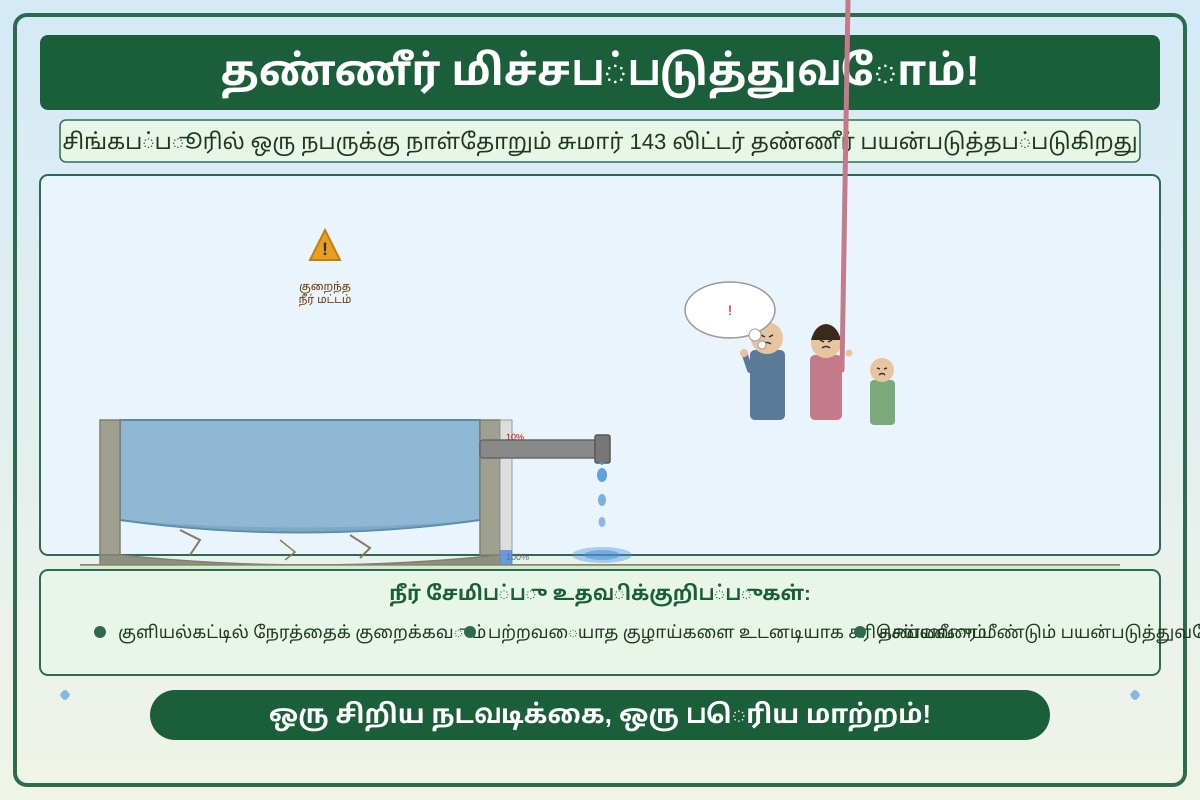
Question 1 [2]
Answer: The main purpose of the poster is to raise awareness about water conservation / to encourage people to save water.
Marking notes: Award 2 marks for stating the purpose clearly (awareness + conservation/saving water). Award 1 mark for a partial answer (e.g., only "to save water" without context).
Common mistake: Students may write "to advertise" without specifying water conservation — this is too vague for full marks.
Question 2 [2]
Answer: Each person in Singapore uses approximately 143 litres of water per day.
Marking notes: Award 1 mark for the figure (143) and 1 mark for the unit (litres). Both must be correct for full marks.
Common mistake: Writing only the number without the unit, or writing "litres per person" without the daily context.
Question 3 [2]
Answer: Any two of the following:
(i) குளியல்கட்டில் நேரத்தைக் குறைக்கவும் (Reduce time in the shower)
(ii) பற்றவையாத குழாய்களை உடனடியாக சரிசெய்யவும் (Fix leaking pipes immediately)
(iii) தண்ணீரை மீண்டும் பயன்படுத்துவோம் (Reuse water)
Marking notes: Award 1 mark for each correct tip. Accept any two. Answers must be from the poster content.
Question 4 [2]
Answer: The phrase motivates/inspires the reader by suggesting that even a small individual action can lead to a significant positive impact. It encourages people not to underestimate the power of their personal efforts in conserving water.
Marking notes: Award 2 marks for explaining both the motivational effect and the meaning (small action → big change). Award 1 mark for a partial explanation.
Common mistake: Simply translating the phrase without explaining its effect on the reader.
Question 5 [2]
Answer: The intended audience is the general public / all Singapore residents. The reason is that the poster uses simple, accessible language and practical tips that apply to everyone, and it addresses water usage statistics relevant to all Singaporeans.
Marking notes: Award 1 mark for identifying the audience (general public/residents) and 1 mark for a valid reason based on the content.
Common mistake: Writing "everyone" without justification — a reason must be provided.
Section B: Narrative Comprehension [30 marks]
Question 6 [1]
Answer: The village was called செங்கல்பட்டு (Sengalpatu).
Marking notes: Award 1 mark for the correct name. Spelling must be accurate in Tamil.
Question 7 [2]
Answer: Any two of the following:
(i) நெல் (paddy/rice)
(ii) கோதுமை (wheat)
(iii) காய்கறிகள் (vegetables)
Marking notes: Award 1 mark for each correct crop. Accept any two.
Question 8 [1]
Answer: The temple was forty (40) years old.
Marking notes: Award 1 mark for the correct figure. Accept "40 years" or "forty years."
Question 9 [1]
Answer: The stone inscriptions were about the history of the village (கிராமத்தின் வரலாறு).
Marking notes: Award 1 mark for stating that the inscriptions described the village's history.
Question 10 [2]
Answer: Every morning before going to school, Rajesh would wake up early, go to the temple, and perform pooja (பூஜை செய்வான்).
Marking notes: Award 1 mark for mentioning going to the temple and 1 mark for performing pooja/worship. Both elements required for full marks.
Common mistake: Only mentioning "he went to the temple" without specifying the pooja.
Question 11 [3]
Answer:
Duration: The heavy rain lasted for three (3) days (மூன்று நாட்கள்).
Effect (i): The village fields were submerged in flood water (வயல்வெளிகள் வெள்ளத்தில் மூழ்கின).
Effect (ii): The crops were destroyed (பயிர்கள் அழிந்தன).
Marking notes: Award 1 mark for the correct duration and 1 mark for each correct effect. Both effects must be from the passage.
Question 12 [3]
Answer: Rajesh's grandmother said, "இந்தக் கோவில் நம்மைக் காக்கும். நாம் ஒன்றுசேர்ந்து வேலை செய்தால், இந்தப் பிரச்சனையைச் சமாளிக்கலாம்" (This temple will protect us. If we work together, we can solve this problem).
She meant that the villagers should not lose hope and that by uniting and working together, they would be able to overcome the flood crisis.
Marking notes: Award 1 mark for quoting/referencing the grandmother's statement, 1 mark for explaining the meaning of unity, and 1 mark for connecting it to overcoming the problem.
Common mistake: Only quoting the statement without explaining its significance.
Question 13 [3]
Answer:
| Group of People | What They Did |
|---|---|
| All villagers together | Stacked sandbags to block the flood water (மணல் மூட்டைகளை அடுக்கினர்) |
| Women | Prepared/cooked food (உணவு தயாரித்தனர்) |
| Young people | Repaired old houses (பழைய வீடுகளை பழுதுபார்த்தனர்) |
Marking notes: Award 1 mark for each correct row. Answers must accurately reflect the passage.
Question 14 [3]
Answer: After the flood, Rajesh decided to teach Tamil language and culture to the young people in the village. He conducted Tamil classes during weekend hours. This decision was important because it helped preserve the Tamil language and cultural heritage among the younger generation, ensuring that the traditions and language would continue in the village.
Marking notes: Award 1 mark for stating the decision (teaching Tamil to youth), 1 mark for explaining the action (weekend classes), and 1 mark for explaining why it was important (preserving language and culture for the future).
Common mistake: Only stating the decision without explaining its importance.
Question 15 [5]
Answer (model response):
The villagers' unity played a crucial role in helping them overcome the flood. When the heavy rain submerged their fields and destroyed their crops, the villagers did not give up. Instead, they came together as a community. All the villagers worked together to stack sandbags to block the flood waters. The women prepared food to feed everyone, and the young people repaired damaged old houses. Because everyone contributed according to their ability, the flood waters receded and the village was saved. This shows that when people unite and work together, they can overcome even the most difficult challenges.
Marking descriptors:
- 5 marks: Clear explanation with at least two specific examples from the passage; well-structured response within the word limit; demonstrates understanding of the theme of unity.
- 3–4 marks: Adequate explanation with at least one example from the passage; reasonably structured; some understanding of the theme.
- 1–2 marks: Vague or general response with little or no reference to the passage; limited understanding.
- 0 marks: No response or completely irrelevant answer.
Common mistake: Writing a generic essay about unity without referencing specific events from the passage.
Section C: Expository Comprehension [40 marks]
Question 16 [3]
Answer: Three countries other than India where Tamil is widely spoken:
(i) இலங்கை (Sri Lanka)
(ii) மலேசியா (Malaysia)
(iii) சிங்கப்பூர் (Singapore) / மொரிசியஸ் (Mauritius)
Marking notes: Award 1 mark for each correct country. Accept any three from the passage (Sri Lanka, Malaysia, Singapore, Mauritius).
Question 17 [3]
Answer: Sangam literature (சங்க இலக்கியம்) is the oldest form of Tamil literature, written during the Sangam period. It is important because it provides excellent information about the lifestyle, art, and culture of the Tamil people from that era.
Marking notes: Award 1 mark for identifying Sangam literature as the oldest form of Tamil literature, 1 mark for mentioning the Sangam period, and 1 mark for explaining its importance (information about lifestyle, art, culture).
Common mistake: Only stating what it is without explaining its significance.
Question 18 [2]
Answer: "தொல்காப்பியம்" (Tolkappiyam) is considered one of the oldest grammar (இலக்கண) books in the world.
Marking notes: Award 2 marks for stating both that it is a grammar book and that it is one of the oldest in the world. Award 1 mark for only one of these points.
Question 19 [4]
Answer:
(i) பழமையான (ancient)
(ii) வாரம் (week)
(iii) கேட்டல் (listening)
(iv) சவால்கள் (challenges)
Marking notes: Award 1 mark for each correct word. Words must be taken directly from the passage.
Common mistake: Using synonyms instead of the exact word from the passage.
Question 20 [5]
Answer (model response):
According to the passage, protecting Tamil is a social responsibility that requires the combined efforts of families, schools, and community organisations. Families can help by speaking Tamil at home and encouraging children to use the language daily. Schools can strengthen Tamil education by offering Higher Tamil and organising cultural activities such as Tamil Language Week, book fairs, poetry recitation competitions, and art performances. Community organisations, such as the Tamil Language Council in Singapore, can organise events and programmes that promote the language. Additionally, using technology such as mobile apps, online classes, and digital libraries can make learning Tamil more accessible to young people. When all these groups work together, the Tamil language can be preserved for future generations.
Marking descriptors:
- 5 marks: Comprehensive response addressing all three groups (families, schools, community organisations) with specific actions from the passage; well-structured; within word limit; may include technology point.
- 3–4 marks: Response addresses at least two groups with relevant actions; reasonably structured; some reference to the passage.
- 1–2 marks: Response addresses only one group or is very general; limited reference to the passage.
- 0 marks: No response or completely irrelevant answer.
Common mistake: Writing only about what "should be done" in general terms without connecting to the specific information in the passage.
Total: 80 marks
End of Answer Key