AI Generated Quiz
O Level Geography Resources Sustainability Quiz
Free O Level Geography Resources Sustainability quiz, HY3 AI version, with questions, answers, and O Level-style practice for Singapore students.
These static practice materials are generated from the site's syllabus and paper-generation workflow, with source and model context shown so students and parents can evaluate the material before use.
Questions
Free quiz and exam paper access
Enter your details to view this paper
Your access is remembered on this device.
Answers
O-Level Geography Quiz - Resources Sustainability (Answer Key)
Total Marks: 40
Topic: Resources Sustainability
Level: O-Level
Section A: Short Answer
Q1 [2 marks]
Answers: (1) Freshwater is renewed by the water cycle (evaporation, precipitation) so it is renewable; (2) It is finite because total usable freshwater is limited by storage and pollution, and overuse exceeds recharge rate.
Teaching note: Renewable means naturally replenished; finite means limited stock. Student must show both ideas.
Marking: 1 mark each point.
Q2 [1 mark]
Answer: The total volume of freshwater used directly and indirectly to produce goods and services consumed by a person or community.
Teaching note: Link to virtual water in food/products.
Q3 [2 marks]
Answers: Coal, oil, natural gas (any two).
Marking: 1 mark each.
Q4 [1 mark]
Answer: A situation where all people have physical and economic access to sufficient safe and nutritious food.
Teaching note: Must include access + quantity + quality.
Q5 [2 marks]
Answer: e.g., Reduces food miles and transport energy; uses vacant rooftops; lowers import dependence. (Any one explained = 2 marks)
Teaching note: Connect to energy/land use.
Q6 [1 mark]
Answer: e.g., UN Sustainable Development Goals (SDG 12), Paris Agreement (indirect), ASEAN Agreement on Transboundary Haze (any valid).
Q7 [2 marks]
Answers: Land subsidence, saltwater intrusion, aquifer depletion (any two).
Marking: 1 mark each.
Q8 [1 mark]
Answer: Reduce, Reuse, Recycle.
Section B: Data & Source Interpretation
Q9 [3 marks]
Working: 136 000 m³ ÷ 8 000 households = 17 m³/household/month.
Answer: 17 m³.
Marking: 1 mark working, 2 marks correct answer with unit.
Common mistake: Dividing households by use.
Q10 [2 marks]
Town A: 150k/10k=15; B:17; C:156k/12k=13. Lowest = Town C at 13 m³.
Marking: 1 mark town, 1 mark value.
Q11 [3 marks]
Answers: (1) Exporting 80% timber while forests shrink; (2) Issuing logging licences despite loss; (3) Replanting slower than loss. (Any two = 2 marks + 1 for clear identification)
Marking: 1.5 each up to 3.
Q12 [2 marks]
Answer: e.g., Logging continues so loss > gain; trees take years to mature; monoculture may reduce biodiversity.
Marking: 2 marks for reasoned link.
Q13 [3 marks]
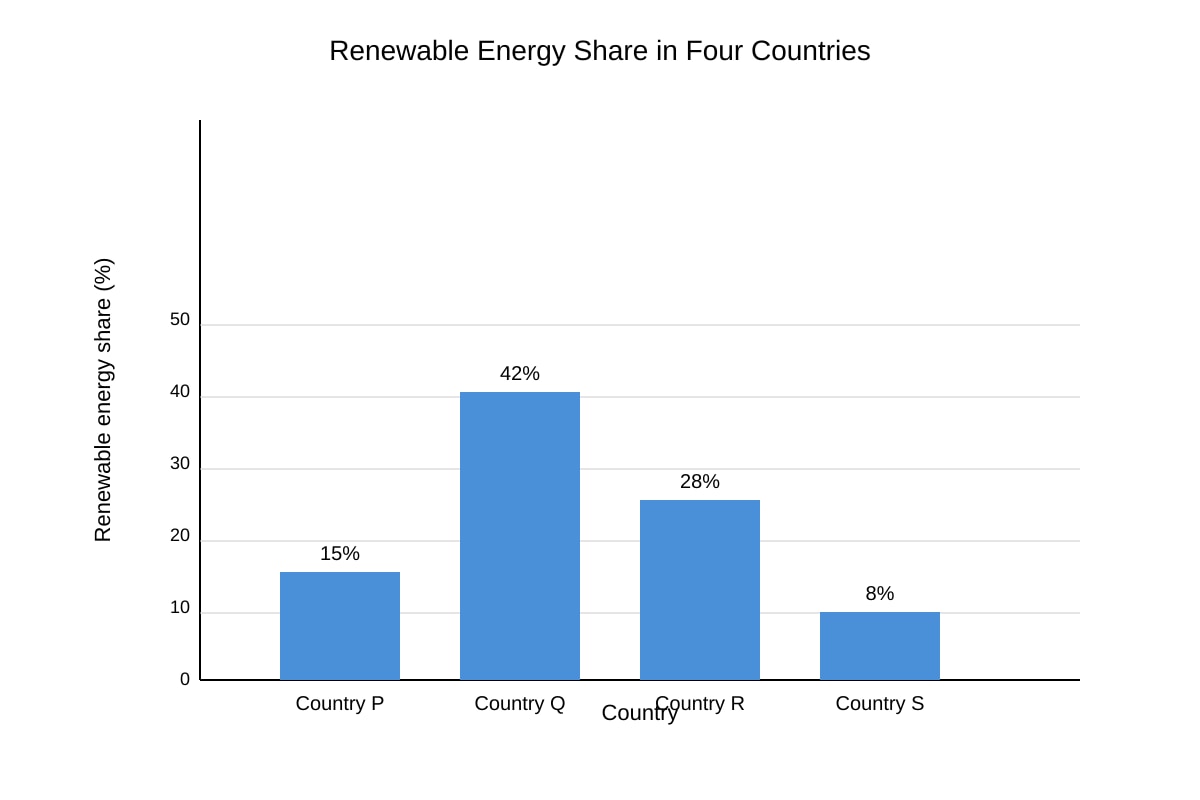
Country: Q (42%). Difference: 42% – 8% = 34%.
Marking: 1 mark country, 2 marks difference with working.
Q14 [2 marks]
Answer: Solar is clean (no CO₂ when operating), inexhaustible; coal emits greenhouse gases and is finite.
Marking: 1 mark point, 1 mark contrast.
Q15 [3 marks]
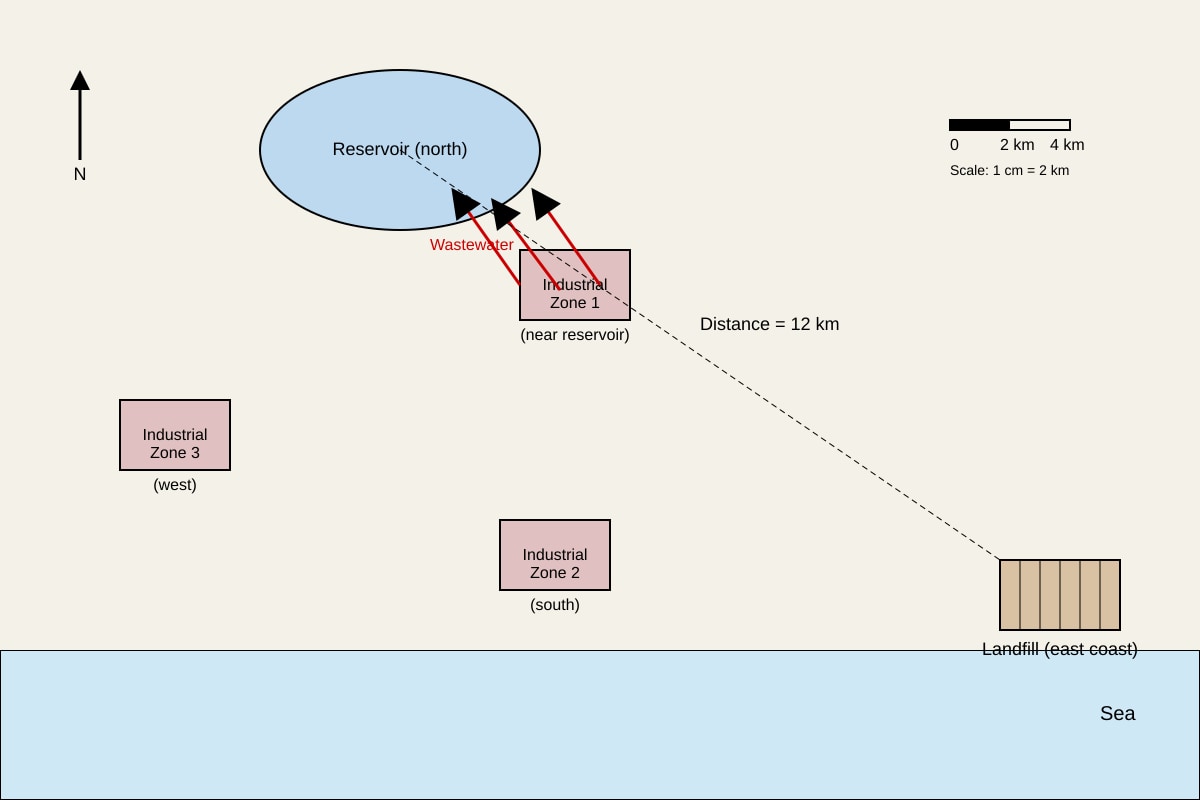
Answer: Industrial Zone 1 wastewater flows into reservoir → contaminates water supply; spatial proximity (12 km) risks sustainability.
Marking: 1 mark relationship, 2 marks explanation.
Section C: Structured & Extended Response
Q16 [3 marks]
Answers: Desalinisation converts seawater to drinkable water, adding to supply (1). Reduces rain dependence (1). Limitation: high energy cost / brine waste (1).
Marking descriptors: 3 = all three; 2 = two.
Q17 [4 marks]
Position: Not alone (1). Reason: recycling handles waste but not extraction of new materials (1); need reduce/reuse (1); behavioural and tech limits (1).
Marking: 4 = balanced eval; 2–3 = partial.
Q18 [3 marks]
Working: (90+70+85)÷3 = 245÷3 = 81.67%.
Answer: 81.7% (or 81.67%).
Marking: 1 working, 2 answer.
Q19 [3 marks]
Answers: Composting, water-saving taps, solar panels, green procurement (any two explained).
Marking: 1.5 each.
Q20 [5 marks]
Content: Tech (efficiency, alternatives) helps (2); examples: LED, vertical farm (1); but not total fix due to rebound effect, equity (1); conclusion balanced (1).
Marking descriptors: 5 = eval + examples + conclusion; 3–4 = partial.