AI Generated Quiz
O Level Geography Human Geography Quiz
Free O Level Geography Human Geography quiz, HY3 AI version, with questions, answers, and O Level-style practice for Singapore students.
These static practice materials are generated from the site's syllabus and paper-generation workflow, with source and model context shown so students and parents can evaluate the material before use.
Questions
Free quiz and exam paper access
Enter your details to view this paper
Your access is remembered on this device.
Answers
O-Level Geography Quiz - Human Geography (Answer Key)
Total Marks: 40
Topic: Human Geography (syllabus-first, Stage 4/5 generated; not claimed as past-year derived)
Section A Answers
Q1 [2 marks]
Answers (any two): lack of jobs, low income, poor services, natural disaster, conflict, drought.
Teaching note: Push factors are conditions that drive people away. 1 mark per valid factor.
Q2 [1 mark]
Urbanisation (or rural-urban migration).
Teaching note: Movement from village to city is rural-urban migration; the broad process is urbanisation.
Q3 [2 marks]
Example: creates employment (1) and increases national income / foreign exchange (1).
Teaching note: Economic impact relates to money/jobs, not culture or environment.
Q4 [2 marks]
Anthropocentric: people-centred; environment valued for human use (1). Ecocentric: nature-centred; environment has intrinsic value (1).
Teaching note: From Sustainable Development topic; contrasting value orientations.
Q5 [1 mark]
Pro-poor tourism (or community-based tourism, ecotourism).
Teaching note: Pro-poor tourism directs income to local poor.
Section B Answers
Q6 [3 marks]
Working: 2020 = 400, 2023 = 1300. Increase = 1300 − 400 = 900. % = (900 / 400) × 100 = 225%.
Marks: 1 for correct difference, 1 for division by 2020 base, 1 for 225%.
Teaching note: Percentage increase uses original year as denominator.
Q7 [2 marks]
Example: COVID-19 pandemic / travel restrictions (1) reduced international flights (1).
Teaching note: 2020 global drop linked to pandemic; accept any valid closure reason.
Q8 [3 marks]
Use one line graph with x-axis = months, y-axis = temperature °C, four lines (one per district) with legend (1); or grouped bar chart (1); label axes and units (1); allows comparison of trends (1).
Teaching note: From Stage 4 data-skills template; one combined graph not separate.
Q9 [2 marks]
Loss of access to beach / exclusion of locals / no consultation (1) shows marginalisation (1).
Teaching note: Socio-cultural: community rights and identity.
Q10 [3 marks]
Tourist spends at hotel (1) → hotel buys local food (1) → farmer earns and spends in town (1) → repeated rounds grow income (multiplier).
Teaching note: Multiplier = recirculation of tourism money locally.
Q11 [2 marks]
Positive = (10×2)+(5×1)=25; Negative = (3×1)+(2×2)=7; Net = 25−7=18. Describe: multiply frequency by weight then sum.
Teaching note: From Stage 4 weighted score template.
Q12 [2 marks]
Positive score = 25.
Teaching note: Only positive part requested.
Q13 [3 marks]
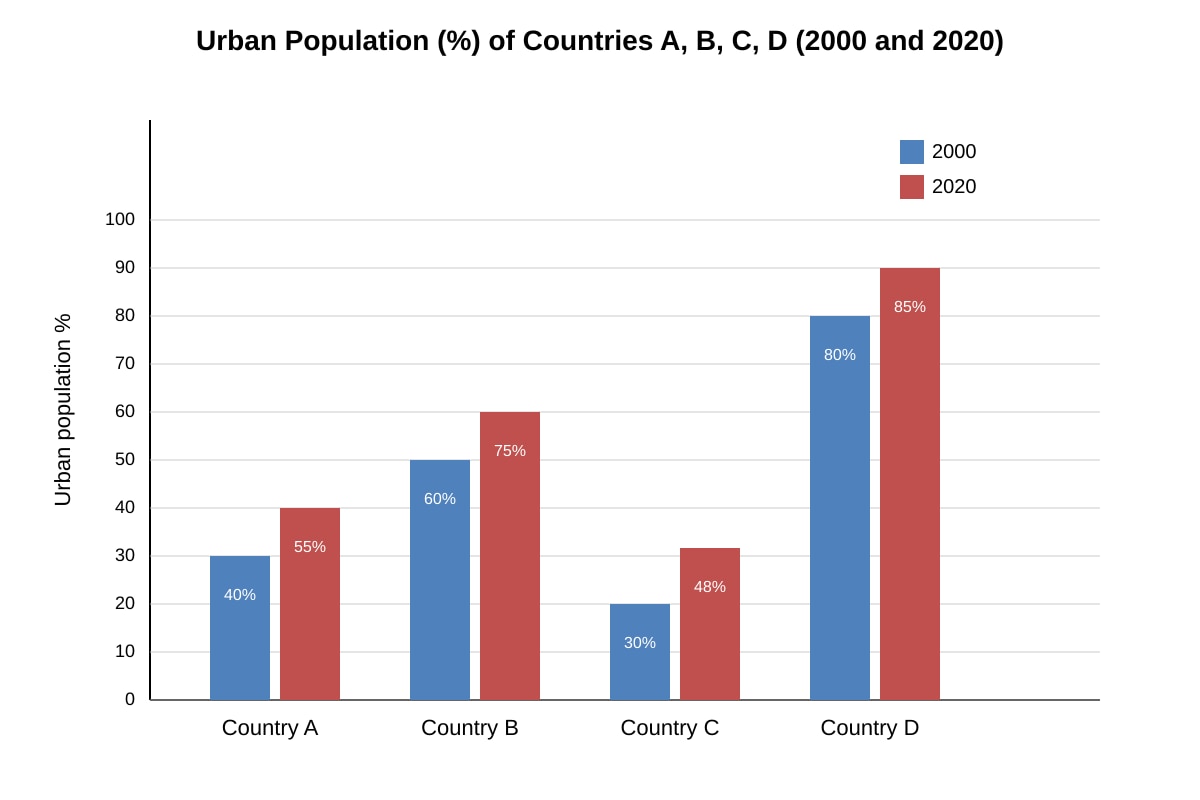
Country C rose from 30% to 48% (1); increase of 18 percentage points (1); shows accelerating urbanisation (1).
Teaching note: Read paired bars; difference not ratio.
Q14 [2 marks]
Example: loss of green space / heat island / river pollution (1) due to concrete expansion (1).
Teaching note: Environmental not economic.
Q15 [3 marks]
Partial reliability (1): only Saturdays and 2h limits representativeness (1); one month small sample, but tally is simple and consistent (1).
Teaching note: From Stage 4 reliability evaluation; both sides needed.
Section C Answers
Q16 [2 marks]
Any two: limits visitor numbers, uses local guides, conserves resources, educates tourists. (1 each)
Q17 [3 marks]
GIS overlays population and road layers to find gaps (1); model routes (1); limitation: needs updated data / cost (1).
Teaching note: From Stage 4 GIS template.
Q18 [3 marks]
Brings factory/jobs (1); raises land prices (1); changes town from agricultural to industrial (1).
Q19 [4 marks]
Benefits: jobs, infrastructure (1+1). Harms: cultural loss, environmental stress (1+1). Conclusion with extent (e.g., partially agree).
Marking: 2 content marks + 2 balance/conclusion.
Q20 [4 marks]
Postal code gives location proxy (1); stratified survey ensures income groups represented (1); but postal code may not show income (1); survey self-report bias (1). Useful but incomplete.
Teaching note: From Stage 4 hypothesis testing template.