AI Generated Quiz
O Level English Argument Evaluation Quiz
Free O Level English Argument Evaluation quiz, HY3 AI version, with questions, answers, and O Level-style practice for Singapore students.
These static practice materials are generated from the site's syllabus and paper-generation workflow, with source and model context shown so students and parents can evaluate the material before use.
Questions
O-Level English Quiz - Argument Evaluation
Name:
Class:
Date:
Score:
Duration: 45 minutes
Total Marks: 30
Topic: Argument Evaluation (syllabus-first practice; not derived from past-year papers)
Instructions:
- This quiz tests your ability to identify, analyse, and evaluate arguments in texts.
- Answer all 20 questions. Section A and B have short items; Section C requires explanation.
- Write your answers in the blank spaces provided.
- Use evidence from the passages given to support your answers where asked.
Section A: Identifying Arguments and Claims (Questions 1–7)
1. Read the statement below: "We should ban mobile phones in schools because they distract students from learning." What is the conclusion of this argument? (1 mark)
2. In the statement in Q1, what is the reason given to support the conclusion? (1 mark)
3. Read the passage: Jia Wei says that the canteen food is unhealthy. She points out that the fries are oily and the drinks have too much sugar. Identify one piece of evidence Jia Wei uses to support her claim. (1 mark)
4. Which of the following is an argument, not just a statement of fact? (1 mark)
A. The library closes at 5 pm.
B. Exercise improves mood, so schools should have daily PE.
C. Mr Tan is the principal.
D. The exam is in October.
5. "The new rule is unfair since it punishes everyone for one person's mistake."
What type of support does the word "since" introduce? (1 mark)
A. Conclusion
B. Reason
C. Counterargument
D. Fact
6. Read: Jia Hui argues that homework should be reduced. She says students are tired and have no time for hobbies. State Jia Hui's claim in your own words. (1 mark)
7. In the text below, underline the claim (write the claim on the line): Jogging is better than cycling because it uses more muscles and needs no equipment. Claim: _______________________________________________________ (1 mark)
Section B: Evaluating Evidence and Counterarguments (Questions 8–14)
8. Read the extract: Jia Ming: "Online learning is ineffective. A 2023 survey showed that 60% of students scored lower in online classes." Is the survey result strong evidence for Jia Ming's claim? Give one reason. (2 marks)
9. A writer says: "We must cut arts funding because the economy is weak." What is a possible counterargument? (2 marks)
10. Read: Passage A: "Uniforms help students focus by removing distractions." Passage B: "Uniforms suppress individuality and do not raise grades." What is the main point of disagreement between A and B? (2 marks)
11. "The film is good. Everyone I know liked it." Identify the weakness in this argument. (2 marks)
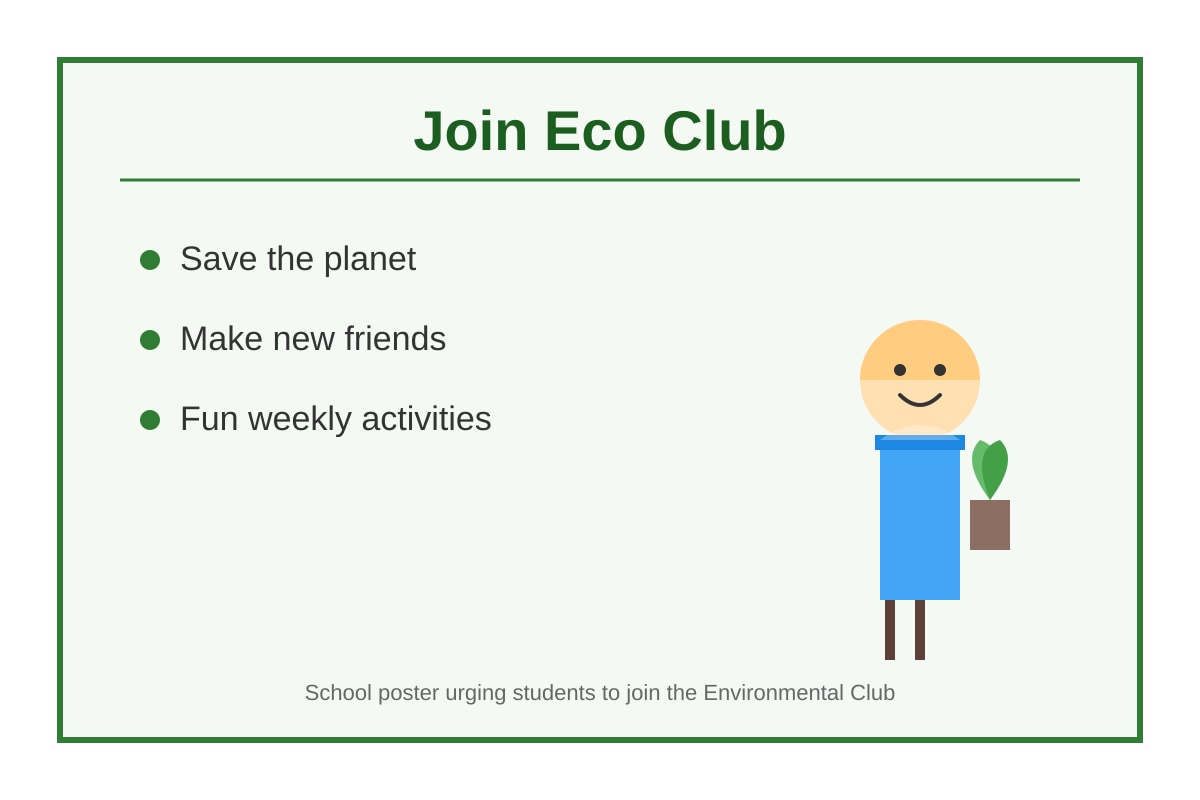
12. Read the poster extract:
Image pending generation: source_image for Q12.
Using the poster, name one appeal used to persuade students to join. (1 mark)
13. In Q12's poster, is "Make new friends" a logical reason or an emotional appeal? Explain. (2 marks)
14. Read: "You should vote for me as class chair because my opponent is lazy."
What fallacy is used here? (1 mark)
A. Circular reasoning
B. Ad hominem
C. False cause
D. Hasty generalisation
Section C: Analysing Argument Structure (Questions 15–20)
15. Read the paragraph: School trips should be compulsory. They build character. Students learn outside the classroom. Many jobs need teamwork, which trips teach. (a) State the writer's conclusion. (1 mark) (b) List two supporting points. (2 marks)
(a) _______________________________________________________ (b) 1. ___________________________________________________ 2. ___________________________________________________
16. Evaluate the strength of the argument below. Use evidence from the text. (3 marks) "Homework should be banned. In Finland, students have less homework and still do well. Therefore, less homework means better results here."
17. Read the two texts: Text 1: "Social media connects people across the world and spreads news fast." Text 2: "Social media causes anxiety and spreads false information." Compare the perspectives in both texts. Use one point from each. (3 marks)
18. A student writes: "The canteen should sell more vegetarian food. It is healthier. It helps the environment. My friend agrees." (a) Which supporting point is based on opinion rather than fact? (1 mark) (b) Suggest one factual improvement to strengthen the argument. (2 marks)
(a) _______________________________________________________ (b) _______________________________________________________
19. Identify the language technique in the sentence and explain its effect on the argument: (3 marks) "If we do not act now, our school will crumble into dust."
20. Read the extract: Mrs Lim: "I believe CCA is a waste of time. A report from 2022 said 70% of employers value CCA experience." Explain why Mrs Lim's argument is flawed using the evidence given. (3 marks)
Answers
O-Level English Quiz - Argument Evaluation: Answer Key
Topic: Argument Evaluation
Level: O-Level
Total Marks: 30
Note: Syllabus-first content generated from LLM-inferred patterns. Not claimed as past-year exam derived.
Section A: Identifying Arguments and Claims
1. Conclusion: "We should ban mobile phones in schools" (1 mark)
- Teaching note: The conclusion is the main point the writer wants you to accept. It is supported by "because they distract students".
2. Reason: "They distract students from learning" (1 mark)
- Teaching note: The reason (premise) justifies the conclusion. Signal word "because" introduces it.
3. Evidence: "the fries are oily" or "the drinks have too much sugar" (1 mark)
- Teaching note: Evidence is a specific detail used to back a claim. Either example is acceptable.
4. Answer: B (1 mark)
- Teaching note: B gives a reason ("so") leading to a claim; A, C, D are facts without argument.
5. Answer: B (Reason) (1 mark)
- Teaching note: "Since" introduces a premise/reason, not the conclusion.
6. Claim: Homework should be reduced / less homework (1 mark)
- Teaching note: Restating in own words shows understanding of the claim.
7. Claim: "Jogging is better than cycling" (1 mark)
- Teaching note: The clause after "because" is support; before it is the claim.
Section B: Evaluating Evidence and Counterarguments
8. (2 marks)
- Yes, it is reasonably strong (1 mark) because it uses a specific survey with a percentage to show a result (1 mark).
- Common mistake: saying "no" without reason. Marking: 1 for position, 1 for reason.
9. (2 marks)
- Example: "The economy being weak does not mean arts have no value; arts can boost tourism." (1 mark for relevant counter, 1 mark for logic)
- Teaching note: A counterargument accepts the fact but challenges the link.
10. (2 marks)
- They disagree on whether uniforms help learning/focus or harm individuality (2 marks: 1 each side).
- Marking: Point from A (focus) and B (individuality) = 2 marks.
11. (2 marks)
- Weakness: small sample / biased (friends) / not factual proof (2 marks: identify 1 mark, explain 1 mark).
- Teaching note: "Everyone I know" is anecdotal, not representative.
12. (1 mark)
- "Save the planet" or "Make new friends" or "Fun weekly activities" (1 mark)
13. (2 marks)
- Emotional appeal (1 mark). It targets feelings of belonging, not logic (1 mark).
- Marking: type 1, explanation 1.
14. Answer: B (Ad hominem) (1 mark)
- Teaching note: Attacks opponent not the issue.
Section C: Analysing Argument Structure
15. (3 marks) (a) Conclusion: School trips should be compulsory (1 mark) (b) Two points: build character; learn outside classroom (or teamwork for jobs) (2 marks: 1 each)
- Marking descriptors: 1 + 2.
16. (3 marks)
- Argument weak (1 mark): Finland example may not apply locally (1 mark); correlation not cause (1 mark).
- Teaching note: Hasty generalisation / false analogy. Marking: 1 position, 2 reasoning.
17. (3 marks)
- Text 1: connects people / fast news (1 mark). Text 2: causes anxiety / false info (1 mark). Compare: opposite views on impact (1 mark).
- Marking: 1 + 1 + 1.
18. (3 marks) (a) "My friend agrees" (opinion) (1 mark) (b) Use data e.g., "WHO says veg diet lowers heart risk" (2 marks: factual 1, relevant 1)
- Teaching note: Fact strengthens; opinion weakens.
19. (3 marks)
- Technique: hyperbole/exaggeration (1 mark). Effect: creates fear to push urgency (2 marks: identify effect 1, link to argument 1).
- Marking: 1 + 2.
20. (3 marks)
- Flawed: she says CCA waste but evidence shows employers value it (1 mark). Contradicts her claim (1 mark). She ignores given report (1 mark).
- Marking: 3 points × 1.
Free quiz and exam paper access
Enter your details to view this paper
Your access is remembered on this device.