AI Generated Exam Paper
O Level English Practice Paper 3
Free AI-Generated DeepSeek V4 Pro O Level English Practice Paper 3 practice paper with questions and answers for Singapore students. This page is rendered as a direct URL so the questions and answers can be discovered without pressing in-page buttons.
These static practice materials are generated from the site's syllabus and paper-generation workflow, with source and model context shown so students and parents can evaluate the material before use.
Questions
TuitionGoWhere Practice Paper - English O-Level
TuitionGoWhere Practice Paper (AI)
Subject: English Language (1184) Level: O-Level Paper: 2 (Comprehension) — Version 3 of 5 Duration: 1 hour 50 minutes Total Marks: 50
Name: _________________________ Class: _________________________ Date: _________________________
Instructions to Candidates
- This paper consists of three sections: Section A, Section B, and Section C.
- Answer all questions.
- Write your answers in the spaces provided.
- Read the passages carefully before answering the questions.
- Pay attention to the mark allocation for each question. Marks indicate the depth of response expected.
- For summary writing, use your own words as far as possible.
Section A [5 marks]
Read Text 1 and Text 2 carefully. Then answer Questions 1–5.
Text 1
The Rise of Urban Beekeeping
On the rooftop of a downtown office block, something unexpected is buzzing. Amid the hum of air-conditioning units and the distant drone of traffic, thousands of honeybees are going about their business in a row of brightly painted hives. Urban beekeeping, once a niche hobby, has taken flight in cities across the globe. From London to Singapore, Tokyo to New York, city-dwellers are installing hives on rooftops, in community gardens, and even on hotel balconies.
Why the sudden interest? For some, it is an act of environmental stewardship. Bee populations worldwide have been declining due to habitat loss, pesticide use, and disease. By providing safe havens in the urban jungle, beekeepers hope to bolster local pollinator numbers. For others, the appeal is more tangible: a steady supply of hyper-local honey, which enthusiasts claim tastes distinctively of its neighbourhood — perhaps a hint of linden blossom from the park, or a whisper of lavender from a nearby window box.
Yet urban beekeeping is not without its critics. Some ecologists warn that too many hives concentrated in one area can place unsustainable pressure on limited urban forage. Honeybees, they argue, are generalist foragers that may outcompete native wild bee species for nectar and pollen. The solution, they suggest, is not to abandon urban beekeeping but to practise it responsibly: planting more bee-friendly flora, limiting hive density, and supporting wild bee habitats alongside managed hives.
Text 2
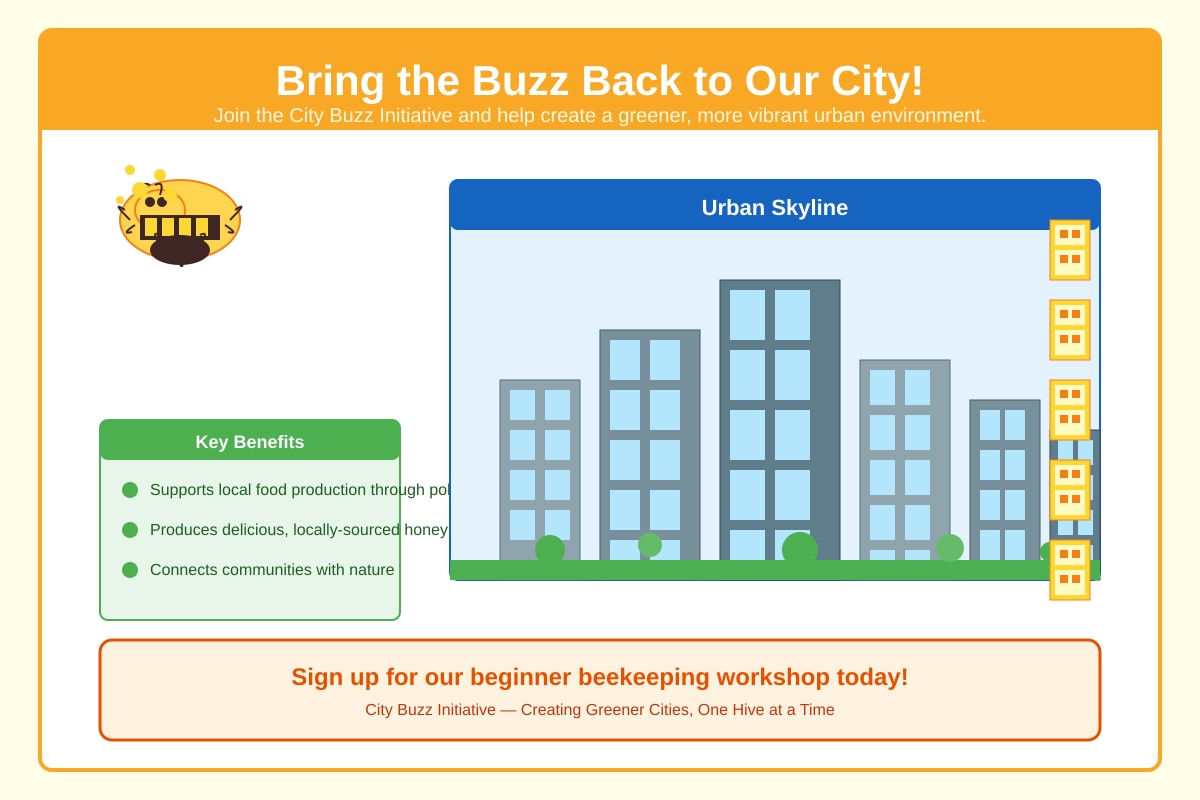
[Image description: A poster from the "City Buzz Initiative." The poster features a stylised illustration of a honeybee against a city skyline. The heading reads: "Bring the Buzz Back to Our City!" Below the heading, a subheading states: "Join the City Buzz Initiative and help create a greener, more vibrant urban environment." The poster lists three key benefits of urban beekeeping: "Supports local food production through pollination," "Produces delicious, locally-sourced honey," and "Connects communities with nature." At the bottom, a call to action reads: "Sign up for our beginner beekeeping workshop today!"]
Question 1 [1 mark]
From Text 1, identify one reason why some people take up urban beekeeping for environmental reasons.
Question 2 [1 mark]
What does the phrase "hyper-local honey" (Text 1) suggest about the honey produced by urban bees?
Question 3 [1 mark]
Refer to Text 2. Which sentence in the poster conveys the main purpose of the City Buzz Initiative?
Question 4 [1 mark]
Look at the heading and subheading of Text 2. Identify two separate words that support the idea that the initiative aims to improve the city environment.
(i) _________________________
(ii) _________________________
Question 5 [1 mark]
What concern do some ecologists have about urban beekeeping, according to Text 1?
Section B [20 marks]
Read Text 3 carefully. Then answer Questions 6–15.
Text 3
The bus groaned to a halt at the depot, its engine ticking over with a weary rattle that spoke of too many years and too little maintenance. I was the last passenger off, stepping down onto the cracked tarmac with the reluctance of someone leaving a warm bed on a winter morning. The depot at night was a landscape of shadows and diesel fumes, a place where the city's buses came to rest like exhausted beasts after a long day's labour.
My grandfather had worked here for forty-two years. He had started as a conductor when buses still had open platforms at the back, when passengers swung aboard with a casual grace that belonged to a different era. By the time he retired, he was the depot manager, a man who knew every rattle and wheeze of every vehicle in his charge. He could diagnose a faulty gearbox by sound alone, they said, and could tell you the service history of any bus just by glancing at its number plate.
I had come to collect his belongings. A cardboard box of odds and ends that had sat in his office for the past three months since his heart attack. The night supervisor, a thin man with a permanent stoop, handed me the box without ceremony. "He was a good man, your grandfather," he said, and the words hung in the air like a verdict. "The best," I replied, though my voice came out thinner than I intended.
His office was exactly as he had left it. A mug with the faded logo of a bus manufacturer. A calendar still open to March, the month he fell ill. A framed photograph of my grandmother, taken on a pier somewhere, her hair whipped by a wind that no longer blew. And on the desk, a small notebook, its pages dense with his cramped handwriting.
I sat in his chair — a worn leather thing that still held the ghost of his shape — and began to read. The notebook was not a diary, not exactly. It was a record of kindnesses. Small acts, mostly. A sandwich bought for a homeless man who slept in the depot doorway. An extra day off quietly arranged for a colleague whose wife was ill. A schoolgirl's lost purse returned by post, the postage paid from his own pocket. None of it had ever been spoken of. He had simply done these things, recorded them in his spidery script, and then closed the book.
I thought of the man I had known: a quiet figure who said little at family gatherings, who preferred the company of engines to people, or so I had believed. Yet here, in these pages, was a different man entirely — a man who had moved through the world leaving small deposits of goodness, like a bee leaving pollen on every flower it visited. The realisation settled on me with the weight of both shame and wonder. How little we know of those we think we know best.
Outside, another bus rumbled into the depot, its headlights sweeping across the window like a searchlight. I closed the notebook and held it against my chest. Somewhere in the distance, a night bird called out, and the sound was unexpectedly beautiful — a single, clear note in the diesel-scented darkness.
Question 6 [1 mark]
From paragraph 1, identify one word or phrase that suggests the bus was old and in poor condition.
Question 7 [1 mark]
What does the writer mean by the phrase "like exhausted beasts" (paragraph 1)?
Question 8 [1 mark]
In paragraph 2, what evidence is there that the grandfather was highly skilled at his job?
Question 9 [1 mark]
Explain what the word "stooped" (paragraph 3) suggests about the night supervisor.
Question 10 [2 marks]
Explain how the writer creates a contrast between the grandfather's public persona and his private actions. Support your answer with evidence from the passage.
Question 11 [1 mark]
What does the phrase "the ghost of his shape" (paragraph 5) suggest about the writer's feelings at that moment?
Question 12 [1 mark]
Identify one example from paragraph 5 of a kind act the grandfather recorded in his notebook.
Question 13 [2 marks]
Explain how the writer uses language in paragraph 6 to convey the impact of the discovery on the narrator. Support your answer with two examples.
Question 14 [1 mark]
What is the tone of the narrator's reflection in paragraph 6: "How little we know of those we think we know best"?
Question 15 [1 mark]
Explain what the simile "like a bee leaving pollen on every flower it visited" (paragraph 6) suggests about the grandfather's character.
Question 16 [2 marks]
Refer to the whole passage. The narrator's feelings towards his grandfather change over the course of the evening. Identify two distinct emotions the narrator experiences and support each with evidence from the passage.
Emotion 1: ____________________________________________________________________
Evidence: _____________________________________________________________________
Emotion 2: ____________________________________________________________________
Evidence: _____________________________________________________________________
Question 17 [2 marks]
Explain how the writer uses the setting of the bus depot to create atmosphere in the passage. Support your answer with two examples.
Question 18 [1 mark]
What does the final sentence — "a single, clear note in the diesel-scented darkness" — suggest about the narrator's state of mind at the end of the passage?
Question 19 [1 mark]
From paragraph 3, identify a phrase that shows the night supervisor respected the grandfather.
Question 20 [1 mark]
Explain what the word "cramped" (paragraph 4) suggests about the grandfather's handwriting.
Section C [25 marks]
Read Text 4 carefully. Then answer Questions 21–25.
Text 4
The Quiet Power of Reading Fiction
In an age of constant digital distraction, the act of reading fiction can seem almost quaint — a slow, solitary pursuit in a world that demands speed and connectivity. Yet a growing body of research suggests that reading fiction offers profound cognitive and emotional benefits that are uniquely suited to the challenges of modern life.
The most striking finding concerns empathy. In a series of studies conducted at the New School for Social Research in New York, researchers found that readers of literary fiction scored significantly higher on tests measuring empathy, social perception, and emotional intelligence. The theory is that fiction, by immersing readers in the inner lives of characters, provides a kind of "cognitive workout" for understanding others. When we read about a character's joy, grief, or moral dilemma, our brains simulate those experiences, strengthening the neural pathways involved in real-world social interaction.
Beyond empathy, fiction also enhances what psychologists call "theory of mind" — the ability to attribute mental states to others and to understand that others may hold beliefs, desires, and intentions different from our own. This skill is fundamental to navigating complex social environments, from the school playground to the corporate boardroom. Interestingly, the effect appears strongest for literary fiction, which tends to present characters with rich, ambiguous inner lives, rather than plot-driven genre fiction, which often relies on stock characters and predictable motivations.
Reading fiction may also offer cognitive benefits that extend well into old age. A long-term study published in the journal Neurology found that individuals who engaged in mentally stimulating activities — including reading — throughout their lives showed a slower rate of cognitive decline in later years. The researchers hypothesised that reading builds "cognitive reserve," a kind of mental buffer that helps the brain compensate for age-related changes. While non-fiction reading was also beneficial, fiction appeared to offer additional advantages, possibly because of the imaginative engagement it requires.
Sceptics might argue that in a world of pressing practical problems, fiction is an indulgence — a retreat from reality rather than an engagement with it. Yet this criticism misses a crucial point. Fiction does not simply offer an escape; it offers a different way of seeing. By presenting alternative worlds and perspectives, it challenges our assumptions and expands our sense of what is possible. In this sense, reading fiction is not a withdrawal from the world but a deeper form of participation in it.
Perhaps the most compelling argument for fiction, however, is not utilitarian at all. It is simply that stories are one of the oldest and most fundamental ways humans make meaning. Long before we had science or philosophy, we had stories — around campfires, on cave walls, in the rhythm of chants and songs. To read fiction is to participate in this ancient tradition, to connect with the deepest currents of human experience. In a fragmented world, that connection may be more valuable than ever.
Question 21 [2 marks]
From paragraph 2, identify two benefits that researchers found were associated with reading literary fiction.
(i) ____________________________________________________________________________
(ii) ____________________________________________________________________________
Question 22 [2 marks]
Explain how the writer uses language in paragraph 2 to emphasise the value of reading fiction. Support your answer with one example.
Question 23 [1 mark]
What does the phrase "cognitive reserve" (paragraph 4) mean in the context of the passage?
Question 24 [2 marks]
Explain how the writer addresses a counterargument in paragraph 5. What is the counterargument, and how does the writer respond to it?
Question 25 [15 marks]
Using your own words as far as possible, summarise the benefits of reading fiction as presented in paragraphs 2 to 5 of Text 4.
Your summary must be in continuous writing and not exceed 80 words. Use only information from paragraphs 2 to 5.
You should write your summary in the box provided below.
Content: 8 marks | Language: 7 marks
— End of Paper —
Check your work carefully. Ensure all questions are answered.
Answers
TuitionGoWhere Practice Paper - English O-Level — Answer Key and Marking Scheme
Paper: 2 (Comprehension) — Version 3 of 5 Total Marks: 50
Section A: Text 1 and Text 2 [5 marks]
Question 1 [1 mark]
Answer: They want to bolster local pollinator numbers / provide safe havens for bees / act as environmental stewards. (Accept any one of these or a close paraphrase.)
Marking notes: Award 1 mark for any reason explicitly linked to environmental concern. Do not accept "to get honey" or other non-environmental reasons.
Question 2 [1 mark]
Answer: It suggests the honey has a distinctive taste that reflects the specific local area/neighbourhood where it was produced. (Accept answers that convey the idea of locality-specific flavour.)
Marking notes: Award 1 mark for explaining that "hyper-local" means extremely specific to a small area, and that this affects the honey's taste. Do not award marks for simply defining "local."
Question 3 [1 mark]
Answer: "Join the City Buzz Initiative and help create a greener, more vibrant urban environment." (Accept the full sentence or a close quotation.)
Marking notes: Award 1 mark for correctly identifying the subheading as the sentence that conveys the main purpose. Do not accept the heading alone ("Bring the Buzz Back to Our City!") as it is less specific about purpose.
Question 4 [1 mark]
Answer: (i) greener (ii) vibrant (Accept "greener" and "vibrant." Also accept "create" if linked to improvement, but "greener" and "vibrant" are the strongest answers.)
Marking notes: Award 1 mark for both words correctly identified. Award 0 marks if only one word is correct. Both words must come from the heading or subheading.
Question 5 [1 mark]
Answer: Too many hives in one area can place unsustainable pressure on limited urban forage / honeybees may outcompete native wild bee species for nectar and pollen.
Marking notes: Award 1 mark for identifying the concern about hive density or competition with wild bees. Accept paraphrased answers that capture the core concern.
Section B: Text 3 [20 marks]
Question 6 [1 mark]
Answer: "groaned" / "weary rattle" / "too many years and too little maintenance" (Accept any one.)
Marking notes: Award 1 mark for any word or phrase that clearly indicates age and poor condition.
Question 7 [1 mark]
Answer: It means the buses are being compared to tired animals that have worked hard all day and are now returning to rest. (Accept answers that explain the comparison to tired/weary animals.)
Marking notes: Award 1 mark for explaining the simile. The answer must show understanding that the buses are personified/compared to tired animals.
Question 8 [1 mark]
Answer: He could diagnose a faulty gearbox by sound alone / he could tell the service history of any bus just by glancing at its number plate. (Accept either piece of evidence.)
Marking notes: Award 1 mark for quoting or closely paraphrasing one piece of evidence that demonstrates skill.
Question 9 [1 mark]
Answer: It suggests he is old / has a bent posture / has worked in a physically demanding job for a long time / appears worn down. (Accept any reasonable inference about age, posture, or weariness.)
Marking notes: Award 1 mark for a plausible inference. Do not accept literal definitions without contextual inference.
Question 10 [2 marks]
Answer: The writer contrasts the grandfather's quiet, reserved public persona ("a quiet figure who said little at family gatherings, who preferred the company of engines to people") with his private acts of kindness recorded in the notebook (e.g., buying a sandwich for a homeless man, arranging leave for a colleague, returning a lost purse). This contrast shows the difference between how he appeared to others and who he really was.
Marking notes: Award 1 mark for identifying the contrast (public quietness vs. private kindness). Award 1 mark for supporting with evidence from the passage. Accept any reasonable evidence from paragraphs 5–6.
Question 11 [1 mark]
Answer: It suggests the writer feels the grandfather's presence/absence strongly / feels a sense of loss and connection to his grandfather / feels that the chair still carries the memory of his grandfather. (Accept any answer that conveys emotional connection, loss, or memory.)
Marking notes: Award 1 mark for an answer that goes beyond literal meaning to suggest emotional resonance.
Question 12 [1 mark]
Answer: A sandwich bought for a homeless man / an extra day off arranged for a colleague / a schoolgirl's lost purse returned by post. (Accept any one.)
Marking notes: Award 1 mark for correctly identifying one kind act from paragraph 5.
Question 13 [2 marks]
Answer: The writer uses language to convey the emotional weight of the discovery. For example:
- "The realisation settled on me with the weight of both shame and wonder" — the word "weight" suggests the discovery was heavy/significant, while "shame and wonder" reveals mixed emotions of regret and admiration.
- "How little we know of those we think we know best" — the rhetorical question/exclamation conveys a sense of humility and a profound shift in understanding. (Accept any two valid examples with explanation.)
Marking notes: Award 1 mark for each example with explanation (2 marks total). The explanation must link the language choice to the impact on the narrator.
Question 14 [1 mark]
Answer: Reflective / contemplative / rueful / humbled / wondering. (Accept any appropriate tone descriptor.)
Marking notes: Award 1 mark for a tone word that accurately captures the reflective, slightly regretful quality of the reflection. Do not accept "sad" or "angry" without qualification.
Question 15 [1 mark]
Answer: It suggests the grandfather quietly and consistently spread goodness/kindness wherever he went, without drawing attention to himself — just as a bee unintentionally spreads pollen while going about its work.
Marking notes: Award 1 mark for explaining that the simile conveys quiet, consistent, and perhaps unnoticed acts of goodness.
Question 16 [2 marks]
Answer: (Accept any two distinct emotions with supporting evidence. Examples below.)
Emotion 1: Sadness/grief/loss Evidence: "I had come to collect his belongings" / "his heart attack" / "the ghost of his shape"
Emotion 2: Wonder/admiration/surprise Evidence: "a different man entirely" / "the realisation settled on me with the weight of both shame and wonder" / "leaving small deposits of goodness"
Marking notes: Award 1 mark for each emotion with appropriate evidence (2 marks total). Emotions must be distinct and supported by textual reference.
Question 17 [2 marks]
Answer: The writer uses the depot setting to create a sombre, reflective atmosphere. For example:
- "a landscape of shadows and diesel fumes" creates a dark, industrial, slightly melancholic mood.
- "the city's buses came to rest like exhausted beasts" personifies the buses and adds to the sense of weariness and end-of-day stillness. (Accept any two valid examples with explanation.)
Marking notes: Award 1 mark for each example with explanation of how it contributes to atmosphere (2 marks total).
Question 18 [1 mark]
Answer: It suggests the narrator has found a moment of clarity, peace, or beauty amid the sadness/darkness — a sense of hope or resolution. (Accept answers that convey a positive or peaceful shift in the narrator's state of mind.)
Marking notes: Award 1 mark for an answer that interprets the contrast between the "clear note" and the "darkness" as symbolising hope, clarity, or peace.
Question 19 [1 mark]
Answer: "He was a good man, your grandfather" (Accept this quotation or a close paraphrase.)
Marking notes: Award 1 mark for correctly identifying the phrase that shows respect.
Question 20 [1 mark]
Answer: It suggests the handwriting was small, tight, and perhaps difficult to read — possibly reflecting the grandfather's quiet, private nature. (Accept answers that convey smallness, tightness, or difficulty of reading.)
Marking notes: Award 1 mark for explaining the connotation of "cramped" in context.
Section C: Text 4 [25 marks]
Question 21 [2 marks]
Answer: (i) Higher scores on tests measuring empathy (ii) Higher scores on tests measuring social perception / emotional intelligence (Accept any two distinct benefits from paragraph 2.)
Marking notes: Award 1 mark for each correct benefit (2 marks total). Benefits must be from paragraph 2.
Question 22 [2 marks]
Answer: The writer uses language to emphasise value. For example, the phrase "cognitive workout" is a metaphor that compares reading fiction to physical exercise, suggesting it strengthens the brain in a similarly essential and beneficial way. This makes the benefit feel concrete and significant.
Marking notes: Award 1 mark for identifying a language feature (e.g., metaphor, specific word choice). Award 1 mark for explaining how it emphasises value. Accept other valid examples from paragraph 2.
Question 23 [1 mark]
Answer: It means a mental buffer or reserve of brain capacity built up through mentally stimulating activities, which helps the brain cope with age-related decline. (Accept answers that convey the idea of built-up mental resilience or protection.)
Marking notes: Award 1 mark for explaining the term in context. The answer must go beyond a literal definition to explain its function.
Question 24 [2 marks]
Answer: The counterargument is that fiction is an indulgence or escape from reality rather than an engagement with it. The writer responds by arguing that fiction offers "a different way of seeing" — it challenges assumptions and expands our sense of what is possible, making it a deeper form of participation in the world, not a withdrawal from it.
Marking notes: Award 1 mark for correctly identifying the counterargument. Award 1 mark for explaining the writer's response. Both parts must be addressed.
Question 25 [15 marks]
Answer: (Model summary — approximately 78 words)
Reading fiction enhances empathy and emotional intelligence by immersing readers in characters' inner lives. It also develops "theory of mind," helping people understand that others have different beliefs and intentions. Literary fiction is especially effective because it presents complex characters. Additionally, reading fiction throughout life may slow cognitive decline by building "cognitive reserve," a mental buffer against age-related changes. While non-fiction is also beneficial, fiction offers extra advantages due to the imaginative engagement it demands.
Content points (8 marks):
- Enhances empathy
- Improves emotional intelligence / social perception
- Develops "theory of mind"
- Helps understand others' different beliefs/intentions
- Literary fiction especially effective (complex characters)
- Slows cognitive decline in later life
- Builds "cognitive reserve" (mental buffer)
- Fiction offers advantages over non-fiction (imaginative engagement)
Language (7 marks):
- Use of own words (paraphrasing, not copying)
- Continuous writing (not note form)
- Organisation and coherence
- Grammatical accuracy
- Within 80-word limit
Marking notes: Award 1 mark per content point (maximum 8). Award up to 7 marks for language based on the syllabus band descriptors for summary writing. Deduct marks for copying verbatim, exceeding word limit, or writing in note form.
— End of Answer Key —