AI Generated Exam Paper
O Level English Practice Paper 2
Free AI-Generated Qwen3.6 Plus O Level English Practice Paper 2 practice paper with questions and answers for Singapore students. This page is rendered as a direct URL so the questions and answers can be discovered without pressing in-page buttons.
These static practice materials are generated from the site's syllabus and paper-generation workflow, with source and model context shown so students and parents can evaluate the material before use.
Questions
TuitionGoWhere Practice Paper - English O-Level
TuitionGoWhere Practice Paper (AI) Version: 2 of 5 Subject: English Language (1184) Level: O-Level Paper: Paper 2 (Comprehension) – Practice Set Duration: 1 hour 50 minutes Total Marks: 50 Name: __________________________ Class: __________________________ Date: __________________________
Instructions to Candidates
- Write your name, class, and date in the spaces provided.
- Answer all questions.
- Read each text carefully before answering the questions.
- For questions requiring "own words," you must not copy phrases directly from the text unless instructed otherwise.
- The number of marks is given in brackets [ ] at the end of each question or part question.
Section A: Visual and Short Texts (5 marks)
Read Text 1 (an infographic poster) and Text 2 (a short blog excerpt) below.
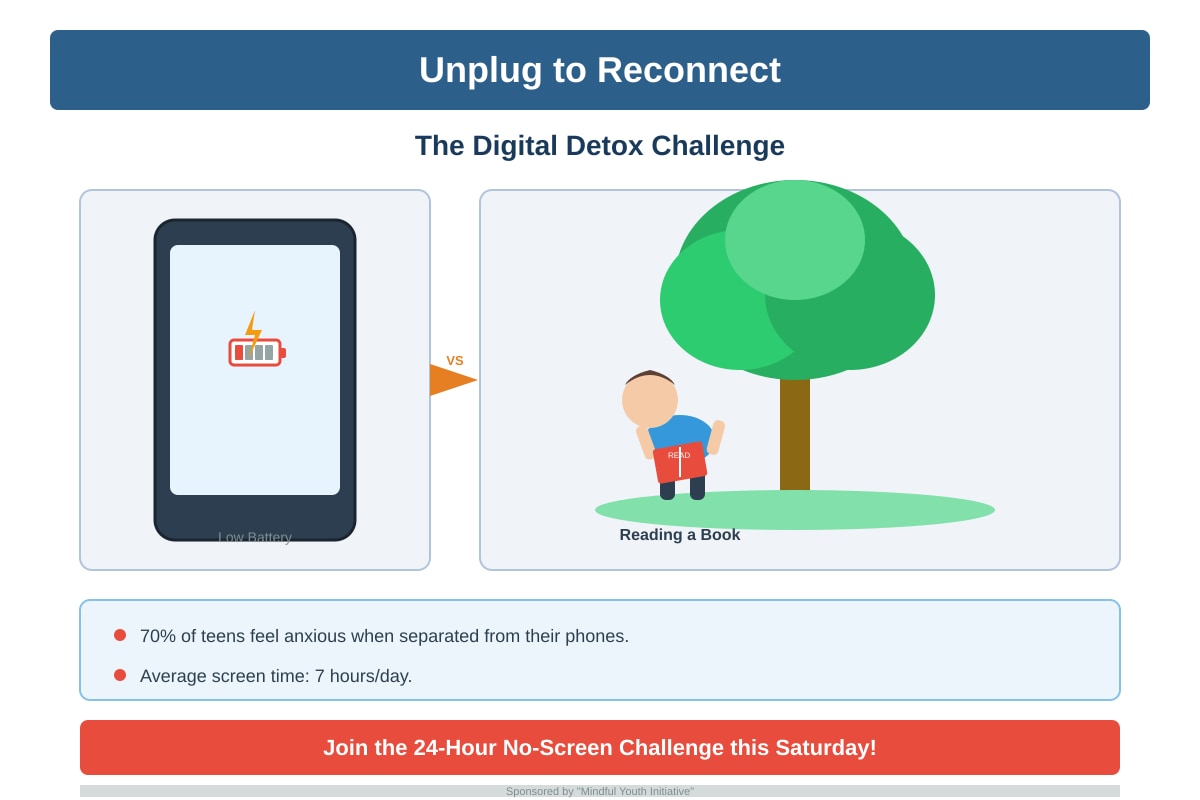
Text 1: [Visual Description] An infographic titled "The Digital Detox Challenge."
- Header: "Unplug to Reconnect."
- Visual: A smartphone with a "Low Battery" icon, next to a person sitting under a tree reading a book.
- Bullet Point 1: "70% of teens feel anxious when separated from their phones."
- Bullet Point 2: "Average screen time: 7 hours/day."
- Call to Action: "Join the 24-Hour No-Screen Challenge this Saturday!"
- Footer: Sponsored by "Mindful Youth Initiative."
Text 2: Blog Excerpt
"I decided to try the challenge last weekend. Honestly, the first hour was agony. I kept reaching for my pocket, phantom-vibrating. But by hour three, I noticed the birds. Actually heard them. By evening, I felt a strange sense of calm I hadn’t felt in months. It wasn’t about hating technology; it was about remembering how to be bored, and how beautiful that boredom can be."
1. Look at Text 1. What is the main purpose of this infographic? [1]
2. Who is the intended target audience for the "Digital Detox Challenge"? [1]
3. In Text 2, what does the phrase "phantom-vibrating" suggest about the writer’s state of mind in the first hour? [1]
4. Identify one piece of evidence from Text 1 that supports the need for the challenge. [1]
5. How does the tone of Text 2 change from the beginning to the end? [1]
Section B: Narrative Text (20 marks)
Read the following narrative passage, then answer Questions 6–15.
The Clockmaker’s Secret
The shop smelled of oil, old wood, and time itself. Elias Thorne did not just repair clocks; he negotiated with them. At seventy, his hands were gnarled like oak roots, yet they moved with the precision of a surgeon’s scalpel. He adjusted the escapement of a grand father clock, holding his breath as the pendulum swung. Tick. Tock. Tick. Tock. A heartbeat restored.
"It’s not just about the gears, boy," Elias muttered to his apprentice, Leo, who was sweeping dust motes from the air. "It’s about the rhythm. You have to listen to what the clock is trying to say."
Leo rolled his eyes, though he kept sweeping. He was nineteen, impatient, and convinced that digital watches had rendered this dusty shrine obsolete. "It’s saying it’s late, Master Elias. The customer will be here in ten minutes."
Elias ignored him. He picked up a tiny brass screw, no larger than a grain of rice. "Impatience is the enemy of precision. Look here." He pointed to a hairline fracture in the main spring. "This clock has been rushed before. See how the metal is stressed? It’s angry."
"Clocks don’t get angry," Leo said, leaning on his broom.
"Everything that is made by hand has a spirit," Elias insisted. "If you rush it, it breaks. If you respect it, it lasts. That is the secret."
The bell above the door jingled. A woman entered, shaking rain from her umbrella. She looked harried, her eyes darting around the shop. "Mr. Thorne? Is it ready? My husband’s anniversary is tonight. He’s had this clock since his grandfather died. It’s... it’s all he has left of him."
Elias looked at Leo. "Well?"
Leo froze. The clock was not ready. The spring needed to be replaced, a task that would take hours. He looked at the woman’s hopeful face, then at Elias’s stern expression. He remembered the "spirit" of the clock. He remembered the anger in the metal.
"It’s not ready," Leo said, his voice trembling slightly. "But we can fix it properly. It will take until tomorrow morning. If we rush it, it will break again within a week."
The woman’s face fell. "Tomorrow? But..."
Elias stepped forward. "The boy is right, Madam. A quick fix is a lie. A proper repair is a promise. Do you want a lie or a promise?"
The woman looked at the clock, then at Leo’s honest, terrified face. She sighed, the tension leaving her shoulders. "A promise," she whispered. "Give me a promise."
As she left, Elias smiled, a rare, crinkling expression. "You listened," he said to Leo.
"I just didn't want to lie," Leo admitted.
"Same thing," Elias said, returning to his workbench. "Now, hand me the tweezers. We have work to do."
6. In paragraph 1, what does the description of Elias’s hands as "gnarled like oak roots" suggest about his character? [1]
7. Why does Elias say he "negotiated" with the clocks (paragraph 1)? [1]
8. In paragraph 3, why does Leo roll his eyes? [1]
9. Explain the meaning of the phrase "rendered this dusty shrine obsolete" in paragraph 3. [2]
10. What evidence is there in paragraph 4 that the clock had been poorly treated in the past? [1]
11. "Everything that is made by hand has a spirit." What does Elias mean by this statement? [2]
12. How does the writer use language in paragraph 9 to show the woman’s emotional state? Refer to two specific words or phrases. [2]
13. Why does Leo’s voice tremble in paragraph 11? [1]
14. Explain the irony in Elias’s response to Leo in the final paragraph ("Same thing"). [2]
15. What lesson has Leo learned by the end of the story? [2]
Section C: Non-Narrative Text (25 marks)
Read the following article, then answer Questions 16–20.
The Rise of Vertical Farming: Feeding the Future?
By 2050, the global population is expected to reach 9.7 billion. With arable land shrinking due to urbanization and climate change, traditional agriculture faces a crisis. Enter vertical farming: the practice of growing crops in stacked layers, often in controlled indoor environments. Proponents argue it is the silver bullet for food security, but skeptics warn of high energy costs and technical complexities.
The Benefits: Efficiency and Sustainability
Vertical farms use up to 95% less water than traditional farms, as water is recycled in a closed-loop system. Furthermore, because these farms are indoors, they are unaffected by weather extremes such as droughts or floods. Pesticides are largely unnecessary, resulting in cleaner produce. Location is another advantage; vertical farms can be built in city centers, reducing the "food miles" associated with transporting produce from rural areas to urban consumers. This means fresher food and a lower carbon footprint from transportation.
The Challenges: Energy and Economics
However, the technology is not without its drawbacks. The primary concern is energy consumption. Artificial lighting, climate control, and hydroponic systems require significant electricity. If this energy is sourced from fossil fuels, the environmental benefits may be negated. Critics argue that until renewable energy becomes cheaper and more widespread, vertical farming remains a luxury rather than a solution.
Additionally, the initial setup cost is prohibitive. Building a high-tech vertical farm requires millions of dollars in investment. This limits the technology to wealthy corporations or governments, potentially excluding small-scale farmers who have traditionally fed local communities. There is also the issue of crop variety. Currently, vertical farms are most efficient with leafy greens and herbs. Staple crops like wheat, rice, and corn, which provide the majority of global calories, are not yet economically viable to grow vertically.
The Verdict
Vertical farming is not a replacement for traditional agriculture, but a complement. It offers a resilient source of fresh produce for urban populations, reducing pressure on rural land. However, for it to become a true global solution, advancements in renewable energy and cost reduction are essential. As one expert noted, "We cannot grow our way out of hunger with technology alone; we must also address distribution and waste."
16. According to paragraph 1, what are two reasons why traditional agriculture is facing a crisis? [2]
17. Explain how vertical farming reduces the "carbon footprint" of food production, based on paragraph 2. [2]
18. In paragraph 3, what does the writer mean by the phrase "negated" in the context of environmental benefits? [1]
19. Identify two limitations of vertical farming mentioned in paragraph 4. [2]
20. Summary Writing Using your own words as far as possible, summarise the benefits and challenges of vertical farming discussed in the article.
- Use only information from paragraphs 2, 3, and 4.
- Your summary should be about 80 words.
- Write in continuous prose.
[15 marks: 8 for content, 7 for language]
[End of Paper]
Answers
TuitionGoWhere Practice Paper - English O-Level (Answer Key)
Version: 2 of 5 Subject: English Language Paper: Paper 2 (Comprehension)
Section A: Visual and Short Texts (5 marks)
1. Look at Text 1. What is the main purpose of this infographic? [1]
- Answer: To persuade/encourage teenagers/young people to participate in the 24-Hour No-Screen Challenge / To raise awareness about the negative effects of excessive screen time.
- Marking Note: Accept "To promote the Digital Detox Challenge." Do not accept "To sell phones."
2. Who is the intended target audience for the "Digital Detox Challenge"? [1]
- Answer: Teenagers / Youth / Young people.
- Marking Note: Based on "70% of teens" and "Mindful Youth Initiative."
3. In Text 2, what does the phrase "phantom-vibrating" suggest about the writer’s state of mind in the first hour? [1]
- Answer: He was addicted/anxious/dependent on his phone / He was experiencing withdrawal symptoms / He felt uneasy without his phone.
- Marking Note: Must imply psychological dependence or anxiety.
4. Identify one piece of evidence from Text 1 that supports the need for the challenge. [1]
- Answer: "70% of teens feel anxious when separated from their phones." OR "Average screen time: 7 hours/day."
- Marking Note: Must be a direct quote or accurate paraphrase from Text 1.
5. How does the tone of Text 2 change from the beginning to the end? [1]
- Answer: It changes from anxious/stressed/agitated to calm/peaceful/reflective.
- Marking Note: Must identify the shift in emotion.
Section B: Narrative Text (20 marks)
6. In paragraph 1, what does the description of Elias’s hands as "gnarled like oak roots" suggest about his character? [1]
- Answer: It suggests he is old/experienced/has worked for a long time / It suggests strength and endurance.
- Marking Note: "Old" or "Experienced" is sufficient.
7. Why does Elias say he "negotiated" with the clocks (paragraph 1)? [1]
- Answer: Because repairing them requires patience, understanding, and care, not just mechanical force / He treats them with respect as if they have a will of their own.
- Marking Note: Must imply a relationship of respect or careful interaction.
8. In paragraph 3, why does Leo roll his eyes? [1]
- Answer: He is impatient/disrespectful/thinks Elias is being silly or old-fashioned / He disagrees with Elias’s philosophical view.
- Marking Note: Must show Leo’s dismissal of Elias’s words.
9. Explain the meaning of the phrase "rendered this dusty shrine obsolete" in paragraph 3. [2]
- Answer: "Rendered... obsolete" means made useless or outdated [1]. "Dusty shrine" refers to the clock shop, implying Leo sees it as an old, irrelevant place compared to modern digital technology [1].
- Marking Note: 1 mark for explaining "obsolete" (outdated/useless). 1 mark for context (shop vs. digital watches).
10. What evidence is there in paragraph 4 that the clock had been poorly treated in the past? [1]
- Answer: There is a "hairline fracture in the main spring" / The metal is "stressed."
- Marking Note: Must cite the specific physical damage.
11. "Everything that is made by hand has a spirit." What does Elias mean by this statement? [2]
- Answer: He means that handmade objects carry the care, effort, and intention of the creator [1]. If treated with respect, they last longer; if rushed, they fail [1].
- Marking Note: 1 mark for the idea of "care/intention." 1 mark for the consequence (durability/quality).
12. How does the writer use language in paragraph 9 to show the woman’s emotional state? Refer to two specific words or phrases. [2]
- Answer: The word "harried" suggests she is stressed/rushed [1]. The phrase "eyes darting" suggests she is anxious/nervous/unable to focus [1].
- Marking Note: 1 mark for each word/phrase + explanation.
13. Why does Leo’s voice tremble in paragraph 11? [1]
- Answer: He is nervous/afraid of disappointing the customer or Elias / He is unsure if he is doing the right thing.
- Marking Note: Must indicate fear or nervousness.
14. Explain the irony in Elias’s response to Leo in the final paragraph ("Same thing"). [2]
- Answer: Leo distinguishes between "not wanting to lie" (moral) and "listening to the clock" (technical/spiritual) [1]. Elias says they are the "same thing," implying that honesty/integrity is essential to good craftsmanship, or that respecting the object is a form of truth [1].
- Marking Note: 1 mark for identifying the contrast Leo sees. 1 mark for explaining Elias’s unification of the concepts (integrity = quality).
15. What lesson has Leo learned by the end of the story? [2]
- Answer: He has learned that patience and honesty are more important than speed [1]. He understands that quality work requires respecting the craft and the customer, not just finishing quickly [1].
- Marking Note: 1 mark for patience/honesty. 1 mark for respect for craft/customer.
Section C: Non-Narrative Text (25 marks)
16. According to paragraph 1, what are two reasons why traditional agriculture is facing a crisis? [2]
- Answer: 1. Shrinking arable land due to urbanization. 2. Climate change. (OR Growing global population).
- Marking Note: 1 mark for each reason. Accept "Urbanization" and "Climate Change."
17. Explain how vertical farming reduces the "carbon footprint" of food production, based on paragraph 2. [2]
- Answer: Vertical farms can be located in city centers [1], which reduces the distance food needs to be transported ("food miles") from rural areas, thus lowering emissions from transport [1].
- Marking Note: 1 mark for location/city centers. 1 mark for reduced transport distance/emissions.
18. In paragraph 3, what does the writer mean by the phrase "negated" in the context of environmental benefits? [1]
- Answer: Cancelled out / Nullified / Made ineffective / Undone.
- Marking Note: Must mean "cancelled out."
19. Identify two limitations of vertical farming mentioned in paragraph 4. [2]
- Answer: Any two of:
- High initial setup costs / Prohibitive investment.
- Limited to wealthy corporations/governments (excludes small farmers).
- Limited crop variety (mostly leafy greens, not staples like wheat/rice).
- Marking Note: 1 mark for each limitation.
20. Summary Writing [15 marks]
Content Points (8 marks): Award 1 mark for each of the following points, up to a maximum of 8. Points must be paraphrased.
- Vertical farms use significantly less water (recycled system).
- They are resilient to weather extremes (droughts/floods).
- They require fewer/no pesticides (cleaner produce).
- Located in cities, reducing transport distance/emissions (freshness).
- High energy consumption for lighting/climate control is a drawback.
- If energy is from fossil fuels, environmental benefits are lost.
- High initial setup costs limit access to wealthy entities.
- Currently limited to leafy greens/herbs, not staple crops (wheat/rice).
Language Marks (7 marks):
- 7 marks: Excellent use of own words; fluent, cohesive, and concise. No lifting.
- 5-6 marks: Good use of own words; mostly cohesive. Minor lifting.
- 3-4 marks: Some own words; some cohesion. Noticeable lifting.
- 1-2 marks: Heavy lifting; poor cohesion; disjointed.
- 0 marks: Entirely lifted or irrelevant.
Model Summary (approx. 80 words): Vertical farming offers significant advantages, including drastic water reduction through recycling and immunity to weather disruptions. By locating farms in urban centers, transport emissions are lowered, providing fresher produce without pesticides. However, the method faces challenges. High energy demands for lighting and climate control can offset environmental gains if fossil fuels are used. Furthermore, prohibitive setup costs restrict access to wealthy investors, and the technology is currently limited to leafy greens, excluding staple crops essential for global calorie intake.
[End of Marking Scheme]