From Real Exams Exam Paper

O Level English Practice Paper 5

Free Exam-Derived Qwen3.6 Plus O Level English Practice Paper 5 practice paper with questions and answers for Singapore students. This page is rendered as a direct URL so the questions and answers can be discovered without pressing in-page buttons.

These static practice materials are generated from the site's syllabus and paper-generation workflow, with source and model context shown so students and parents can evaluate the material before use.

O Level English From Real Exams Generated by Qwen3.6 Plus Updated 2026-06-03

Questions

<!-- TuitionGoWhere generation metadata: stage=3-1; model=qwen/qwen3.6-plus; model_label=Qwen3.6 Plus; generated=2026-05-28; Sources: Stage 2-1 real exam-derived templates and Stage 2-2 exam-enriched syllabus. -->

TuitionGoWhere Exam Practice (AI)

Subject: English Language
Level: O-Level (1184)
Paper: Paper 2 - Comprehension (Practice Version 5)
Duration: 1 hour 50 minutes
Total Marks: 50
Name: __________________________
Class: __________________________
Date: __________________________


INSTRUCTIONS TO CANDIDATES

  1. Answer all questions.
  2. Write your answers in the spaces provided in this booklet.
  3. All questions carry marks as indicated.
  4. For Section C, Question 10, you are advised to spend no more than 35 minutes on this question.

SECTION A (5 marks)

Read Text 1 and Text 2 and answer the questions that follow.

Text 1: The Rise of Vertical Farming

In the heart of Singapore’s industrial estate, a nondescript warehouse hums with the quiet efficiency of the future. Inside, rows of leafy greens stretch towards LED lights that mimic the sun’s spectrum without the heat. This is vertical farming, a method that stacks crops in layers, using 95% less water than traditional agriculture and zero pesticides.

"We are not just growing food; we are engineering resilience," says Dr. Lim, the chief agronomist. "With climate change threatening traditional supply chains, local production is no longer a luxury—it is a necessity." The facility produces 500 kilograms of kale and lettuce daily, enough to feed 2,000 people. Yet, the high energy costs of maintaining artificial climates remain a hurdle. Critics argue that unless renewable energy sources are integrated, the carbon footprint of vertical farming may outweigh its benefits.

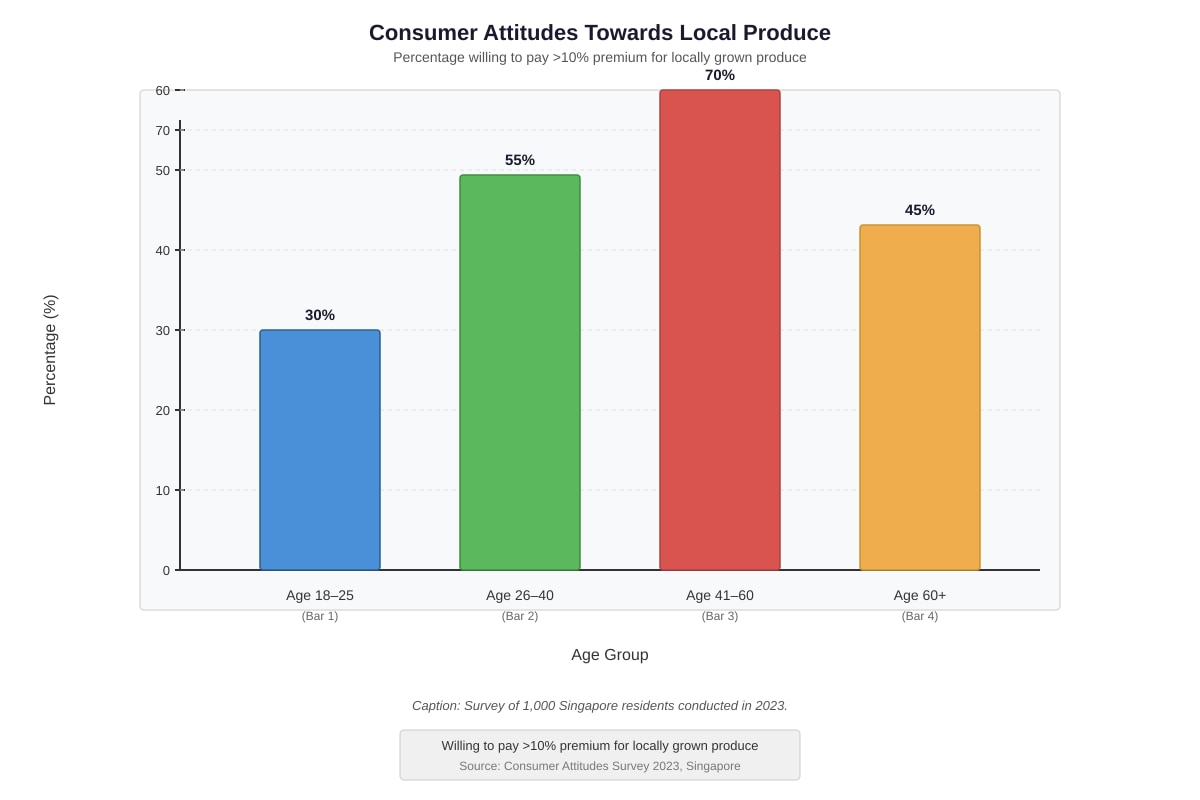
Text 2: Infographic Snapshot – Consumer Attitudes Towards Local Produce

[Visual Description]: A bar chart titled "Willingness to Pay Premium for Locally Grown Vegetables".

  • Bar 1 (Age 18-25): 30% willing to pay >10% premium.
  • Bar 2 (Age 26-40): 55% willing to pay >10% premium.
  • Bar 3 (Age 41-60): 70% willing to pay >10% premium.
  • Bar 4 (Age 60+): 45% willing to pay >10% premium.

Caption: Survey of 1,000 Singapore residents conducted in 2023.

1. Refer to Text 1. Identify one example from the first paragraph that illustrates the efficiency of vertical farming.
[1]

<br> <br>

2. Refer to Text 1. What does Dr. Lim mean by "engineering resilience" in the second paragraph?
[1]

<br> <br>

3. Refer to Text 2. Which age group shows the highest willingness to pay a premium for locally grown vegetables?
[1]

<br> <br>

4. Refer to Text 1 and Text 2. Based on both texts, suggest one reason why the age group identified in Question 3 might be more willing to pay a premium.
[1]

<br> <br>

5. Refer to Text 1. What is the tone of the phrase "nondescript warehouse hums with the quiet efficiency of the future" in the first sentence?
[1]

<br> <br>

SECTION B (20 marks)

Read Text 3 and answer the questions that follow.

Text 3: The Last Train Home

The platform was deserted, save for a single flickering fluorescent light that buzzed like an angry insect. Elias checked his watch for the third time in a minute. 11:58 PM. The last train was due in two minutes, but the tracks remained stubbornly empty. He pulled his coat tighter, the damp chill of the underground station seeping through the fabric.

It had been a long day. The presentation had gone poorly, his boss’s face a mask of polite disappointment that stung more than outright anger. Elias had walked out without a word, leaving his colleagues to clean up the mess. Now, standing in the silence, he felt the weight of his impulsiveness. He wasn’t a quitter. He was a fighter. Or so he had told himself for ten years.

A distant rumble echoed through the tunnel. Hope surged, then died as the sound faded into the distance. Just a maintenance vehicle. Elias slumped against the tiled wall, closing his eyes. He thought of his apartment, cold and empty, and the takeout container sitting on the counter, untouched. He had missed dinner again. He had missed his sister’s birthday call. He had missed his own life, chasing a ladder that seemed to lead nowhere.

"Excuse me?"

The voice was soft, tentative. Elias opened his eyes. A young woman stood a few feet away, clutching a violin case. She looked tired, her hair escaping from a messy bun, but her eyes were bright.

"Is this the platform for the North-South line?" she asked.

Elias nodded, too weary to speak.

"I think I’m lost," she said, offering a small, apologetic smile. "I was playing at the concert hall next door. I got turned around in the tunnels."

Elias looked at her violin case. It was battered, covered in stickers from cities he’d never visited. "You’re a musician?"

"I try to be," she said. "It’s hard. The pay is terrible, and the hours are worse. But when I play... it feels like I’m exactly where I’m supposed to be."

Elias felt a pang of envy. He couldn’t remember the last time he felt that certainty. His job paid well, but it felt like wearing a suit that was two sizes too small—restrictive, uncomfortable, never quite fitting.

"Do you love it?" he asked, the question slipping out before he could stop it.

She paused, considering. "I love the music. I hate the struggle. But I suppose they come together."

The rumble returned, louder this time. Headlights cut through the darkness. The train arrived with a screech of brakes, the doors sliding open with a welcoming hiss.

"This is us," Elias said, gesturing to the open doors.

"Thank you," she said, stepping onto the train. She turned back, her smile genuine now. "Good luck with your fight."

Elias froze. "What fight?"

"The one you’re having with yourself," she said softly. "I can see it in your shoulders. You’re carrying a lot."

The doors closed, separating them. Elias stood alone on the platform again, but the silence felt different now. Less oppressive. More expectant. He looked at his reflection in the darkened window of the departing train. For the first time in years, he didn’t look away.

6. In paragraph 1, what evidence is there that the station is in a state of disrepair?
[1]

<br> <br>

7. Refer to paragraph 2. Explain why Elias’s boss’s reaction "stung more than outright anger".
[2]

<br> <br> <br>

8. In paragraph 3, what does the phrase "chasing a ladder that seemed to lead nowhere" suggest about Elias’s view of his career?
[2]

<br> <br> <br>

9. Refer to paragraph 8. Explain the irony in Elias’s feeling of envy towards the young woman.
[2]

<br> <br> <br>

10. In paragraph 10, what does the woman’s response ("I love the music. I hate the struggle.") reveal about her attitude towards her profession?
[2]

<br> <br> <br>

11. Refer to paragraph 13. What does the woman mean by "The one you’re having with yourself"?
[2]

<br> <br> <br>

12. Explain how the writer creates a contrast between the atmosphere at the beginning of the story and the atmosphere at the end.
[3]

<br> <br> <br> <br>

13. Identify two words or phrases from paragraph 14 that suggest Elias’s internal state has changed.
[2]

<br> <br> <br>

14. What is the main theme of Text 3? Support your answer with one reference to the text.
[3]

<br> <br> <br> <br>

SECTION C (25 marks)

Read Text 4 and answer the questions that follow.

Text 4: The Digital Detox Movement

Paragraph 1
In an era where connectivity is synonymous with existence, the act of disconnecting has become a radical statement. The "Digital Detox" movement, gaining momentum globally, encourages individuals to voluntarily refrain from using digital devices for a set period. Proponents argue that constant connectivity fragments attention spans, disrupts sleep patterns, and erodes genuine human connection. By stepping away from screens, individuals claim to rediscover mindfulness, creativity, and the joy of presence.

Paragraph 2
However, critics argue that the digital detox is a privilege of the affluent. For many, digital devices are not luxuries but lifelines. Gig economy workers rely on apps for income; students need online platforms for education; families use video calls to bridge geographical divides. To suggest that everyone can simply "unplug" ignores the structural reliance on technology in modern society. For these groups, disconnection is not a wellness choice; it is an economic impossibility.

Paragraph 3
Furthermore, the effectiveness of short-term detoxes is debated. Psychologists suggest that while a weekend without phones may provide temporary relief, it does not address the underlying habits that drive compulsive usage. Without long-term behavioral changes, individuals often return to their devices with renewed intensity, a phenomenon known as the "rebound effect." True digital wellness, experts argue, requires not abstinence, but intentionality—curating how and when we engage with technology rather than rejecting it entirely.

Paragraph 4
Schools are beginning to adopt this nuanced approach. Instead of banning devices outright, some institutions are introducing "digital literacy" curricula that teach students to manage their online presence critically. These programs focus on recognizing algorithmic manipulation, understanding data privacy, and fostering healthy boundaries. The goal is not to create Luddites, but to empower students to be masters of their tools, not servants.

Paragraph 5
Ultimately, the debate is not about technology itself, but about our relationship with it. As digital integration deepens, the challenge lies in finding a sustainable balance. We must acknowledge the benefits of connectivity while safeguarding our mental health and social fabric. The solution may not lie in throwing away our smartphones, but in learning when to put them down.

15. Refer to Paragraph 1. Identify two negative effects of constant connectivity mentioned by proponents of the Digital Detox movement.
[2]

<br> <br> <br>

16. Refer to Paragraph 2. Explain why critics describe the digital detox as a "privilege of the affluent".
[2]

<br> <br> <br>

17. In Paragraph 3, what does the term "rebound effect" refer to?
[1]

<br> <br>

18. Refer to Paragraph 4. How do schools with "digital literacy" curricula differ from those that ban devices outright?
[2]

<br> <br> <br>

19. What is the writer’s overall stance on the Digital Detox movement? Support your answer with evidence from Paragraph 5.
[3]

<br> <br> <br> <br>

20. Summary Writing

Using your own words as far as possible, summarise the arguments against the effectiveness of simple digital detoxes and the alternative approach suggested by experts and schools.

You should write about 80 words.
Use only information from Paragraphs 2, 3 and 4.
Your summary must be in continuous writing (not note form).
Up to 10 marks are available for the content of your answer and up to 5 marks for the quality of your writing.

<br> <br> <br> <br> <br> <br> <br> <br> <br> <br> <br> <br> <br> <br> <br> <br> <br> <br> <br> <br> <br> <br> <br> <br> <br> <br> <br> <br> <br> <br> <br> <br> <br> <br> <br> <br> <br> <br> <br> <br> <br> <br> <br> <br> <br> <br> <br> <br> <br> <br> <br> <br> <br> <br> <br> <br> <br> <br> <br> <br> <br> <br> <br> <br> <br> <br> <br> <br> <br> <br> <br> <br> <br> <br> <br> <br> <br> <br> <br> <br> <br> <br> <br> <br> <br> <br> <br> <br> <br> <br> <br> <br> <br> <br> <br> <br> <br> <br> <br> <br> <br> <br> <br> <br> <br> <br> <br> <br> <br> <br> <br> <br> <br> <br> <br> <br> <br> <br> <br> <br> <br> <br> <br> <br> <br> <br> <br> <br> <br> <br> <br> <br> <br> <br> <br> <br> <br> <br> <br> <br> <br> <br> <br> <br> <br> <br> <br> <br> <br> <br> <br> <br> <br> <br> <br> <br> <br> <br> <br> <br> <br> <br> <br> <br> <br> <br> <br> <br> <br......

Answers

<!-- TuitionGoWhere generation metadata: stage=3-1; model=qwen/qwen3.6-plus; model_label=Qwen3.6 Plus; generated=2026-05-28; Sources: Stage 2-1 real exam-derived templates and Stage 2-2 exam-enriched syllabus. -->

TuitionGoWhere Exam Practice (AI) - Answer Key

Subject: English Language
Level: O-Level (1184)
Paper: Paper 2 - Comprehension (Practice Version 5)


SECTION A (5 marks)

1. Refer to Text 1. Identify one example from the first paragraph that illustrates the efficiency of vertical farming.
[1]
Answer:

  • Using 95% less water than traditional agriculture.
  • OR: Using zero pesticides.
  • OR: Stacking crops in layers (to save space/implied efficiency).
    (Accept any one direct quote or paraphrase from the first paragraph that highlights efficiency/resource saving.)

2. Refer to Text 1. What does Dr. Lim mean by "engineering resilience" in the second paragraph?
[1]
Answer:

  • It means creating a food supply system that is strong and able to withstand challenges (like climate change or supply chain disruptions).
    (1 mark for understanding "resilience" as strength/endurance against threats.)

3. Refer to Text 2. Which age group shows the highest willingness to pay a premium for locally grown vegetables?
[1]
Answer:

  • Age 41-60.

4. Refer to Text 1 and Text 2. Based on both texts, suggest one reason why the age group identified in Question 3 might be more willing to pay a premium.
[1]
Answer:

  • They may be more concerned about health/food safety (pesticides mentioned in Text 1).
  • OR: They may have higher disposable income/financial stability compared to younger groups.
  • OR: They are more aware of climate change issues mentioned in Text 1.
    (Accept any reasonable inference linking the demographic to the benefits in Text 1.)

5. Refer to Text 1. What is the tone of the phrase "nondescript warehouse hums with the quiet efficiency of the future" in the first sentence?
[1]
Answer:

  • Optimistic / Appreciative / Awe-inspired.
    (Do not accept: Neutral, Descriptive.)

SECTION B (20 marks)

6. In paragraph 1, what evidence is there that the station is in a state of disrepair?
[1]
Answer:

  • The single flickering fluorescent light.
  • OR: The light buzzing like an angry insect.

7. Refer to paragraph 2. Explain why Elias’s boss’s reaction "stung more than outright anger".
[2]
Answer:

  • Point 1: Outright anger would have been a direct confrontation, which Elias might have been able to defend against or expect.
  • Point 2: "Polite disappointment" implied a failure of character or competence that was quiet and judgmental, making Elias feel guilty or inadequate without a chance to argue.
    (1 mark for each point.)

8. In paragraph 3, what does the phrase "chasing a ladder that seemed to lead nowhere" suggest about Elias’s view of his career?
[2]
Answer:

  • Point 1: He feels his efforts are futile or pointless.
  • Point 2: He realizes that professional advancement (the ladder) does not bring him fulfillment or a clear destination/purpose.
    (1 mark for futility, 1 mark for lack of purpose/fulfillment.)

9. Refer to paragraph 8. Explain the irony in Elias’s feeling of envy towards the young woman.
[2]
Answer:

  • Point 1: Elias has a stable, well-paying job (which the woman lacks), yet he envies her.
  • Point 2: The woman struggles financially ("pay is terrible"), yet she possesses the sense of purpose/certainty that Elias lacks.
    (1 mark for identifying the contrast in their situations, 1 mark for explaining the unexpected nature of the envy.)

10. In paragraph 10, what does the woman’s response ("I love the music. I hate the struggle.") reveal about her attitude towards her profession?
[2]
Answer:

  • Point 1: She is realistic/pragmatic; she acknowledges the difficulties.
  • Point 2: She is passionate/dedicated; her love for the art outweighs the hardships.
    (1 mark for realism, 1 mark for passion/dedication.)

11. Refer to paragraph 13. What does the woman mean by "The one you’re having with yourself"?
[2]
Answer:

  • Point 1: Elias is internally conflicted about his life choices/career.
  • Point 2: He is burdened by stress/unhappiness that he is trying to suppress or ignore.
    (1 mark for internal conflict, 1 mark for emotional burden.)

12. Explain how the writer creates a contrast between the atmosphere at the beginning of the story and the atmosphere at the end.
[3]
Answer:

  • Beginning: The atmosphere is cold, isolated, and oppressive (e.g., "deserted," "damp chill," "silence," "oppressive").
  • End: The atmosphere becomes hopeful and expectant (e.g., "silence felt different," "less oppressive," "more expectant").
  • Method: The writer uses sensory details (cold vs. light) and Elias’s internal reaction (slumping vs. not looking away) to show the shift from despair to self-reflection.
    (1 mark for beginning atmosphere, 1 mark for end atmosphere, 1 mark for method/evidence.)

13. Identify two words or phrases from paragraph 14 that suggest Elias’s internal state has changed.
[2]
Answer:

  • "Less oppressive"
  • "More expectant"
  • OR: "Didn’t look away"
    (1 mark for each correct phrase.)

14. What is the main theme of Text 3? Support your answer with one reference to the text.
[3]
Answer:

  • Theme: The search for purpose/meaning over material success.
  • Support: Elias realizes his well-paying job feels like a "suit that was two sizes too small," while the musician finds certainty in her passion despite the struggle.
  • OR Theme: Human connection can spark self-reflection.
  • Support: The brief interaction with the stranger leads Elias to confront his own unhappiness ("For the first time in years, he didn’t look away").
    (1 mark for theme, 2 marks for relevant support/explanation.)

SECTION C (25 marks)

15. Refer to Paragraph 1. Identify two negative effects of constant connectivity mentioned by proponents of the Digital Detox movement.
[2]
Answer:

  1. Fragments attention spans.
  2. Disrupts sleep patterns.
  3. Erodes genuine human connection.
    (Any two. 1 mark each.)

16. Refer to Paragraph 2. Explain why critics describe the digital detox as a "privilege of the affluent".
[2]
Answer:

  • Point 1: Wealthier individuals can afford to disconnect because their livelihoods do not depend on constant digital availability.
  • Point 2: Lower-income individuals/gig workers rely on devices for income, education, and essential communication, making disconnection an "economic impossibility."
    (1 mark for each point.)

17. In Paragraph 3, what does the term "rebound effect" refer to?
[1]
Answer:

  • The tendency for individuals to return to their devices with renewed intensity/compulsion after a period of abstinence.

18. Refer to Paragraph 4. How do schools with "digital literacy" curricula differ from those that ban devices outright?
[2]
Answer:

  • Ban: Prohibits use completely (restrictive).
  • Digital Literacy: Teaches students to manage usage critically, understand algorithms, and set boundaries (educative/empowering).
    (1 mark for describing the ban approach, 1 mark for describing the literacy approach.)

19. What is the writer’s overall stance on the Digital Detox movement? Support your answer with evidence from Paragraph 5.
[3]
Answer:

  • Stance: The writer supports a balanced, intentional approach rather than total abstinence.
  • Evidence: The writer states the solution is "learning when to put them down" rather than "throwing away our smartphones."
  • Explanation: The writer acknowledges benefits of connectivity but emphasizes the need for "sustainable balance" to protect mental health.
    (1 mark for stance, 1 mark for evidence, 1 mark for explanation.)

20. Summary Writing

Task: Summarise the arguments against the effectiveness of simple digital detoxes and the alternative approach suggested by experts and schools.
Source: Paragraphs 2, 3, and 4.
Length: ~80 words.

Marking Scheme:

  • Content (10 marks): 1 mark for each valid point identified (up to 10 points available, but capped by word count and relevance).
  • Language (5 marks):
    • 5: Concise, precise, excellent own words, coherent.
    • 4: Clear, mostly own words, good coherence.
    • 3: Understandable, some lifting, adequate coherence.
    • 2: Difficult to follow, excessive lifting.
    • 1: Very poor, incomprehensible.

Indicative Content Points (Paraphrased):

  1. Detox is a privilege; many rely on devices for income/livelihood (Para 2).
  2. Disconnection is economically impossible for some (Para 2).
  3. Short-term detoxes offer only temporary relief (Para 3).
  4. They do not address underlying habits/compulsions (Para 3).
  5. Users often experience a "rebound effect" (increased usage) (Para 3).
  6. Experts suggest "intentionality" rather than abstinence (Para 3).
  7. Schools teach "digital literacy" instead of banning devices (Para 4).
  8. This helps students manage online presence critically (Para 4).
  9. Focus on understanding algorithms and data privacy (Para 4).
  10. Goal is to empower students to master tools, not reject them (Para 4).

Model Answer (approx. 80 words):
Critics argue that digital detoxes are impractical for those who rely on technology for income and education, making disconnection economically impossible. Furthermore, psychologists note that short-term abstinence provides only temporary relief, often leading to a "rebound effect" where usage intensifies. Instead, experts advocate for intentionality. Schools are adopting this by teaching digital literacy, which empowers students to critically manage their online presence, understand algorithms, and set healthy boundaries, thereby mastering technology rather than simply rejecting it.