From Real Exams Exam Paper
O Level English Practice Paper 5
Free O Level English Practice Paper 5, HY3 Exam version, with questions, answers, and O Level-style practice for Singapore students.
These static practice materials are generated from the site's syllabus and paper-generation workflow, with source and model context shown so students and parents can evaluate the material before use.
Questions
TuitionGoWhere Exam Practice (AI) - English O-Level Practice Paper
School: TuitionGoWhere Secondary School (AI)
Subject: English
Level: O-Level
Paper: Practice Paper 2 (Comprehension) – Version 5 of 5
Duration: 1h 50min
Total Marks: 50
Name: ___________________________
Class: ___________________________
Date: ___________________________
Instructions:
- This practice paper follows the O-Level English Paper 2 comprehension structure.
- Read all passages carefully before answering.
- Write your answers in the spaces provided.
- Section A is worth 5 marks, Section B 20 marks, Section C 25 marks.
- Total marks = 50.
Section A (5 marks)
Text 1 and Text 2 below include a visual text. Answer Questions 1–5.
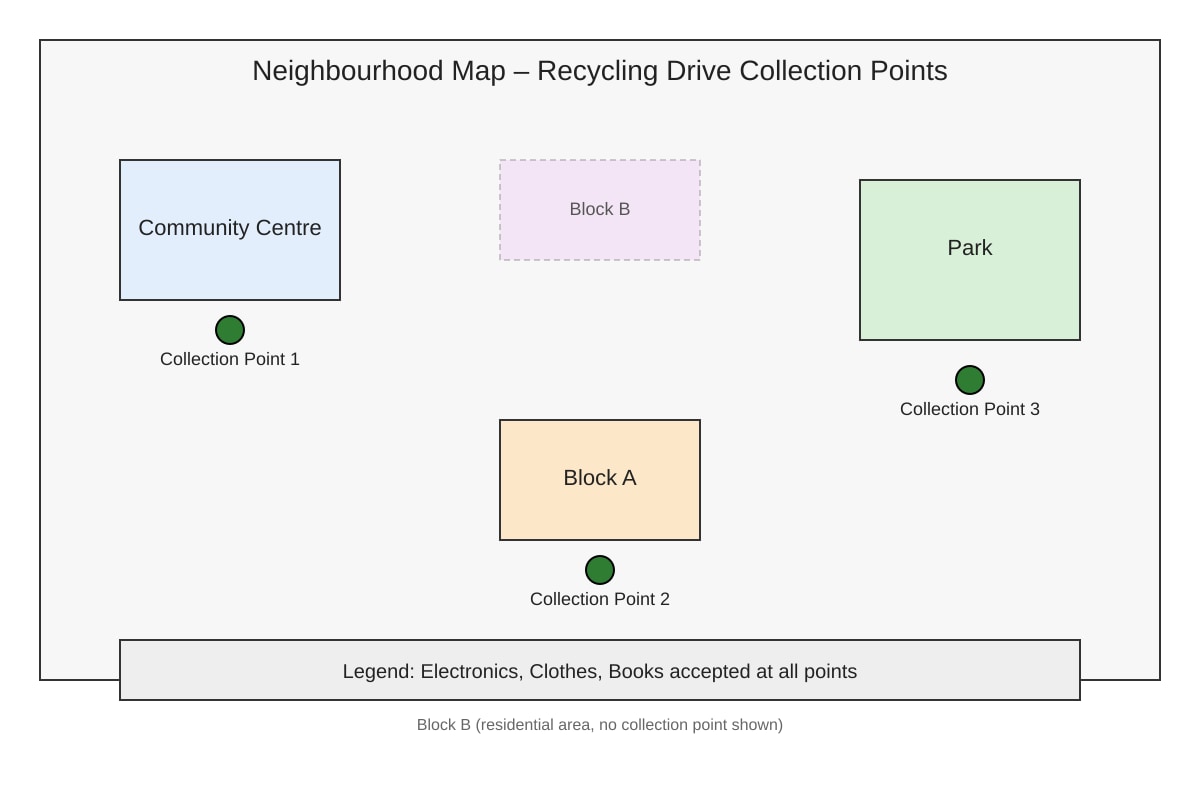
Text 1 The local community centre announced a weekend recycling drive. Residents were encouraged to bring old electronics, clothes, and books. A poster showed the collection points around the neighbourhood.
Image pending generation: diagram for Q1.
Text 2 A survey by the centre found that 68% of residents supported the drive, but only 22% had participated in the previous year.
-
From the map in Text 1, identify one collection point that is not at a residential block. (1 mark)
-
According to Text 2, what percentage of residents had taken part in the previous year's drive? (1 mark)
-
Using both texts, give one reason why the centre used a poster with a map. (1 mark)
-
What does the word "supported" in Text 2 suggest about residents' attitude? (1 mark)
-
Identify one item accepted at all collection points. (1 mark)
Section B (20 marks)
Text 3 – Narrative (for Questions 6–13)
Lena stood at the edge of the empty playground, her hands clutching a faded photograph. The swing where she had once laughed with her brother was now chained and silent. She remembered his voice, bright as the morning sun, before the accident took him away. A cold wind passed, and she whispered, "I promised I would come back." Nearby, a worker began drilling into the old slide, preparing for its removal. Lena turned away; the noise was a rude interruption to her grief. In the distance, children at the new centre laughed — a sound that felt like mockery. She wiped her eyes and walked slowly home, the photograph safe in her pocket.
-
Identify one example from the paragraph that shows Lena felt a strong connection to her brother. (1 mark)
-
What evidence is there in lines 2–3 that the playground was no longer in use? (1 mark)
-
At the end of the paragraph, what is the tone of Lena's action in walking "slowly home"? (1 mark)
-
Explain the irony in the phrase "a sound that felt like mockery" (line 7). (2 marks)
-
What does the writer mean by the word "rude" in line 5? (1 mark)
- Identify two separate words from the text that show Lena's sadness. (2 marks)
- Explain how the writer creates a contrast between the old playground and the new centre. (2 marks)
- In your own words, what does Lena's promise ("I promised I would come back") tell us about her character? (2 marks)
Text 3 continued (for Questions 14–15)
Her mother had told her to let go, but Lena could not. The photograph was proof of a bond that death had not broken. She knew the playground would vanish, yet the memory remained untouched.
- What example from this paragraph supports the view that Lena resists moving on? (1 mark)
- Explain how the language in line 2 ("proof of a bond that death had not broken") suggests permanence. (2 marks)
Section C (25 marks)
Text 4 – Non-narrative (for Questions 16–20)
Schools should prioritise sleep education. Studies show that teenagers need at least eight hours of sleep, yet 70% get fewer than six. Lack of sleep harms memory and mood. Some parents argue that homework must come first, but exhausted students learn poorly. A local school introduced a "no homework Friday" rule and reported better focus on Mondays. Critics say this reduces revision time, yet results improved by 12%. Sleep is not laziness; it is preparation for learning.
- According to Text 4, how many hours of sleep do teenagers need? (1 mark)
- Identify one piece of evidence from the text that shows lack of sleep affects students negatively. (1 mark)
- What does the phrase "Sleep is not laziness; it is preparation for learning" (line 6) suggest about the writer's view? (2 marks)
- Explain how the writer uses the example of the local school to support the argument. (3 marks)
- Summary Task (16 marks)
Using your own words, summarise the writer's reasons for why schools should prioritise sleep education. Write about 80 words.
Answers
TuitionGoWhere Exam Practice (AI) - English O-Level Practice Paper (Version 5) Answer Key
Total Marks: 50
Section A (5 marks)
Q1. Collection Point at the Park (or Community Centre, which is not a residential block).
Mark: 1. Accept "Park" or "Community Centre". Teaching note: The map labels Block A and Block B as residential; Park and Community Centre are not blocks.
Q2. 22%
Mark: 1. Teaching note: Text 2 states "only 22% had participated". Common mistake: confusing with 68% support.
Q3. To show residents where to bring items / increase participation by clarifying locations.
Mark: 1. Teaching note: Link map (Text 1) with low participation (Text 2).
Q4. They agree with or favour the drive (positive attitude).
Mark: 1. Teaching note: "Supported" = backed or approved.
Q5. Electronics / Clothes / Books (any one).
Mark: 1. Teaching note: Legend says all three accepted at all points.
Section B (20 marks)
Q6. "her hands clutching a faded photograph" or "the swing where she had once laughed with her brother".
Mark: 1. Teaching note: Shows connection via keepsake or memory.
Q7. "swing was now chained and silent" / "worker began drilling… preparing for removal".
Mark: 1. Teaching note: Chained and drilling show disuse.
Q8. Resigned / sorrowful / heavy-hearted.
Mark: 1. Teaching note: "slowly" implies reluctance and grief.
Q9. Irony: Children's laughter is normally happy, but to Lena it feels like mockery because she is grieving.
Mark: 2 (1 for identifying contrast, 1 for explanation). Teaching note: This is ironic because expected joy contrasts with her pain.
Q10. "rude" means unwelcome / disrespectful to her grief.
Mark: 1. Teaching note: Not polite; interrupts her moment.
Q11. "grief" and "cried/wiped her eyes" (or "faded", "silent"). Any two sad words.
Mark: 2 (1 each).
Q12. Contrast: Old playground = "chained and silent"; new centre = "children laughed". Writer uses juxtaposition to highlight loss vs. life.
Mark: 2 (1 technique, 1 effect).
Q13. She is loyal / keeps promises / cannot forget brother.
Mark: 2. Teaching note: Shows devotion despite mother's advice.
Q14. "Lena could not [let go]" or "The photograph was proof…".
Mark: 1.
Q15. "bond that death had not broken" suggests lasting connection; "proof" shows tangible, unchanging.
Mark: 2 (1 word analysis, 1 explanation).
Section C (25 marks)
Q16. At least eight hours.
Mark: 1.
Q17. "Lack of sleep harms memory and mood" or "exhausted students learn poorly".
Mark: 1.
Q18. Writer believes sleep is necessary and productive, not idle.
Mark: 2 (1 view, 1 because "preparation").
Q19. Example shows real school with "no homework Friday" had 12% improvement, proving rest helps learning.
Mark: 3 (1 example, 1 result, 1 link to argument).
Q20. Summary (16 marks):
Expected points: teens need 8h but most get <6h; sleep loss hurts memory/mood; school trial improved focus & results; sleep aids learning.
Marking: Content 8 (2 per point), Use of own words 4, Organisation 4.约80 words. Sample: Teenagers require eight hours of sleep but most get under six. Insufficient sleep damages memory and mood. A school that removed Friday homework saw better Monday focus and a 12% result rise. Thus, rest is vital for learning, not laziness.
Free quiz and exam paper access
Enter your details to view this paper
Your access is remembered on this device.