From Real Exams Exam Paper
O Level English Practice Paper 5
Free O Level English Practice Paper 5, DeepSeek Exam version, with questions, answers, and O Level-style practice for Singapore students.
These static practice materials are generated from the site's syllabus and paper-generation workflow, with source and model context shown so students and parents can evaluate the material before use.
Questions
Free quiz and exam paper access
Enter your details to view this paper
Your access is remembered on this device.
Answers
TuitionGoWhere Practice Paper – English O-Level
Paper 2: Comprehension – Answer Key and Marking Scheme
Version 5 of 5
Section A [5 marks]
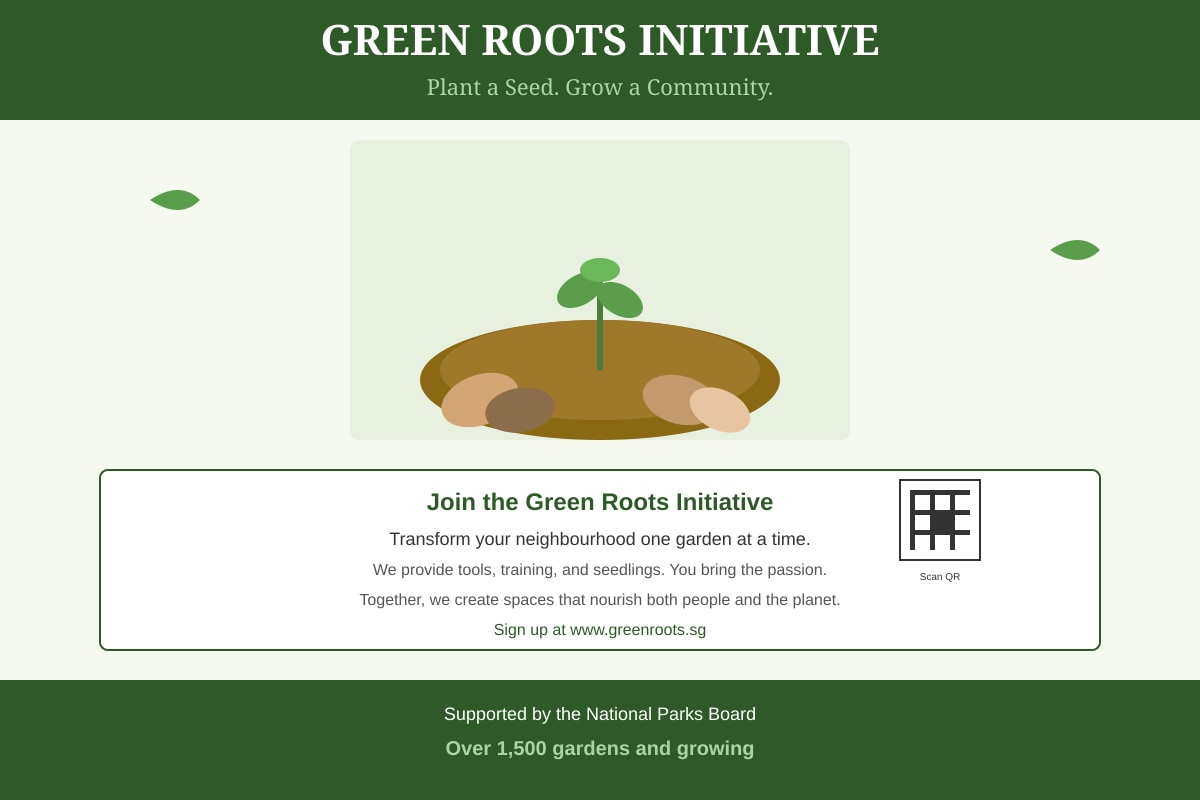
Text 1 and Text 2
Question 1 [1 mark]
Which sentence in Text 2 conveys the main purpose of the poster?
Answer: "Join the Green Roots Initiative and transform your neighbourhood one garden at a time."
Marking notes:
- Award 1 mark for the exact sentence or a close paraphrase that captures the call to action.
- Do not accept: the headline alone ("Plant a Seed. Grow a Community.") as this is a slogan, not the main purpose statement.
- Do not accept: the footer or body text describing what the initiative provides.
Question 2 [2 marks]
Look at the headline and the body text of Text 2. Identify two separate words that support the idea that community gardens bring people together.
Answer (any two of the following):
- "Community" (from headline or body text)
- "together" (from body text: "Together, we create spaces...")
- "neighbourhood" (from body text)
- "Join" (from body text)
Marking notes:
- Award 1 mark for each correct word identified.
- The words must be from Text 2 (the poster), not Text 1.
- Accept any two distinct words that convey togetherness, collective action, or community.
Question 3 [1 mark]
Refer to Text 1. Identify one example from paragraph 2 that the writer uses to illustrate the benefits of community gardening beyond growing food.
Answer (any one of the following):
- "reduces stress levels"
- "improves physical fitness"
- "fosters social cohesion in neighbourhoods where residents might otherwise remain strangers"
Marking notes:
- Award 1 mark for any one of the three benefits listed in paragraph 2.
- The answer must be quoted or closely paraphrased from the text.
- Do not accept: the general statement "benefits extend far beyond the harvest" as this is not a specific example.
Question 4 [1 mark]
What does the phrase "contested" (Text 1, line 12) suggest about land in densely populated cities?
Answer: It suggests that land is fought over / competed for / in high demand / there is conflict over how it should be used / many different parties want to use it.
Marking notes:
- Award 1 mark for any answer that conveys the idea of competition, conflict, or high demand for land.
- Accept: "land is scarce and many people want it," "there is disagreement over land use," "land is disputed."
- Do not accept: a simple dictionary definition without contextual application (e.g., "contested means argued about" without linking to land scarcity).
Question 5 [2 marks]
Explain how the writer of Text 1 creates a contrast between the challenges and the rewards of community gardening in the final paragraph. Support your answer with reference to the text.
Answer framework: The writer creates a contrast by first listing the challenges ("land scarcity," "soil contamination," "water access," "occasional vandalism") and then presenting the rewards ("a basket of home-grown vegetables," "a new friendship," "a moment of quiet in a noisy city"). The use of the contrasting conjunction "Yet" signals the shift from difficulties to benefits. The challenges are presented as persistent and practical obstacles, while the rewards are described in personal, sensory, and emotional terms, emphasising that the intangible benefits outweigh the tangible difficulties.
Marking notes:
- Award 1 mark for identifying the contrast (challenges vs. rewards) with at least one reference from each side.
- Award 1 mark for explaining how the contrast is created (e.g., through the use of "Yet," through the juxtaposition of practical problems with emotional rewards, through the listing structure).
- Accept any reasonable explanation that demonstrates understanding of contrast as a literary technique.
Section B [20 marks]
Text 3
Question 6 [2 marks]
From paragraph 1, identify two words or phrases that suggest the writer's grandmother was anxious about the delayed monsoon.
Answer (any two of the following):
- "restlessness"
- "quiet intensity"
- "searching for a familiar face in a crowd"
- "scanning the horizon"
Marking notes:
- Award 1 mark for each correct word or phrase identified.
- The words must convey anxiety, worry, restlessness, or intense anticipation.
- Do not accept: "damp cloth" (this describes the atmosphere, not the grandmother's emotion).
Question 7 [1 mark]
"Her voice carried the certainty of someone who had never owned a weather app and never needed one." (lines 6–7) What does this sentence suggest about the grandmother's relationship with technology?
Answer: It suggests that she does not rely on / has no need for modern technology / she trusts her own knowledge and experience instead / technology is unnecessary for her because of her traditional knowledge.
Marking notes:
- Award 1 mark for any answer that conveys the idea that the grandmother is independent of or indifferent to modern technology because her traditional knowledge is sufficient.
- Accept: "She does not need technology to know things," "Her knowledge makes technology redundant for her."
Question 8 [1 mark]
In paragraph 3, what evidence is there that the grandmother was not affected by Amir's scepticism?
Answer: She did not reply. / Instead, she walked to the garden and began covering her rose bushes. / Her movements were deliberate and unhurried.
Marking notes:
- Award 1 mark for any one of the above pieces of evidence.
- The answer must demonstrate that she ignored or was unaffected by his comment.
Question 9 [2 marks]
Explain how the writer creates a contrast between the grandmother's world and Amir's world in paragraph 3. Support your answer with reference to the text.
Answer framework: The writer creates a contrast by describing the grandmother's world as "measured in cloud formations and the behaviour of ants" while Amir's world is "measured in percentages and push notifications." The grandmother's knowledge is based on direct observation of nature, while Amir's is based on digital data and technology. The contrast is emphasised by the parallel structure of the sentence and the juxtaposition of natural indicators (clouds, ants) with technological ones (percentages, notifications).
Marking notes:
- Award 1 mark for identifying the two contrasting worlds with textual reference.
- Award 1 mark for explaining how the contrast is created (e.g., through parallel structure, juxtaposition, specific word choices).
- Accept any reasonable explanation that demonstrates understanding of contrast as a literary technique.
Question 10 [1 mark]
"They were fat and heavy, the kind that announce themselves with a drumroll on the roof before settling into a steady rhythm." (lines 14–15) What does the writer mean by the phrase "announce themselves with a drumroll"?
Answer: The writer means that the first raindrops were loud and dramatic / made a loud, attention-grabbing sound on the roof / arrived with a dramatic, noticeable intensity before becoming steady / the rain made its arrival known in a dramatic way.
Marking notes:
- Award 1 mark for any answer that conveys the idea of a loud, dramatic, or attention-grabbing arrival.
- Accept: "The rain started loudly and dramatically," "The drops made a loud noise like a drumroll."
Question 11 [1 mark]
At the end of paragraph 5, what is the tone of the grandmother's comment to Amir?
Answer: Gentle / kind / patient / instructive / not unkind / matter-of-fact / wise / calm.
Marking notes:
- Award 1 mark for any appropriate tone descriptor that matches the text's description of her speaking "not unkindly."
- Do not accept: "gloating," "triumphant," "smug," "angry," "sarcastic."
Question 12 [1 mark]
"She was not gloating. That was not her way." (line 23) What does this statement reveal about the grandmother's character?
Answer: It reveals that she was humble / modest / gracious / not the type to boast or show off / she did not take pleasure in being right at someone else's expense.
Marking notes:
- Award 1 mark for any answer that conveys humility, modesty, or graciousness.
- Accept: "She was not arrogant," "She was humble and did not boast."
Question 13 [1 mark]
Refer to paragraph 7. Identify one example the writer uses to illustrate the grandmother's type of intelligence.
Answer (any one of the following):
- "patience"
- "attention"
- "a willingness to be still long enough to notice the world"
- "knowledge... woven into the fabric of her days"
- "as natural to her as breathing"
Marking notes:
- Award 1 mark for any one of the above examples from paragraph 7.
- The answer must be quoted or closely paraphrased.
Question 14 [1 mark]
What does the phrase "woven into the fabric of her days" (lines 25–26) suggest about the grandmother's knowledge?
Answer: It suggests that her knowledge was an inseparable / integral / natural part of her daily life / it was not separate from her everyday existence / it was deeply embedded in her routine and experience.
Marking notes:
- Award 1 mark for any answer that conveys the idea of knowledge being inseparable from daily life, deeply integrated, or natural.
- Accept: "It was part of her everyday life," "It was inseparable from who she was."
Question 15 [3 marks]
The writer states that the grandmother taught her that "some things cannot be downloaded or streamed. They must be lived." (lines 30–31) Explain what the writer means by this statement, with reference to the passage as a whole.
Answer framework: The writer means that certain types of knowledge and wisdom cannot be acquired through technology or passive consumption; they require direct, lived experience. Throughout the passage, the grandmother's knowledge of the weather comes from years of observing the sky, not from apps or forecasts. Her understanding of gardening, nature, and the world is described as "woven into the fabric of her days" and "as natural to her as breathing." This contrasts with Amir's reliance on his phone for weather predictions. The grandmother's way of knowing—through patience, attention, and stillness—represents a form of intelligence that cannot be replaced by digital information. The statement is a reflection on the value of experiential, embodied knowledge in an increasingly technology-dependent world.
Marking notes:
- Award 1 mark for explaining the literal meaning: some knowledge requires direct experience, not technology.
- Award 1 mark for referencing the grandmother's knowledge as an example (weather prediction, gardening, etc.).
- Award 1 mark for linking to the broader theme of experiential vs. technological knowledge.
- Accept any reasonable explanation that demonstrates understanding of the statement in the context of the passage.
Section C [25 marks]
Text 4
Question 16 [2 marks]
From paragraph 1, identify two negative environmental impacts of traditional agriculture mentioned by the writer.
Answer (any two of the following):
- "deforestation"
- "soil degradation"
- "greenhouse gas emissions"
- (Also accept: "occupies nearly 40 percent of the Earth's land surface" and "accounts for 70 percent of freshwater withdrawals" if the candidate frames these as negative impacts.)
Marking notes:
- Award 1 mark for each correct environmental impact identified.
- The answer must be from paragraph 1.
- Accept close paraphrases.
Question 17 [3 marks]
Refer to paragraphs 2 and 3. Using your own words as far as possible, explain three ways in which vertical farming differs from traditional farming.
Answer (any three of the following, paraphrased):
(i) Vertical farming grows crops in stacked layers indoors, while traditional farming grows crops on open land. / Vertical farming uses vertical space rather than horizontal fields.
(ii) Vertical farming uses hydroponic or aeroponic systems without soil, while traditional farming relies on soil.
(iii) Vertical farming does not need pesticides or herbicides, while traditional farming typically uses them.
(iv) Vertical farming recycles water in closed-loop systems, using far less water than traditional farming.
(v) Vertical farming is not affected by seasons or weather, while traditional farming depends on seasonal conditions.
(vi) Vertical farming uses calibrated LED lighting instead of sunlight.
(vii) Vertical farming uses sensors and AI to monitor and adjust conditions automatically.
Marking notes:
- Award 1 mark for each clearly explained difference, using the candidate's own words.
- Do not award marks for direct copying from the text without paraphrasing.
- Accept any three distinct differences that are factually correct and drawn from paragraphs 2–3.
Question 18 [1 mark]
What does the phrase "free agriculture from the tyranny of seasons and weather" (lines 11–12) suggest about the advantage of vertical farming?
Answer: It suggests that vertical farming is not limited or controlled by seasonal changes or weather conditions / it allows farming to happen year-round regardless of external climate / it removes the restrictions that seasons and weather impose on traditional farming.
Marking notes:
- Award 1 mark for any answer that conveys the idea of freedom from seasonal/weather constraints.
- The word "tyranny" implies oppressive control; candidates should recognise that vertical farming escapes this control.
Question 19 [2 marks]
Refer to paragraph 5. Identify two limitations of vertical farming that the writer mentions.
Answer (any two of the following):
- "substantial" energy demands / high energy consumption for lighting and climate control
- "overall carbon footprint" concerns
- limited range of crops (only high-value produce like salad greens and herbs; staple crops cannot be grown profitably)
- high capital costs / produce is more expensive than conventionally grown alternatives
- limited accessibility for lower-income consumers
Marking notes:
- Award 1 mark for each correct limitation identified from paragraph 5.
- Accept close paraphrases.
Question 20 – Summary Writing [15 marks]
Using your own words as far as possible, summarise the reasons why Singapore has invested in vertical farming, and the challenges that vertical farming faces, as described in Text 4. Use only information from paragraphs 4 to 6. Your summary must be in continuous writing (not note form). It must not be longer than 80 words.
Marking Scheme for Summary Writing
Content Points (8 marks):
Reasons for Singapore's investment (from paragraph 4):
- Singapore has very limited land for agriculture (only 1% available)
- Singapore imports over 90% of its food (vulnerability)
- The COVID-19 pandemic exposed this food vulnerability
- The government's "30 by 30" initiative aims to produce 30% of nutritional needs locally by 2030
- Vertical farming is central to this ambition
Challenges faced by vertical farming (from paragraphs 5–6): 6. Energy demands are substantial (for lighting and climate control) 7. Questions about overall carbon footprint 8. Limited range of crops (only high-value produce; staple crops cannot be grown profitably) 9. High capital costs / produce is more expensive 10. Limited accessibility for lower-income consumers
Award 1 mark for each content point, up to a maximum of 8 marks. Candidates must cover both reasons and challenges to score full content marks.
Language Marks (7 marks):
| Band | Marks | Descriptor |
|---|---|---|
| 5 | 7 | Excellent paraphrasing; almost entirely in own words; clear, precise, and well-organised; no lifting of whole phrases. |
| 4 | 5–6 | Good paraphrasing; mostly in own words; clear and organised; minimal lifting. |
| 3 | 3–4 | Adequate paraphrasing; some use of own words; some lifting but not excessive; generally clear. |
| 2 | 1–2 | Limited paraphrasing; heavy reliance on text; meaning may be unclear in places. |
| 1 | 0 | Wholesale copying; not in continuous writing; meaning unclear. |
Model Summary (80 words):
Singapore has invested in vertical farming because it has very little farmland and imports most of its food, a weakness highlighted by the pandemic. The nation aims to produce nearly a third of its food locally by 2030, with vertical farming playing a key role. However, this method faces obstacles such as high energy use, concerns about its environmental impact, a narrow variety of crops that can be grown profitably, and steep setup costs that make the produce unaffordable for some consumers.
(Word count: 80)
Marking notes:
- Word count: Do not count the opening phrase "Singapore has invested in vertical farming because..." Candidates must not exceed 80 words of their own writing.
- If the summary exceeds 80 words, apply the penalty as per examination guidelines (typically, mark only up to the 80th word).
- The summary must be in continuous writing with appropriate connectives.
- Content points must be drawn only from paragraphs 4–6.
- Award language marks based on the band descriptors above.
— END OF ANSWER KEY —