From Real Exams Exam Paper
O Level English Practice Paper 3
Free O Level English Practice Paper 3, Qwen3.6 Exam version, with questions, answers, and O Level-style practice for Singapore students.
These static practice materials are generated from the site's syllabus and paper-generation workflow, with source and model context shown so students and parents can evaluate the material before use.
Questions
Free quiz and exam paper access
Enter your details to view this paper
Your access is remembered on this device.
Answers
TuitionGoWhere Exam Practice (AI) - O-Level English Language (1184)
Answer Key & Marking Scheme - Practice Version 3
Subject: English Language
Level: O-Level
Paper: Paper 2 (Comprehension)
SECTION A (5 marks)
1. Identify one example from Text 1 that proponents use to support the claim that vertical farming is environmentally friendly. [1]
- Answer: It uses 95% less water than traditional agriculture.
- OR: It eliminates the need for pesticides.
- Marking: 1 mark for either point. Must be from Text 1.
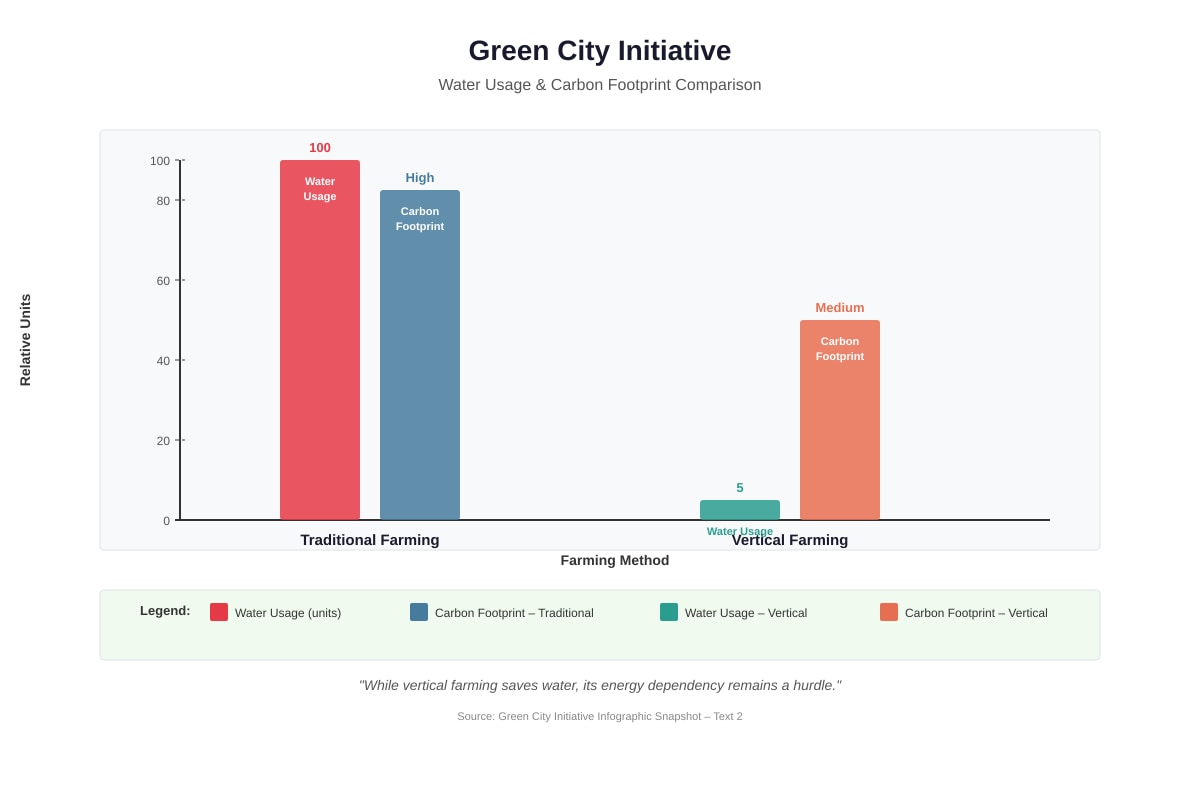
2. Refer to Text 2. Which specific data point suggests that vertical farming is not entirely carbon-neutral? [1]
- Answer: Its carbon footprint is listed as "Medium" (due to energy use).
- OR: The caption states its "energy dependency remains a hurdle."
- Marking: 1 mark for identifying the medium carbon footprint or energy dependency.
3. In Text 1, line 4, what does the word "integrating" suggest about how cities are adopting vertical farming? [1]
- Answer: It suggests that vertical farms are being incorporated or built into the existing city structure/system, rather than being separate or isolated.
- Marking: 1 mark for understanding that it is becoming part of the infrastructure.
4. Look at Text 1 and Text 2. What is the main contrast between the proponents' view in Text 1 and the caption in Text 2? [1]
- Answer: Proponents in Text 1 focus on the benefits (water saving/no pesticides), while the caption in Text 2 highlights the drawback (energy costs/carbon footprint).
- Marking: 1 mark for identifying the contrast between benefit (Text 1) and drawback/cost (Text 2).
5. Based on both texts, identify one challenge that vertical farming faces which is not related to water usage. [1]
- Answer: High energy costs.
- OR: Artificial lighting requirements.
- OR: Climate control costs.
- Marking: 1 mark for any of the above.
SECTION B (20 marks)
6. In paragraph 1, what evidence is there that the shop is a sanctuary from the outside world? [1]
- Answer: The contrast between the "roar" and "cacophony" outside and the "only the rhythmic tick-tick-tick" inside.
- OR: The description of the shop having a "steady heartbeat in a world that had forgotten how to wait."
- Marking: 1 mark for citing the auditory contrast or the "steady heartbeat" metaphor.
7. Explain the irony in Julian’s statement in paragraph 2: "Why fix what nobody uses?" [2]
- Answer: It is ironic because Julian is using a watch (smartwatch) himself, implying he uses watches, yet he claims nobody uses them.
- OR: It is ironic because he is dismissing the value of the craft while benefiting from the concept of timekeeping.
- Marking: 1 mark for identifying that Julian uses a watch/timekeeping device. 1 mark for explaining the contradiction between his action and his statement.
8. In paragraph 2, what does the phrase "sharp and dismissive" suggest about Julian’s attitude towards his grandfather’s work? [1]
- Answer: It suggests that Julian is disrespectful, impatient, and lacks appreciation for the skill involved.
- Marking: 1 mark for "disrespectful" or "lacking appreciation." (Do not accept "angry").
9. Refer to paragraph 3. Identify two separate words that show how Elias’s father viewed the act of watchmaking. [2]
- Answer: (i) Respect / Respected
- Answer: (ii) Understood / Craft
- Marking: 1 mark for each word. Must be from the text or directly derived from the father's quote "respected, repaired, and understood." Accept "craft" as a noun representing the view.
10. In paragraph 5, why does Elias smile "sadly" at the young woman? [2]
- Answer: He feels pity for her because she is anxious and disconnected from the true meaning of time.
- OR: He realizes she misunderstands the nature of his work and is trapped by technology.
- Marking: 1 mark for pity/sympathy. 1 mark for referencing her anxiety/misunderstanding of time vs. technology.
11. Explain how the writer creates a contrast between the "smartwatch" and the "pocket watch" in the text. [2]
- Answer: The pocket watch is described with organic, delicate imagery ("heart," "ribs," "mechanical bird"), suggesting life and craft. The smartwatch is described as a "tether" and "technology," suggesting confinement and cold utility.
- Marking: 1 mark for identifying the organic/craft nature of the pocket watch. 1 mark for identifying the utilitarian/confining nature of the smartwatch.
12. What does the word "tether" in paragraph 9 imply about the young woman’s relationship with her device? [2]
- Answer: It implies that she is bound or chained to the device, lacking freedom.
- OR: It suggests a dependency that restricts her rather than liberates her.
- Marking: 1 mark for "bound/chained/restricted." 1 mark for explaining the lack of freedom/dependency.
13. Identify one example from paragraph 10 that shows Elias feels a sense of accomplishment. [1]
- Answer: "The watch began to tick, a strong, clear sound."
- OR: "Elias felt a profound sense of peace."
- Marking: 1 mark for either quote.
14. In your own words, explain what Elias means when he says, "I repair time. I do not troubleshoot technology." [2]
- Answer: Elias believes his work is about preserving the meaningful, rhythmic experience of time (craft/patience), whereas the smartwatch represents a functional, stressful connection to digital demands that he does not support.
- Marking: 1 mark for explaining "repair time" (preserving craft/meaning/patience). 1 mark for explaining "troubleshoot technology" (fixing digital devices/stressful connectivity). Must be in own words.
15. What is the tone of the final sentence of the text? [2]
- Answer: Reflective and peaceful.
- OR: Contemplative and serene.
- Marking: 1 mark for "reflective/contemplative." 1 mark for "peaceful/serene." (Do not accept "happy" or "sad").
SECTION C (25 marks)
16. Identify one example from paragraph 1 that explains why humans are naturally drawn to negative news. [1]
- Answer: Negativity bias (or humans are wired to pay more attention to negative information).
- OR: It helped ancestors survive by keeping them alert to threats.
- Marking: 1 mark for either point.
17. In paragraph 2, what does the term "mean world syndrome" refer to? [2]
- Answer: It refers to the perception that the world is more dangerous and hostile than it really is, caused by consuming too much negative news.
- Marking: 1 mark for "perception of world as dangerous/hostile." 1 mark for linking it to excessive negative news consumption.
18. Explain how the writer uses the comparison to "slot machines" in paragraph 3 to illustrate the nature of social media algorithms. [2]
- Answer: It illustrates that social media uses unpredictable rewards (variable reward schedules) to create addiction.
- OR: It shows that the uncertainty of the next post keeps users engaged in a dopamine loop, just like gambling.
- Marking: 1 mark for identifying "unpredictable rewards/uncertainty." 1 mark for linking to "addiction/engagement/dopamine loop."
19. In paragraph 4, what is the purpose of the phrase "digital noise"? [1]
- Answer: To describe the overwhelming, distracting, and unnecessary amount of information online.
- Marking: 1 mark for "overwhelming/distracting information."
20. Summary Writing [15 marks]
Content Points (Up to 10 marks): Award 1 mark for each relevant point, up to a maximum of 10. Points must be paraphrased.
- Cause: Humans have a natural "negativity bias" (wired to notice threats/negative info).
- Cause: Social media algorithms are designed to keep users engaged (using variable rewards/uncertainty).
- Cause: Fear of Missing Out (FOMO) drives users to stay informed.
- Effect: Increases anxiety, stress, and sleep problems.
- Effect: Leads to "mean world syndrome" (viewing the world as more dangerous than it is).
- Effect: Erodes trust in institutions and creates helplessness.
- Solution: Curate feeds by unfollowing distressing accounts.
- Solution: Set time limits on app usage.
- Solution: Engage in offline activities (exercise/socializing) to take a break.
- Solution: Taking control of consumption helps protect mental health/balance perspective.
Language Marks (Up to 5 marks):
- 5 marks: Excellent use of own words; sophisticated sentence structures; coherent and cohesive summary; within word limit (approx. 80 words).
- 4 marks: Good use of own words; clear sentences; good cohesion; minor language errors.
- 3 marks: Adequate paraphrasing; some copying of text; reasonable cohesion; some language errors.
- 2 marks: Limited paraphrasing (heavy copying); disjointed sentences; frequent language errors.
- 1 mark: Very little own words; poor structure; many errors.
- 0 marks: No relevant content or unintelligible.
Penalty:
- Deduct 1 mark if the word count exceeds 90 words significantly.
- Deduct 1 mark if the summary is in note form (must be continuous writing).
Model Answer (for reference): Doomscrolling is driven by humans’ natural negativity bias, which once aided survival, and by social media algorithms that exploit this through unpredictable rewards. Additionally, the fear of missing out compels continuous scrolling. This habit causes anxiety, sleep issues, and "mean world syndrome," where the world seems dangerously hostile. To combat this, experts suggest curating feeds to remove distressing content, setting strict time limits, and engaging in offline activities. These steps help users regain mental balance and control.