AI Generated Quiz
O Level Elementary Mathematics Statistics Probability Quiz
Free O Level E Maths Statistics quiz, HY3 AI version, with questions, answers, and O Level-style practice for Singapore students.
These static practice materials are generated from the site's syllabus and paper-generation workflow, with source and model context shown so students and parents can evaluate the material before use.
Questions

Free quiz and exam paper access
Enter your details to view this paper
Your access is remembered on this device.
Answers
O-Level Elementary Mathematics Quiz - Statistics Probability (Answer Key)
Total Marks: 40
Topic: Statistics and Probability (syllabus-first generated content, not past-year derived)
Section A: Data Handling and Representation
Q1. [2 marks]
Total books = ( (0 \times 4) + (1 \times 9) + (2 \times 8) + (3 \times 6) + (4 \times 3) )
= ( 0 + 9 + 16 + 18 + 12 = 55 )
Answer: 55 books.
Teaching note: Multiply each value by its frequency then sum. Common mistake: adding frequencies only (30) instead of weighted books.
Q2. [2 marks]
Mean = total books ÷ number of students = ( 55 \div 30 = 1.833... )
= 1.83 (2 d.p.)
Answer: 1.83.
Teaching note: Mean = sum of all data ÷ number of data points. Use total from Q1.
Q3. [1 mark]
Ordered masses: 2.0, 2.1, 2.2, 2.3, 2.3, 2.4, 2.5. Middle (4th) value = 2.3.
Answer: 2.3 kg.
Teaching note: Median is the middle number after sorting. For 7 values, the 4th is median.
Q4. [1 mark]
7 appears most often (three times).
Answer: 7.
Teaching note: Mode is the most frequent value.
Q5. [1 mark]
Range = largest – smallest = 24 – 12 = 12.
Answer: 12.
Teaching note: Range shows spread; subtract min from max.
Q6. [2 marks]
Bus students = 60 out of 120.
Angle = ( \frac{60}{120} \times 360^\circ = 180^\circ ).
Answer: 180°.
Teaching note: Pie angle = (frequency ÷ total) × 360°. Check: MRT 108°, Walk 54°, Cycle 18°, sum = 360°.
Q7. [1 mark]
Highest frequency is 8 at mark 30.
Answer: 30.
Teaching note: Modal mark is the mark with highest frequency.
Section B: Probability Basics
Q8. [2 marks]
Total marbles = 5 + 3 + 2 = 10.
P(blue) = ( \frac{3}{10} ).
Answer: ( \frac{3}{10} ).
Teaching note: Probability = favourable ÷ total outcomes.
Q9. [1 mark]
Numbers >4 on die: 5, 6 → 2 outcomes.
P = ( \frac{2}{6} = \frac{1}{3} ).
Answer: ( \frac{1}{3} ).
Teaching note: Fair die has 6 equal outcomes.
Q10. [2 marks]
Outcomes: HH, HT, TH, TT.
Answer: HH, HT, TH, TT.
Teaching note: Two coins, each H or T; list systematically.
Q11. [1 mark]
Exactly one head: HT, TH → 2 of 4.
P = ( \frac{2}{4} = \frac{1}{2} ).
Answer: ( \frac{1}{2} ).
Q12. [2 marks]
"ELEMENTARY" has 10 letters; E appears at positions 1,4,7 → 3 times.
P(E) = ( \frac{3}{10} ).
Answer: ( \frac{3}{10} ).
Teaching note: Count repeated letters carefully.
Q13. [1 mark]
Red appears in 2 of 4 equal sections.
P(red) = ( \frac{2}{4} = \frac{1}{2} ).
Answer: ( \frac{1}{2} ).
Q14. [1 mark]
P(no rain) = 1 – 0.3 = 0.7.
Answer: 0.7.
Teaching note: Total probability = 1.
Section C: Combined and Extended Probability
Q15. [3 marks]
P(first white) = ( \frac{6}{10} ). After drawing one white, 5 white left of 9 total.
P(second white) = ( \frac{5}{9} ).
P(both) = ( \frac{6}{10} \times \frac{5}{9} = \frac{30}{90} = \frac{1}{3} ).
Answer: ( \frac{1}{3} ).
Marking: 1m for first prob, 1m second, 1m final. Without replacement reduces total.
Q16. [3 marks]
Use inclusion: n(Phys ∪ Chem) = 12 + 8 – 5 = 15.
P(at least one) = ( \frac{15}{20} = \frac{3}{4} ).
Answer: ( \frac{3}{4} ).
Teaching note: Avoid double-counting overlap.
Q17. [3 marks]
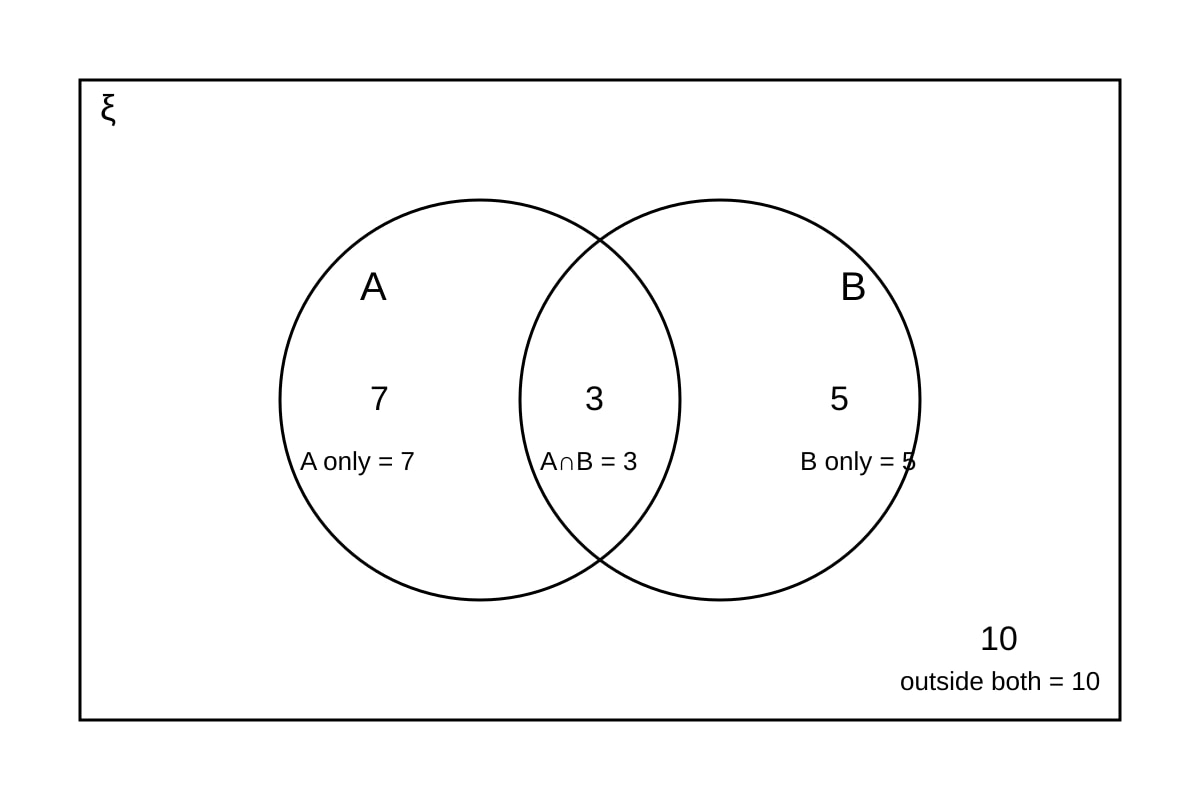
From diagram: n(A∪B) = 7 + 5 + 3 = 15.
Total students = 15 + 10 = 25.
P(A∪B) = ( \frac{15}{25} = \frac{3}{5} ).
Answer: n(A∪B)=15, P=( \frac{3}{5} ).
Teaching note: Union includes all inside circles.
Q18. [2 marks]
P(red) = ( \frac{3}{5} ). With replacement, independent.
P(both red) = ( \frac{3}{5} \times \frac{3}{5} = \frac{9}{25} ).
Answer: ( \frac{9}{25} ).
Q19. [2 marks]
Total students = 10+8+6+4+7+9+5+3 = 52.
Girls liking Badminton = 9.
P = ( \frac{9}{52} ).
Answer: ( \frac{9}{52} ).
Q20. [3 marks]
Hearts = 13, Kings = 4, King of Hearts counted twice.
Favourable = 13 + 4 – 1 = 16.
P = ( \frac{16}{52} = \frac{4}{13} ).
Answer: ( \frac{4}{13} ).
Teaching note: Use OR rule: P(A∪B)=P(A)+P(B)–P(A∩B).