AI Generated Quiz
O Level Elementary Mathematics Algebra Functions Quiz
Free O Level E Maths Algebra Functions quiz, DeepSeek AI version, with questions, answers, and O Level-style practice for Singapore students.
These static practice materials are generated from the site's syllabus and paper-generation workflow, with source and model context shown so students and parents can evaluate the material before use.
Questions
Free quiz and exam paper access
Enter your details to view this paper
Your access is remembered on this device.
Answers
O-Level Elementary Mathematics Quiz - Algebra Functions
ANSWER KEY AND MARKING SCHEME
Total Marks: 50
Section A: Short Answer (10 marks)
1. f(-2) = 3(-2)² - 5(-2) + 2 = 3(4) + 10 + 2 = 12 + 10 + 2 = 24 [M1 for correct substitution, A1 for correct answer]
2. 4x - 7 = 13 4x = 20 x = 5 [M1 for setting up equation, A1 for correct answer]
3. h(x) is undefined when denominator = 0: x - 2 = 0 x = 2 [M1 for setting denominator to zero, A1 for correct answer]
4. p(1) = a(1) + b = 5 → a + b = 5 ...(1) p(3) = a(3) + b = 13 → 3a + b = 13 ...(2) (2) - (1): 2a = 8 → a = 4 Substitute into (1): 4 + b = 5 → b = 1 a = 4, b = 1 [M1 for forming equations, A1 for both correct]
5. y = x² - 6x + 11 = (x² - 6x + 9) + 11 - 9 = (x - 3)² + 2 y = (x - 3)² + 2 [M1 for completing the square, A1 for correct form]
Section B: Structured Questions (20 marks)
6. f(x) = 2x² - 8x + 5
(a) f(x) = 2(x² - 4x) + 5 = 2(x² - 4x + 4 - 4) + 5 = 2[(x - 2)² - 4] + 5 = 2(x - 2)² - 8 + 5 = 2(x - 2)² - 3 [M1 for factorising out 2 and completing square, A1 for correct expression]
(b) Turning point is at (2, -3). Since a = 2 > 0, it is a minimum point. [B1 for coordinates, B1 for minimum]
(c) Line of symmetry: x = 2 [B1]
7. f(x) = 3x + 1, g(x) = x² - 4
(a) fg(2) = f(g(2)) g(2) = 2² - 4 = 0 f(0) = 3(0) + 1 = 1 [M1 for finding g(2), A1 for correct answer]
(b) gf(x) = g(f(x)) = g(3x + 1) = (3x + 1)² - 4 = 9x² + 6x + 1 - 4 = 9x² + 6x - 3 [M1 for substitution, A1 for correct simplified expression]
(c) fg(x) = gf(x) f(x² - 4) = 9x² + 6x - 3 3(x² - 4) + 1 = 9x² + 6x - 3 3x² - 12 + 1 = 9x² + 6x - 3 3x² - 11 = 9x² + 6x - 3 0 = 6x² + 6x + 8 0 = 3x² + 3x + 4 Discriminant = 3² - 4(3)(4) = 9 - 48 = -39 < 0 No real solutions [M1 for finding fg(x), M1 for setting up equation, A1 for correct conclusion]
8. h(t) = 20t - 5t²
(a) h(1.5) = 20(1.5) - 5(1.5)² = 30 - 5(2.25) = 30 - 11.25 = 18.75 m [A1]
(b) Stone hits ground when h(t) = 0: 20t - 5t² = 0 5t(4 - t) = 0 t = 0 or t = 4 t = 0 is initial position, so stone hits ground at t = 4 seconds [M1 for setting h(t) = 0, A1 for correct answer]
(c) h(t) = -5t² + 20t = -5(t² - 4t) = -5(t² - 4t + 4 - 4) = -5[(t - 2)² - 4] = -5(t - 2)² + 20 = 20 - 5(t - 2)² Maximum height = 20 m, occurring at t = 2 seconds [M1 for completing square, A1 for maximum height, A1 for time]
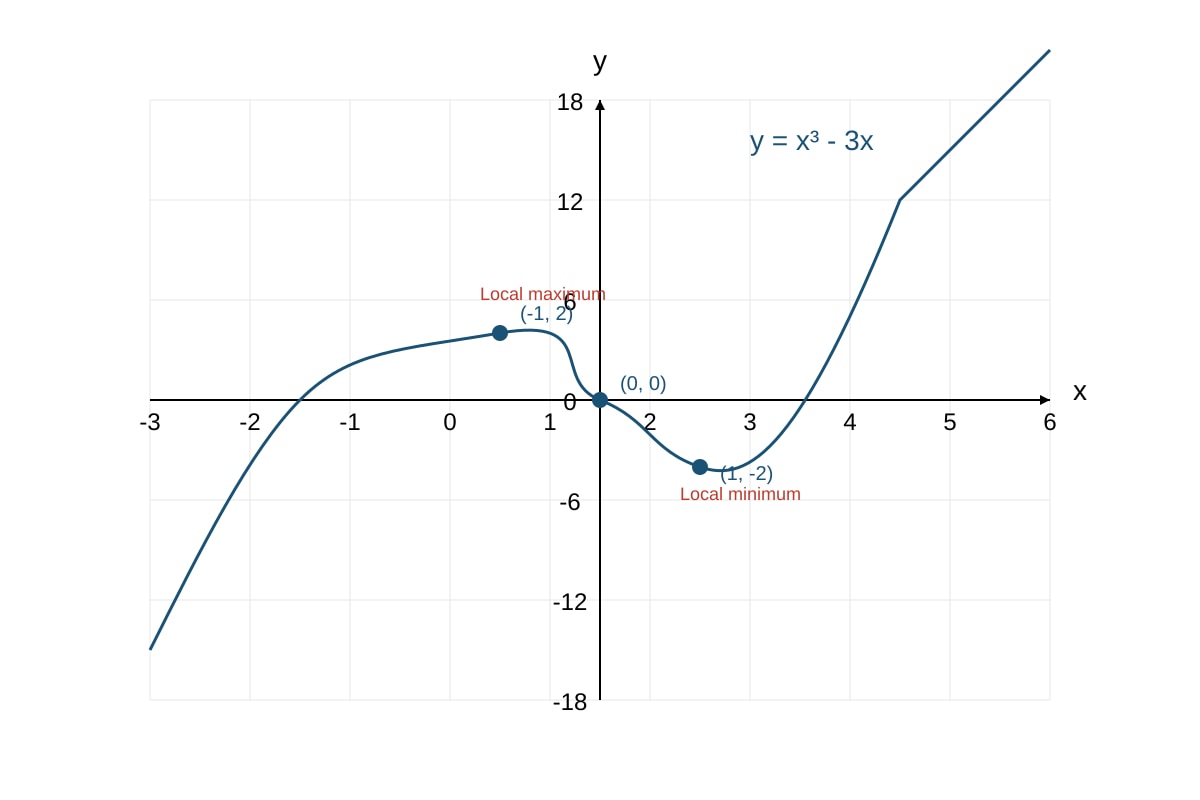
9. f(x) = x³ - 3x
(a) From graph, f(x) = 0 when curve crosses x-axis: x = -√3 ≈ -1.73, 0, √3 ≈ 1.73 (accept values read from graph: approximately -1.7, 0, 1.7) [A1 for all three]
(b) Graph of y = f(x) + 2 is the original graph shifted up by 2 units. y-intercept: when x = 0, y = f(0) + 2 = 0 + 2 = 2 x-intercepts: solve x³ - 3x + 2 = 0 (x - 1)(x² + x - 2) = 0 (x - 1)(x + 2)(x - 1) = 0 x = 1 (repeated), x = -2 [Sketch should show cubic shifted up, crossing x-axis at x = -2 and touching at x = 1, crossing y-axis at (0, 2)] [B1 for correct y-intercept, B1 for correct x-intercepts and shape]
(c) For exactly three solutions, k must be between the local maximum and local minimum values. From graph, local maximum ≈ 2, local minimum ≈ -2. Range: -2 < k < 2 [B1]
10. f(x) = (2x + 1)/(x - 3), x ≠ 3
(a) f(4) = (2(4) + 1)/(4 - 3) = 9/1 = 9 [A1]
(b) Let y = (2x + 1)/(x - 3) y(x - 3) = 2x + 1 yx - 3y = 2x + 1 yx - 2x = 3y + 1 x(y - 2) = 3y + 1 x = (3y + 1)/(y - 2) Therefore, f⁻¹(x) = (3x + 1)/(x - 2) [M1 for cross-multiplying, M1 for collecting x terms, A1 for correct expression]
(c) Domain of f⁻¹: x ≠ 2 (all real numbers except 2) [B1]
(d) f(x) = f⁻¹(x) (2x + 1)/(x - 3) = (3x + 1)/(x - 2) (2x + 1)(x - 2) = (3x + 1)(x - 3) 2x² - 4x + x - 2 = 3x² - 9x + x - 3 2x² - 3x - 2 = 3x² - 8x - 3 0 = x² - 5x - 1 x = [5 ± √(25 + 4)]/2 x = (5 ± √29)/2 x = (5 + √29)/2 or x = (5 - √29)/2 [M1 for cross-multiplying, M1 for solving quadratic, A1 for both solutions]
Section C: Application and Reasoning (20 marks)
11. P(x) = -2x² + 120x - 800
(a) P(20) = -2(20)² + 120(20) - 800 = -2(400) + 2400 - 800 = -800 + 2400 - 800 = $800 [A1]
(b) P(x) = -2x² + 120x - 800 = -2(x² - 60x) - 800 = -2(x² - 60x + 900 - 900) - 800 = -2[(x - 30)² - 900] - 800 = -2(x - 30)² + 1800 - 800 = 1000 - 2(x - 30)² [M1 for completing square, A1 for correct form]
(c) Maximum profit occurs at vertex: $1000 when x = 30 units [B1 for profit, B1 for units]
(d) P(x) > 0: -2x² + 120x - 800 > 0 x² - 60x + 400 < 0 (x - 20)(x - 40) < 0 20 < x < 40 [M1 for factorising, M1 for inequality sign, A1 for correct range]
12. (a) Fencing: x + y + x = 60 (two widths and one length) 2x + y = 60 y = 60 - 2x [A1]
(b) Area A = x × y = x(60 - 2x) = 60x - 2x² [B1 for showing substitution]
(c) A = -2x² + 60x = -2(x² - 30x) = -2(x² - 30x + 225 - 225) = -2[(x - 15)² - 225] = 450 - 2(x - 15)² Maximum area when x = 15 Maximum area = 450 m² x = 15 [M1 for completing square, A1 for x value, A1 for maximum area]
13. f(x) = x² - 4x + 7 = (x² - 4x + 4) + 7 - 4 = (x - 2)² + 3 Since (x - 2)² ≥ 0, minimum value is 3. Range: f(x) ≥ 3 [M1 for completing square, A1 for correct range]
14. g(x) = 5/(x - 1) for x > 1 Let y = 5/(x - 1) y(x - 1) = 5 x - 1 = 5/y x = 5/y + 1 g⁻¹(x) = 5/x + 1 Domain of g⁻¹: Since range of g for x > 1 is y > 0, domain is x > 0 [M1 for swapping and solving, A1 for expression, B1 for domain]
15. (x + 2)/(x - 1) = 3 x + 2 = 3(x - 1) x + 2 = 3x - 3 2 + 3 = 3x - x 5 = 2x x = 2.5 [M1 for cross-multiplying, A1 for correct answer]
Section D: Problem Solving (10 marks)
16. Let the numbers be x and y. x + y = 10 → y = 10 - x x² + y² = 58 x² + (10 - x)² = 58 x² + 100 - 20x + x² = 58 2x² - 20x + 42 = 0 x² - 10x + 21 = 0 (x - 3)(x - 7) = 0 x = 3 or x = 7 The two numbers are 3 and 7 [M1 for forming equation, M1 for solving, A1 for both numbers]
17. f(x) = 2x² - 3x + 1 = 6 2x² - 3x - 5 = 0 (2x - 5)(x + 1) = 0 x = 5/2 or x = -1 x = 2.5 or x = -1 [M1 for setting equation, M1 for factorising, A1 for both solutions]
18. y = (x - 2)(x + 4) x-intercepts: x = 2, x = -4 → A(-4, 0), B(2, 0) y-intercept: y = (0 - 2)(0 + 4) = -8 → C(0, -8) Base AB = 2 - (-4) = 6 Height = | -8 | = 8 Area = 1/2 × 6 × 8 = 24 square units [M1 for finding intercepts, A1 for correct area]
19. f(x) = ax² + bx + c Minimum at (1, -4): f(x) = a(x - 1)² - 4 f(0) = a(0 - 1)² - 4 = a - 4 = -1 → a = 3 f(x) = 3(x - 1)² - 4 = 3(x² - 2x + 1) - 4 = 3x² - 6x - 1 a = 3, b = -6, c = -1 [M1 for using vertex form, A1 for all correct]
20. h(x) = 1/(x + 2) Let y = 1/(x + 2) y(x + 2) = 1 x + 2 = 1/y x = 1/y - 2 h⁻¹(x) = 1/x - 2 h(x) = h⁻¹(x): 1/(x + 2) = 1/x - 2 1/(x + 2) + 2 = 1/x (1 + 2x + 4)/(x + 2) = 1/x (2x + 5)/(x + 2) = 1/x x(2x + 5) = x + 2 2x² + 5x = x + 2 2x² + 4x - 2 = 0 x² + 2x - 1 = 0 x = [-2 ± √(4 + 4)]/2 = -1 ± √2 x = -1 + √2 or x = -1 - √2 [M1 for finding inverse, M1 for solving, A1 for both solutions]
END OF ANSWER KEY