From Real Exams Exam Paper

O Level Elementary Mathematics Practice Paper 3

Free Exam-Derived Qwen3.7 Plus O Level Elementary Mathematics Practice Paper 3 practice paper with questions and answers for Singapore students. This page is rendered as a direct URL so the questions and answers can be discovered without pressing in-page buttons.

These static practice materials are generated from the site's syllabus and paper-generation workflow, with source and model context shown so students and parents can evaluate the material before use.

O Level Elementary Mathematics From Real Exams Generated by Qwen3.7 Plus Updated 2026-06-04

Questions

<!-- TuitionGoWhere generation metadata: stage=3-1; model=qwen/qwen3.7-plus; model_label=Qwen3.7 Plus; generated=2026-06-04; Sources: Stage 2-1 real exam-derived templates and Stage 2-2 exam-enriched syllabus. -->

TuitionGoWhere Practice Paper - Elementary Mathematics O-Level

TuitionGoWhere Exam Practice (AI)

Subject: Elementary Mathematics (4052)
Level: O-Level
Topic: Geometry & Trigonometry
Paper: Practice Paper (Version 3 of 5)
Duration: 1 hour 30 minutes
Total Marks: 60

Name: __________________________
Class: __________________________
Date: __________________________

Instructions to Candidates:

  1. Write your name, class, and date in the spaces provided.
  2. Answer all questions.
  3. Write your answers in the spaces provided in this booklet.
  4. If working is needed for any question it must be shown below that question.
  5. The use of an approved scientific calculator is expected.
  6. Where appropriate, give non-exact numerical answers correct to 3 significant figures, or 1 decimal place for angles in degrees, unless a different level of accuracy is specified in the question.

Section A (30 Marks)

Answer all questions in this section. Questions carry 1–3 marks each.

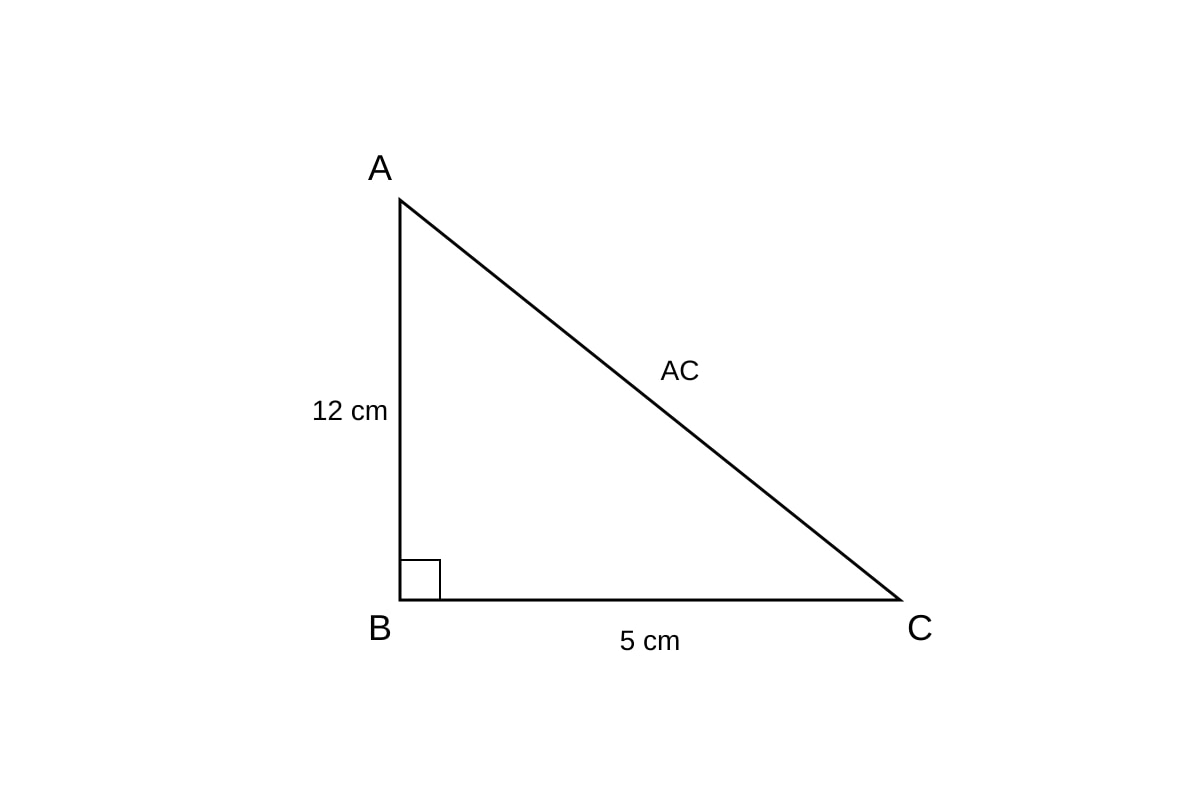
1. In the diagram below, ABCABC is a right-angled triangle with ABC=90\angle ABC = 90^\circ. AB=12AB = 12 cm and BC=5BC = 5 cm. <image_placeholder> id: Q1-fig1 type: diagram linked_question: Q1 description: Right-angled triangle ABC with right angle at B. Side AB is vertical, BC is horizontal. Hypotenuse AC connects top of AB to end of BC. labels: A (top), B (bottom-left, 90 deg symbol), C (bottom-right) values: AB = 12 cm, BC = 5 cm must_show: Right angle symbol at B, side lengths labeled. </image_placeholder>

Calculate the length of ACAC.

Answer: __________________________ cm [2]

2. Solve the equation tanx=0.5\tan x^\circ = 0.5 for 0x900^\circ \le x \le 90^\circ. Give your answer correct to 1 decimal place.

Answer: x=x = __________________________ [2]

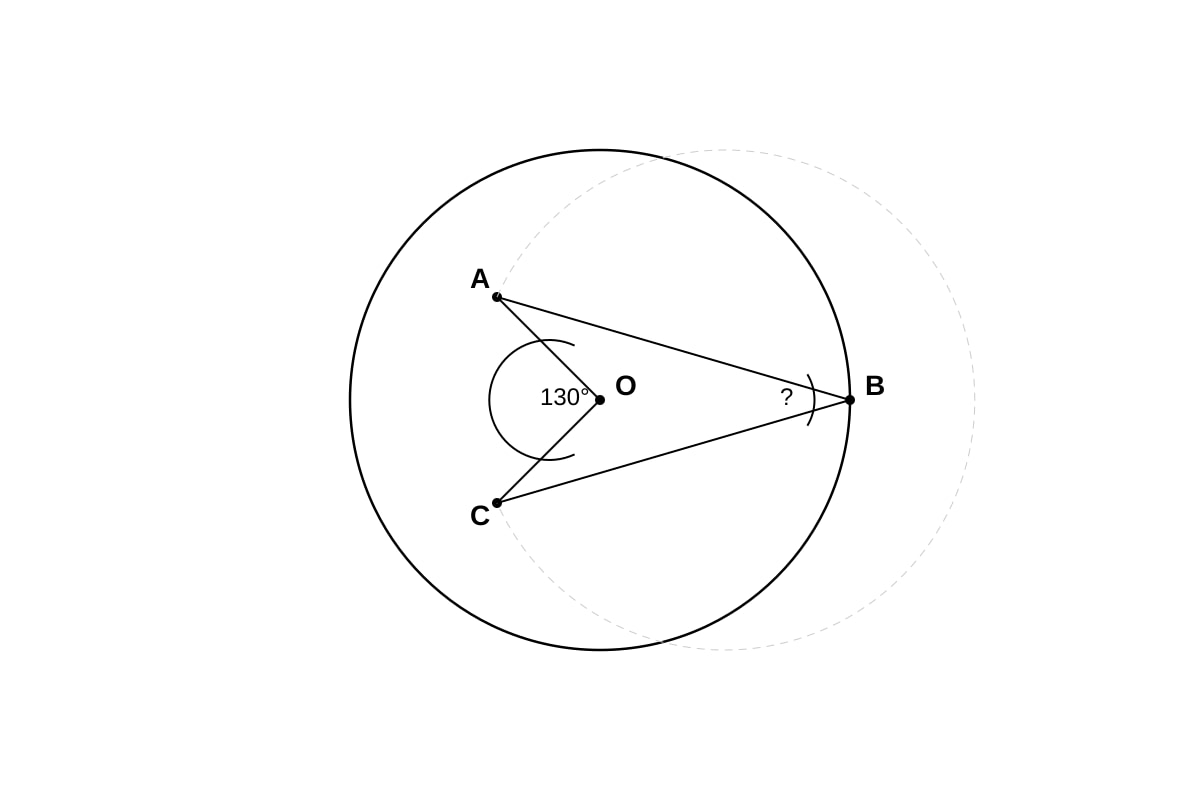
3. The diagram shows a circle with centre OO. Points A,BA, B, and CC lie on the circumference. AOC=130\angle AOC = 130^\circ. <image_placeholder> id: Q3-fig1 type: diagram linked_question: Q3 description: Circle with centre O. Points A, B, C on circumference. Angle AOC is obtuse. Angle ABC is inscribed angle subtending the major arc AC? No, standard theorem: Angle at centre is twice angle at circumference. Let's make B on the major arc so angle ABC is acute. labels: O (centre), A, B, C on circle. values: Angle AOC = 130 degrees. must_show: Angle AOC marked 130. Point B on the major arc. Angle ABC to be found. </image_placeholder>

Find the value of ABC\angle ABC.

Answer: ABC=\angle ABC = __________________________ ^\circ [2]

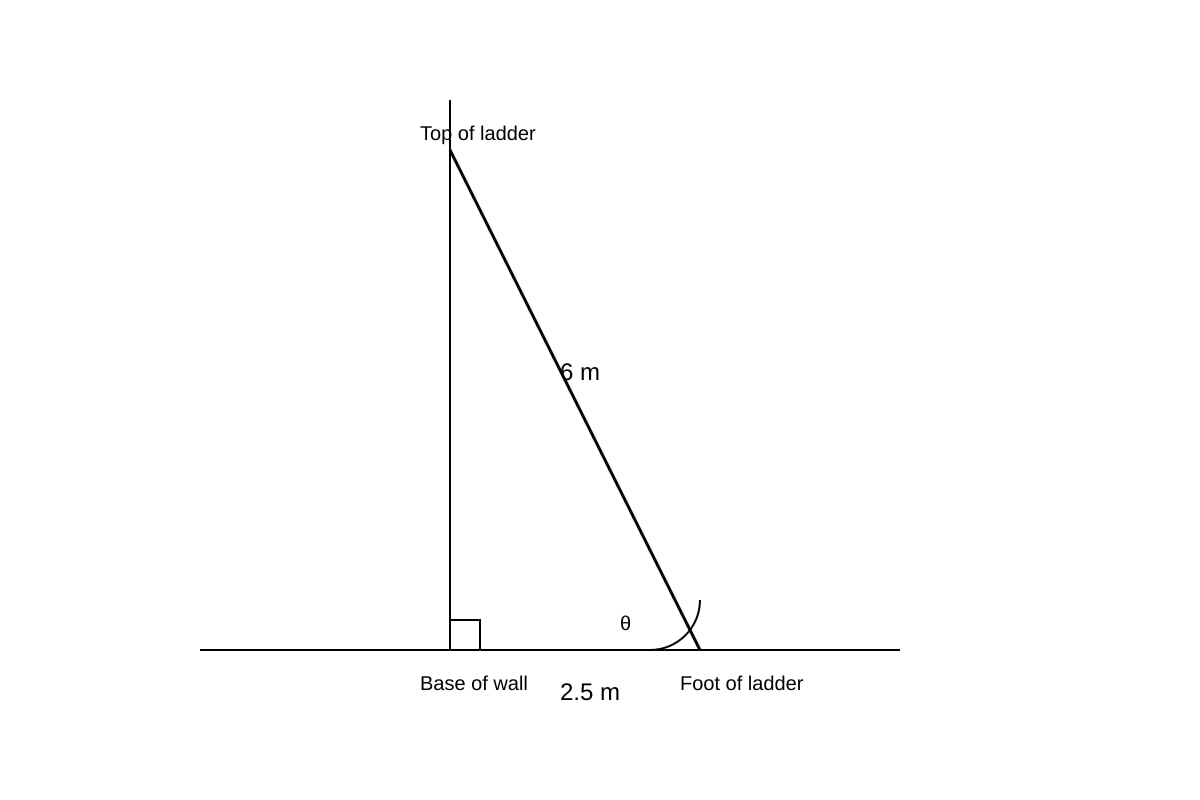
4. A ladder of length 6 m leans against a vertical wall. The foot of the ladder is 2.5 m from the base of the wall. <image_placeholder> id: Q4-fig1 type: diagram linked_question: Q4 description: Right-angled triangle formed by ladder, wall, and ground. Hypotenuse is ladder. Vertical side is wall. Horizontal side is ground. labels: Top of ladder, Foot of ladder, Base of wall. values: Hypotenuse = 6 m, Base = 2.5 m. must_show: Right angle between wall and ground. </image_placeholder>

Calculate the angle the ladder makes with the horizontal ground. Give your answer correct to 1 decimal place.

Answer: __________________________ ^\circ [2]

5. In the diagram, ABAB is parallel to CDCD. BAE=40\angle BAE = 40^\circ and CDE=35\angle CDE = 35^\circ. EE is a point between the parallel lines such that AEDA-E-D is not a straight line, but rather a zig-zag AEDA-E-D? No, let's use the standard "zig-zag" or "M" shape. Let's refine: ABCDAB \parallel CD. Transversal ADAD intersects them? No. Let's use: ABCDAB \parallel CD. Point EE is such that AEAE and DEDE meet at EE. BAE=40\angle BAE = 40^\circ, CDE=35\angle CDE = 35^\circ. Find AED\angle AED. <image_placeholder> id: Q5-fig1 type: diagram linked_question: Q5 description: Two parallel horizontal lines AB (top) and CD (bottom). Point E is between them. Line segment AE connects A on top line to E. Line segment DE connects D on bottom line to E. Angle BAE is inside the parallel strip. Angle CDE is inside the parallel strip. labels: A, B on top line. C, D on bottom line. E in middle. values: Angle BAE = 40 deg, Angle CDE = 35 deg. must_show: Parallel arrows on AB and CD. Angles marked. </image_placeholder>

Calculate AED\angle AED.

Answer: AED=\angle AED = __________________________ ^\circ [2]

6. The volume of a cylinder is 500 cm3500 \text{ cm}^3. Its height is 10 cm. Calculate the radius of the base of the cylinder. Give your answer correct to 3 significant figures.

Answer: __________________________ cm [3]

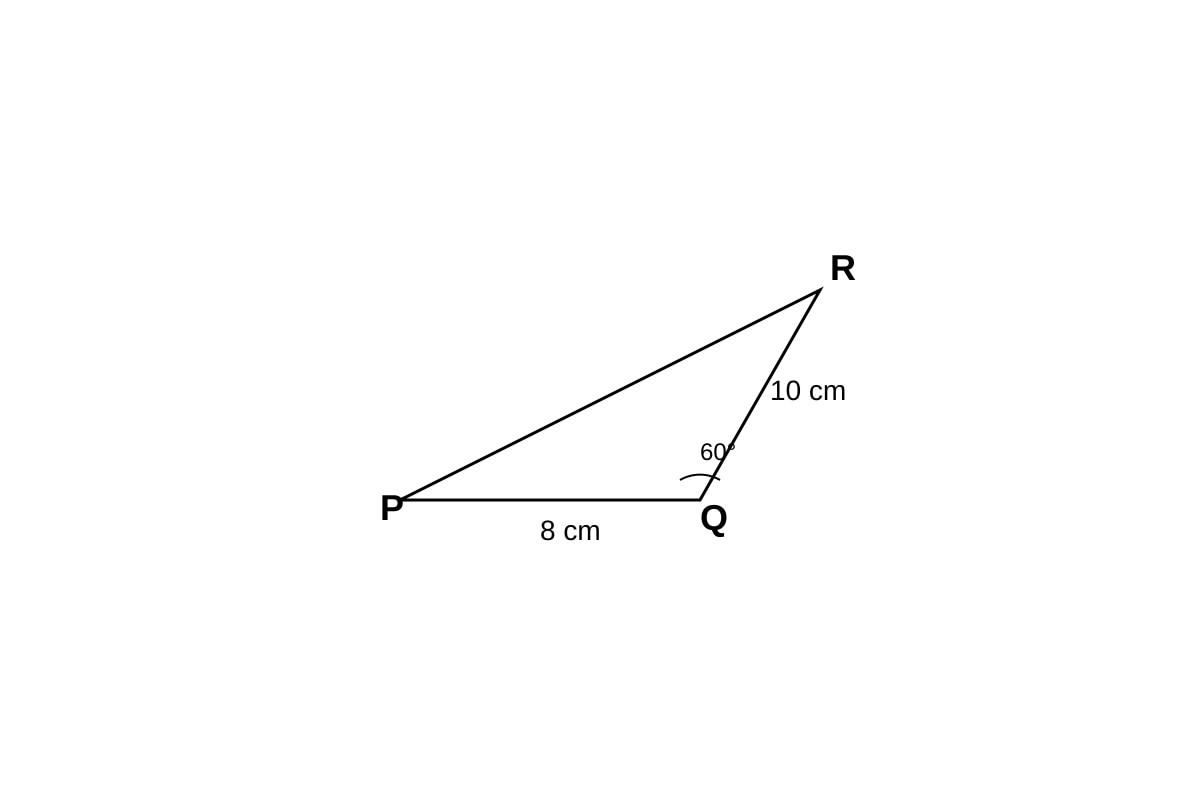
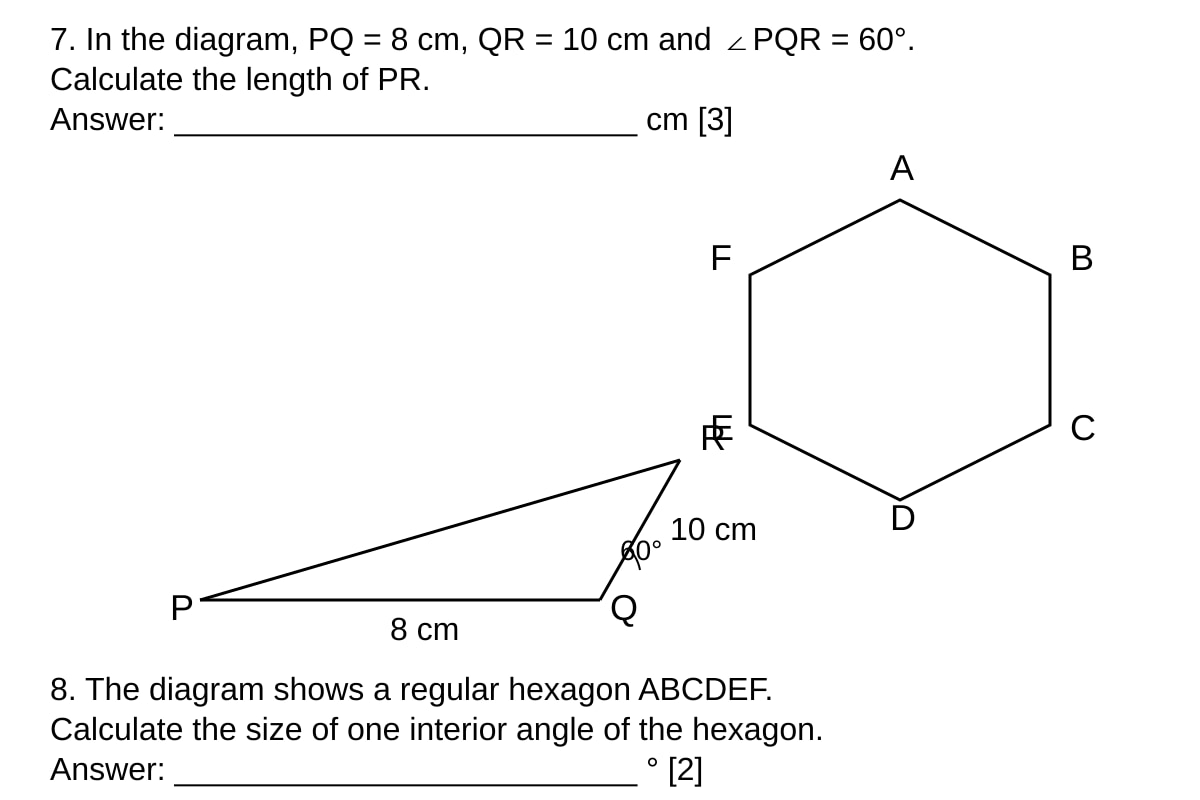
7. In PQR\triangle PQR, PQ=8PQ = 8 cm, QR=10QR = 10 cm and PQR=60\angle PQR = 60^\circ. <image_placeholder> id: Q7-fig1 type: diagram linked_question: Q7 description: Triangle PQR. Side PQ and QR known. Included angle Q known. labels: P, Q, R. values: PQ=8, QR=10, Angle PQR=60. must_show: Angle 60 marked at Q. </image_placeholder>

Calculate the length of PRPR.

Answer: __________________________ cm [3]

8. The diagram shows a regular hexagon ABCDEFABCDEF. <image_placeholder> id: Q8-fig1 type: diagram linked_question: Q8 description: Regular hexagon ABCDEF. labels: Vertices A, B, C, D, E, F in order. must_show: Regular shape indication. </image_placeholder>

Calculate the size of one interior angle of the hexagon.

Answer: __________________________ ^\circ [2]

9. Given that sinθ=35\sin \theta = \frac{3}{5} and θ\theta is an acute angle, find the exact value of cosθ\cos \theta.

Answer: cosθ=\cos \theta = __________________________ [2]

10. A cone has a base radius of 3 cm and a slant height of 5 cm. Calculate the total surface area of the cone. Leave your answer in terms of π\pi.

Answer: __________________________ cm2\text{cm}^2 [3]


Section B (30 Marks)

Answer all questions in this section. Questions carry 4–6 marks each.

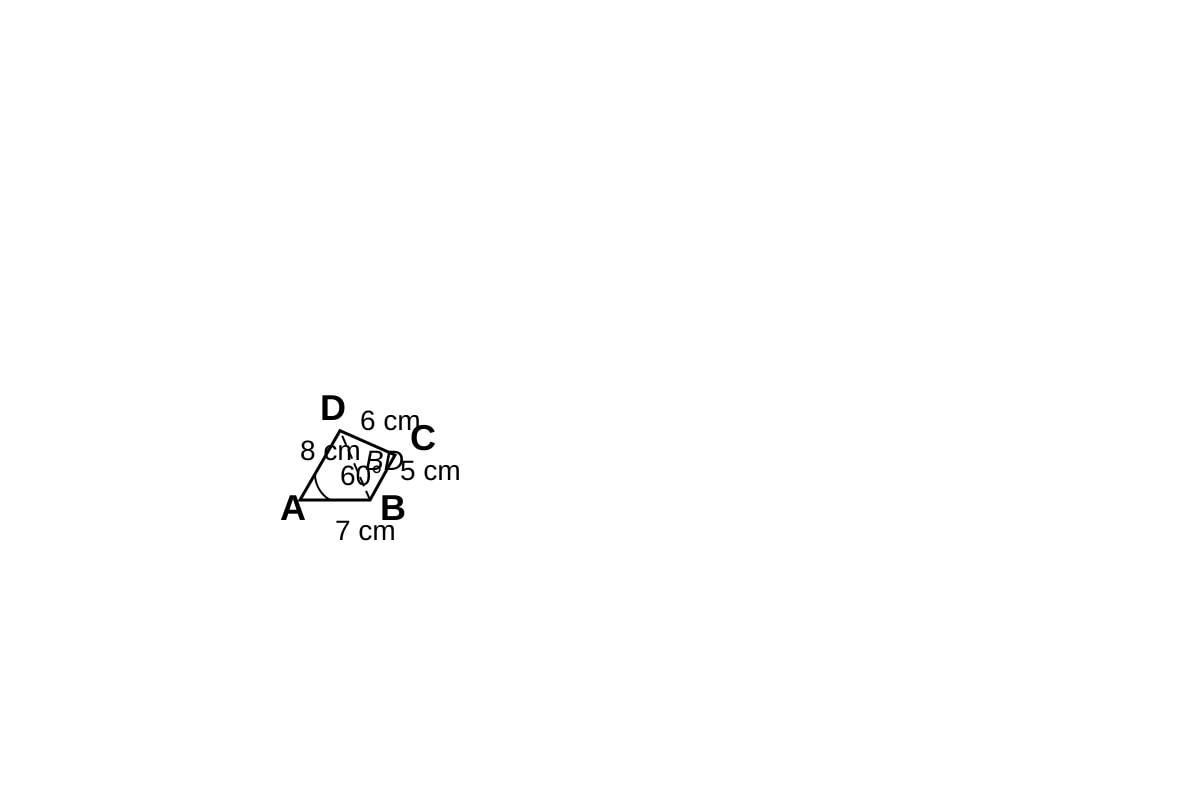
11. The diagram shows a quadrilateral ABCDABCD. AB=7AB = 7 cm, BC=5BC = 5 cm, CD=6CD = 6 cm, DA=8DA = 8 cm and DAB=60\angle DAB = 60^\circ. <image_placeholder> id: Q11-fig1 type: diagram linked_question: Q11 description: Quadrilateral ABCD. Diagonal BD is drawn to split it into two triangles ABD and BCD. labels: A, B, C, D. values: AB=7, AD=8, Angle DAB=60. BC=5, CD=6. must_show: Diagonal BD. Angle A marked 60. </image_placeholder>

(a) Calculate the length of the diagonal BDBD. [3]

Answer: __________________________ cm

(b) Hence, or otherwise, calculate BCD\angle BCD. [3]

Answer: BCD=\angle BCD = __________________________ ^\circ

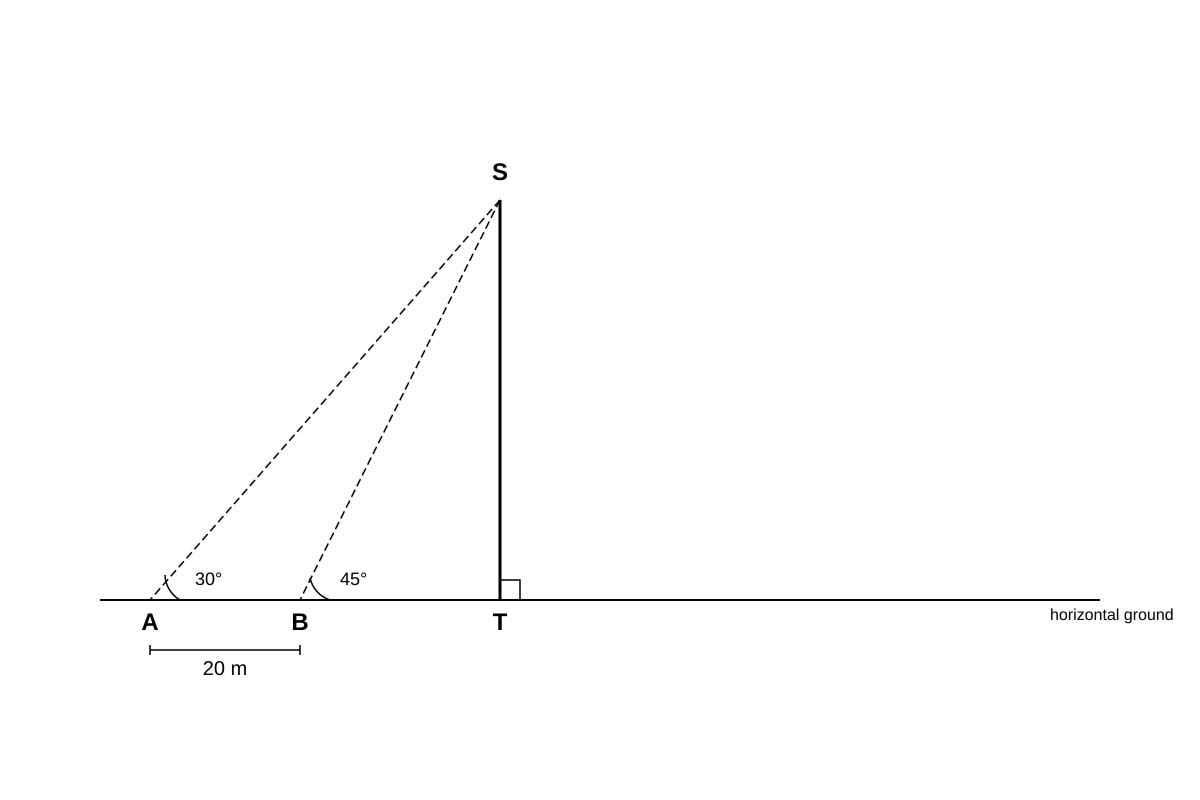
12. The diagram shows a vertical tower STST standing on horizontal ground. Points AA and BB are on the ground in a straight line with the foot of the tower TT. The angle of elevation of the top of the tower SS from AA is 3030^\circ and from BB is 4545^\circ. The distance AB=20AB = 20 m. <image_placeholder> id: Q12-fig1 type: diagram linked_question: Q12 description: Vertical line ST (tower). Horizontal line passing through T, B, A. B is closer to T than A. Angle SAT = 30 deg. Angle SBT = 45 deg. Distance AB = 20m. labels: S (top), T (foot), A, B. values: Angle A = 30, Angle B = 45, AB = 20. must_show: Right angles at T. </image_placeholder>

(a) Let the height of the tower ST=hST = h m. Express TBTB in terms of hh. [1]

Answer: TB=TB = __________________________

(b) Express TATA in terms of hh. [1]

Answer: TA=TA = __________________________

(c) Form an equation in hh and solve it to find the height of the tower. Give your answer correct to 3 significant figures. [4]

Answer: Height = __________________________ m

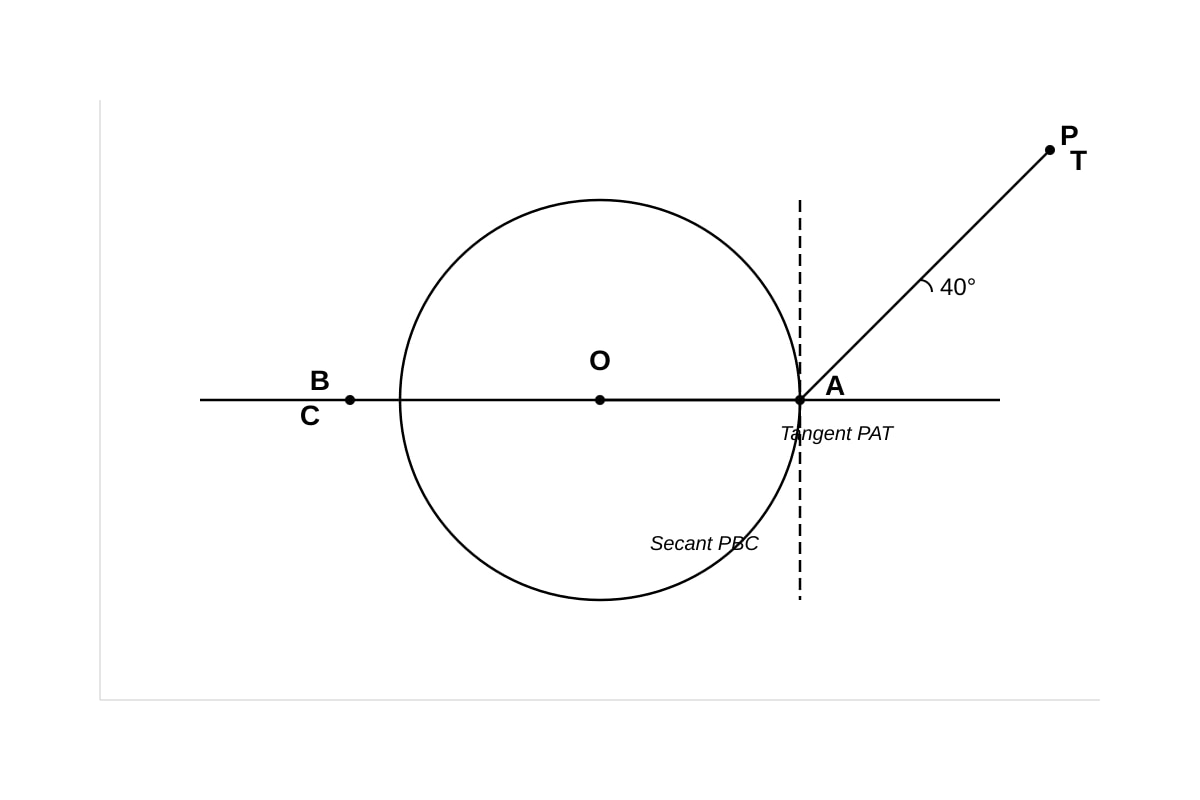
13. In the diagram, OO is the centre of the circle. PATPAT is a tangent to the circle at AA. PBCPBC is a secant line passing through the centre OO. APT=40\angle APT = 40^\circ. <image_placeholder> id: Q13-fig1 type: diagram linked_question: Q13 description: Circle with centre O. Tangent PAT at A. Secant PBC passes through O. P is outside. B is closer to P, C is further. Radius OA is drawn. labels: P, A, T (tangent line). P, B, O, C (secant line). values: Angle APT = 40 deg. must_show: Right angle between radius OA and tangent PAT. </image_placeholder>

(a) State the value of OAP\angle OAP. [1]

Answer: OAP=\angle OAP = __________________________ ^\circ

(b) Calculate AOP\angle AOP. [2]

Answer: AOP=\angle AOP = __________________________ ^\circ

(c) Calculate ACB\angle ACB. [2]

Answer: ACB=\angle ACB = __________________________ ^\circ

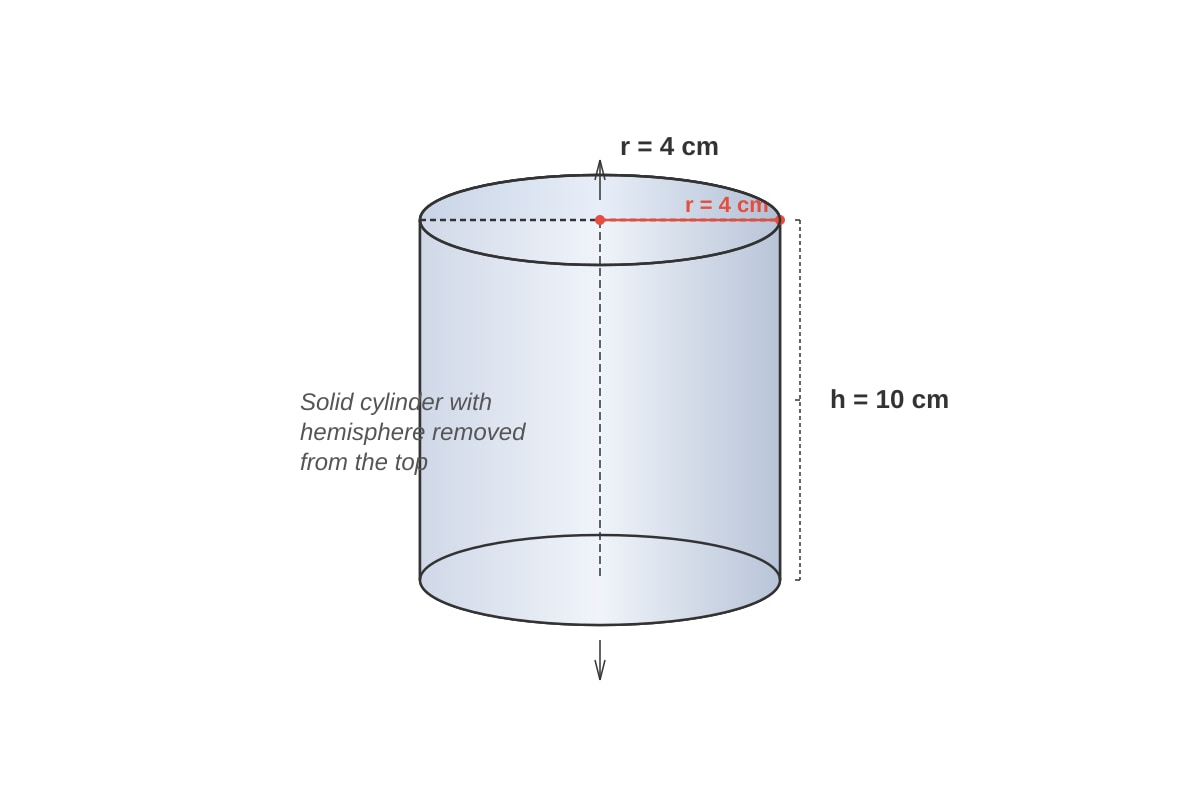
14. A solid is made by removing a hemisphere from a cylinder. The cylinder has a radius of 4 cm and a height of 10 cm. The hemisphere has the same radius as the cylinder and is removed from one end of the cylinder. <image_placeholder> id: Q14-fig1 type: diagram linked_question: Q14 description: Cylinder with a hemispherical hollow at the top. labels: Radius r=4, Height h=10. must_show: Dimensions labeled. </image_placeholder>

(a) Calculate the volume of the remaining solid. Give your answer correct to 3 significant figures. [4]

Answer: __________________________ cm3\text{cm}^3

(b) Calculate the total surface area of the remaining solid. Give your answer correct to 3 significant figures. [4]

Answer: __________________________ cm2\text{cm}^2

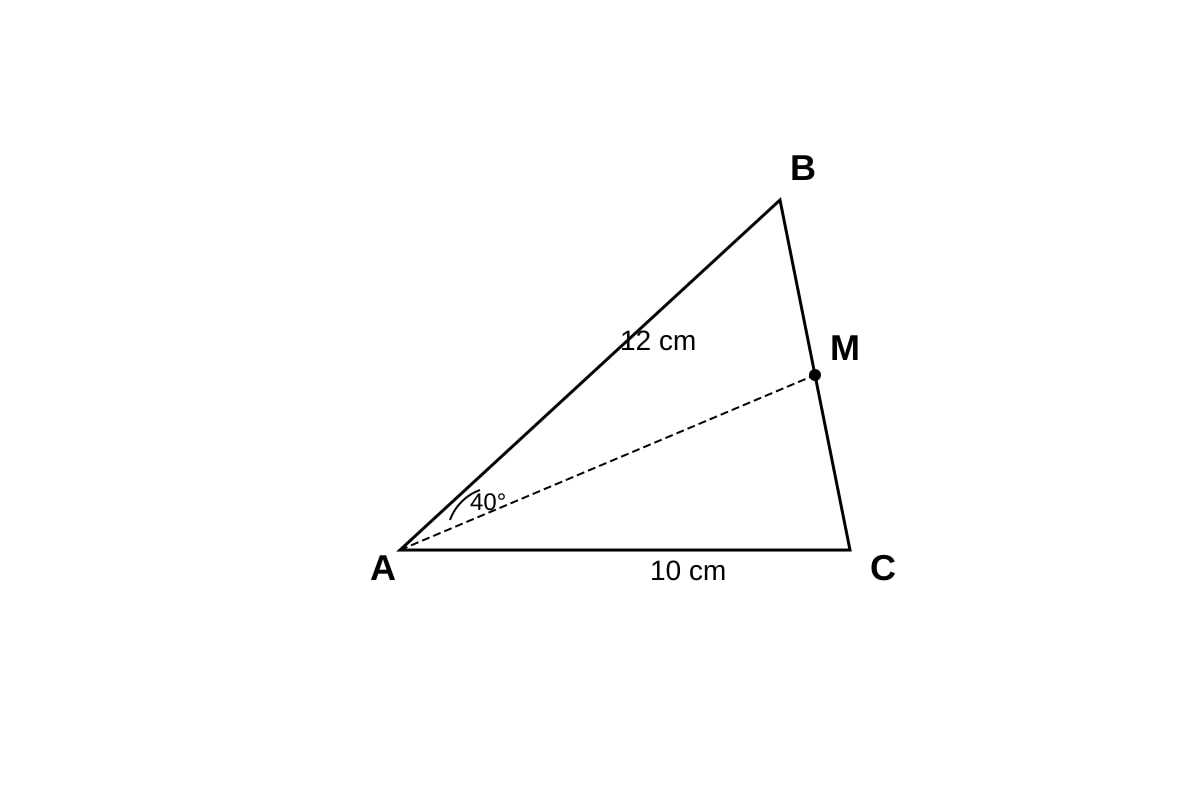
15. The diagram shows a triangle ABCABC with AB=12AB = 12 cm, AC=10AC = 10 cm and BAC=40\angle BAC = 40^\circ. MM is the midpoint of BCBC. <image_placeholder> id: Q15-fig1 type: diagram linked_question: Q15 description: Triangle ABC. Median AM drawn. labels: A, B, C, M. values: AB=12, AC=10, Angle A=40. must_show: M marked as midpoint of BC. </image_placeholder>

(a) Calculate the length of BCBC. [3]

Answer: __________________________ cm

(b) Calculate the area of ABC\triangle ABC. [2]

Answer: __________________________ cm2\text{cm}^2

(c) Calculate the length of the median AMAM. [3]

Answer: __________________________ cm

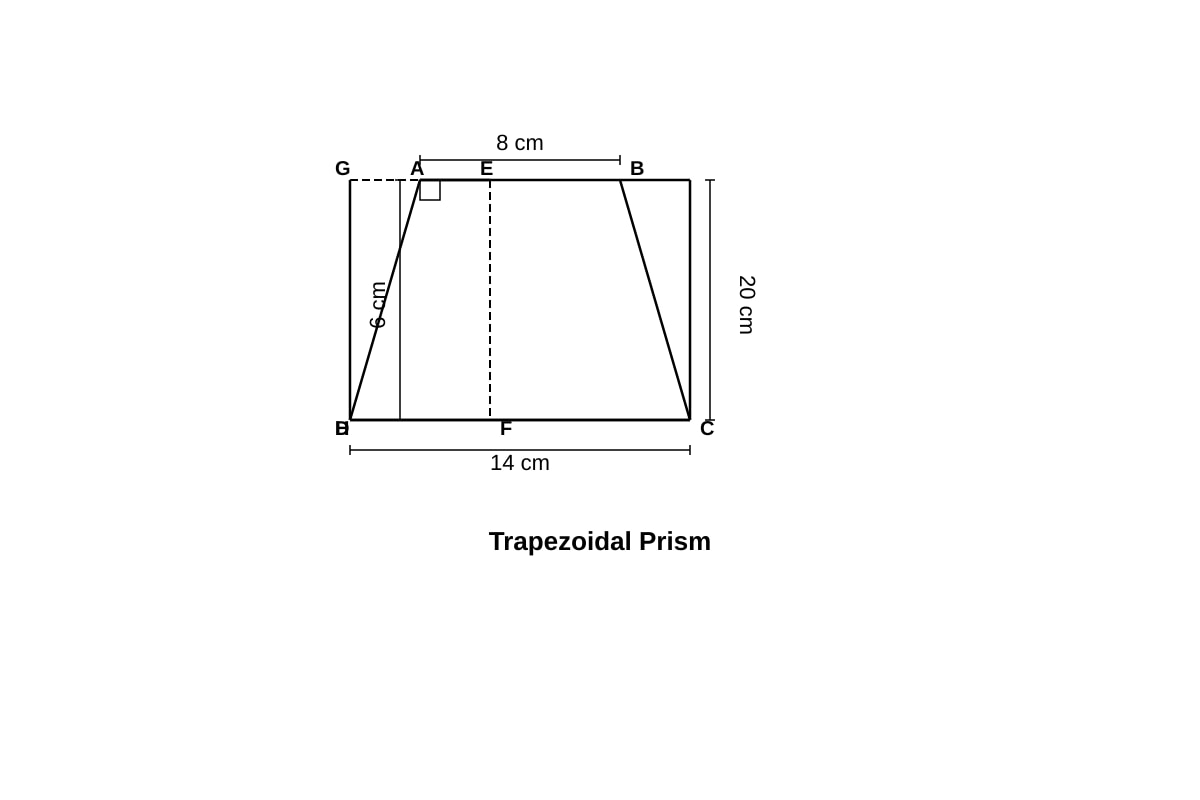
16. The diagram shows a prism with a cross-section in the shape of a trapezium. The parallel sides of the trapezium are 8 cm and 14 cm. The perpendicular height of the trapezium is 6 cm. The length of the prism is 20 cm. <image_placeholder> id: Q16-fig1 type: diagram linked_question: Q16 description: Trapezoidal prism. labels: Parallel sides 8 and 14. Height 6. Length 20. must_show: Right angle symbol for height of trapezium. </image_placeholder>

(a) Calculate the volume of the prism. [3]

Answer: __________________________ cm3\text{cm}^3

(b) Calculate the total surface area of the prism. Note: The non-parallel sides of the trapezium are equal in length. [5]

Answer: __________________________ cm2\text{cm}^2

17. In the diagram, ABCDABCD is a rectangle. EE is a point on CDCD such that DE=3DE = 3 cm and EC=5EC = 5 cm. DAE=30\angle DAE = 30^\circ. <image_placeholder> id: Q17-fig1 type: diagram linked_question: Q17 description: Rectangle ABCD. Point E on CD. Triangle ADE is right-angled at D. labels: A, B, C, D, E. values: DE=3, EC=5, Angle DAE=30. must_show: Right angles at corners of rectangle. </image_placeholder>

(a) Calculate the length of ADAD. [2]

Answer: __________________________ cm

(b) Calculate EBC\angle EBC. [3]

Answer: EBC=\angle EBC = __________________________ ^\circ

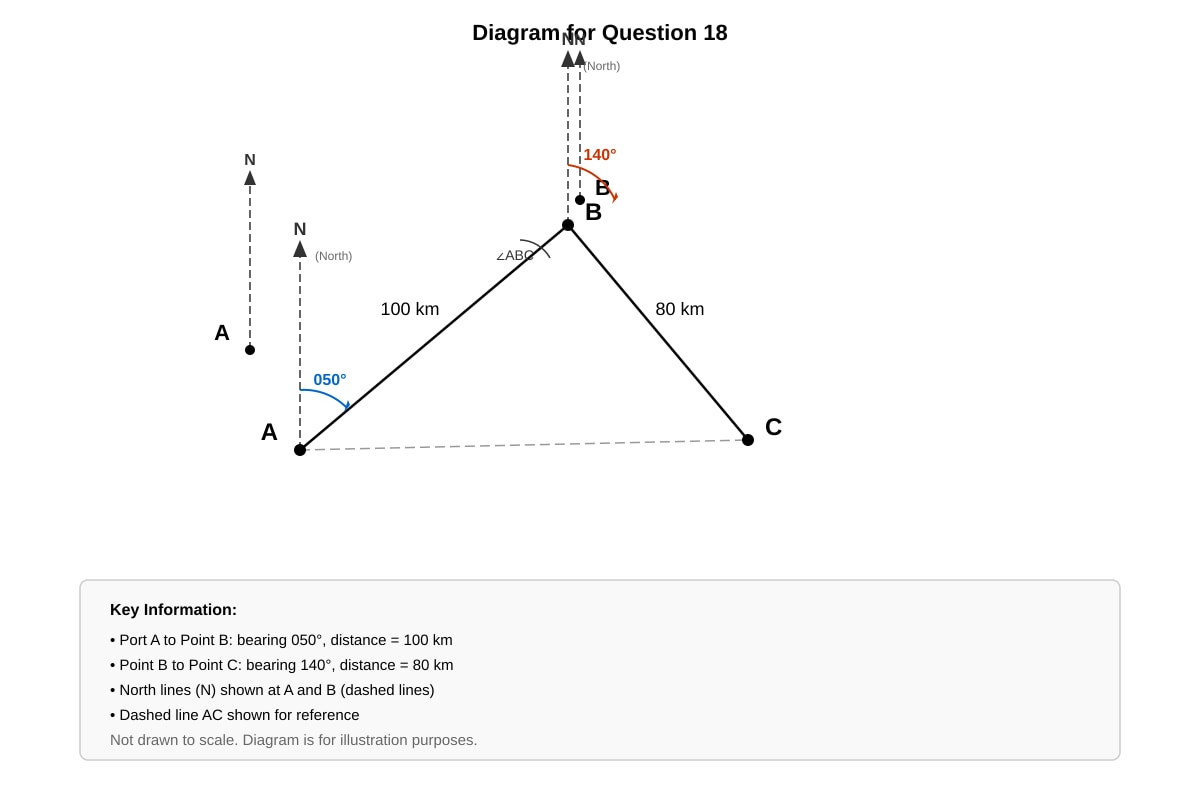
18. A ship sails from port AA on a bearing of 050050^\circ for 100 km to point BB. It then changes course and sails on a bearing of 140140^\circ for 80 km to point CC. <image_placeholder> id: Q18-fig1 type: diagram linked_question: Q18 description: Triangle ABC. North lines at A and B. Bearing 050 from A to B. Bearing 140 from B to C. labels: A, B, C. North arrows. values: AB=100, BC=80. must_show: Bearings indicated. </image_placeholder>

(a) Calculate the size of ABC\angle ABC. [2]

Answer: ABC=\angle ABC = __________________________ ^\circ

(b) Calculate the distance ACAC. [3]

Answer: __________________________ km

(c) Calculate the bearing of AA from CC. [3]

Answer: __________________________ ^\circ

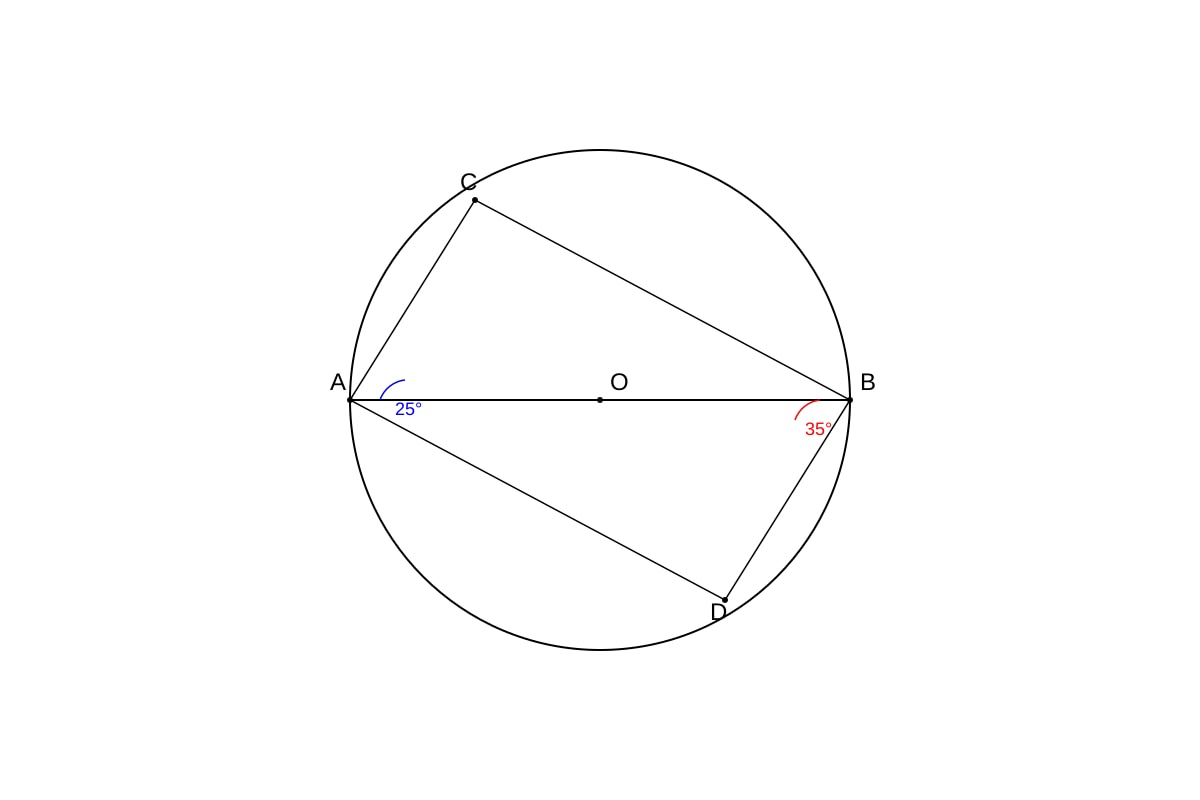
19. The diagram shows a circle with centre OO. ABAB is a diameter. CC and DD are points on the circumference such that ABCDABCD is a cyclic quadrilateral. CAB=25\angle CAB = 25^\circ and ABD=35\angle ABD = 35^\circ. <image_placeholder> id: Q19-fig1 type: diagram linked_question: Q19 description: Circle with diameter AB. Points C, D on circumference. Chords AC, CB, BD, DA drawn. labels: O, A, B, C, D. values: Angle CAB=25, Angle ABD=35. must_show: Diameter AB passing through O. </image_placeholder>

(a) Find ACB\angle ACB. [1]

Answer: ACB=\angle ACB = __________________________ ^\circ

(b) Find ADB\angle ADB. [1]

Answer: ADB=\angle ADB = __________________________ ^\circ

(c) Find BDC\angle BDC. [3]

Answer: BDC=\angle BDC = __________________________ ^\circ

20. A cone has a base radius rr and height hh. Its volume is VV. (a) Write down the formula for the volume of a cone. [1]

Answer: V=V = __________________________

(b) A second cone has base radius 2r2r and height 3h3h. Express the volume of the second cone in terms of VV. [2]

Answer: Volume = __________________________

(c) The total surface area of the first cone is AA. If the linear dimensions of the cone are doubled, what is the new total surface area in terms of AA? [2]

Answer: New Area = __________________________

Answers

<!-- TuitionGoWhere generation metadata: stage=3-1; model=qwen/qwen3.7-plus; model_label=Qwen3.7 Plus; generated=2026-06-04; Sources: Stage 2-1 real exam-derived templates and Stage 2-2 exam-enriched syllabus. -->

Answer Key and Marking Scheme

TuitionGoWhere Practice Paper - Elementary Mathematics O-Level Topic: Geometry & Trigonometry (Version 3)


Section A

1.

  • Concept: Pythagoras' Theorem.
  • Working: AC2=AB2+BC2AC^2 = AB^2 + BC^2 AC2=122+52=144+25=169AC^2 = 12^2 + 5^2 = 144 + 25 = 169 AC=169=13AC = \sqrt{169} = 13
  • Answer: 13 cm
  • Marks: [2] (1 for substitution, 1 for answer)

2.

  • Concept: Inverse trigonometric ratios.
  • Working: x=tan1(0.5)x = \tan^{-1}(0.5) x26.565...x \approx 26.565...
  • Answer: 26.6
  • Marks: [2] (1 for correct inverse operation, 1 for correct rounding)

3.

  • Concept: Angle at centre is twice angle at circumference.
  • Working: The angle at the centre AOC=130\angle AOC = 130^\circ. The angle at the circumference ABC\angle ABC subtends the same arc ACAC. ABC=12×AOC\angle ABC = \frac{1}{2} \times \angle AOC ABC=12×130=65\angle ABC = \frac{1}{2} \times 130^\circ = 65^\circ
  • Answer: 65
  • Marks: [2] (1 for stating relationship, 1 for answer)

4.

  • Concept: Cosine ratio in right-angled triangle.
  • Working: Let θ\theta be the angle with the ground. Adjacent side = 2.5 m, Hypotenuse = 6 m. cosθ=2.56\cos \theta = \frac{2.5}{6} θ=cos1(2.56)\theta = \cos^{-1}\left(\frac{2.5}{6}\right) θ65.375...\theta \approx 65.375...^\circ
  • Answer: 65.4
  • Marks: [2] (1 for correct ratio, 1 for answer)

5.

  • Concept: Parallel lines and angles (Zig-zag theorem).
  • Working: Draw a line through EE parallel to ABAB and CDCD. The angle at EE is split into two parts: alternate interior to BAE\angle BAE and alternate interior to CDE\angle CDE. AED=BAE+CDE\angle AED = \angle BAE + \angle CDE AED=40+35=75\angle AED = 40^\circ + 35^\circ = 75^\circ
  • Answer: 75
  • Marks: [2] (1 for method/reasoning, 1 for answer)

6.

  • Concept: Volume of a cylinder.
  • Working: V=πr2hV = \pi r^2 h 500=πr2(10)500 = \pi r^2 (10) r2=50010π=50πr^2 = \frac{500}{10\pi} = \frac{50}{\pi} r=50π3.989...r = \sqrt{\frac{50}{\pi}} \approx 3.989...
  • Answer: 3.99
  • Marks: [3] (1 for formula, 1 for substitution/rearrangement, 1 for answer)

7.

  • Concept: Cosine Rule.
  • Working: PR2=PQ2+QR22(PQ)(QR)cos(PQR)PR^2 = PQ^2 + QR^2 - 2(PQ)(QR)\cos(\angle PQR) PR2=82+1022(8)(10)cos(60)PR^2 = 8^2 + 10^2 - 2(8)(10)\cos(60^\circ) PR2=64+100160(0.5)PR^2 = 64 + 100 - 160(0.5) PR2=16480=84PR^2 = 164 - 80 = 84 PR=849.165...PR = \sqrt{84} \approx 9.165...
  • Answer: 9.17
  • Marks: [3] (1 for formula, 1 for substitution, 1 for answer)

8.

  • Concept: Interior angles of regular polygons.
  • Working: Sum of interior angles =(n2)×180= (n-2) \times 180^\circ. For hexagon, n=6n=6: (62)×180=720(6-2) \times 180 = 720^\circ. One interior angle =7206=120= \frac{720}{6} = 120^\circ. Alternatively: Exterior angle =3606=60= \frac{360}{6} = 60^\circ. Interior =18060=120= 180 - 60 = 120^\circ.
  • Answer: 120
  • Marks: [2] (1 for method, 1 for answer)

9.

  • Concept: Trigonometric identities / Pythagorean theorem in trig.
  • Working: sinθ=35\sin \theta = \frac{3}{5}. Imagine a right triangle with opposite 3, hypotenuse 5. Adjacent side =5232=259=16=4= \sqrt{5^2 - 3^2} = \sqrt{25-9} = \sqrt{16} = 4. cosθ=AdjacentHypotenuse=45\cos \theta = \frac{\text{Adjacent}}{\text{Hypotenuse}} = \frac{4}{5}.
  • Answer: 45\frac{4}{5} or 0.8
  • Marks: [2] (1 for finding adjacent side, 1 for ratio)

10.

  • Concept: Total Surface Area of a Cone.
  • Working: TSA =πr2+πrl= \pi r^2 + \pi r l r=3,l=5r = 3, l = 5. TSA =π(32)+π(3)(5)=9π+15π=24π= \pi(3^2) + \pi(3)(5) = 9\pi + 15\pi = 24\pi.
  • Answer: 24π24\pi
  • Marks: [3] (1 for base area, 1 for curved surface area, 1 for total)

Section B

11. (a)

  • Concept: Cosine Rule in ABD\triangle ABD.
  • Working: BD2=AB2+AD22(AB)(AD)cos(60)BD^2 = AB^2 + AD^2 - 2(AB)(AD)\cos(60^\circ) BD2=72+822(7)(8)(0.5)BD^2 = 7^2 + 8^2 - 2(7)(8)(0.5) BD2=49+6456=57BD^2 = 49 + 64 - 56 = 57 BD=577.55BD = \sqrt{57} \approx 7.55
  • Answer: 7.55 cm
  • Marks: [3]

(b)

  • Concept: Cosine Rule in BCD\triangle BCD.
  • Working: Sides are BC=5,CD=6,BD=57BC=5, CD=6, BD=\sqrt{57}. BD2=BC2+CD22(BC)(CD)cos(BCD)BD^2 = BC^2 + CD^2 - 2(BC)(CD)\cos(\angle BCD) 57=52+622(5)(6)cos(BCD)57 = 5^2 + 6^2 - 2(5)(6)\cos(\angle BCD) 57=25+3660cos(BCD)57 = 25 + 36 - 60\cos(\angle BCD) 57=6160cos(BCD)57 = 61 - 60\cos(\angle BCD) 60cos(BCD)=6157=460\cos(\angle BCD) = 61 - 57 = 4 cos(BCD)=460=115\cos(\angle BCD) = \frac{4}{60} = \frac{1}{15} BCD=cos1(115)86.2\angle BCD = \cos^{-1}\left(\frac{1}{15}\right) \approx 86.2^\circ
  • Answer: 86.2
  • Marks: [3]

12. (a)

  • Concept: Trigonometry in right-angled STB\triangle STB.
  • Working: tan(45)=hTB1=hTBTB=h\tan(45^\circ) = \frac{h}{TB} \Rightarrow 1 = \frac{h}{TB} \Rightarrow TB = h.
  • Answer: hh
  • Marks: [1]

(b)

  • Concept: Trigonometry in right-angled STA\triangle STA.
  • Working: tan(30)=hTATA=htan(30)=h3\tan(30^\circ) = \frac{h}{TA} \Rightarrow TA = \frac{h}{\tan(30^\circ)} = h\sqrt{3} or h1/3\frac{h}{1/\sqrt{3}}.
  • Answer: h3h\sqrt{3} or htan30\frac{h}{\tan 30^\circ}
  • Marks: [1]

(c)

  • Concept: Forming and solving equations.
  • Working: TATB=AB=20TA - TB = AB = 20. h3h=20h\sqrt{3} - h = 20 h(31)=20h(\sqrt{3} - 1) = 20 h=2031h = \frac{20}{\sqrt{3} - 1} h201.7321=200.73227.32h \approx \frac{20}{1.732 - 1} = \frac{20}{0.732} \approx 27.32
  • Answer: 27.3 m
  • Marks: [4] (1 for equation, 1 for rearrangement, 1 for calculation, 1 for accuracy)

13. (a)

  • Concept: Tangent-Radius theorem.
  • Working: Radius is perpendicular to tangent at point of contact.
  • Answer: 90
  • Marks: [1]

(b)

  • Concept: Angles in OAP\triangle OAP.
  • Working: Sum of angles in OAP=180\triangle OAP = 180^\circ. AOP=1809040=50\angle AOP = 180 - 90 - 40 = 50^\circ.
  • Answer: 50
  • Marks: [2]

(c)

  • Concept: Angle at centre vs circumference.
  • Working: AOP\angle AOP is the angle at centre subtending arc ABAB? No, subtending arc ACAC? Wait, PBCPBC is a line through centre. So AOP\angle AOP is the angle at centre subtending arc ABAB? No, AA and BB are on the circle. Angle at centre AOB\angle AOB? No, BB is on the line POCPOC. The angle at the centre subtending arc ACAC is AOC\angle AOC. AOC=180AOP=18050=130\angle AOC = 180 - \angle AOP = 180 - 50 = 130^\circ. Angle at circumference ABC\angle ABC? No, question asks for ACB\angle ACB. ACB\angle ACB subtends arc ABAB? No. Let's look at AOC\triangle AOC. It is isosceles (OA=OCOA=OC). AOC=130\angle AOC = 130^\circ. OCA=OAC=(180130)/2=25\angle OCA = \angle OAC = (180-130)/2 = 25^\circ. So ACB=25\angle ACB = 25^\circ. Alternative: Angle at centre AOB\angle AOB? No. Angle AOP=50\angle AOP = 50^\circ. This is exterior to AOC\triangle AOC? No. AOB\angle AOB? BB is on the segment POPO. So AOB=50\angle AOB = 50^\circ? No, PBOCP-B-O-C. So AOB\angle AOB is not defined as a central angle for arc ABAB in the standard sense if BB is just a point on the secant. Actually, BB is on the circumference. So AOB\angle AOB is the angle at centre subtending arc ABAB. AOB=18050=130\angle AOB = 180 - 50 = 130? No. P,B,O,CP, B, O, C are collinear. AOP=50\angle AOP = 50^\circ. Since BB is between PP and OO, AOB=18050\angle AOB = 180 - 50? No, A,O,BA, O, B form triangle? Angle AOB\angle AOB is supplementary to AOP\angle AOP only if A,O,PA, O, P is a line? No. PBOCP-B-O-C is a line. AOP=50\angle AOP = 50^\circ. Therefore AOC=18050=130\angle AOC = 180 - 50 = 130^\circ. ABC\angle ABC is angle at circumference subtending arc ACAC? No. Question asks for ACB\angle ACB. ACB\angle ACB subtends arc ABAB. Angle at centre for arc ABAB is AOB\angle AOB. Since PBOP-B-O is a line, AOB=180AOP\angle AOB = 180 - \angle AOP? No. AOP\angle AOP is the angle between OAOA and OPOP. BB lies on OPOP. So AOB=AOP=50\angle AOB = \angle AOP = 50^\circ. Angle at circumference ACB=12AOB=12(50)=25\angle ACB = \frac{1}{2} \angle AOB = \frac{1}{2}(50) = 25^\circ.
  • Answer: 25
  • Marks: [2]

14. (a)

  • Concept: Volume of composite solid.
  • Working: Volume of Cylinder =πr2h=π(42)(10)=160π= \pi r^2 h = \pi(4^2)(10) = 160\pi. Volume of Hemisphere =23πr3=23π(43)=128π3= \frac{2}{3}\pi r^3 = \frac{2}{3}\pi(4^3) = \frac{128\pi}{3}. Remaining Volume =160π128π3=480π128π3=352π3= 160\pi - \frac{128\pi}{3} = \frac{480\pi - 128\pi}{3} = \frac{352\pi}{3}. 352π3368.58...\frac{352\pi}{3} \approx 368.58...
  • Answer: 369
  • Marks: [4]

(b)

  • Concept: Surface Area of composite solid.
  • Working: Curved Surface Area of Cylinder =2πrh=2π(4)(10)=80π= 2\pi r h = 2\pi(4)(10) = 80\pi. Base Area of Cylinder =πr2=16π= \pi r^2 = 16\pi. Curved Surface Area of Hemisphere =2πr2=2π(16)=32π= 2\pi r^2 = 2\pi(16) = 32\pi. (Note: The circular top of the cylinder is removed, replaced by the hemisphere's curved surface). Total SA =80π+16π+32π=128π= 80\pi + 16\pi + 32\pi = 128\pi. 128π402.12...128\pi \approx 402.12...
  • Answer: 402
  • Marks: [4]

15. (a)

  • Concept: Cosine Rule.
  • Working: BC2=122+1022(12)(10)cos(40)BC^2 = 12^2 + 10^2 - 2(12)(10)\cos(40^\circ) BC2=144+100240(0.7660...)BC^2 = 144 + 100 - 240(0.7660...) BC2=244183.85...=60.14...BC^2 = 244 - 183.85... = 60.14... BC=60.14...7.755BC = \sqrt{60.14...} \approx 7.755
  • Answer: 7.76
  • Marks: [3]

(b)

  • Concept: Area of triangle.
  • Working: Area =12absinC=12(12)(10)sin(40)= \frac{1}{2} ab \sin C = \frac{1}{2}(12)(10)\sin(40^\circ). Area =60sin(40)38.567...= 60 \sin(40^\circ) \approx 38.567...
  • Answer: 38.6
  • Marks: [2]

(c)

  • Concept: Median length formula or Cosine Rule on sub-triangles.
  • Working: Using Apollonius theorem: AB2+AC2=2(AM2+BM2)AB^2 + AC^2 = 2(AM^2 + BM^2). BM=BC23.877BM = \frac{BC}{2} \approx 3.877. 122+102=2(AM2+3.8772)12^2 + 10^2 = 2(AM^2 + 3.877^2). 244=2(AM2+15.03)244 = 2(AM^2 + 15.03). 122=AM2+15.03122 = AM^2 + 15.03. AM2=106.97AM^2 = 106.97. AM=106.9710.34AM = \sqrt{106.97} \approx 10.34.
  • Answer: 10.3
  • Marks: [3]

16. (a)

  • Concept: Volume of prism.
  • Working: Area of Trapezium =12(8+14)(6)=12(22)(6)=66 cm2= \frac{1}{2}(8+14)(6) = \frac{1}{2}(22)(6) = 66 \text{ cm}^2. Volume =Area×Length=66×20=1320= \text{Area} \times \text{Length} = 66 \times 20 = 1320.
  • Answer: 1320
  • Marks: [3]

(b)

  • Concept: Surface Area of prism.
  • Working: Two trapezium faces: 2×66=1322 \times 66 = 132. Rectangular faces: Bottom: 14×20=28014 \times 20 = 280. Top: 8×20=1608 \times 20 = 160. Vertical side: 6×20=1206 \times 20 = 120. Slanted side: Need length. Horizontal projection of slant =1482=3= \frac{14-8}{2} = 3 (assuming isosceles trapezium as implied by "non-parallel sides are equal"). Slant length =62+32=36+9=456.708= \sqrt{6^2 + 3^2} = \sqrt{36+9} = \sqrt{45} \approx 6.708. Area of slanted face =45×20134.16= \sqrt{45} \times 20 \approx 134.16. Wait, the question says "non-parallel sides... are equal". So there are two slanted sides? No, "perpendicular height... is 6". Usually implies one side is perpendicular if not specified isosceles? "The non-parallel sides of the trapezium are equal in length." -> Isosceles Trapezium. So there are TWO slanted sides in the cross-section? No, a trapezium has 4 sides. 2 parallel, 2 non-parallel. If it is isosceles, both non-parallel sides are slanted. So the prism has: 2 Trapezium ends. 4 Rectangular lateral faces:
    1. Base 14×2014 \times 20.
    2. Top 8×208 \times 20.
    3. Slant 1 ×20\times 20.
    4. Slant 2 ×20\times 20. Slant length calculation: Drop perpendiculars from top vertices to base. Base segments: (148)/2=3(14-8)/2 = 3 on each side. Slant =62+32=45= \sqrt{6^2 + 3^2} = \sqrt{45}. Lateral Area =20(14+8+45+45)=20(22+245)= 20(14 + 8 + \sqrt{45} + \sqrt{45}) = 20(22 + 2\sqrt{45}). 245=2(6.708)=13.4162\sqrt{45} = 2(6.708) = 13.416. Lateral Area =20(35.416)=708.32= 20(35.416) = 708.32. Total SA =132+708.32=840.32= 132 + 708.32 = 840.32.
  • Answer: 840
  • Marks: [5]

17. (a)

  • Concept: Tangent ratio.
  • Working: In ADE\triangle ADE, tan(30)=DEAD=3AD\tan(30^\circ) = \frac{DE}{AD} = \frac{3}{AD}. AD=3tan(30)=31/3=335.196AD = \frac{3}{\tan(30^\circ)} = \frac{3}{1/\sqrt{3}} = 3\sqrt{3} \approx 5.196.
  • Answer: 5.20
  • Marks: [2]

(b)

  • Concept: Trigonometry in BCE\triangle BCE.
  • Working: BC=AD=33BC = AD = 3\sqrt{3}. EC=5EC = 5. BCE\triangle BCE is right-angled at CC. tan(EBC)=ECBC=533\tan(\angle EBC) = \frac{EC}{BC} = \frac{5}{3\sqrt{3}}. $\angle EBC = \tan^{-1}\left(\frac{5}{3\sqrt{3}}

<stage3_exam_answers_md>

Answer Key and Marking Scheme

TuitionGoWhere Practice Paper - Elementary Mathematics O-Level Topic: Geometry & Trigonometry (Version 3)


Section A

1.

  • Concept: Pythagoras' Theorem.
  • Working: AC2=AB2+BC2AC^2 = AB^2 + BC^2 AC2=122+52=144+25=169AC^2 = 12^2 + 5^2 = 144 + 25 = 169 AC=169=13AC = \sqrt{169} = 13
  • Answer: 13 cm
  • Marks: [2] (1 for substitution, 1 for answer)

2.

  • Concept: Inverse trigonometric ratios.
  • Working: x=tan1(0.5)x = \tan^{-1}(0.5) x26.565...x \approx 26.565...
  • Answer: 26.6
  • Marks: [2] (1 for correct inverse operation, 1 for correct rounding)

3.

  • Concept: Angle at centre is twice angle at circumference.
  • Working: The angle at the centre AOC=130\angle AOC = 130^\circ. The angle at the circumference ABC\angle ABC subtends the same arc ACAC. ABC=12×AOC\angle ABC = \frac{1}{2} \times \angle AOC ABC=12×130=65\angle ABC = \frac{1}{2} \times 130^\circ = 65^\circ
  • Answer: 65
  • Marks: [2] (1 for stating relationship, 1 for answer)

4.

  • Concept: Cosine ratio in right-angled triangle.
  • Working: Let θ\theta be the angle with the ground. Adjacent side = 2.5 m, Hypotenuse = 6 m. cosθ=2.56\cos \theta = \frac{2.5}{6} θ=cos1(2.56)\theta = \cos^{-1}\left(\frac{2.5}{6}\right) θ65.375...\theta \approx 65.375...^\circ
  • Answer: 65.4
  • Marks: [2] (1 for correct ratio, 1 for answer)

5.

  • Concept: Parallel lines and angles (Zig-zag theorem).
  • Working: Draw a line through EE parallel to ABAB and CDCD. The angle at EE is split into two parts: alternate interior to BAE\angle BAE and alternate interior to CDE\angle CDE. AED=BAE+CDE\angle AED = \angle BAE + \angle CDE AED=40+35=75\angle AED = 40^\circ + 35^\circ = 75^\circ
  • Answer: 75
  • Marks: [2] (1 for method/reasoning, 1 for answer)

6.

  • Concept: Volume of a cylinder.
  • Working: V=πr2hV = \pi r^2 h 500=πr2(10)500 = \pi r^2 (10) r2=50010π=50πr^2 = \frac{500}{10\pi} = \frac{50}{\pi} r=50π3.989...r = \sqrt{\frac{50}{\pi}} \approx 3.989...
  • Answer: 3.99
  • Marks: [3] (1 for formula, 1 for substitution/rearrangement, 1 for answer)

7.

  • Concept: Cosine Rule.
  • Working: PR2=PQ2+QR22(PQ)(QR)cos(PQR)PR^2 = PQ^2 + QR^2 - 2(PQ)(QR)\cos(\angle PQR) PR2=82+1022(8)(10)cos(60)PR^2 = 8^2 + 10^2 - 2(8)(10)\cos(60^\circ) PR2=64+100160(0.5)PR^2 = 64 + 100 - 160(0.5) PR2=16480=84PR^2 = 164 - 80 = 84 PR=849.165...PR = \sqrt{84} \approx 9.165...
  • Answer: 9.17
  • Marks: [3] (1 for formula, 1 for substitution, 1 for answer)

8.

  • Concept: Interior angles of regular polygons.
  • Working: Sum of interior angles =(n2)×180= (n-2) \times 180^\circ. For hexagon, n=6n=6: (62)×180=720(6-2) \times 180 = 720^\circ. One interior angle =7206=120= \frac{720}{6} = 120^\circ. Alternatively: Exterior angle =3606=60= \frac{360}{6} = 60^\circ. Interior =18060=120= 180 - 60 = 120^\circ.
  • Answer: 120
  • Marks: [2] (1 for method, 1 for answer)

9.

  • Concept: Trigonometric identities / Pythagorean theorem in triangles.
  • Working: Consider a right-angled triangle with opposite side 3 and hypotenuse 5. Adjacent side =5232=259=16=4= \sqrt{5^2 - 3^2} = \sqrt{25 - 9} = \sqrt{16} = 4. cosθ=AdjacentHypotenuse=45\cos \theta = \frac{\text{Adjacent}}{\text{Hypotenuse}} = \frac{4}{5}
  • Answer: 45\frac{4}{5} (or 0.8)
  • Marks: [2] (1 for finding adjacent side, 1 for ratio)

10.

  • Concept: Total Surface Area of a Cone.
  • Working: TSA=πr2+πrlTSA = \pi r^2 + \pi r l TSA=π(3)2+π(3)(5)TSA = \pi (3)^2 + \pi (3)(5) TSA=9π+15π=24πTSA = 9\pi + 15\pi = 24\pi
  • Answer: 24π24\pi
  • Marks: [3] (1 for curved surface area, 1 for base area, 1 for total)

Section B

11. (a)

  • Concept: Cosine Rule in ABD\triangle ABD.
  • Working: BD2=AB2+AD22(AB)(AD)cos(60)BD^2 = AB^2 + AD^2 - 2(AB)(AD)\cos(60^\circ) BD2=72+822(7)(8)(0.5)BD^2 = 7^2 + 8^2 - 2(7)(8)(0.5) BD2=49+6456=57BD^2 = 49 + 64 - 56 = 57 BD=577.55BD = \sqrt{57} \approx 7.55
  • Answer: 7.55 cm
  • Marks: [3]

(b)

  • Concept: Cosine Rule in BCD\triangle BCD.
  • Working: BD2=BC2+CD22(BC)(CD)cos(BCD)BD^2 = BC^2 + CD^2 - 2(BC)(CD)\cos(\angle BCD) 57=52+622(5)(6)cos(BCD)57 = 5^2 + 6^2 - 2(5)(6)\cos(\angle BCD) 57=25+3660cos(BCD)57 = 25 + 36 - 60\cos(\angle BCD) 57=6160cos(BCD)57 = 61 - 60\cos(\angle BCD) 60cos(BCD)=6157=460\cos(\angle BCD) = 61 - 57 = 4 cos(BCD)=460=115\cos(\angle BCD) = \frac{4}{60} = \frac{1}{15} BCD=cos1(115)86.18\angle BCD = \cos^{-1}\left(\frac{1}{15}\right) \approx 86.18^\circ
  • Answer: 86.2^\circ
  • Marks: [3]

12. (a)

  • Concept: Trigonometry in right-angled STB\triangle STB.
  • Working: tan(45)=hTB    1=hTB    TB=h\tan(45^\circ) = \frac{h}{TB} \implies 1 = \frac{h}{TB} \implies TB = h
  • Answer: hh
  • Marks: [1]

(b)

  • Concept: Trigonometry in right-angled STA\triangle STA.
  • Working: tan(30)=hTA    TA=htan(30)=h3\tan(30^\circ) = \frac{h}{TA} \implies TA = \frac{h}{\tan(30^\circ)} = h\sqrt{3}
  • Answer: h3h\sqrt{3} (or htan30\frac{h}{\tan 30^\circ})
  • Marks: [1]

(c)

  • Concept: Forming and solving equations.
  • Working: TATB=ABTA - TB = AB h3h=20h\sqrt{3} - h = 20 h(31)=20h(\sqrt{3} - 1) = 20 h=2031h = \frac{20}{\sqrt{3} - 1} h201.7321=200.73227.32h \approx \frac{20}{1.732 - 1} = \frac{20}{0.732} \approx 27.32
  • Answer: 27.3 m
  • Marks: [4]

13. (a)

  • Concept: Radius is perpendicular to tangent.
  • Answer: 90
  • Marks: [1]

(b)

  • Concept: Angles in OAP\triangle OAP.
  • Working: In OAP\triangle OAP, sum of angles is 180180^\circ. AOP=180OAPAPO\angle AOP = 180^\circ - \angle OAP - \angle APO Note: APO\angle APO is the same as APT=40\angle APT = 40^\circ. AOP=1809040=50\angle AOP = 180^\circ - 90^\circ - 40^\circ = 50^\circ
  • Answer: 50
  • Marks: [2]

(c)

  • Concept: Angle at centre vs circumference / Isosceles triangle.
  • Working: OAC\triangle OAC is isosceles (OA=OC=radiusOA=OC=radius). Angle at centre AOC=180AOP=18050=130\angle AOC = 180^\circ - \angle AOP = 180^\circ - 50^\circ = 130^\circ (Angles on a straight line P-O-C). Wait, P-B-O-C is a line. So AOC\angle AOC and AOP\angle AOP are supplementary. AOC=18050=130\angle AOC = 180 - 50 = 130^\circ. In OAC\triangle OAC, base angles are equal: OAC=OCA\angle OAC = \angle OCA. 2(OCA)+130=180    2(OCA)=50    OCA=252(\angle OCA) + 130^\circ = 180^\circ \implies 2(\angle OCA) = 50^\circ \implies \angle OCA = 25^\circ ACB\angle ACB is the same as OCA\angle OCA (since O, B, C are collinear? No, B is on the segment OC? No, P-B-O-C. So C is on the circle. B is between P and O? "PBC is a secant line passing through the centre O". Usually implies order P-B-O-C or P-O-B-C. Given APT=40\angle APT=40, A is "above". Let's assume standard diagram where B is the near intersection and C is the far intersection. So P-B-O-C. Then ACB\angle ACB subtends arc AB? No. Let's use the property: Angle between tangent and chord equals angle in alternate segment. Chord is AB? No, chord is AC? Let's stick to centre angle. AOP=50\angle AOP = 50^\circ. This is the exterior angle to AOC\triangle AOC? No. AOC=18050=130\angle AOC = 180 - 50 = 130^\circ. AOC\triangle AOC is isosceles. OCA=(180130)/2=25\angle OCA = (180-130)/2 = 25^\circ. Since B lies on the line segment OC (or extension), ACB\angle ACB is the same angle as ACO\angle ACO.
  • Answer: 25
  • Marks: [2]

14. (a)

  • Concept: Volume subtraction.
  • Working: Volume of Cylinder Vcyl=πr2h=π(42)(10)=160πV_{cyl} = \pi r^2 h = \pi (4^2)(10) = 160\pi. Volume of Hemisphere Vhem=23πr3=23π(43)=128π3V_{hem} = \frac{2}{3} \pi r^3 = \frac{2}{3} \pi (4^3) = \frac{128\pi}{3}. Remaining Volume =160π128π3=480π128π3=352π3= 160\pi - \frac{128\pi}{3} = \frac{480\pi - 128\pi}{3} = \frac{352\pi}{3}. 352π3368.61...\frac{352\pi}{3} \approx 368.61...
  • Answer: 369 cm3\text{cm}^3
  • Marks: [4]

(b)

  • Concept: Surface Area.
  • Working: Curved Surface Area of Cylinder =2πrh=2π(4)(10)=80π= 2\pi r h = 2\pi(4)(10) = 80\pi. Base Area of Cylinder (bottom only) =πr2=16π= \pi r^2 = 16\pi. Curved Surface Area of Hemisphere (inner) =2πr2=2π(16)=32π= 2\pi r^2 = 2\pi(16) = 32\pi. Top rim area is removed (it's a hole). Total SA =80π+16π+32π=128π= 80\pi + 16\pi + 32\pi = 128\pi. 128π402.12...128\pi \approx 402.12...
  • Answer: 402 cm2\text{cm}^2
  • Marks: [4]

15. (a)

  • Concept: Cosine Rule.
  • Working: BC2=122+1022(12)(10)cos(40)BC^2 = 12^2 + 10^2 - 2(12)(10)\cos(40^\circ) BC2=144+100240(0.7660...)BC^2 = 144 + 100 - 240(0.7660...) BC2=244183.85...=60.14...BC^2 = 244 - 183.85... = 60.14... BC=60.14...7.755...BC = \sqrt{60.14...} \approx 7.755...
  • Answer: 7.76 cm
  • Marks: [3]

(b)

  • Concept: Area of triangle.
  • Working: Area=12absinC=12(12)(10)sin(40)Area = \frac{1}{2} ab \sin C = \frac{1}{2}(12)(10)\sin(40^\circ) Area=60sin(40)38.567...Area = 60 \sin(40^\circ) \approx 38.567...
  • Answer: 38.6 cm2\text{cm}^2
  • Marks: [2]

(c)

  • Concept: Median length formula or Cosine Rule on sub-triangles.
  • Working: Using Apollonius Theorem: AB2+AC2=2(AM2+BM2)AB^2 + AC^2 = 2(AM^2 + BM^2). BM=BC23.877BM = \frac{BC}{2} \approx 3.877. 122+102=2(AM2+3.8772)12^2 + 10^2 = 2(AM^2 + 3.877^2). 244=2(AM2+15.03)244 = 2(AM^2 + 15.03). 122=AM2+15.03122 = AM^2 + 15.03. AM2=106.97AM^2 = 106.97. AM=106.9710.34AM = \sqrt{106.97} \approx 10.34.
  • Answer: 10.3 cm
  • Marks: [3]

16. (a)

  • Concept: Volume of prism.
  • Working: Area of Trapezium =12(8+14)×6=12(22)(6)=66 cm2= \frac{1}{2}(8 + 14) \times 6 = \frac{1}{2}(22)(6) = 66 \text{ cm}^2. Volume =Area×Length=66×20=1320= \text{Area} \times \text{Length} = 66 \times 20 = 1320.
  • Answer: 1320 cm3\text{cm}^3
  • Marks: [3]

(b)

  • Concept: Surface Area.
  • Working: Two trapezium faces: 2×66=1322 \times 66 = 132. Rectangular faces: Bottom: 14×20=28014 \times 20 = 280. Top: 8×20=1608 \times 20 = 160. Slanted sides: Need slant height. Horizontal projection of slant =1482=3= \frac{14-8}{2} = 3. Height =6= 6. Slant length =32+62=9+36=456.708= \sqrt{3^2 + 6^2} = \sqrt{9+36} = \sqrt{45} \approx 6.708. Two slanted faces: 2×(6.708×20)=2×134.16=268.322 \times (6.708 \times 20) = 2 \times 134.16 = 268.32. Total SA =132+280+160+268.32=840.32= 132 + 280 + 160 + 268.32 = 840.32.
  • Answer: 840 cm2\text{cm}^2
  • Marks: [5]

17. (a)

  • Concept: Trigonometry in ADE\triangle ADE.
  • Working: tan(30)=DEAD=3AD\tan(30^\circ) = \frac{DE}{AD} = \frac{3}{AD}. AD=3tan(30)=335.196AD = \frac{3}{\tan(30^\circ)} = 3\sqrt{3} \approx 5.196.
  • Answer: 5.20 cm
  • Marks: [2]

(b)

  • Concept: Trigonometry in BCE\triangle BCE.
  • Working: BC=AD=33BC = AD = 3\sqrt{3}. EC=5EC = 5. tan(EBC)=ECBC=533\tan(\angle EBC) = \frac{EC}{BC} = \frac{5}{3\sqrt{3}}. EBC=tan1(533)tan1(0.962)43.9\angle EBC = \tan^{-1}\left(\frac{5}{3\sqrt{3}}\right) \approx \tan^{-1}(0.962) \approx 43.9^\circ.
  • Answer: 43.9^\circ
  • Marks: [3]

18. (a)

  • Concept: Bearings and geometry.
  • Working: Bearing of B from A is 050050^\circ. Bearing of A from B is 050+180=230050 + 180 = 230^\circ. Bearing of C from B is 140140^\circ. ABC=230140=90\angle ABC = 230^\circ - 140^\circ = 90^\circ.
  • Answer: 90
  • Marks: [2]

(b)

  • Concept: Pythagoras' Theorem (since B=90\angle B = 90^\circ).
  • Working: AC2=AB2+BC2=1002+802=10000+6400=16400AC^2 = AB^2 + BC^2 = 100^2 + 80^2 = 10000 + 6400 = 16400. AC=16400128.06AC = \sqrt{16400} \approx 128.06.
  • Answer: 128 km
  • Marks: [3]

(c)

  • Concept: Bearings.
  • Working: In right ABC\triangle ABC, tan(BAC)=80100=0.8\tan(\angle BAC) = \frac{80}{100} = 0.8. BAC=tan1(0.8)38.66\angle BAC = \tan^{-1}(0.8) \approx 38.66^\circ. Bearing of B from A is 050050^\circ. Bearing of C from A is 050+38.66=088.66050 + 38.66 = 088.66^\circ. We need bearing of A from C. Bearing of A from C = Bearing of C from A + 180180^\circ (if <180<180) or 180-180^\circ. 88.66+180=268.6688.66 + 180 = 268.66^\circ.
  • Answer: 269^\circ
  • Marks: [3]

19. (a)

  • Concept: Angle in a semicircle.
  • Answer: 90
  • Marks: [1]

(b)

  • Concept: Angle in a semicircle.
  • Answer: 90
  • Marks: [1]

(c)

  • Concept: Angles in same segment / Cyclic quad.
  • Working: In ABD\triangle ABD, ADB=90\angle ADB = 90^\circ, ABD=35\angle ABD = 35^\circ. BAD=1809035=55\angle BAD = 180 - 90 - 35 = 55^\circ. BAC=25\angle BAC = 25^\circ. CAD=BADBAC=5525=30\angle CAD = \angle BAD - \angle BAC = 55 - 25 = 30^\circ. BDC\angle BDC and BAC\angle BAC subtend the same arc BC? No. BDC\angle BDC subtends arc BC. BAC\angle BAC subtends arc BC. Therefore BDC=BAC=25\angle BDC = \angle BAC = 25^\circ.
  • Answer: 25
  • Marks: [3]

20. (a)

  • Answer: 13πr2h\frac{1}{3}\pi r^2 h
  • Marks: [1]

(b)

  • Concept: Scaling.
  • Working: V2=13π(2r)2(3h)=13π(4r2)(3h)=12(13πr2h)=12VV_2 = \frac{1}{3}\pi (2r)^2 (3h) = \frac{1}{3}\pi (4r^2)(3h) = 12 (\frac{1}{3}\pi r^2 h) = 12V.
  • Answer: 12V12V
  • Marks: [2]

(c)

  • Concept: Area scaling.
  • Working: Linear scale factor k=2k=2. Area scale factor k2=22=4k^2 = 2^2 = 4.
  • Answer: 4A4A
  • Marks: [2]