From Real Exams Exam Paper

O Level Elementary Mathematics Practice Paper 3

Free Exam-Derived Qwen3.6 Plus O Level Elementary Mathematics Practice Paper 3 practice paper with questions and answers for Singapore students. This page is rendered as a direct URL so the questions and answers can be discovered without pressing in-page buttons.

These static practice materials are generated from the site's syllabus and paper-generation workflow, with source and model context shown so students and parents can evaluate the material before use.

O Level Elementary Mathematics From Real Exams Generated by Qwen3.6 Plus Updated 2026-06-03

Questions

<!-- TuitionGoWhere generation metadata: stage=3-1; model=qwen/qwen3.6-plus; model_label=Qwen3.6 Plus; generated=2026-05-28; Sources: Stage 2-1 real exam-derived templates and Stage 2-2 exam-enriched syllabus. -->

TuitionGoWhere Exam Practice (AI)

O-Level Elementary Mathematics (4052)

Practice Paper - Version 3 of 5

Topic Focus: Geometry & Trigonometry

Subject: Elementary Mathematics
Level: O-Level
Paper: Practice Paper (Geometry & Trigonometry Focus)
Duration: 1 hour 30 minutes
Total Marks: 60

Name: __________________________
Class: __________________________
Date: __________________________


INSTRUCTIONS TO CANDIDATES

  • Write your name, class, and date in the spaces provided.
  • Answer all questions.
  • Write your answers in the spaces provided on the question paper.
  • If working is needed for any question it must be shown below that question.
  • Omission of essential working will result in loss of marks.
  • The use of an approved scientific calculator is expected, where appropriate.
  • If the degree of accuracy is not specified in the question, and if the answer is not exact, give the answer to three significant figures. Give answers in degrees to one decimal place.
  • For π\pi, use either your calculator value or 3.1423.142, unless the question requires the answer in terms of π\pi.

Section A: Short Answer Questions (25 Marks)

Answer all questions in this section. Each question carries marks as indicated.

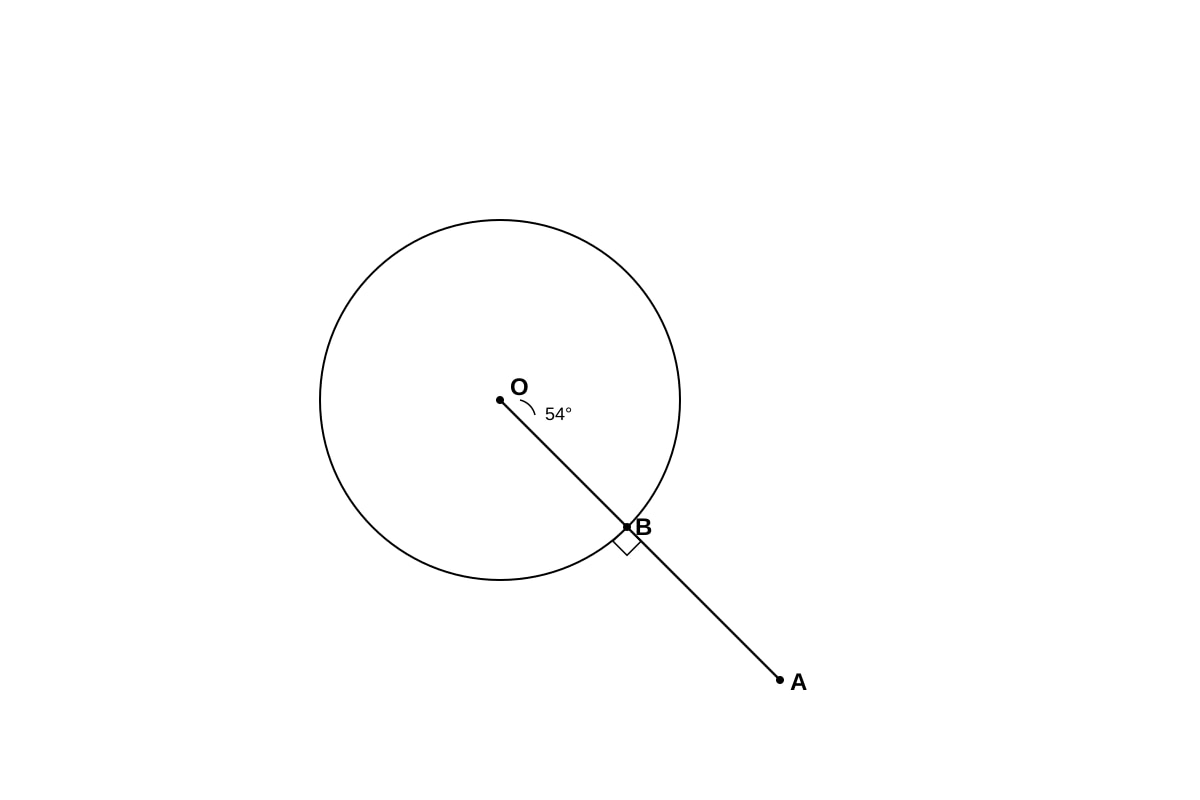
1. In the diagram below, OO is the centre of the circle. ABAB is a tangent to the circle at BB. Angle AOB=54AOB = 54^\circ.

[Diagram Description: Circle with centre O. Radius OB. Tangent line AB touching circle at B. Line OA connects external point A to centre O.]

Find the value of angle OABOAB.

Answer: __________________________ ^\circ [1]

2. The diagram shows a right-angled triangle PQRPQR with angle PQR=90PQR = 90^\circ. PQ=8PQ = 8 cm and QR=15QR = 15 cm.

Calculate the length of PRPR.

Answer: __________________________ cm [2]

3. Given that sinx=0.6\sin x^\circ = 0.6 and 0<x<900 < x < 90, find the exact value of tanx\tan x^\circ.

Answer: __________________________ [2]

4. In triangle ABCABC, AB=12AB = 12 cm, AC=10AC = 10 cm, and angle BAC=60BAC = 60^\circ.

Calculate the area of triangle ABCABC.

Answer: __________________________ cm2^2 [2]

5. The bearing of point BB from point AA is 135135^\circ.

What is the bearing of point AA from point BB?

Answer: __________________________ ^\circ [1]

6. A sector of a circle has a radius of 99 cm and an angle of 8080^\circ at the centre.

Calculate the area of this sector. Give your answer in terms of π\pi.

Answer: __________________________ cm2^2 [2]

7. In the diagram, ABCDABCD is a cyclic quadrilateral. Angle ADC=110ADC = 110^\circ.

Find the size of angle ABCABC.

Answer: __________________________ ^\circ [1]

8. Solve the equation 2sinθ=12 \sin \theta = 1 for 0θ3600^\circ \le \theta \le 360^\circ.

Answer: θ=\theta = __________________________ ^\circ and __________________________ ^\circ [2]

9. A ladder of length 55 m leans against a vertical wall. The foot of the ladder is 1.51.5 m from the base of the wall.

Calculate the angle the ladder makes with the horizontal ground.

Answer: __________________________ ^\circ [2]

10. In triangle XYZXYZ, XY=7XY = 7 cm, YZ=9YZ = 9 cm, and angle XYZ=40XYZ = 40^\circ.

Use the Cosine Rule to calculate the length of side XZXZ.

Answer: __________________________ cm [3]

11. The diagram shows two concentric circles with centre OO. The radius of the smaller circle is 44 cm and the radius of the larger circle is 77 cm.

Calculate the area of the shaded region between the two circles.

Answer: __________________________ cm2^2 [2]

12. Points A(2,3)A(2, 3) and B(8,11)B(8, 11) lie on a coordinate grid.

Calculate the length of the line segment ABAB.

Answer: __________________________ units [2]

13. In the diagram, TATA and TBTB are tangents to the circle with centre OO from an external point TT. Angle AOB=100AOB = 100^\circ.

Find angle ATBATB.

Answer: __________________________ ^\circ [2]

14. A cone has a base radius of 55 cm and a slant height of 1313 cm.

Calculate the curved surface area of the cone. Give your answer in terms of π\pi.

Answer: __________________________ cm2^2 [2]

15. In triangle PQRPQR, angle P=30P = 30^\circ, angle Q=45Q = 45^\circ, and side PR=10PR = 10 cm.

Use the Sine Rule to find the length of side QRQR.

Answer: __________________________ cm [3]


Section B: Structured Questions (35 Marks)

Answer all questions in this section. Show your working clearly.

16. The diagram shows a cuboid ABCDEFGHABCDEFGH. AB=10AB = 10 cm, BC=6BC = 6 cm, and CG=8CG = 8 cm.

(a) Calculate the length of the diagonal ACAC on the base ABCDABCD. <br><br><br> Answer: __________________________ cm [2]

(b) Calculate the angle between the diagonal AGAG and the base ABCDABCD. <br><br><br> Answer: __________________________ ^\circ [3]

(c) Calculate the total surface area of the cuboid. <br><br><br> Answer: __________________________ cm2^2 [2]

17. The diagram shows a triangle ABCABC with AB=14AB = 14 cm, AC=11AC = 11 cm, and BC=9BC = 9 cm.

(a) Calculate the size of angle BACBAC. <br><br><br> Answer: __________________________ ^\circ [3]

(b) Hence, or otherwise, calculate the area of triangle ABCABC. <br><br><br> Answer: __________________________ cm2^2 [2]

(c) Point DD lies on ACAC such that BDBD is perpendicular to ACAC. Calculate the length of BDBD. <br><br><br> Answer: __________________________ cm [2]

18. The diagram shows a circle with centre OO and radius 1010 cm. Points AA and BB lie on the circumference such that angle AOB=1.2AOB = 1.2 radians.

(a) Calculate the length of the arc ABAB. <br><br><br> Answer: __________________________ cm [2]

(b) Calculate the area of the minor sector OABOAB. <br><br><br> Answer: __________________________ cm2^2 [2]

(c) Calculate the area of the triangle OABOAB. <br><br><br> Answer: __________________________ cm2^2 [2]

(d) Hence, find the area of the minor segment bounded by the chord ABAB and the arc ABAB. <br><br><br> Answer: __________________________ cm2^2 [2]

19. A vertical tower STST stands on horizontal ground. From a point AA on the ground, the angle of elevation of the top of the tower TT is 2525^\circ. From a point BB, which is 5050 m closer to the tower than AA and in line with AA and the base of the tower SS, the angle of elevation of TT is 4040^\circ.

(a) Draw a labelled diagram representing this information. <br><br><br> [Space for diagram] [2]

(b) Calculate the height of the tower STST. <br><br><br><br><br> Answer: __________________________ m [4]

20. The diagram shows a pyramid with a square base ABCDABCD of side 1010 cm. The vertex VV is vertically above the centre MM of the base. The slant edge VA=15VA = 15 cm.

(a) Calculate the length of the diagonal ACAC of the base. <br><br><br> Answer: __________________________ cm [2]

(b) Calculate the height VMVM of the pyramid. <br><br><br> Answer: __________________________ cm [3]

(c) Calculate the angle between the slant edge VAVA and the base ABCDABCD. <br><br><br> Answer: __________________________ ^\circ [2]

(d) Calculate the total surface area of the pyramid. <br><br><br><br> Answer: __________________________ cm2^2 [3]


END OF PAPER

Answers

<!-- TuitionGoWhere generation metadata: stage=3-1; model=qwen/qwen3.6-plus; model_label=Qwen3.6 Plus; generated=2026-05-28; Sources: Stage 2-1 real exam-derived templates and Stage 2-2 exam-enriched syllabus. -->

TuitionGoWhere Exam Practice (AI) - Answer Key

O-Level Elementary Mathematics (4052)

Practice Paper - Version 3 of 5

Topic Focus: Geometry & Trigonometry

Total Marks: 60


Section A: Short Answer Questions

1.

  • Tangent is perpendicular to radius, so OBA=90\angle OBA = 90^\circ.
  • Sum of angles in OAB=180\triangle OAB = 180^\circ.
  • OAB=1809054=36\angle OAB = 180^\circ - 90^\circ - 54^\circ = 36^\circ.
  • Answer: 3636 [1]

2.

  • Pythagoras' Theorem: PR2=PQ2+QR2PR^2 = PQ^2 + QR^2.
  • PR2=82+152=64+225=289PR^2 = 8^2 + 15^2 = 64 + 225 = 289.
  • PR=289=17PR = \sqrt{289} = 17.
  • Answer: 1717 [2]

3.

  • If sinx=0.6=35\sin x = 0.6 = \frac{3}{5}, then Opposite =3= 3, Hypotenuse =5= 5.
  • Adjacent =5232=16=4= \sqrt{5^2 - 3^2} = \sqrt{16} = 4.
  • tanx=OppositeAdjacent=34\tan x = \frac{\text{Opposite}}{\text{Adjacent}} = \frac{3}{4}.
  • Answer: 0.750.75 or 34\frac{3}{4} [2]

4.

  • Area =12absinC= \frac{1}{2} ab \sin C.
  • Area =12×12×10×sin60= \frac{1}{2} \times 12 \times 10 \times \sin 60^\circ.
  • Area =60×32=30351.96= 60 \times \frac{\sqrt{3}}{2} = 30\sqrt{3} \approx 51.96.
  • Answer: 52.052.0 (3 s.f.) [2]

5.

  • Back bearing =135+180=315= 135^\circ + 180^\circ = 315^\circ.
  • Answer: 315315 [1]

6.

  • Area of sector =θ360×πr2= \frac{\theta}{360} \times \pi r^2.
  • Area =80360×π(92)=29×81π=18π= \frac{80}{360} \times \pi (9^2) = \frac{2}{9} \times 81\pi = 18\pi.
  • Answer: 18π18\pi [2]

7.

  • Opposite angles in a cyclic quadrilateral sum to 180180^\circ.
  • ABC+110=180\angle ABC + 110^\circ = 180^\circ.
  • ABC=70\angle ABC = 70^\circ.
  • Answer: 7070 [1]

8.

  • sinθ=0.5\sin \theta = 0.5.
  • Reference angle =30= 30^\circ.
  • Sine is positive in 1st and 2nd quadrants.
  • θ1=30\theta_1 = 30^\circ.
  • θ2=18030=150\theta_2 = 180^\circ - 30^\circ = 150^\circ.
  • Answer: 30,15030, 150 [2]

9.

  • Let angle be θ\theta. Adjacent =1.5= 1.5, Hypotenuse =5= 5.
  • cosθ=1.55=0.3\cos \theta = \frac{1.5}{5} = 0.3.
  • θ=cos1(0.3)72.54\theta = \cos^{-1}(0.3) \approx 72.54^\circ.
  • Answer: 72.572.5 [2]

10.

  • Cosine Rule: a2=b2+c22bccosAa^2 = b^2 + c^2 - 2bc \cos A.
  • XZ2=72+922(7)(9)cos40XZ^2 = 7^2 + 9^2 - 2(7)(9) \cos 40^\circ.
  • XZ2=49+81126(0.7660)XZ^2 = 49 + 81 - 126(0.7660).
  • XZ2=13096.52=33.48XZ^2 = 130 - 96.52 = 33.48.
  • XZ=33.485.786XZ = \sqrt{33.48} \approx 5.786.
  • Answer: 5.795.79 [3]

11.

  • Area large circle =π(72)=49π= \pi (7^2) = 49\pi.
  • Area small circle =π(42)=16π= \pi (4^2) = 16\pi.
  • Shaded Area =49π16π=33π103.67= 49\pi - 16\pi = 33\pi \approx 103.67.
  • Answer: 104104 (3 s.f.) [2]

12.

  • Distance formula: d=(x2x1)2+(y2y1)2d = \sqrt{(x_2-x_1)^2 + (y_2-y_1)^2}.
  • AB=(82)2+(113)2=62+82AB = \sqrt{(8-2)^2 + (11-3)^2} = \sqrt{6^2 + 8^2}.
  • AB=36+64=100=10AB = \sqrt{36 + 64} = \sqrt{100} = 10.
  • Answer: 1010 [2]

13.

  • Tangents from external point are equal length; OATOBT\triangle OAT \cong \triangle OBT.
  • Angles at tangent points are 9090^\circ.
  • Quadrilateral OATBOATB: Sum of angles =360= 360^\circ.
  • ATB=3609090100=80\angle ATB = 360^\circ - 90^\circ - 90^\circ - 100^\circ = 80^\circ.
  • Answer: 8080 [2]

14.

  • Curved Surface Area =πrl= \pi r l.
  • CSA =π(5)(13)=65π= \pi (5)(13) = 65\pi.
  • Answer: 65π65\pi [2]

15.

  • Sine Rule: asinA=bsinB\frac{a}{\sin A} = \frac{b}{\sin B}.
  • QRsin30=10sin45\frac{QR}{\sin 30^\circ} = \frac{10}{\sin 45^\circ}.
  • QR=10sin30sin45=10(0.5)0.7071QR = \frac{10 \sin 30^\circ}{\sin 45^\circ} = \frac{10(0.5)}{0.7071}.
  • QR=50.70717.071QR = \frac{5}{0.7071} \approx 7.071.
  • Answer: 7.077.07 [3]

Section B: Structured Questions

16. (a) In ABC\triangle ABC (right-angled at B): AC2=AB2+BC2=102+62=100+36=136AC^2 = AB^2 + BC^2 = 10^2 + 6^2 = 100 + 36 = 136. AC=13611.66AC = \sqrt{136} \approx 11.66. Answer: 11.711.7 cm [2]

(b) In ACG\triangle ACG (right-angled at C, since CG is vertical height): Wait, diagonal of cuboid is AG. We need angle between AG and base ABCD. This is angle GAC\angle GAC. First find AG. AG2=AC2+CG2=136+82=136+64=200AG^2 = AC^2 + CG^2 = 136 + 8^2 = 136 + 64 = 200. AG=200AG = \sqrt{200}. Alternatively, use tan(GAC)=OppositeAdjacent=CGAC\tan(\angle GAC) = \frac{\text{Opposite}}{\text{Adjacent}} = \frac{CG}{AC}. tan(GAC)=8136\tan(\angle GAC) = \frac{8}{\sqrt{136}}. GAC=tan1(811.66)tan1(0.686)\angle GAC = \tan^{-1}\left(\frac{8}{11.66}\right) \approx \tan^{-1}(0.686). GAC34.45\angle GAC \approx 34.45^\circ. Answer: 34.534.5^\circ [3]

(c) Total Surface Area =2(lw+lh+wh)= 2(lw + lh + wh). =2(10×6+10×8+6×8)= 2(10 \times 6 + 10 \times 8 + 6 \times 8). =2(60+80+48)=2(188)=376= 2(60 + 80 + 48) = 2(188) = 376. Answer: 376376 cm2^2 [2]

17. (a) Cosine Rule for angle A: cosA=b2+c2a22bc=112+142922(11)(14)\cos A = \frac{b^2 + c^2 - a^2}{2bc} = \frac{11^2 + 14^2 - 9^2}{2(11)(14)}. cosA=121+19681308=2363080.7662\cos A = \frac{121 + 196 - 81}{308} = \frac{236}{308} \approx 0.7662. A=cos1(0.7662)39.97A = \cos^{-1}(0.7662) \approx 39.97^\circ. Answer: 40.040.0^\circ [3]

(b) Area =12bcsinA= \frac{1}{2} bc \sin A. Area =12(11)(14)sin(39.97)= \frac{1}{2}(11)(14) \sin(39.97^\circ). Area =77×0.642549.47= 77 \times 0.6425 \approx 49.47. Answer: 49.549.5 cm2^2 [2]

(c) Area =12×base×height= \frac{1}{2} \times \text{base} \times \text{height}. Using base AC (1111 cm) and height BD (hh): 49.47=12×11×h49.47 = \frac{1}{2} \times 11 \times h. h=49.47×2118.99h = \frac{49.47 \times 2}{11} \approx 8.99. Answer: 9.009.00 cm [2]

18. (a) Arc length s=rθs = r\theta. s=10×1.2=12s = 10 \times 1.2 = 12. Answer: 1212 cm [2]

(b) Sector Area =12r2θ= \frac{1}{2} r^2 \theta. Area =12(102)(1.2)=50×1.2=60= \frac{1}{2} (10^2) (1.2) = 50 \times 1.2 = 60. Answer: 6060 cm2^2 [2]

(c) Triangle Area =12absinC= \frac{1}{2} ab \sin C (using degrees) or 12r2sinθ\frac{1}{2} r^2 \sin \theta (radians). Angle in degrees =1.2×180π68.75= 1.2 \times \frac{180}{\pi} \approx 68.75^\circ. Area =12(10)(10)sin(68.75)=50×0.932=46.6= \frac{1}{2} (10)(10) \sin(68.75^\circ) = 50 \times 0.932 = 46.6. Or using formula 12r2sinθrad\frac{1}{2} r^2 \sin \theta_{rad} is not standard, convert to degrees or use geometry. Height of triangle from O to chord: h=10cos(0.6 rad)h = 10 \cos(0.6 \text{ rad}). Base =2×10sin(0.6 rad)= 2 \times 10 \sin(0.6 \text{ rad}). Area =12×20sin(0.6)×10cos(0.6)=100sin(0.6)cos(0.6)=50sin(1.2)= \frac{1}{2} \times 20 \sin(0.6) \times 10 \cos(0.6) = 100 \sin(0.6)\cos(0.6) = 50 \sin(1.2). 50sin(1.2 rad)50(0.932)=46.650 \sin(1.2 \text{ rad}) \approx 50(0.932) = 46.6. Answer: 46.646.6 cm2^2 [2]

(d) Segment Area == Sector Area - Triangle Area. 6046.6=13.460 - 46.6 = 13.4. Answer: 13.413.4 cm2^2 [2]

19. (a) Diagram should show:

  • Vertical line ST (Tower).
  • Horizontal line ASB.
  • Angle TAS=25\angle TAS = 25^\circ.
  • Angle TBS=40\angle TBS = 40^\circ.
  • Distance AB=50AB = 50 m.
  • Right angles at S. [2 marks for correct labels and angles]

(b) Let height ST=hST = h. In TAS\triangle TAS: tan25=hASAS=htan25\tan 25^\circ = \frac{h}{AS} \Rightarrow AS = \frac{h}{\tan 25^\circ}. In TBS\triangle TBS: tan40=hBSBS=htan40\tan 40^\circ = \frac{h}{BS} \Rightarrow BS = \frac{h}{\tan 40^\circ}. ASBS=AB=50AS - BS = AB = 50. htan25htan40=50\frac{h}{\tan 25^\circ} - \frac{h}{\tan 40^\circ} = 50. h(1tan251tan40)=50h (\frac{1}{\tan 25^\circ} - \frac{1}{\tan 40^\circ}) = 50. h(2.14451.1918)=50h (2.1445 - 1.1918) = 50. h(0.9527)=50h (0.9527) = 50. h=500.952752.48h = \frac{50}{0.9527} \approx 52.48. Answer: 52.552.5 m [4]

20. (a) Diagonal of square base AC=102+102=200=102AC = \sqrt{10^2 + 10^2} = \sqrt{200} = 10\sqrt{2}. Answer: 14.114.1 cm (or 10210\sqrt{2}) [2]

(b) MM is midpoint of ACAC. AM=1022=527.071AM = \frac{10\sqrt{2}}{2} = 5\sqrt{2} \approx 7.071. In right-angled VMA\triangle VMA: VM2+AM2=VA2VM^2 + AM^2 = VA^2. VM2+(52)2=152VM^2 + (5\sqrt{2})^2 = 15^2. VM2+50=225VM^2 + 50 = 225. VM2=175VM^2 = 175. VM=17513.23VM = \sqrt{175} \approx 13.23. Answer: 13.213.2 cm [3]

(c) Angle between VA and base is VAM\angle VAM. cos(VAM)=AMVA=5215=23\cos(\angle VAM) = \frac{AM}{VA} = \frac{5\sqrt{2}}{15} = \frac{\sqrt{2}}{3}. VAM=cos1(23)cos1(0.4714)61.87\angle VAM = \cos^{-1}(\frac{\sqrt{2}}{3}) \approx \cos^{-1}(0.4714) \approx 61.87^\circ. Answer: 61.961.9^\circ [2]

(d) Total Surface Area == Area of Base ++ 4 ×\times Area of Triangular Faces. Area of Base =10×10=100= 10 \times 10 = 100 cm2^2. For triangular face VAB: Base AB=10AB=10. Need slant height of face (let's call it lfacel_{face}). Let NN be midpoint of ABAB. VNVN is slant height. In VMN\triangle VMN (right-angled at M): MN=5MN = 5 (half side of base). VM=175VM = \sqrt{175}. VN2=VM2+MN2=175+25=200VN^2 = VM^2 + MN^2 = 175 + 25 = 200. VN=200=10214.14VN = \sqrt{200} = 10\sqrt{2} \approx 14.14. Area of one triangle =12×base×height=12×10×102=50270.71= \frac{1}{2} \times \text{base} \times \text{height} = \frac{1}{2} \times 10 \times 10\sqrt{2} = 50\sqrt{2} \approx 70.71. Total Area =100+4(502)=100+2002= 100 + 4(50\sqrt{2}) = 100 + 200\sqrt{2}. 100+282.84=382.84100 + 282.84 = 382.84. Answer: 383383 cm2^2 [3]