From Real Exams Exam Paper
O Level Elementary Mathematics Practice Paper 1
Free O Level E Maths Practice Paper 1, Exam version, with questions, answers, and O Level-style practice for Singapore students.
These static practice materials are generated from the site's syllabus and paper-generation workflow, with source and model context shown so students and parents can evaluate the material before use.
Questions
Free quiz and exam paper access
Enter your details to view this paper
Your access is remembered on this device.
Answers
TuitionGoWhere Practice Paper - Elementary Mathematics O-Level (Marking Scheme)
Section A [36 marks]
1. Factorise completely 15x - 10. [1] Answer: 5(3x - 2) Marking: 1 mark for correct factorisation
2. Express 45 seconds as a percentage of 5 minutes. [2] Working: 5 minutes = 300 seconds Percentage = (45/300) × 100% = 15% Answer: 15% Marking: 1 mark for conversion, 1 mark for correct answer
3. Solve 3(2x - 1) = x + 7. [2] Working: 6x - 3 = x + 7 5x = 10 x = 2 Answer: x = 2 Marking: 1 mark for expansion/rearrangement, 1 mark for correct answer
4. Set notation for intersection. [2] Answer: A ∩ B Marking: 2 marks for correct notation
5. Probability point in circle. [2] Working: Area of square = 100 cm² Area of circle = π × 3² = 9π cm² Probability = 9π/100 Answer: 9π/100 ≈ 0.283 Marking: 1 mark for method, 1 mark for answer
6. Inverse proportion. [3] Working: x = k/y², so 8 = k/9, k = 72 When y = 6: x = 72/36 = 2 Answer: x = 2 Marking: 1 mark for formula, 1 mark for finding k, 1 mark for final answer
7. cos 30°. [1] Answer: √3/2 Marking: 1 mark for exact value
8. Simplify (2a³b²)² ÷ (4ab). [2] Working: (4a⁶b⁴) ÷ (4ab) = a⁵b³ Answer: a⁵b³ Marking: 1 mark for expanding power, 1 mark for division
9. Total students from pie chart. [3] Working: 15 students = 54° Students per degree = 15/54 = 5/18 Total = (5/18) × 360 = 100 Answer: 100 students Marking: 1 mark for proportion setup, 1 mark for calculation, 1 mark for answer
10. Gradient of line. [2] Working: Gradient = (8-(-1))/(5-2) = 9/3 = 3 Answer: 3 Marking: 1 mark for formula, 1 mark for calculation
11. Simultaneous equations. [3] Working: From equation 2: x = y + 2 Substitute: 2(y + 2) + y = 7 3y + 4 = 7, y = 1, x = 3 Answer: x = 3, y = 1 Marking: 1 mark for elimination/substitution method, 1 mark for each variable
12. Similar containers. [3] Working: Volume ratio = 8:1, so linear ratio = ∛8 = 2 Height of larger = 6 × 2 = 12 cm Answer: 12 cm Marking: 1 mark for scale factor, 1 mark for cube root, 1 mark for answer
13. Pythagoras theorem. [2] Working: AC² = 5² + 12² = 25 + 144 = 169 AC = 13 cm Answer: 13 cm Marking: 1 mark for Pythagoras, 1 mark for answer
14. Median calculation. [2] Working: Ordered: 38, 44, 45, 49, 52, 55, 58, 63, 67, 71 Median = (52 + 55)/2 = 53.5 Answer: 53.5 Marking: 1 mark for ordering, 1 mark for median
15. Expand (x + 3)(x - 5). [2] Working: x² - 5x + 3x - 15 = x² - 2x - 15 Answer: x² - 2x - 15 Marking: 1 mark for expansion, 1 mark for simplification
16. nth term of sequence. [2] Working: First term = 3, common difference = 4 nth term = 4n - 1 Answer: 4n - 1 Marking: 1 mark for identifying pattern, 1 mark for formula
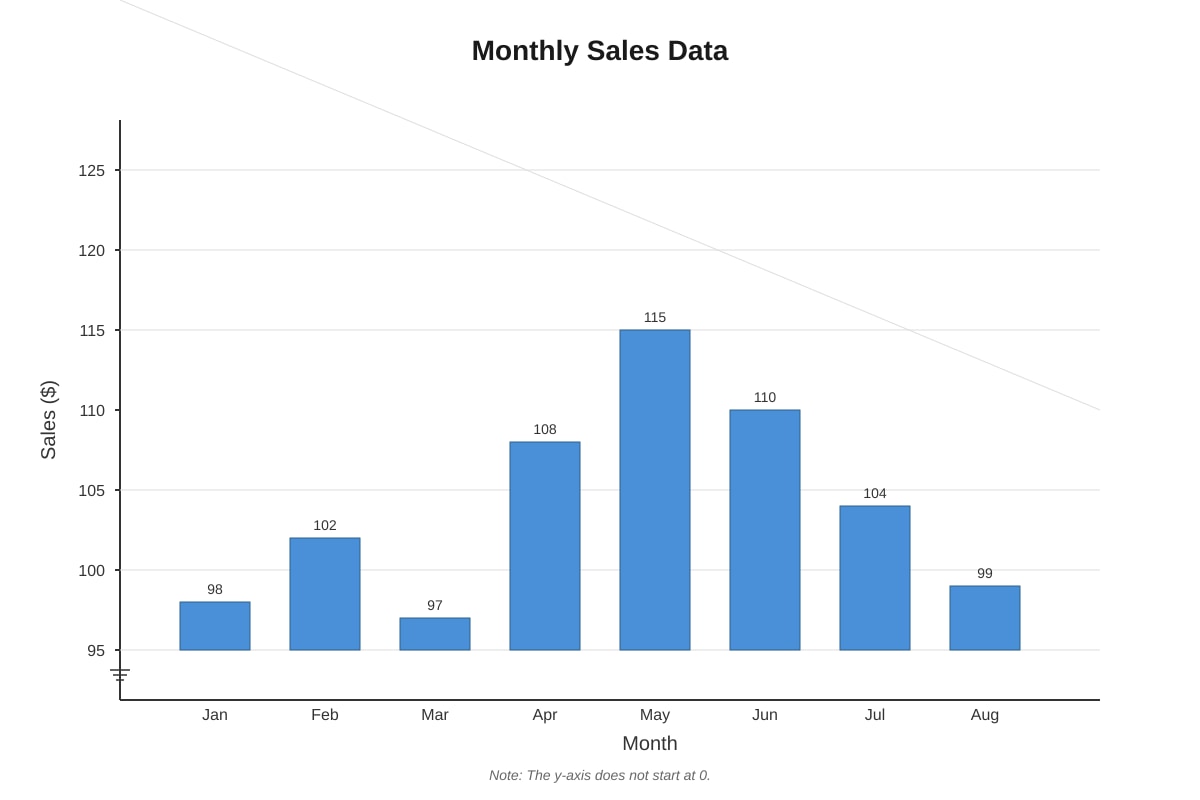
17. Misleading graph feature. [1] Answer: Y-axis does not start at 0 / Broken scale Marking: 1 mark for identifying misleading feature
18. Area using sine rule. [2] Working: Area = ½ × 8 × 6 × sin 60° = 24 × (√3/2) = 12√3 Answer: 12√3 cm² ≈ 20.8 cm² Marking: 1 mark for formula, 1 mark for calculation
Section B [54 marks]
19. Circle and chord problems [9 marks]
(a) Perpendicular distance [3] Working: Let M be midpoint of AB, AM = 6 cm In triangle OMA: OM² + 6² = 8² OM² = 64 - 36 = 28 OM = 2√7 cm Answer: 2√7 cm ≈ 5.29 cm Marking: 1 mark for setup, 1 mark for Pythagoras, 1 mark for answer
(b) Area of minor segment [4] Working: Area of sector = (θ/360°) × π × 8² cos(θ/2) = 2√7/8, θ/2 ≈ 48.6°, θ ≈ 97.2° Area of sector ≈ 54.3 cm² Area of triangle = ½ × 12 × 2√7 = 12√7 ≈ 31.8 cm² Area of segment = 54.3 - 31.8 = 22.5 cm² Answer: 22.5 cm² Marking: 2 marks for sector area, 1 mark for triangle area, 1 mark for segment
(c) Probability [2] Working: P = Area of segment / Area of circle = 22.5/(π × 64) ≈ 0.112 Answer: 0.112 Marking: 1 mark for method, 1 mark for calculation
20. Venn diagram survey [8 marks]
(a) Venn diagram [3] Answer: Correctly drawn diagram with M only = 40, S only = 50, Both = 45, Neither = 65 Marking: 1 mark for circles, 1 mark for correct numbers in regions, 1 mark for universal set
(b) Mathematics only [1] Answer: 40 students Marking: 1 mark for correct calculation
(c) Neither subject [2] Working: Total = 200, Like at least one = 40 + 45 + 50 = 135 Neither = 200 - 135 = 65 Answer: 65 students Marking: 1 mark for method, 1 mark for answer
(d) Probability Science only [2] Working: P = 50/200 = 1/4 = 0.25 Answer: 0.25 Marking: 1 mark for identification, 1 mark for probability
21. Triangular numbers [8 marks]
(a) Expression for nth pattern [3] Working: Pattern: 1, 3, 6, 10, ... Differences: 2, 3, 4, ... (arithmetic sequence) Formula: n(n+1)/2 Answer: n(n+1)/2 Marking: 1 mark for pattern recognition, 1 mark for method, 1 mark for formula
(b) Pattern with 78 dots [2] Working: n(n+1)/2 = 78 n² + n - 156 = 0 (n + 13)(n - 12) = 0 n = 12 (positive solution) Answer: Pattern 12 Marking: 1 mark for equation setup, 1 mark for solving
(c) Ending digits explanation [3] Working: n(n+1)/2 where n and n+1 are consecutive integers Possible endings for n(n+1): 0, 2, 6 (mod 10) When divided by 2: 0, 1, 3, 5, 6, 8 Cannot end in 2, 4, 7, 9 Answer: Triangular numbers can only end in 0, 1, 3, 5, 6, 8 Marking: 2 marks for method, 1 mark for explanation
22. Coordinate geometry [11 marks]
(a) Values of k [4] Working: Area = ½|1(4-k) + 7(k-2) + 3(2-4)| 15 = ½|4-k + 7k-14 + 3(-2)| 15 = ½|6k-16| 30 = |6k-16| k = 23/3 or k = -7/3 Answer: k = 23/3 or k = -7/3 Marking: 2 marks for area formula, 1 mark for equation, 1 mark for solutions
(b) Type of triangle for k = 8 [4] Working: P(1,2), Q(7,4), R(3,8) PQ² = 36+4 = 40, PR² = 4+36 = 40, QR² = 16+16 = 32 PQ = PR, so isosceles triangle Answer: Isosceles triangle Marking: 2 marks for distance calculations, 1 mark for comparison, 1 mark for conclusion
(c) Equation of line PQ [3] Working: Gradient = (4-2)/(7-1) = 1/3 Using y - 2 = ⅓(x - 1) y = ⅓x + 5/3 Answer: y = ⅓x + 5/3 Marking: 1 mark for gradient, 1 mark for point-slope form, 1 mark for final equation
23. Cone problems [9 marks]
(a) Height of cone [2] Working: h² + 9² = 15² h² = 225 - 81 = 144 h = 12 cm Answer: 12 cm Marking: 1 mark for Pythagoras setup, 1 mark for calculation
(b) Volume of cone [3] Working: V = ⅓πr²h = ⅓π(9²)(12) = 324π cm³ Answer: 324π cm³ ≈ 1018 cm³ Marking: 1 mark for formula, 1 mark for substitution, 1 mark for answer
(c) Volume of frustum [4] Working: Small cone height = 12 - 8 = 4 cm Small cone radius = 9 × (4/12) = 3 cm Small cone volume = ⅓π(3²)(4) = 12π cm³ Frustum volume = 324π - 12π = 312π cm³ Answer: 312π cm³ ≈ 980 cm³ Marking: 1 mark for similar triangles, 1 mark for small cone dimensions, 1 mark for small cone volume, 1 mark for frustum volume
24. Box plots comparison [8 marks]
(a) Better performance [3] Answer: Class B performed better. Class B has higher median (60 vs 55), higher Q1 (50 vs 45), and higher Q3 (75 vs 70). Marking: 1 mark for choice, 2 marks for justification with specific values
(b) Interquartile ranges [2] Working: Class A: IQR = 70 - 45 = 25 Class B: IQR = 75 - 50 = 25 Answer: Both classes have IQR = 25 Marking: 1 mark for each calculation
(c) Conditional probability [3] Working: Above median = 50% of class Top 25% = 25% of class P(top 25% | above median) = 25%/50% = 0.5 Answer: 0.5 Marking: 1 mark for identifying regions, 1 mark for conditional probability setup, 1 mark for calculation
25. Vector geometry [11 marks]
(a) Vectors AB and DC [2] Working: AB⃗ = (6-2, 3-1) = (4, 2) DC⃗ = (8-4, 7-5) = (4, 2) Answer: AB⃗ = (4, 2), DC⃗ = (4, 2) Marking: 1 mark for each vector
(b) Type of quadrilateral [3] Working: AB⃗ = DC⃗, so AB is parallel and equal to DC Similarly, AD⃗ = (2, 4) and BC⃗ = (2, 4) Answer: Parallelogram (opposite sides parallel and equal) Marking: 1 mark for vector comparison, 1 mark for checking second pair, 1 mark for conclusion
(c) Area of quadrilateral [4] Working: Split into triangles ABC and ACD Area ABC = ½|2(3-7) + 6(7-1) + 8(1-3)| = ½|−8 + 36 − 16| = 6 Area ACD = ½|2(7-5) + 8(5-1) + 4(1-7)| = ½|4 + 32 − 24| = 6 Total area = 12 Answer: 12 square units Marking: 2 marks for method (triangulation or cross product), 1 mark for calculation, 1 mark for total
(d) Coordinates of E [2] Working: For ABCE to be parallelogram: AB⃗ = EC⃗ (4, 2) = (8-x, 7-y) E = (4, 5) Answer: E(4, 5) Marking: 1 mark for vector equation, 1 mark for coordinates