AI Generated Quiz
O Level Combined Science Scientific Inquiry Quiz
Free O Level Combined Sci Scientific Inquiry quiz, HY3 AI version, with questions, answers, and O Level-style practice for Singapore students.
These static practice materials are generated from the site's syllabus and paper-generation workflow, with source and model context shown so students and parents can evaluate the material before use.
Questions
Free quiz and exam paper access
Enter your details to view this paper
Your access is remembered on this device.
Answers
O-Level Combined Science Quiz - Scientific Inquiry (Answer Key)
Total Marks: 40
Topic: Scientific Inquiry (Practices of Science)
Section A (1 mark each)
1. B
Teaching note: The independent variable is the one deliberately changed by the investigator. Here temperature of water is changed to see its effect. Mass and volume are controls; time is the dependent outcome.
Common mistake: Picking C (time taken) because it is measured — but it depends on temperature, so it is dependent.
2. B
Teaching note: A model is a simplified representation (diagram, equation, idea) used to explain or predict. Scientific knowledge is open to change, so A is wrong.
3. B
Teaching note: A fair test keeps all other variables constant so only the independent variable affects the result.
4. B
Teaching note: Evidence-based means conclusions are drawn from measured/observed data, not opinion.
5. B
Teaching note: Technology (e.g., sensors) can give more precise readings. It does not remove the need for thinking or guarantee correctness.
Section B (2 marks each)
6. (2 marks)
Answer: Repeating reduces the effect of random errors / unusual results, so the average is closer to the true value.
Marking: 1 mark for "reduces chance error", 1 mark for "improves confidence in result".
7. (2 marks)
Answer: Use a standard colour chart or record a specific shade (e.g., "Royal Blue, pH ~10 indicator") and measure time.
Marking: 1 mark for making it measurable/comparable, 1 mark for example.
8. (2 marks)
Answer: A hypothesis is a testable prediction or proposed explanation based on observation.
Marking: 1 mark "testable", 1 mark "prediction/explanation".
9. (2 marks)
Answer: Because science is evidence-based; the conclusion must be supported by what the data shows, not opinion.
Marking: 1 mark evidence-based, 1 mark links claim to data.
10. (2 marks)
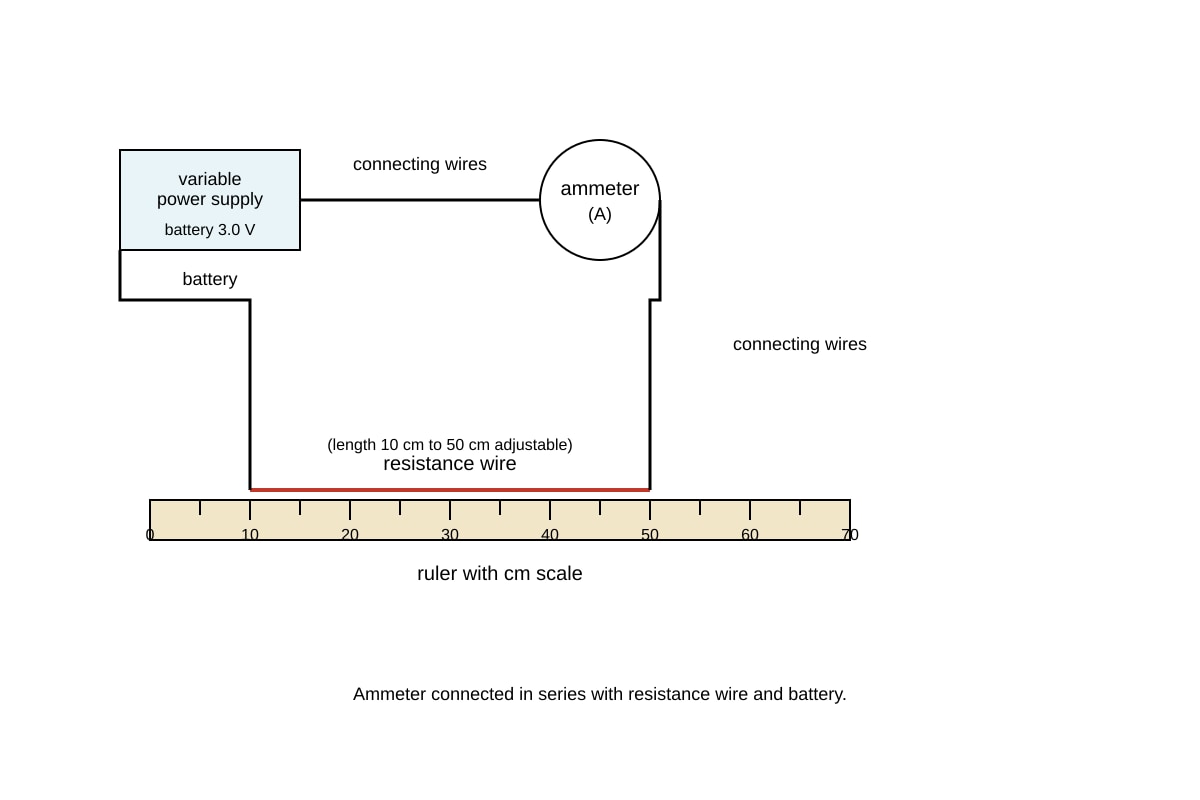
Independent: Length of resistance wire. Dependent: Current (A) shown on ammeter.
Marking: 1 mark each. From image, wire length is adjusted; current is read.
11. (2 marks)
Example: Risk: acid spill / burns. Precaution: wear goggles and use a tray.
Marking: 1 mark risk, 1 mark matching precaution.
12. (2 marks)
Answer: Qualitative = descriptive (e.g., colour changed to blue). Quantitative = numerical (e.g., mass = 5.0 g).
Marking: 1 mark definition, 1 mark examples.
13. (2 marks)
Answer: Report range of temperatures tested, volumes used, repeats, and measurement method.
Marking: 1 mark variables controlled, 1 mark data collection detail.
14. (2 marks)
Answer: Willing to consider new evidence and change ideas if data shows otherwise.
Marking: 1 mark accept evidence, 1 mark change view.
15. (2 marks)
Useful: Quick, portable reading of light level. Limitation: Phone sensor may be less accurate than a calibrated lux meter.
Marking: 1 mark each.
Section C (3–4 marks each)
16. (3 marks)
Answer: Drop ball from set heights (e.g., 20, 40, 60 cm) using same ball and surface; measure bounce with ruler; repeat 3 times; keep mass, surface, and drop method same.
Marking: 1 mark IV (height), 1 mark controls, 1 mark repeats/measurement.
17. (4 marks)
Answer: Explanation: Plants in full sunlight grew tallest (14.2 cm), showing light is needed for growth; dark cupboard shows least growth. Limitation: Only one plant per condition; no info on water/soil consistency.
Marking: 1 mark trend, 1 mark link to photosynthesis, 1 mark limitation identified, 1 mark suggestion to improve (more repeats).
18. (3 marks)
Answer: Models simplify complex ideas so we can predict behaviour (e.g., solids vibrate in fixed positions). They are useful even if not exact because they guide experiments and explain observations.
Marking: 1 mark simplify, 1 mark predict/explain, 1 mark not perfect but useful.
19. (4 marks)
Answer: Control = identical jar without plant. If CO₂ drops only in plant jar, idea supported. Measure CO₂ at start and end.
Marking: 1 mark control, 1 mark same conditions, 1 mark compare data, 1 mark conclusion from difference.
20. (4 marks)
Answer: Example: Solar panels reduce fossil fuel use (benefit: less CO₂). Risk: manufacturing uses metals and may harm habitats. Science provides data; technology applies it.
Marking: 1 mark example, 1 mark benefit, 1 mark risk, 1 mark STSE link.