AI Generated Quiz
O Level Combined Science Physical Sciences Quiz
Free O Level Combined Sci Physical Sciences quiz, HY3 AI version, with questions, answers, and O Level-style practice for Singapore students.
These static practice materials are generated from the site's syllabus and paper-generation workflow, with source and model context shown so students and parents can evaluate the material before use.
Questions
Free quiz and exam paper access
Enter your details to view this paper
Your access is remembered on this device.
Answers
O-Level Combined Science Quiz - Physical Sciences (Answer Key)
Total Marks: 40
Topic: Physical Sciences (syllabus-first, AI-generated from Stage 4 templates; not claimed as past-year derived)
Section A
1. [1 mark]
Answer: Energy cannot be created or destroyed, only converted from one form to another (or total energy in a closed system is conserved).
Teaching note: This is the Principle of Conservation of Energy. Students must mention both "not created/destroyed" and "converted/transformed" for full credit. Common mistake: stating only "cannot be destroyed" without transformation.
2. [1 mark]
Answer: A. Free electrons transfer kinetic energy between particles.
Teaching note: In metals, delocalised electrons move and collide, transferring thermal energy. B describes convection, C radiation, D convection.
3. [1 mark]
Answer: C. Mass.
Teaching note: Scalar has magnitude only. Force, velocity, acceleration are vectors (have direction).
4. [1 mark]
Answer: B. longitudinal.
Teaching note: Sound particles vibrate parallel to direction of travel → longitudinal. Transverse: displacement perpendicular.
5. [1 mark]
Answer: B. watt.
Teaching note: Power = energy/time; unit is watt (W). Joule = energy, Newton = force, Pascal = pressure.
Section B
6. [2 marks]
Answer: Gravitational potential energy → kinetic energy.
Marking: 1 mark for each energy form correctly named and direction correct.
Teaching: At highest point PE max, KE zero; at lowest KE max, PE min.
7. [2 marks]
Answer: Arrow down = Weight (W = mg), arrow up = Normal reaction (N) from table. Both from block centre, equal length.
Marking: 1 mark forces labelled, 1 mark directions correct.
Common mistake: omitting normal force or drawing weight not from centre.
8. [2 marks]
Work done = Weight × height =
= .
Teaching: Height = steps × step height (convert to m: 0.15 m given). W = F × d vertically.
9. [2 marks]
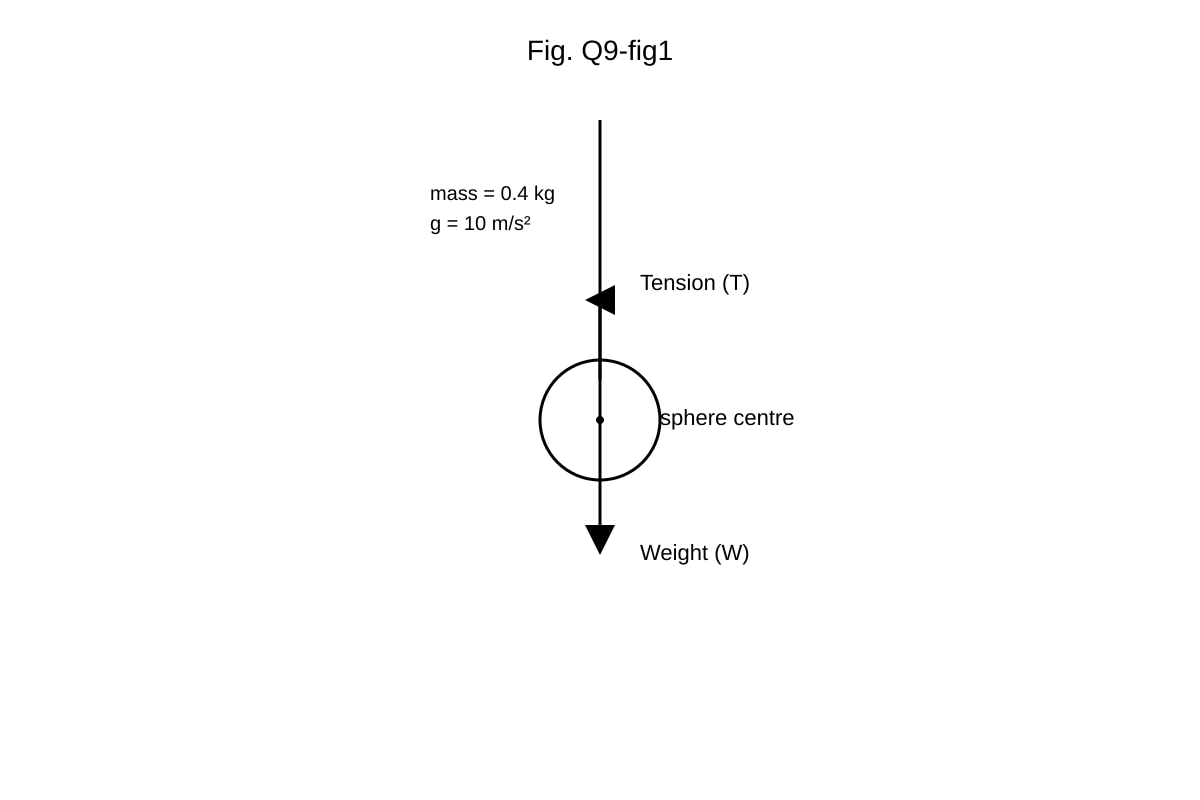
.
Marking: 1 mark for , 1 mark for answer with unit. At rest → T = W.
10. [2 marks]
.
Teaching: Use wave equation .
11. [2 marks]
Metals have free electrons that transfer kinetic energy quickly; wood lacks free electrons, transfers via slow particle vibration only.
Marking: 1 mark free electrons, 1 mark comparison.
12. [1 mark]
Applied force equals friction (balanced, net force zero).
Teaching: Constant velocity → no acceleration → forces balanced.
13. [2 marks]
PE lost = → KE = 1000 J.
Teaching: By conservation, all PE → KE if no air resistance.
Section C
14. [5 marks total]
(a) [2] .
(b) [2] At max height, KE=0, PE= → → .
(c) [1] Assumption: air resistance negligible.
Teaching: Energy conserved; initial KE becomes PE at top.
15. [3 marks]
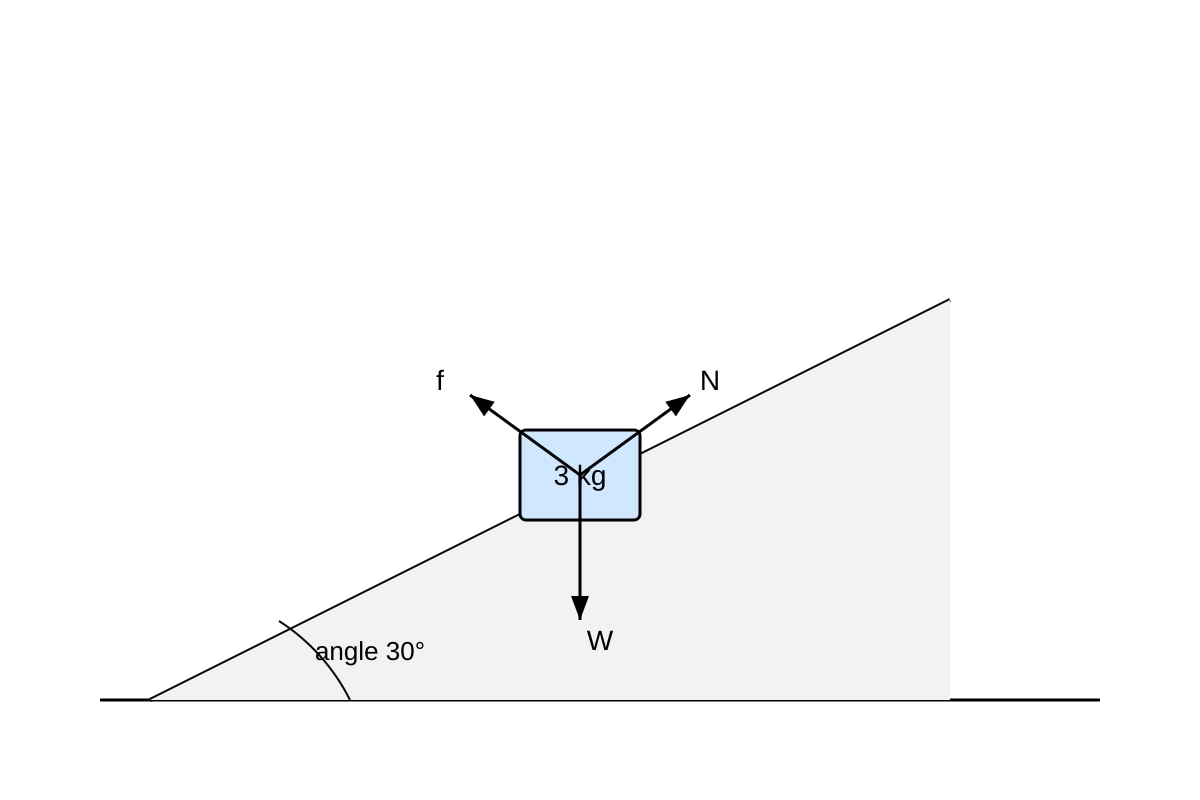
.
Marking: 1 formula, 1 substitution, 1 answer.
Teaching: Normal force perpendicular to plane; weight component perpendicular = .
16. [5 marks]
(a) [1] Height = .
(b) [2] Work = .
(c) [2] Power = .
Teaching: Step-by-step vertical work then divide by time.
17. [3 marks]
(a) [2] .
(b) [1] Medical imaging / scanning / physiotherapy.
Teaching: MHz = Hz.
18. [3 marks]
Copper: free electrons gain KE at hot end and move rapidly transferring energy (2). Wood: only lattice vibration, slower (1).
Marking descriptors: electron mention 2, contrast 1.
19. [4 marks]
(a) [2] .
(b) [2] Power = .
Teaching: Power = energy/time.
20. [3 marks]
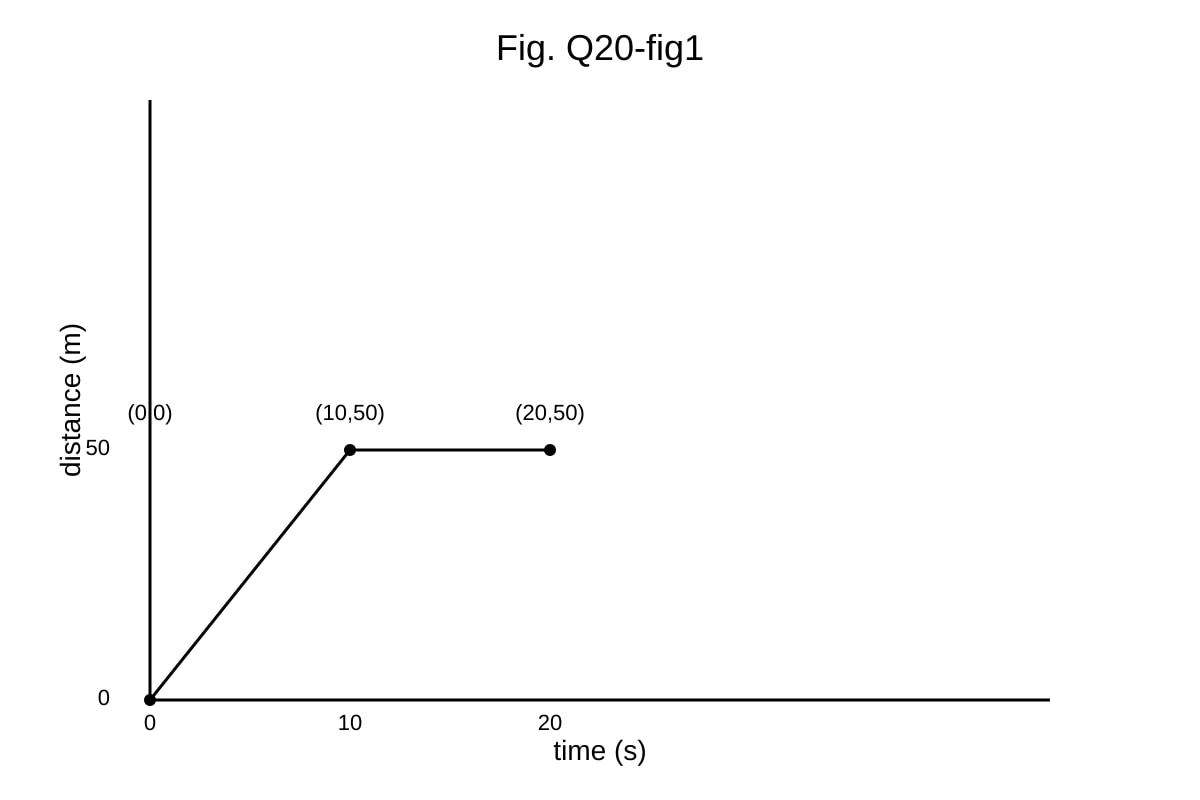
(a) [2] Speed = .
(b) [1] Stationary (distance constant).
Teaching: Graph flat → no distance change.