AI Generated Quiz
O Level Combined Science Physical Sciences Quiz
Free O Level Combined Sci Physical Sciences quiz, DeepSeek AI version, with questions, answers, and O Level-style practice for Singapore students.
These static practice materials are generated from the site's syllabus and paper-generation workflow, with source and model context shown so students and parents can evaluate the material before use.
Questions
Free quiz and exam paper access
Enter your details to view this paper
Your access is remembered on this device.
Answers
O-Level Combined Science Quiz - Physical Sciences: Answer Key
Total Marks: 50
Section A: Short Answer and Structured Questions (20 marks)
1. State the difference between a scalar quantity and a vector quantity. Give one example of each. [2 marks]
Answer:
- A scalar quantity has magnitude only, while a vector quantity has both magnitude and direction. [1 mark]
- Scalar example: distance, speed, mass, time, energy, temperature (any one correct). [0.5 marks]
- Vector example: displacement, velocity, acceleration, force, weight, momentum (any one correct). [0.5 marks]
Marking notes: Award 1 mark for correct distinction. Award 0.5 marks each for valid examples. Do not accept "scalar has no direction" without mentioning magnitude.
2. A student measures the length of a table as 1.52 m using a metre rule. (a) State the precision of the metre rule. [1 mark] (b) Express this length in centimetres and in millimetres. [2 marks]
Answer: (a) 0.1 cm or 1 mm or 0.001 m [1 mark] (b) 1.52 m = 152 cm [1 mark]; 1.52 m = 1520 mm [1 mark]
Marking notes: Accept any valid expression of precision. For (b), both conversions must be correct with units for full marks.
3. An object has a mass of 250 g and a volume of 50 cm³. (a) Calculate the density of the object in g/cm³. [2 marks] (b) The density of water is 1.0 g/cm³. State and explain whether the object will float or sink in water. [2 marks]
Answer: (a) Density = mass / volume = 250 / 50 = 5.0 g/cm³ [2 marks: 1 for formula/substitution, 1 for correct answer with unit] (b) The object will sink. [1 mark] The density of the object (5.0 g/cm³) is greater than the density of water (1.0 g/cm³). [1 mark]
Marking notes: For (a), award 1 mark for correct working even if final answer has minor error. For (b), must state "sink" and give comparative density explanation.
4. State the Principle of Conservation of Energy. [2 marks]
Answer: Energy cannot be created or destroyed. [1 mark] It can only be converted/transformed/transferred from one form to another. [1 mark] OR: The total energy in an isolated/closed system remains constant.
Marking notes: Both parts required for full marks. Accept "total energy is conserved" as equivalent to second part. Do not accept "energy is always conserved" alone.
5. A force of 15 N is applied perpendicularly to a spanner at a distance of 0.25 m from the centre of a bolt. Calculate the moment of the force about the bolt. [2 marks]
Answer: Moment = Force × perpendicular distance [1 mark] Moment = 15 × 0.25 = 3.75 N m [1 mark]
Marking notes: Award 1 mark for correct formula or substitution. Award 1 mark for correct answer with unit (accept N m or Nm).
6. Explain, using the particle model, how thermal energy is transferred through a metal rod when one end is heated. [3 marks]
Answer:
- Particles at the heated end gain kinetic energy and vibrate more vigorously. [1 mark]
- These vibrations are passed to neighbouring particles through collisions, transferring energy along the rod. [1 mark]
- In metals, free electrons also move and transfer kinetic energy rapidly through the metal, making metals good conductors. [1 mark]
Marking notes: Award marks for: (1) increased vibration at hot end, (2) transfer via particle collisions/vibrations, (3) role of free electrons in metals. Accept any valid particle-level explanation.
7. State two differences between boiling and evaporation. [2 marks]
Answer: Any two of the following (1 mark each):
- Boiling occurs at a specific temperature (boiling point); evaporation occurs at any temperature.
- Boiling occurs throughout the liquid; evaporation occurs only at the surface.
- Boiling produces bubbles; evaporation does not.
- Boiling is a rapid process; evaporation is a slow process.
Marking notes: Must state clear contrasting differences. Award 1 mark per valid difference.
8. A student of weight 500 N runs up a flight of 20 steps. Each step has a height of 15 cm. She takes 8.0 s to reach the top. (a) Calculate the total vertical height climbed. [1 mark] (b) Calculate the work done by the student. [1 mark] (c) Calculate the average power developed by the student. [2 marks]
Answer: (a) Total height = 20 × 0.15 = 3.0 m [1 mark] (b) Work done = Force × distance = 500 × 3.0 = 1500 J [1 mark] (c) Power = Work / time = 1500 / 8.0 = 187.5 W ≈ 188 W [2 marks: 1 for formula/substitution, 1 for correct answer with unit]
Marking notes: For (a), must convert cm to m. For (c), accept 187.5 W or 188 W.
Section B: Diagram and Data Interpretation (15 marks)
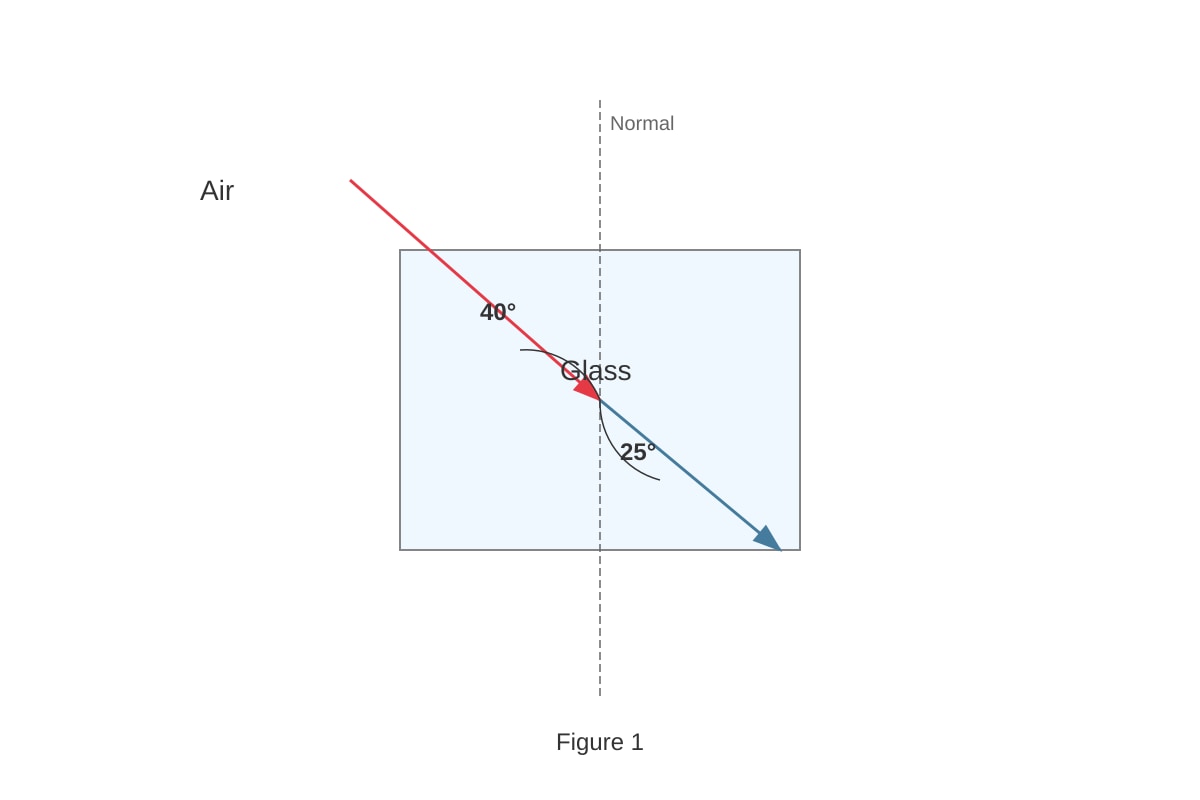
9. Figure 1 shows a ray of light travelling from air into a glass block. (a) State what happens to the speed of light as it enters the glass block. [1 mark] (b) State what happens to the wavelength of light as it enters the glass block. [1 mark] (c) The angle of refraction in the glass is 25°. Calculate the refractive index of the glass. [2 marks]
Answer: (a) The speed of light decreases. [1 mark] (b) The wavelength decreases. [1 mark] (c) n = sin i / sin r = sin 40° / sin 25° [1 mark] n = 0.6428 / 0.4226 = 1.52 [1 mark]
Marking notes: For (a) and (b), accept "reduces" or "becomes smaller". For (c), award 1 mark for correct formula/substitution, 1 mark for correct answer (accept 1.5 to 1.52).
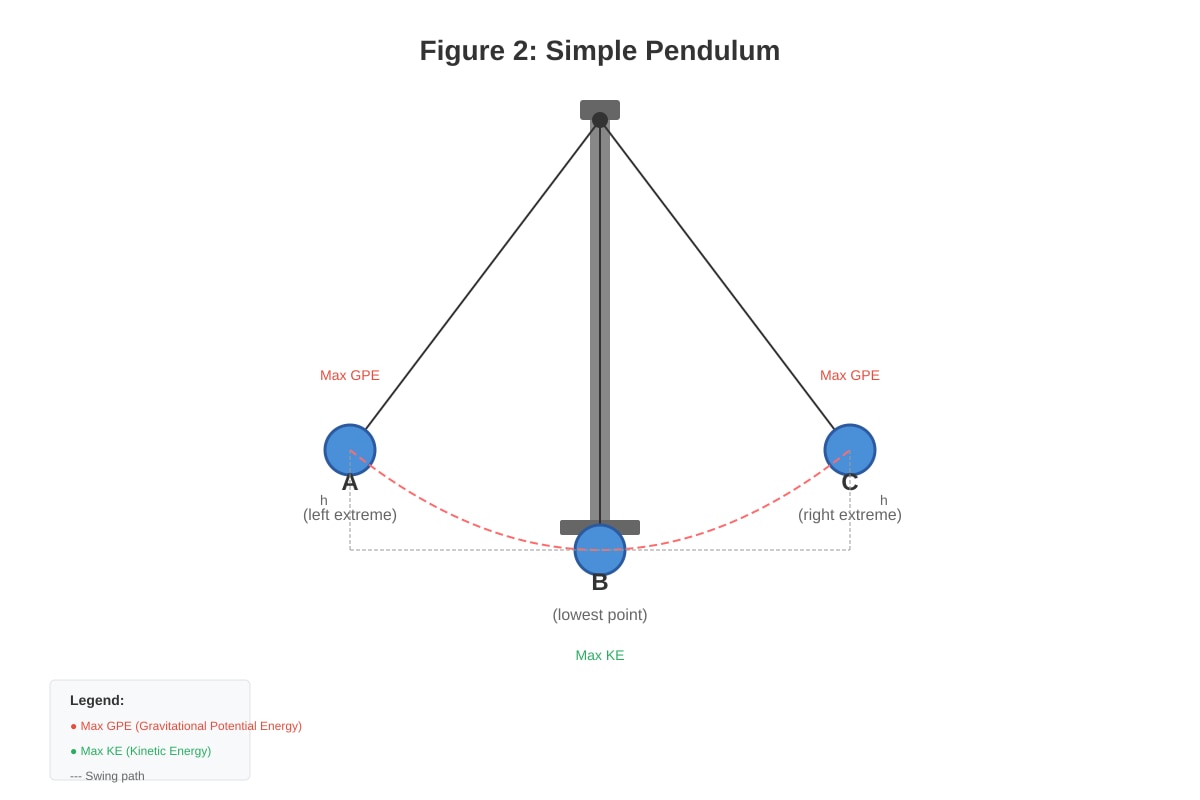
10. Figure 2 shows a simple pendulum swinging between positions A and C. (a) At which position (A, B, or C) does the sphere have maximum kinetic energy? Explain. [2 marks] (b) At which position (A, B, or C) does the sphere have maximum gravitational potential energy? Explain. [2 marks] (c) State the energy conversion that occurs as the sphere moves from position A to position B. [1 mark]
Answer: (a) Position B. [1 mark] At the lowest point, the sphere has maximum speed, so kinetic energy is maximum. [1 mark] (b) Positions A and C. [1 mark] At the highest points, the sphere has maximum height, so gravitational potential energy is maximum. [1 mark] (c) Gravitational potential energy is converted to kinetic energy. [1 mark]
Marking notes: For (b), accept either A or C. Must link position to energy reasoning.
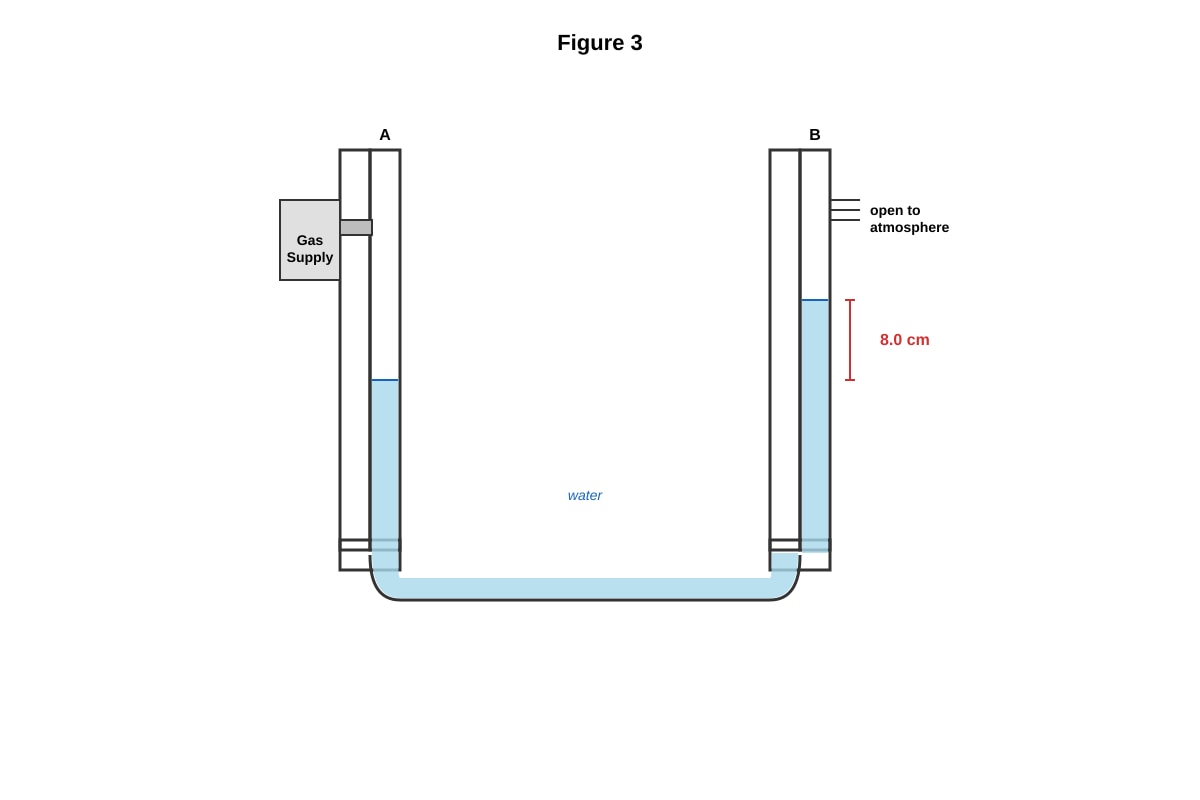
11. Figure 3 shows a U-tube manometer connected to a gas supply. (a) On which side of the U-tube is the pressure greater? Explain. [2 marks] (b) Calculate the pressure difference between the gas supply and the atmosphere. [2 marks]
Answer: (a) The gas supply side has greater pressure. [1 mark] The gas pressure pushes the water level down on the gas side and up on the atmosphere side. [1 mark] (b) Pressure difference = ρgh = 1000 × 10 × 0.080 [1 mark] = 800 Pa [1 mark]
Marking notes: For (b), must convert 8.0 cm to 0.080 m. Award 1 mark for correct substitution, 1 mark for correct answer with unit.
12. Figure 4 shows a circuit with two resistors in parallel across a 6.0 V battery. (a) Calculate the total resistance of the circuit. [2 marks] (b) Calculate the total current flowing from the battery. [2 marks]
Answer: (a) 1/R_total = 1/3.0 + 1/6.0 = 2/6.0 + 1/6.0 = 3/6.0 [1 mark] R_total = 6.0/3 = 2.0 Ω [1 mark] (b) I = V/R = 6.0/2.0 = 3.0 A [2 marks: 1 for formula/substitution, 1 for correct answer with unit]
Marking notes: For (a), accept alternative method. For (b), award full marks if correct current calculated using individual branch currents (I₁ = 2.0 A, I₂ = 1.0 A, total = 3.0 A).
Section C: Application and Analysis (15 marks)
13. A crane lifts a concrete block of mass 200 kg through a vertical height of 15 m in 30 s. (a) Calculate the weight of the concrete block. [1 mark] (b) Calculate the work done by the crane. [2 marks] (c) Calculate the power output of the crane. [2 marks] (d) Calculate the efficiency of the crane. [2 marks]
Answer: (a) Weight = mg = 200 × 10 = 2000 N [1 mark] (b) Work done = Force × distance = 2000 × 15 = 30,000 J [2 marks: 1 for formula, 1 for answer] (c) Power output = Work/time = 30,000/30 = 1000 W [2 marks: 1 for formula, 1 for answer] (d) Efficiency = (Power output / Power input) × 100% [1 mark] = (1000/1500) × 100% = 66.7% [1 mark]
Marking notes: Accept 67% for efficiency. Award method marks even if earlier parts have errors (error carried forward).
14. A student investigates pressure at different depths in a liquid. (a) Plot a graph of pressure against depth. [3 marks] (b) Describe the relationship. [1 mark] (c) Predict pressure at 25 cm depth. [1 mark] (d) State one variable kept constant. [1 mark]
Answer: (a)
Image pending generation for this question.
[3 marks: 1 for correct points, 1 for straight line, 1 for labelled axes] (b) Pressure is directly proportional to depth. [1 mark] (c) 3.0 kPa [1 mark] (d) Density of liquid / temperature / same liquid used (any one). [1 mark]
Marking notes: For (a), deduct 1 mark for each error. For (c), accept 2.9-3.1 kPa.
15. A metal block is heated using a 50 W heater for 5.0 minutes. (a) Calculate total electrical energy supplied. [2 marks] (b) Calculate thermal energy absorbed by the block. [2 marks] (c) Suggest one reason for energy difference. [1 mark]
Answer: (a) Time = 5.0 × 60 = 300 s [0.5 marks] Energy = Power × time = 50 × 300 = 15,000 J [1.5 marks] (b) Energy = mcΔθ = 0.50 × 400 × (65 - 25) [1 mark] = 0.50 × 400 × 40 = 8000 J [1 mark] (c) Energy is lost to the surroundings / heat lost to air / heater also heats the container (any valid reason). [1 mark]
Marking notes: For (a), award full marks for 15,000 J or 15 kJ. For (b), must show temperature change calculation.
16. Explain the observation of paper moving on water when detergent is added. [2 marks]
Answer:
- Detergent reduces the surface tension of water. [1 mark]
- The surface tension is higher in the surrounding water than where the detergent was added. The paper is pulled towards the region of higher surface tension (away from the detergent). [1 mark]
Marking notes: Must mention surface tension and the difference in surface tension causing movement.
17. A car of mass 1200 kg travelling at 20 m/s comes to rest in 5.0 s. (a) Calculate initial kinetic energy. [2 marks] (b) Calculate average braking force. [3 marks]
Answer: (a) KE = ½mv² = ½ × 1200 × (20)² [1 mark] = ½ × 1200 × 400 = 240,000 J [1 mark] (b) Work done by brakes = change in KE = 240,000 J [1 mark] Distance travelled: average speed = (20 + 0)/2 = 10 m/s; distance = 10 × 5.0 = 50 m [1 mark] Force = Work/distance = 240,000/50 = 4800 N [1 mark] OR: F = ma; a = (0 - 20)/5.0 = -4.0 m/s²; F = 1200 × 4.0 = 4800 N
Marking notes: Accept alternative methods. Award marks for correct physics reasoning even if final answer has arithmetic error.
18. Explain why a person feels colder on a windy day than on a calm day at the same temperature. [2 marks]
Answer:
- Wind increases the rate of evaporation of moisture/sweat from the skin. [1 mark]
- Evaporation requires thermal energy (latent heat), which is taken from the skin, causing cooling. [1 mark] OR: Wind removes the layer of warm air near the skin (convection), increasing heat loss from the body.
Marking notes: Must link wind to increased rate of heat loss. Accept either evaporation or convection explanation.
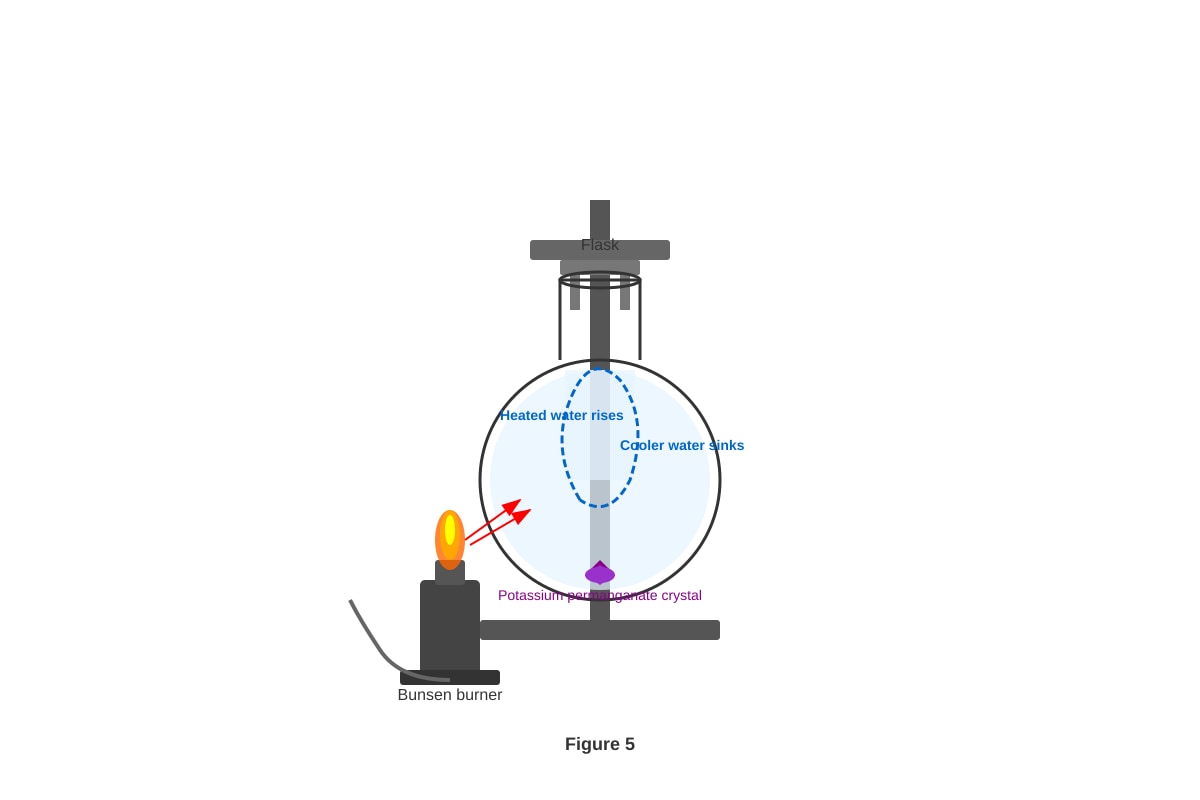
19. A student investigates convection using potassium permanganate in water. (a) Describe and explain the movement of coloured water. [2 marks] (b) State why potassium permanganate is used. [1 mark]
Answer: (a) The coloured water rises above the heated region, moves across the top, sinks at the far side, and moves along the bottom back to the heated region (convection current). [1 mark] Heating causes the water to expand, become less dense, and rise. Cooler, denser water sinks to replace it. [1 mark] (b) Potassium permanganate is used to make the movement of water visible / as a dye/tracer. [1 mark]
Marking notes: For (a), must describe the circulation pattern and explain in terms of density changes.
20. A loudspeaker produces sound of frequency 500 Hz. Speed of sound = 340 m/s. (a) Calculate the wavelength. [2 marks] (b) State what happens to wavelength if frequency increases. [1 mark]
Answer: (a) v = fλ → λ = v/f = 340/500 [1 mark] = 0.68 m [1 mark] (b) The wavelength decreases. [1 mark]
Marking notes: For (a), award 1 mark for correct formula/substitution, 1 mark for correct answer with unit. For (b), accept "becomes shorter" or "reduces".
END OF ANSWER KEY