AI Generated Quiz
O Level Combined Science Chemistry Materials Quiz
Free O Level Combined Sci Chemistry Materials quiz, HY3 AI version, with questions, answers, and O Level-style practice for Singapore students.
These static practice materials are generated from the site's syllabus and paper-generation workflow, with source and model context shown so students and parents can evaluate the material before use.
Questions
Free quiz and exam paper access
Enter your details to view this paper
Your access is remembered on this device.
Answers
O-Level Combined Science Quiz - Chemistry Materials (Answer Key)
Total Marks: 40
Topic: Chemistry Materials
Note: Content generated from syllabus-first LLM templates (Stage 4/5). Not claimed as past-year exam derived.
Section A
1. B [1]
Answer: Poly(ethene).
Teaching note: Cotton, wool, silk are natural polymers from plants/animals. Poly(ethene) is made in industry from ethene, so it is synthetic.
Common mistake: Choosing cotton because it is a "polymer" – but it is natural, not synthetic.
2. C [1]
Answer: Metallic bonding with delocalised electrons.
Teaching note: In metals, outer electrons are delocalised and free to move, carrying charge and energy. Ionic and covalent do not give free electrons in solids.
3. B [1]
Answer: Malleable.
Teaching note: Malleable = can be hammered into sheets. Ductile = drawn into wires. Brittle = breaks easily.
4. C [1]
Answer: Very high melting point.
Teaching note: Diamond has a giant covalent network needing much energy to break many strong covalent bonds. It does not conduct electricity (no free electrons).
5. A [1]
Answer: Ethene monomers.
Teaching note: Addition polymerisation of ethene (CH₂=CH₂) forms poly(ethene).
Section B
6. [2]
Marking: 1 mark for correct structural difference, 1 mark for effect.
Answer: Thermosoftening plastics have linear/branched polymer chains with weak intermolecular forces, so they soften on heating. Thermosetting plastics have cross-links between chains, forming a rigid network that does not soften on reheating.
Teaching note: Cross-linking is the key structural feature preventing reshaping.
7. [2]
Answer: Metals conduct heat well because delocalised electrons gain kinetic energy and transfer it quickly through the metal; also ions vibrate and pass energy.
Marking: 1 mark delocalised electrons, 1 mark transfer mechanism.
8. [2]
Answer: Graphite has a giant covalent structure (layers of carbon atoms). Property: it is soft/slippery (layers slide) OR conducts electricity (delocalised electron per carbon).
Marking: 1 mark structure, 1 mark property.
9. [2]
Answer: Nylon (synthetic) melts and shrinks or gives a chemical smell; cotton (natural) burns with a paper-like smell and leaves soft ash. Any one clear observation.
Marking: 1 mark observation for nylon, 1 mark contrast or stated distinction.
10. [3]
Answer: Suspend equal lengths of each wire from a stand, attach the same load gradually until it breaks, record max load. Constant variable: length of wire, thickness of wire, type of load.
Marking: 1 mark method, 1 mark measurement, 1 mark constant variable.
11. [3]
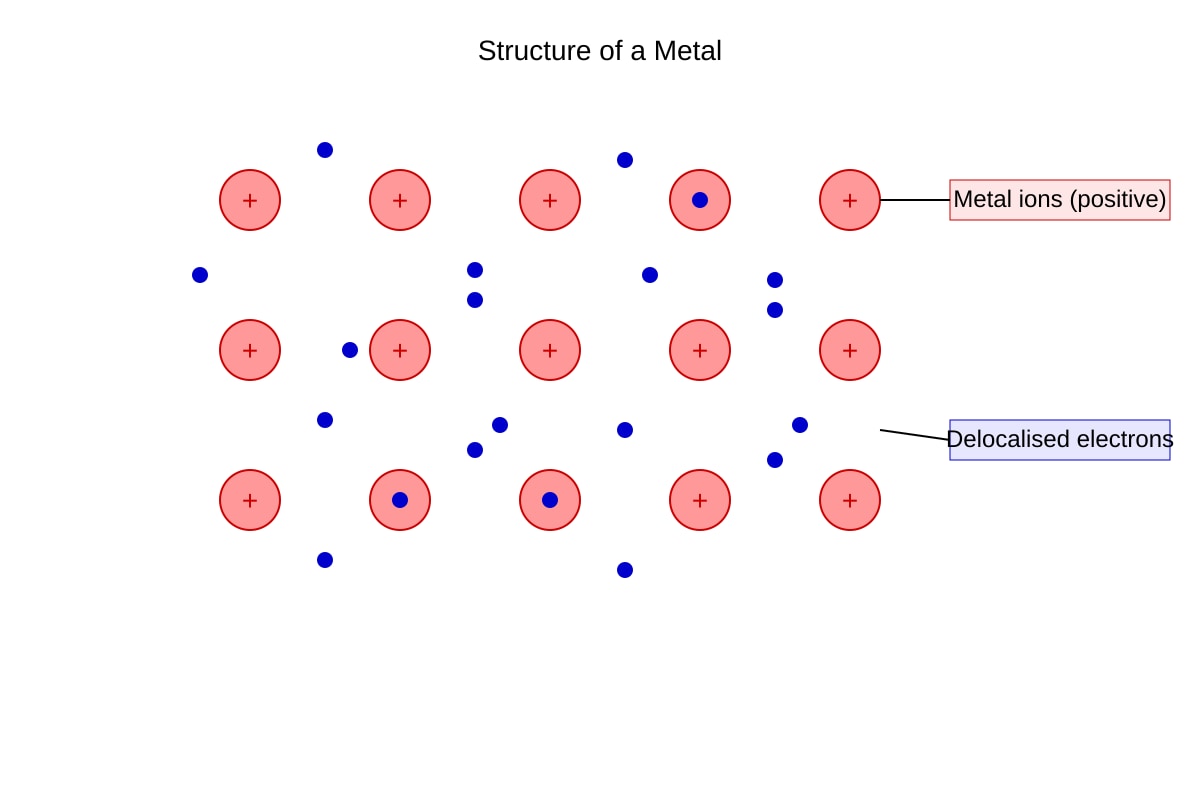
Answer: Positive metal ions are arranged in a lattice. Delocalised electrons (from outer shells) move freely between them. The electrostatic attraction between positive ions and negative electrons holds the metal together.
Marking: 1 mark ions in lattice, 1 mark delocalised electrons, 1 mark attraction described.
Visual needed: Diagram shows ions and electrons; answer references that attraction.
12. [2]
Answer: Polymerisation (addition polymerisation). Type: addition reaction.
Marking: 1 mark process, 1 mark reaction type.
13. [2]
Answer: Problem: non-biodegradable plastics accumulate in landfills/oceans harming wildlife. Reduction: recycling / using biodegradable alternatives.
Marking: 1 mark problem, 1 mark solution.
14. [2]
Answer: Diamond has all four outer electrons covalently bonded in a network, no free electrons → no conduction. Graphite has one delocalised electron per carbon atom in layers → conducts.
Marking: 1 mark diamond reason, 1 mark graphite reason.
15. [3]
(a) [1] Brass.
(b) [1] Harder / more resistant to corrosion than pure copper.
(c) [1] Zinc atoms disrupt the regular copper lattice, making layers harder to slide.
Teaching note: Alloying changes properties by distorting structure.
Section C
16. [3]
(a) [1] R.
(b) [1] It conducts electricity always and has metallic structure.
(c) [1] Q; very high melting point and no conduction matches diamond (giant covalent).
Marking: 1 each.
17. [4]
(a) [1] Hydrogen.
(b) [1] calcium + water → calcium hydroxide + hydrogen.
(c) [2] Calcium is above hydrogen in the reactivity series, so it is reactive enough to displace hydrogen from water. Bubbles show H₂ released.
Marking: 1 mark position, 1 mark displacement explanation.
18. [4]
(a) [1] Tube 3.
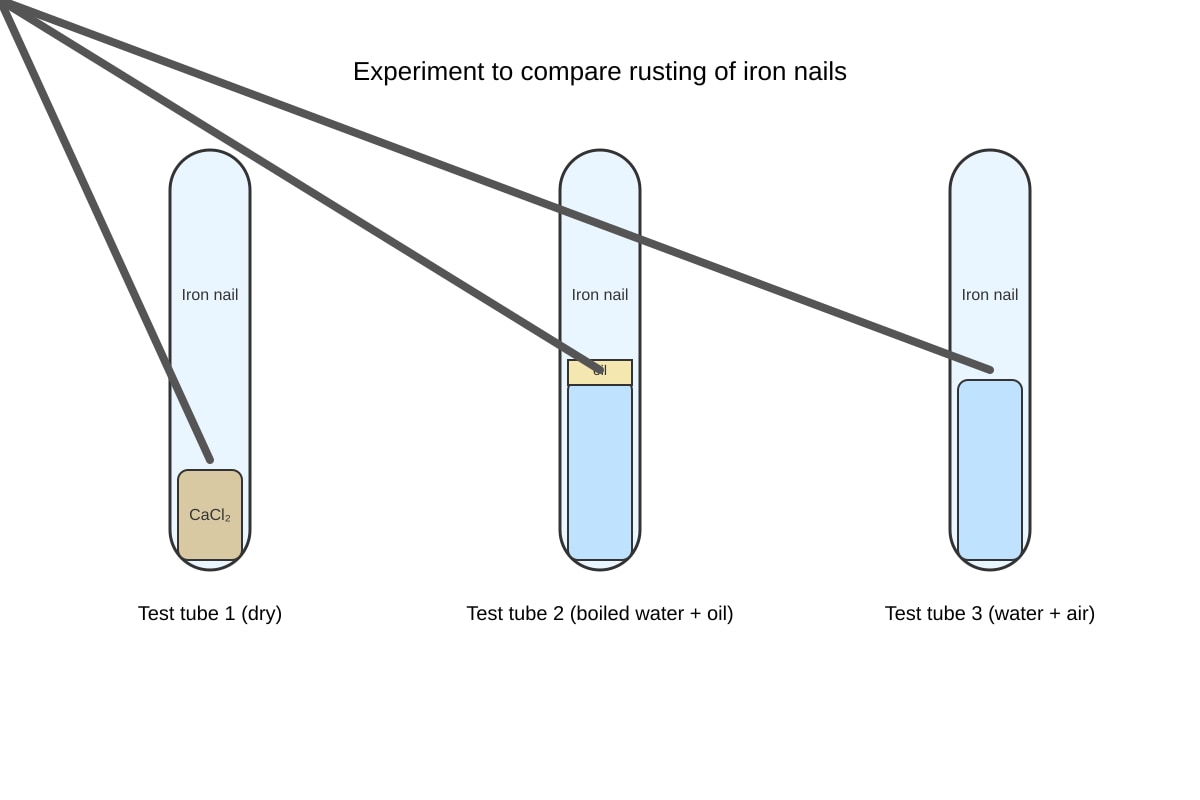
(b) [1] No water (drying agent removes moisture) so rusting cannot occur.
(c) [1] Boiled water has no dissolved oxygen; oil blocks air, so little oxygen → little rust.
(d) [1] Rusting needs both water and oxygen (air).
Marking: 1 each. Visual: see placeholder for setup.
19. [4]
(a) [1] Propene.
(b) [2] Drawing: –[CH₂–CH(CH₃)]– repeated, show two units with CH₃ branch.
(c) [1] Thermosoftening; no cross-links so softens on heating.
Marking: as above.
20. [4]
Answer example:
- Ionic: giant lattice of ions; high melting point; conducts only when molten/dissolved.
- Metallic: lattice of positive ions + delocalised electrons; malleable; conducts always.
Marking: 2 properties each with structure link (2+2).