From Real Exams Quiz
O Level Combined Science Scientific Inquiry Quiz
Free O Level Combined Sci Scientific Inquiry quiz, HY3 Exam version, with questions, answers, and O Level-style practice for Singapore students.
These static practice materials are generated from the site's syllabus and paper-generation workflow, with source and model context shown so students and parents can evaluate the material before use.
Questions
O-Level Combined Science Quiz - Scientific Inquiry
Name: ___________________________
Class: ___________________________
Date: ___________________________
Score: ___________________________
Duration: 45 minutes
Total Marks: 40
Topic: Scientific Inquiry (Practices of Science: WoTD, NOS, STSE)
Instructions:
- Answer all 20 questions.
- Section A: Multiple-choice style short items (1 mark each).
- Section B: Structured short-answer questions (2 marks each).
- Section C: Data interpretation and extended response (3–4 marks each).
- Show working where calculation or reasoning is required.
- Use SI units and correct notation.
Section A (Questions 1–5, 1 mark each, Total 5 marks)
-
What is the main purpose of a control variable in a scientific investigation?
-
State one characteristic of scientific knowledge according to the Nature of Scientific Knowledge (NOS).
-
Which of the following is an example of a qualitative observation?
(A) The mass is 12.4 g
(B) The solution turned blue
(C) The temperature rose to 38 °C
(D) The length is 5.2 cm
-
Give one example of a risk associated with a science application in society (STSE).
-
What term describes a proposed explanation made on the basis of limited evidence, used as a starting point for further investigation?
Section B (Questions 6–10, 2 marks each, Total 10 marks)
-
A student measures the time for a toy car to travel 2.0 m three times and records 4.1 s, 4.3 s, 4.2 s. Calculate the average time and state why repeating measurements is good practice.
Average time = __________ s
Reason: ___________________________________________________ -
Explain why a fair test requires only one independent variable to be changed.
-
A pendulum experiment is carried out to find how length affects period. Identify the independent variable and the dependent variable.
Independent: ____________________
Dependent: ______________________ -
State two values that are important for a scientist when conducting inquiry.
(i) ____________________ (ii) ____________________ -
The graph below shows temperature change over time for two liquids A and B being heated.
Image pending generation: graph for Q10.
Which liquid shows a faster rate of temperature increase? Give a reason from the graph.
Liquid: __________ Reason: ____________________________________
Section C (Questions 11–20, 3–4 marks each, Total 25 marks)
-
A student investigates how the height of a ramp affects the speed of a toy car at the bottom.
(a) State a suitable hypothesis. [1]
(b) Name one control variable. [1]
(c) Describe how the student should record data to analyse the result. [2] -
Read the extract:
"A new pesticide increases crop yield but may harm bees."
Using STSE, identify one benefit and one risk, and suggest one way to reduce the risk. [3]
Benefit: ________________________________________________
Risk: __________________________________________________
Reduction: _____________________________________________ -
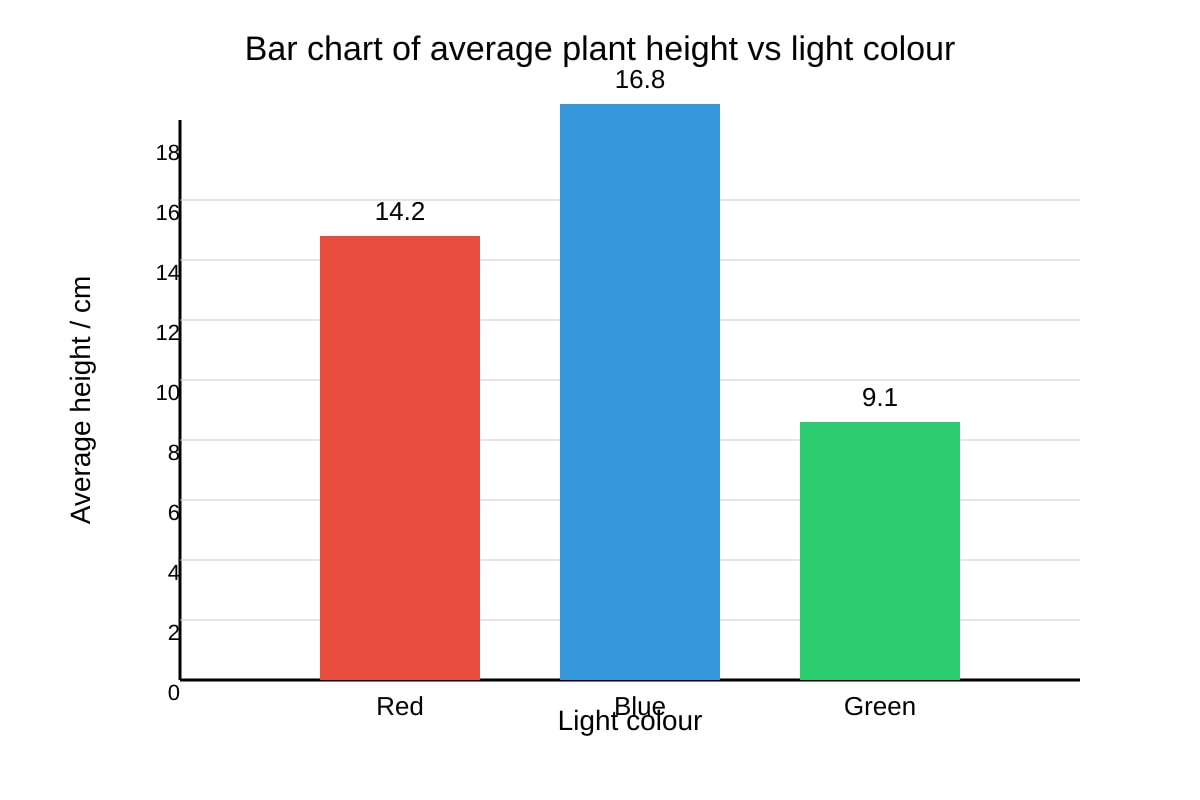
The table shows results from an experiment on plant growth under different light colours.
| Light colour | Average height / cm |
|---|---|
| Red | 14.2 |
| Blue | 16.8 |
| Green | 9.1 |
(a) Which light gives best growth? [1]
(b) Plot a bar chart of the data using the placeholder. [1]
Image pending generation: chart for Q13.
(c) Suggest why green light gave poorest growth. [2]
- Explain the difference between accuracy and precision in measurements. Use an example. [3]
- A student writes: "My experiment proves that all metals expand when heated."
Why is this statement not consistent with the Nature of Scientific Knowledge? [2]
-
Design a simple investigation to test if temperature affects the rate of dissolving sugar in water. Include variables. [4]
Independent: ____________ Dependent: ____________ Control: ____________
Method (2 marks): ________________________________________________ -
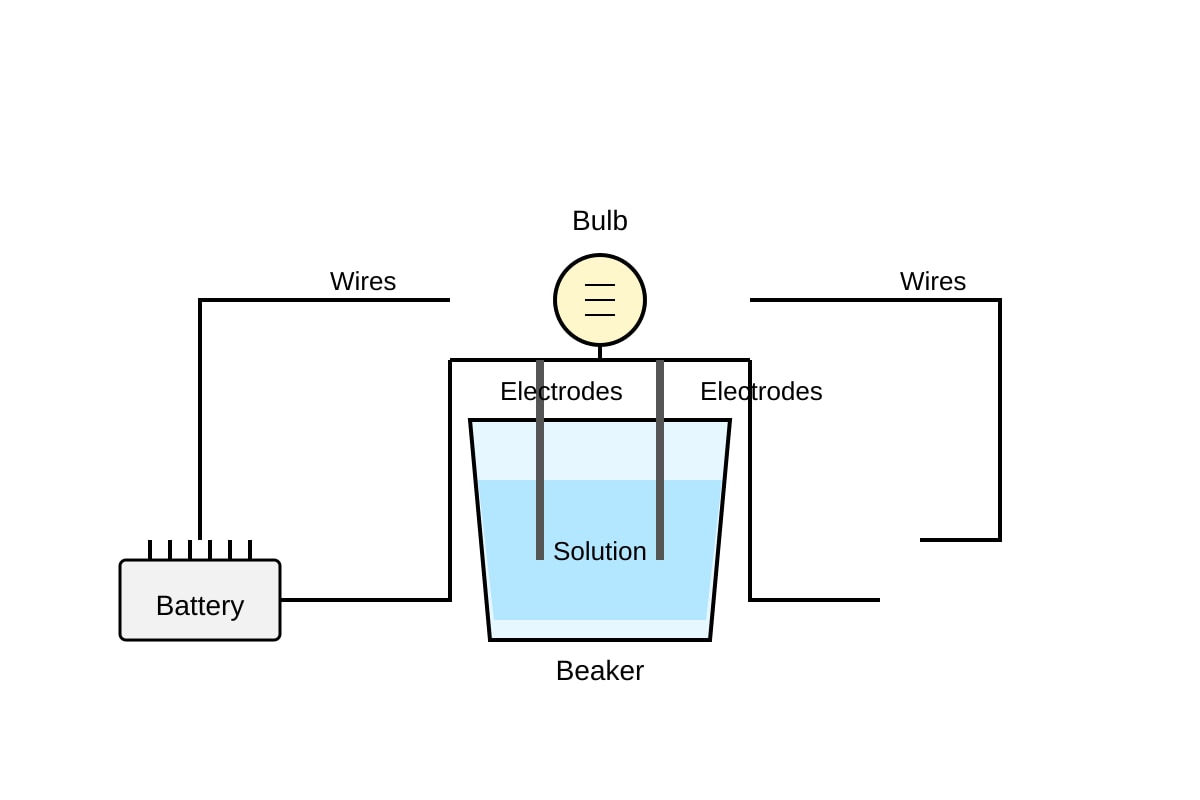
The diagram shows a simple circuit with a battery, wire, and bulb used to test conductivity of solutions.
Image pending generation: experimental_setup for Q17.
(a) What is the purpose of the bulb? [1]
(b) How would you know a solution is a poor conductor? [1]
(c) State one safety precaution. [1]
- A class collected this data on breathing rate before and after exercise.
| Student | Rest / breaths per min | After / breaths per min |
|---|---|---|
| 1 | 14 | 22 |
| 2 | 15 | 24 |
| 3 | 13 | 21 |
(a) Calculate mean breathing rate after exercise. [2]
(b) State a conclusion supported by data. [1]
- "Science is evidence-based and involves model-building." Explain this NOS idea using an example of a model from Combined Science. [3]
- Evaluate the reliability of the following method: "I dropped a ball from 2 m and used a stopwatch once to find fall time." Suggest an improvement. [4]
Evaluation (2): ____________________________________________
Improvement (2): ___________________________________________
Answers
O-Level Combined Science Quiz - Scientific Inquiry (Answer Key)
Total Marks: 40
Topic: Scientific Inquiry
Section A (1–5, 1 mark each)
-
Answer: To keep all other conditions the same so that any change in the outcome is due only to the independent variable.
Teaching note: A control variable is held constant; this isolates the effect of the factor being tested. -
Answer: Science is evidence-based / model-building / open to change / reliable. (Any one NOS point)
Teaching note: NOS states scientific knowledge comes from evidence and can be revised. -
Answer: (B) The solution turned blue
Teaching note: Qualitative = described without numbers; others are quantitative measurements. -
Answer: e.g. pollution from factories / radiation from nuclear plants / pesticide harm to wildlife.
Teaching note: STSE looks at risks of science in society. -
Answer: Hypothesis
Teaching note: A hypothesis is a testable starting explanation.
Section B (6–10, 2 marks each)
-
Average time: (4.1 + 4.3 + 4.2) / 3 = 12.6 / 3 = 4.2 s [1]
Reason: Repeating reduces effect of random error and gives more reliable mean. [1]
Working: sum ÷ count. -
Answer: Changing only one independent variable means any observed effect can be linked to that variable; if many change, cause is unclear. [2]
Teaching note: Fair test = only one factor varied. -
Independent: length of pendulum [1]
Dependent: period / time for one swing [1] -
Two values: e.g. integrity, objectivity, curiosity, open-mindedness (any two) [2]
-
Liquid: A [1]
Reason: Line A has steeper slope, so temperature rises more per second. [1]
From placeholder: A reaches 60 °C at 120 s, B only 45 °C.
Section C (11–20, 3–4 marks each)
-
(a) Hypothesis: Increasing ramp height increases speed at bottom. [1]
(b) Control: same car, same surface, same distance. [1]
(c) Record: Measure time at bottom for each height, repeat 3 times, tabulate height vs speed. [2] -
Benefit: higher food production. [1]
Risk: bee population decline. [1]
Reduction: use pesticide only at night / selective spray. [1] -
(a) Blue [1]
(b) Bar chart drawn with 3 bars per values. [1]
(c) Reason: Plants reflect green, less absorbed for photosynthesis. [2] -
Accuracy = closeness to true value. Precision = closeness of repeated values. Example: hits near bullseye = accurate; tight cluster elsewhere = precise. [3]
-
Answer: NOS says knowledge is reliable but open to change; "proves all" is too absolute, should be "supports". [2]
-
Independent: water temperature [1]
Dependent: time to dissolve [1]
Control: mass of sugar, volume of water [1]
Method: Heat water to set temps, add same sugar, stir same way, time until clear. [1] -
(a) Shows if current flows (lights if conductive). [1]
(b) Bulb does not light. [1]
(c) Avoid water on battery / disconnect after test. [1] -
(a) Mean = (22+24+21)/3 = 67/3 = 22.3 breaths/min [2]
(b) Exercise increases breathing rate. [1] -
Answer: Models simplify reality, e.g. particle model of matter explains states. Evidence supports models, revised when new data appears. [3]
-
Evaluation: Only one trial, reaction time error, not reliable. [2]
Improvement: Repeat many times, use light gate, average. [2]
Free quiz and exam paper access
Enter your details to view this paper
Your access is remembered on this device.