From Real Exams Quiz
O Level Combined Science Physical Sciences Quiz
Free O Level Combined Sci Physical Sciences quiz, HY3 Exam version, with questions, answers, and O Level-style practice for Singapore students.
These static practice materials are generated from the site's syllabus and paper-generation workflow, with source and model context shown so students and parents can evaluate the material before use.
Questions
Free quiz and exam paper access
Enter your details to view this paper
Your access is remembered on this device.
Answers
O-Level Combined Science Quiz - Physical Sciences (Answer Key)
Total Marks: 40
Duration: 60 minutes
Section A: Energy and Forces
Q1 [2 marks]
Answer: Energy cannot be created or destroyed, only converted from one form to another (or total energy in a closed system is conserved).
Teaching note: The principle means the total amount of energy stays the same; it changes form (e.g. kinetic to potential). Common mistake: stating only "cannot be created or destroyed" without mentioning conversion – award 1 mark only.
Q2 [2 marks]
Work done against gravity = weight × vertical height rise
= 60 N × 1.0 m = 60 J.
Teaching note: Use vertical rise, not slope distance. Mark breakdown: 1 mark for identifying correct vertical height, 1 mark for correct calculation with unit J.
Q3 [2 marks]
Free-body diagram: arrow down from centre labelled W = 8.0 N (weight), arrow up from centre labelled N = 8.0 N (normal reaction). Arrows equal length.
Teaching note: Only two forces as table is horizontal and book at rest. Common mistake: adding friction (none, no horizontal motion) or drawing weight not from centre.
Q4 [3 marks]
Total height = 25 × 0.15 m = 3.75 m
Work = 500 N × 3.75 m = 1875 J
Power = 1875 J ÷ 12 s = 156.25 W ≈ 156 W
Teaching note: Convert cm to m (15 cm = 0.15 m). Mark breakdown: 1 mark height conversion, 1 mark work, 1 mark power. Common mistake: forgetting conversion or not dividing by time.
Q5 [2 marks]
At X: gravitational potential energy (GPE). At Y: kinetic energy (KE).
Teaching note: At highest point speed is zero so KE zero; at lowest point GPE minimum, KE maximum.
Section B: Thermal Physics and Waves
Q6 [1 mark]
B. Heat is transferred by vibration of particles and movement of free electrons.
Teaching note: Metals conduct via free electrons and lattice vibration. A is incomplete, C is radiation, D is convection.
Q7 [1 mark]
Conduction transfers heat without bulk movement of material; convection involves bulk movement of fluid.
Teaching note: Any valid difference accepted, e.g. conduction in solids via particles, convection needs fluid circulation.
Q8 [1 mark]
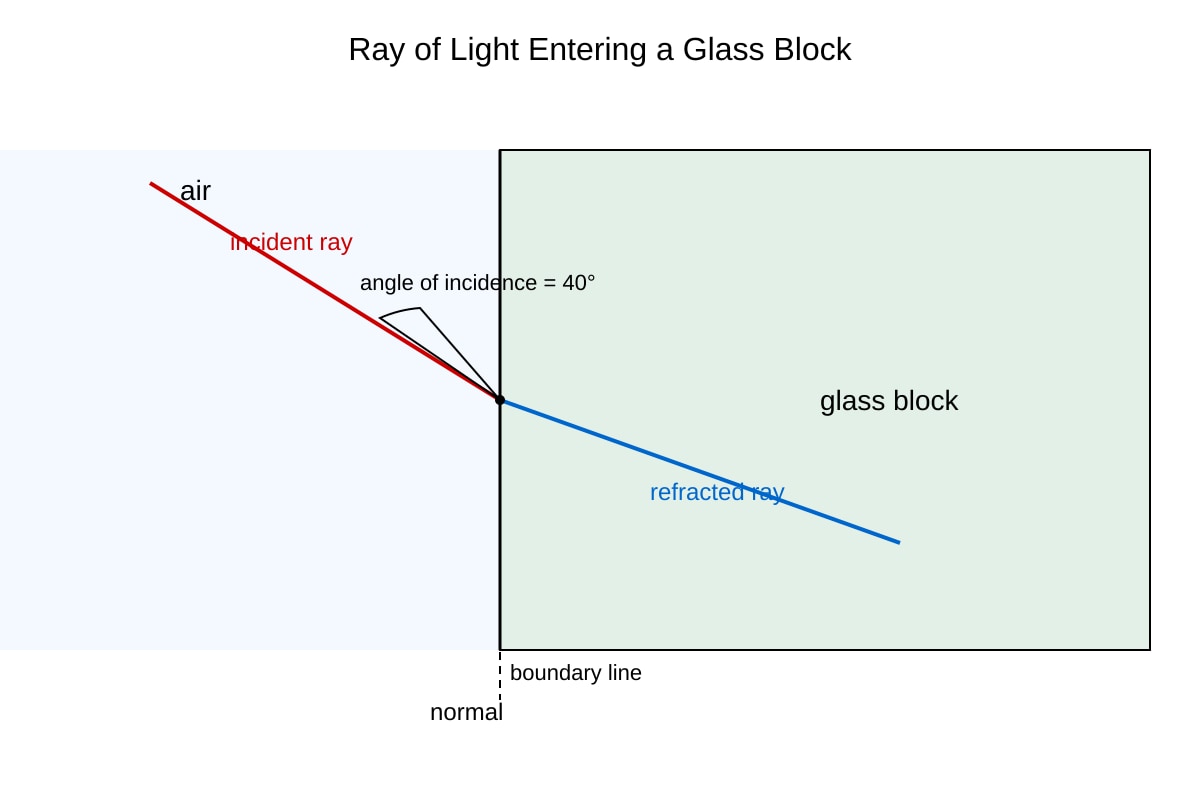
Towards the normal.
Teaching note: Light entering denser medium (glass) from air bends towards normal. Image must show refracted ray closer to normal than incident.
Q9 [1 mark]
Infrared (IR).
Teaching note: TV remotes use infrared waves, part of EM spectrum.
Q10 [2 marks]
v = f λ → λ = v / f = 340 / 512 = 0.664 m
Teaching note: Use formula with units; mark 1 for substitution, 1 for answer with unit m.
Section C: Electricity and Magnetism
Q11 [1 mark]
Current through a metallic conductor is directly proportional to potential difference across it, at constant temperature.
Teaching note: Must mention constant temperature for full credit in exams.
Q12 [2 marks]
R = V / I = 6.0 / 0.50 = 12 Ω
Teaching note: Ohm's law rearrangement. Mark 1 substitution, 1 answer with Ω.
Q13 [2 marks]
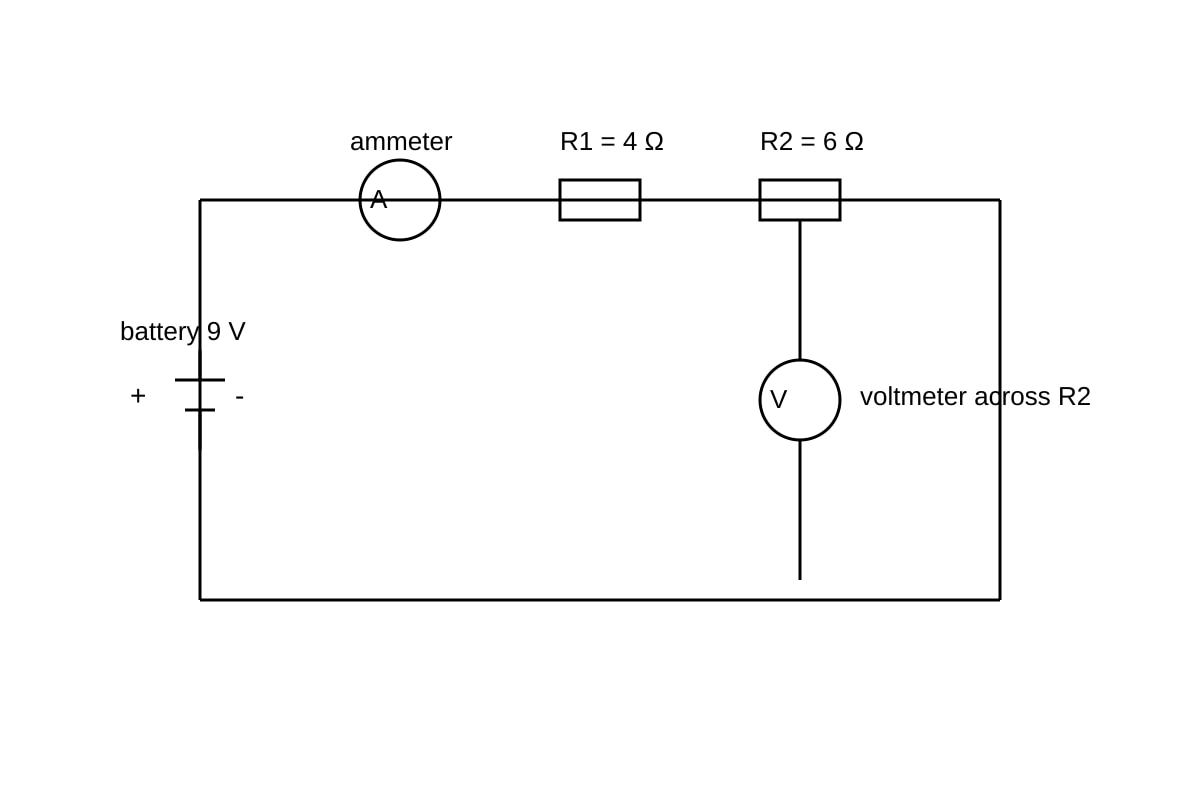
Total R = 4 + 6 = 10 Ω
I = V / R = 9 / 10 = 0.90 A
Teaching note: Series resistors add. Mark 1 total resistance, 1 current.
Q14 [1 mark]
Any one: lifting scrap metal, electric bell, relay, MRI scanner.
Teaching note: Electromagnet is coil around iron core magnetised by current.
Q15 [2 marks]
V_s / V_p = N_s / N_p → V_s = 240 × (50 / 200) = 60 V
Teaching note: Step-down transformer. Mark 1 for ratio, 1 for answer.
Section D: Mixed Physical Sciences
Q16 [3 marks]
a = (v - u)/t = (20 - 0)/10 = 2.0 m/s²
F = ma = 1000 × 2.0 = 2000 N
Teaching note: Use Newton's second law. Mark: 1 acceleration, 1 force formula, 1 answer N.
Q17 [2 marks]
Metals have free electrons that move and transfer kinetic energy quickly; wood lacks free electrons and transfers heat only by slow particle vibration.
Teaching note: 1 mark free electrons, 1 mark comparison with wood.
Q18 [3 marks]
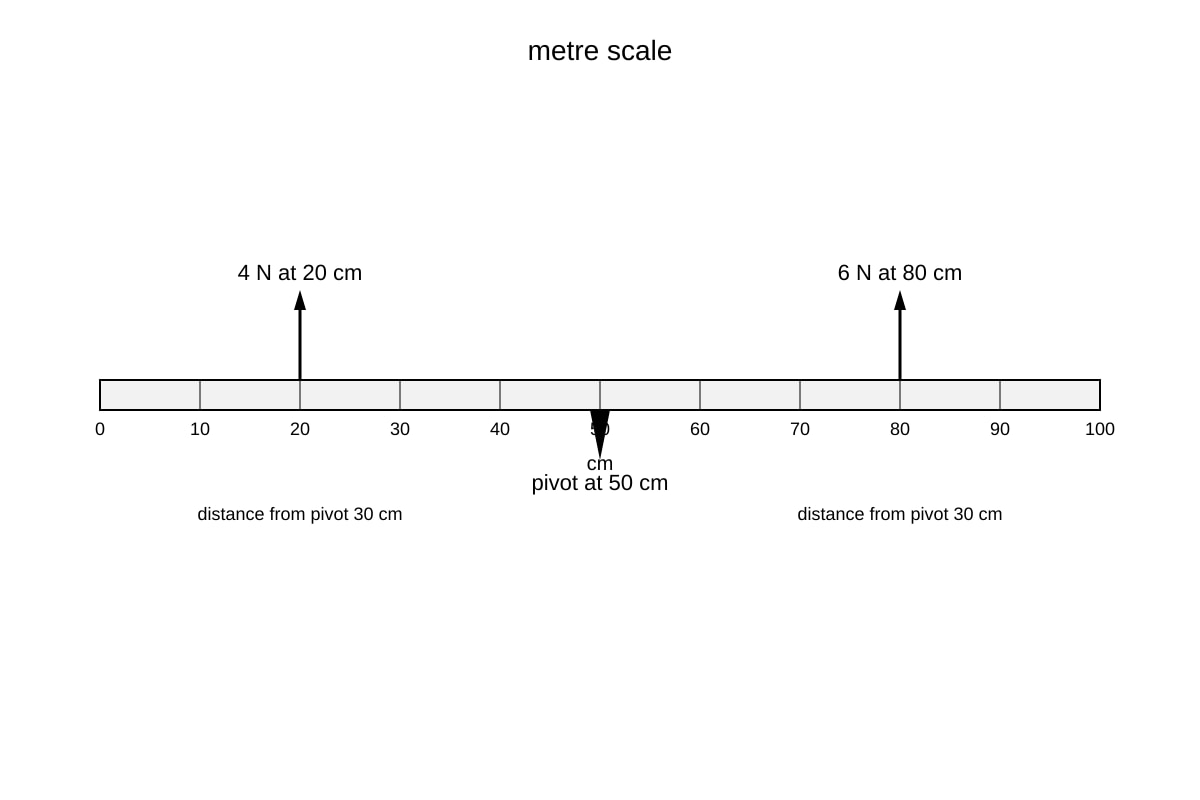
Moment left = 4 × 0.30 = 1.2 N m (clockwise)
Moment right = 6 × 0.30 = 1.8 N m (anticlockwise)
Net = 1.8 - 1.2 = 0.6 N m anticlockwise
Teaching note: Distances from pivot 30 cm = 0.30 m. Mark 1 each moment, 1 net + direction.
Q19 [2 marks]
1/R = 1/3 + 1/3 + 1/3 = 1 Ω⁻¹ → R = 1 Ω
Teaching note: Parallel identical resistors: R/n. Mark 1 working, 1 answer.
Q20 [1 mark]
Any one: global warming, rising sea level, ocean acidification.
Teaching note: Greenhouse gases trap heat.