AI Generated Exam Paper
O Level Combined Science Practice Paper 5
Free O Level Combined Sci Practice Paper 5, HY3 AI version, with questions, answers, and O Level-style practice for Singapore students.
These static practice materials are generated from the site's syllabus and paper-generation workflow, with source and model context shown so students and parents can evaluate the material before use.
Questions
Free quiz and exam paper access
Enter your details to view this paper
Your access is remembered on this device.
Answers
TuitionGoWhere Practice Paper — Combined Science O-Level (Answers)
Version 5 — Answer Key and Teaching Notes
Syllabus-first generated content; not past-year derived.
Section A: Energy and Forces (Q1–8) [26 marks]
Q1 [2 marks]
Answer: Energy cannot be created or destroyed, but can be converted from one form to another (or total energy in a closed system is conserved).
Teaching note: This is the principle of conservation of energy. Students must mention both “not created/destroyed” and “converted/transformed” for full marks. Common mistake: stating only “energy cannot be destroyed” without transformation.
Marking: 1 mark for “cannot be created/destroyed”, 1 mark for “converted/transformed”.
Q2 [3 marks]
Answer: KE = 48 J (using given values). Assumption: air resistance negligible.
Working:
- PE at top =
- By conservation of energy, KE at bottom = PE at top = 48 J.
Teaching note: Mass 0.4 kg, g = 10, h = 12 m. Dropped means initial KE = 0. Assumption must be stated.
Marking: 1 mark assumption, 2 marks for correct substitution and answer.
Q3 [3 marks]
Answer: 125 W
Working:
- Total height =
- Work = Weight × height =
- Power = Work / time =
Teaching note: Use weight directly (not mass). Convert step height to m.
Marking: 1 mark height, 1 mark work, 1 mark power.
Q4 [2 marks]
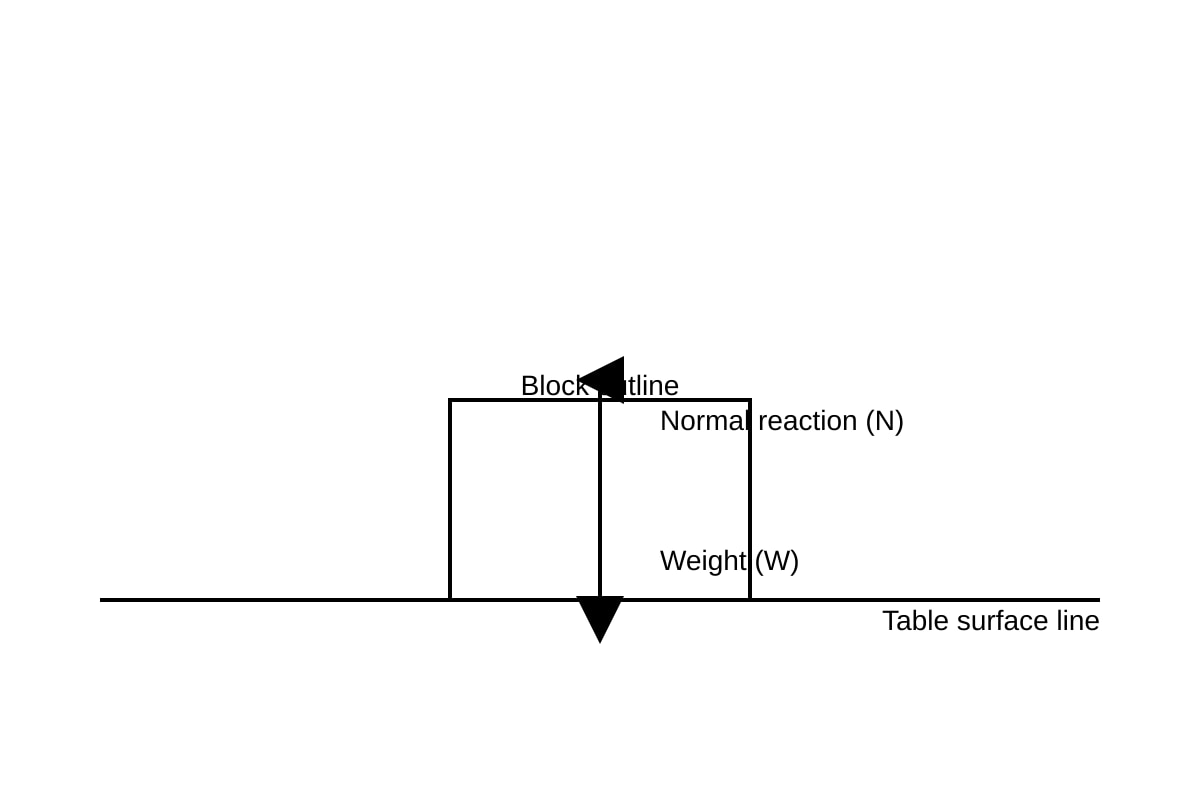
Answer: Free-body diagram with two equal opposite arrows: Weight down (W), Normal up (N).
Teaching note: Block at rest on horizontal table → only W and N. Arrows from centre, equal length.
Marking: 1 mark for W down, 1 mark for N up (balanced).
Q5 [2 marks]
Answer: Gravitational potential energy (GPE). Speed is zero because at highest point velocity momentarily zero before reversing.
Teaching note: At extreme of swing, KE = 0, all energy is GPE.
Marking: 1 mark GPE, 1 mark explanation of zero speed.
Q6 [2 marks]
Answer: Resultant force = 0 N; acceleration = zero (no direction).
Working: . Constant velocity → .
Teaching note: Newton’s first law.
Marking: 1 mark resultant 0, 1 mark no acceleration.
Q7 [2 marks]
Answer: Heat conducted by vibration of particles and movement of free electrons from hot to cold end.
Teaching note: Metals have free electrons that transfer kinetic energy quickly.
Marking: 1 mark vibration/particles, 1 mark free electrons.
Q8 [3 marks]
Answer: Work = 20 000 J; Power = 1000 W
Working:
- Work =
- Power =
Marking: 1 mark work, 2 marks power (or 1+1 for steps).
Section B: Waves, Heat and Electricity (Q9–15) [19 marks]
Q9 [2 marks]
Answer:
Working:
Marking: 1 mark formula, 1 mark answer.
Q10 [2 marks]
Answer: e.g., medical scanning / imaging. High frequency gives short wavelength → better resolution.
Marking: 1 mark application, 1 mark reason.
Q11 [3 marks]
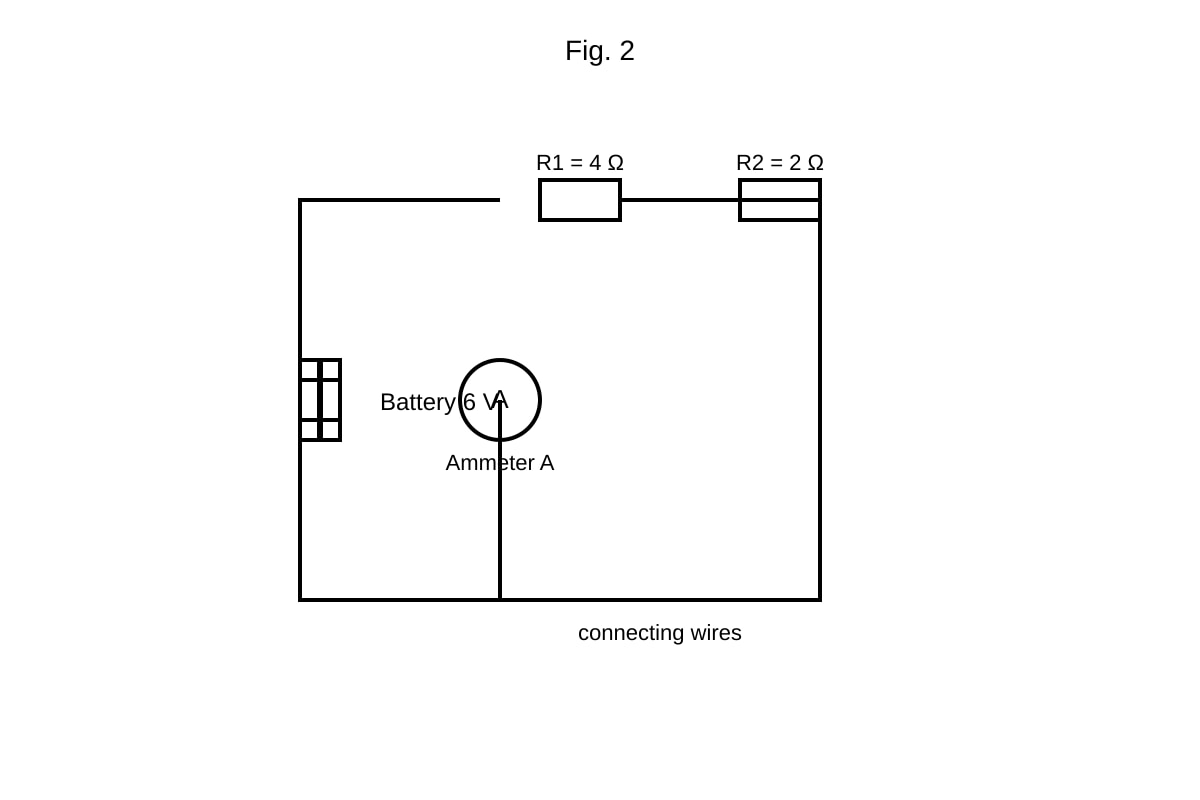
Answer: 1 A
Working:
Marking: 1 mark total R, 2 marks current.
Q12 [2 marks]
Answer: Metals have free electrons that transfer heat energy quickly; wood lacks free electrons.
Marking: 1 mark free electrons, 1 mark comparison.
Q13 [3 marks]
Answer: Water at bottom heated expands, becomes less dense, rises; cooler water sinks, forming convection current.
Marking: 1 mark heating/expansion, 1 mark rise, 1 mark sink/replace.
Q14 [2 marks]
Answer: Speed decreases; direction bends towards normal.
Marking: 1 mark speed, 1 mark direction.
Q15 [3 marks]
Answer: 4 Ω
Working:
Marking: 1 mark reciprocal sum, 2 marks result.
Section C: Integrated Physical Science (Q16–20) [20 marks]
Q16 [4 marks]
Answer: 11.25 m; assumption: air resistance negligible.
Working:
- →
- →
Marking: 1 assumption, 3 for method/answer.
Q17 [4 marks]
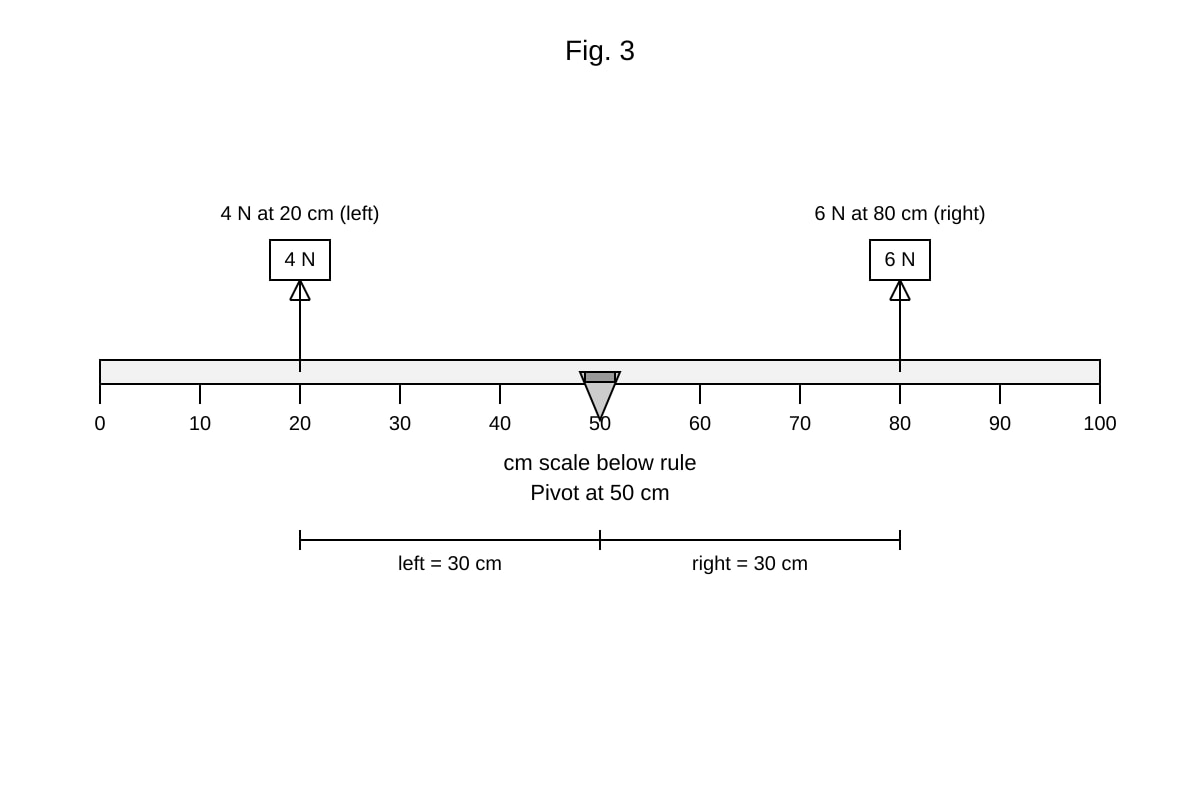
Answer: Net moment = 0.6 N·m; right side turns down.
Working:
- Left moment = (anticlockwise)
- Right moment = (clockwise)
- Net = clockwise → right down.
Marking: 2 marks moments, 1 net, 1 side.
Q18 [4 marks]
Answer: 38.1 °C (or 38 °C)
Working:
- Energy =
Marking: 1 power-time, 1 substitution, 2 answer.
Q19 [4 marks]
Answer: 2000 N
Working:
Marking: 2 acceleration, 2 force.
Q20 [4 marks]
Answer: Particles in liquid are close but can move past each other; no fixed shape but volume fixed due to weak bonds.
Marking: 1 model, 1 shape reason, 1 volume reason, 1 cohesion.