AI Generated Exam Paper
O Level Combined Science Practice Paper 5
Free O Level Combined Sci Practice Paper 5, DeepSeek AI version, with questions, answers, and O Level-style practice for Singapore students.
These static practice materials are generated from the site's syllabus and paper-generation workflow, with source and model context shown so students and parents can evaluate the material before use.
Questions
Free quiz and exam paper access
Enter your details to view this paper
Your access is remembered on this device.
Answers
TuitionGoWhere Practice Paper - Combined Science O-Level
Answer Key and Marking Scheme
Subject: Combined Science (Physics, Chemistry) Level: O-Level Paper: Practice Paper – Physical Sciences Version: 5 of 5 Total Marks: 65
Section A: Structured Questions (40 marks)
Question 1: Measurement and Density (4 marks)
(a) State the SI unit for mass. [1]
- Answer: kilogram / kg
- Marking: 1 mark for correct unit. Accept 'kg' only.
(b) Calculate the density of the stone in g/cm³. [2]
- Answer:
- Volume of stone = 72 – 50 = 22 cm³ [1 mark for correct volume]
- Density = mass / volume = 55 / 22 = 2.5 g/cm³ [1 mark for correct answer with unit]
- Marking: Award 1 mark for correct volume calculation. Award 1 mark for correct density with unit. Accept 2.5 g/cm³. Deduct 0.5 marks if unit missing or incorrect.
(c) Explain whether the stone will float or sink in water. [1]
- Answer: The stone will sink because its density (2.5 g/cm³) is greater than the density of water (1.0 g/cm³).
- Marking: 1 mark for correct prediction with valid reason linking density comparison. Accept 'sink' with reference to greater density.
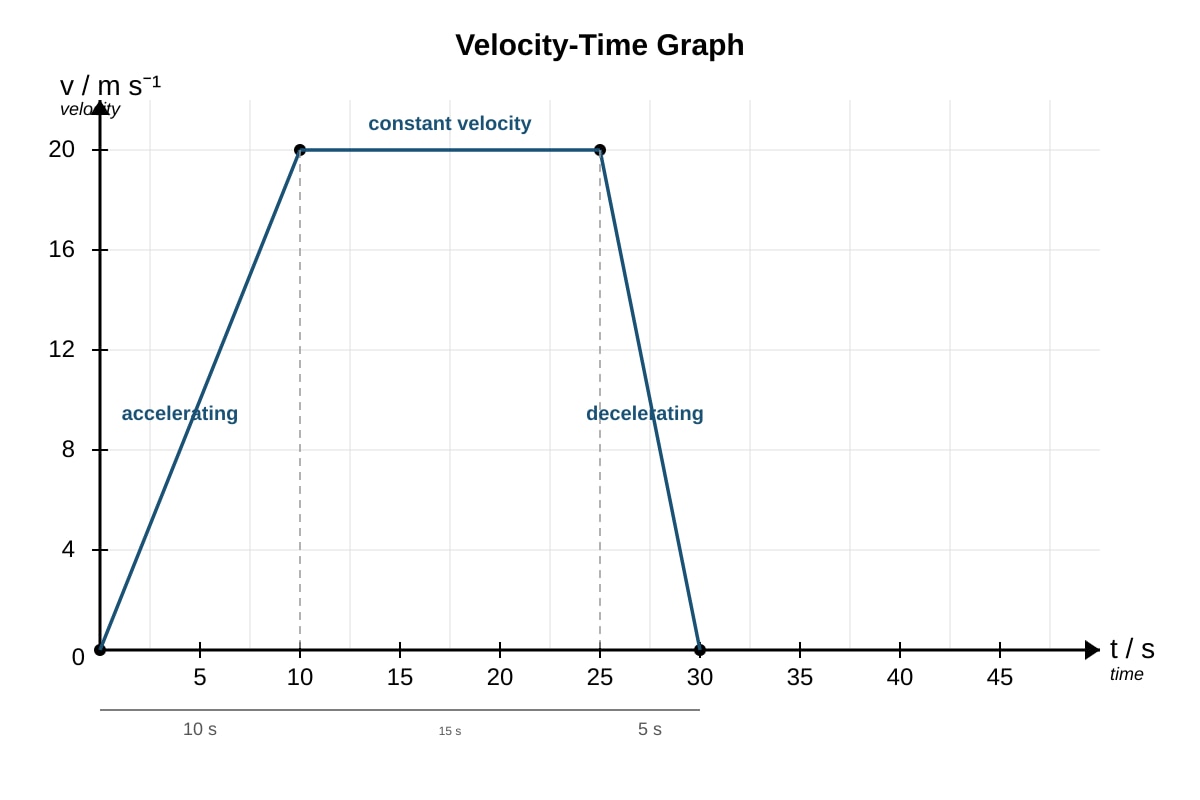
Question 2: Kinematics (4 marks)
(a) Describe the motion of the car between t = 10 s and t = 25 s. [1]
- Answer: The car is travelling at constant velocity / constant speed of 20 m/s.
- Marking: 1 mark for 'constant velocity' or 'constant speed'. Accept 'uniform motion' or 'zero acceleration'.
(b) Calculate the acceleration of the car during the first 10 seconds. [2]
- Answer:
- a = (v – u) / t = (20 – 0) / 10 = 2.0 m/s² [1 mark for correct substitution, 1 mark for correct answer with unit]
- Marking: Award 1 mark for correct formula/substitution. Award 1 mark for correct answer with unit. Accept 2 m/s².
(c) State what the area under a velocity-time graph represents. [1]
- Answer: Distance travelled / displacement
- Marking: 1 mark for 'distance' or 'displacement'.
Question 3: Forces and Moments (5 marks)
(a) Define the moment of a force. [1]
- Answer: The moment of a force is the product of the force and the perpendicular distance from the pivot to the line of action of the force.
- Marking: 1 mark for definition including 'force × perpendicular distance'. Accept 'turning effect of a force'.
(b) Calculate the moment of the box's weight about the support. [2]
- Answer:
- Moment = force × perpendicular distance = 150 × 2.0 = 300 N m [1 mark for substitution, 1 mark for correct answer with unit]
- Marking: Award 1 mark for correct formula/substitution. Award 1 mark for correct answer with unit (N m). Accept Nm.
(c) State the principle used to determine the position of this box. [1]
- Answer: Principle of moments (sum of clockwise moments = sum of anticlockwise moments for a body in equilibrium)
- Marking: 1 mark for 'principle of moments' or statement of equilibrium condition.
(d) Calculate the distance from the support at which the 100 N box must be placed. [1]
- Answer:
- Clockwise moment = Anticlockwise moment
- 100 × d = 150 × 2.0
- d = 300 / 100 = 3.0 m
- Marking: 1 mark for correct answer with unit. Accept 3 m.
Question 4: Pressure (4 marks)
(a) Calculate the maximum pressure the block can exert on a horizontal surface. [2]
- Answer:
- Minimum area = 0.15 × 0.10 = 0.015 m² [1 mark for identifying minimum area]
- Maximum pressure = force / area = 90 / 0.015 = 6000 Pa [1 mark for correct calculation with unit]
- Marking: Award 1 mark for using the smallest face area. Award 1 mark for correct pressure with unit. Accept 6000 N/m².
(b) Explain why the pressure exerted by the block depends on its orientation. [1]
- Answer: Pressure = force / area. The weight (force) is constant, but the contact area changes with orientation. A smaller area produces a larger pressure.
- Marking: 1 mark for explanation linking area to pressure (inverse relationship).
(c) Calculate the density of the liquid. [1]
- Answer:
- P = ρgh → ρ = P / (gh) = 4200 / (10 × 0.50) = 840 kg/m³
- Marking: 1 mark for correct answer with unit. Accept 840 kg/m³.
Question 5: Energy and Power (5 marks)
(a) State the principle of conservation of energy. [1]
- Answer: Energy cannot be created or destroyed; it can only be converted/transferred from one form to another. The total energy in a closed system remains constant.
- Marking: 1 mark for correct statement. Must include 'cannot be created or destroyed' and 'converted/transferred'.
(b) Calculate the work done by the crane in lifting the load. [2]
- Answer:
- Weight = mg = 500 × 10 = 5000 N [1 mark for correct weight]
- Work done = force × distance = 5000 × 30 = 150,000 J / 150 kJ [1 mark for correct work]
- Marking: Award 1 mark for correct weight calculation. Award 1 mark for correct work done with unit.
(c) Calculate the average power developed by the crane. [1]
- Answer:
- Power = work / time = 150,000 / 25 = 6000 W / 6.0 kW
- Marking: 1 mark for correct answer with unit.
(d) Suggest one reason why the crane's motor provides more power than the value calculated in (c). [1]
- Answer: Energy is lost due to friction in the moving parts / Energy is converted to heat and sound / The motor must overcome friction and air resistance / Not all electrical energy is converted to useful work.
- Marking: 1 mark for any valid reason relating to energy losses or inefficiency.
Question 6: Thermal Energy Transfer (4 marks)
(a) Describe what the student observes as the rod heats up. [1]
- Answer: The drawing pins fall off one by one, starting from the end nearest the hot water.
- Marking: 1 mark for correct observation (pins fall sequentially from hot end).
(b) Explain how heat is conducted through the metal rod. [2]
- Answer:
- Particles at the hot end gain kinetic energy and vibrate more vigorously. [1 mark]
- These vibrations are passed to neighbouring particles through collisions. In metals, free electrons also move and transfer kinetic energy rapidly through the rod. [1 mark]
- Marking: Award 1 mark for particle vibration explanation. Award 1 mark for mentioning free electrons in metals.
(c) State and explain how the observation differs with a glass rod. [1]
- Answer: The pins fall off more slowly / take longer to fall. Glass is a poor conductor (insulator) because it lacks free electrons and particle vibrations are transferred more slowly.
- Marking: 1 mark for correct observation with valid explanation.
Question 7: Waves and Light (5 marks)
(a) State what happens to the speed of light as it enters the glass. [1]
- Answer: The speed of light decreases.
- Marking: 1 mark for 'decreases' or 'slows down'.
(b) Calculate the refractive index of the glass. [2]
- Answer:
- n = sin i / sin r = sin 50° / sin 30° = 0.7660 / 0.5000 = 1.53 [1 mark for correct substitution, 1 mark for correct answer]
- Marking: Award 1 mark for correct formula/substitution. Award 1 mark for correct answer (1.53, accept 1.5).
(c) Draw a labelled diagram. [2]
- Answer: Diagram should show:
- Ray entering glass and bending towards the normal [1 mark]
- Ray leaving glass and bending away from the normal (parallel to incident ray)
- Normal line drawn perpendicular to surface at both entry and exit points
- Labels: incident ray, refracted ray, emergent ray, normal, angle of incidence (i), angle of refraction (r) [1 mark]
- Marking: Award 1 mark for correct ray paths (bending towards normal on entry, away on exit). Award 1 mark for correct labels including normal and angles.
Question 8: Electricity (5 marks)
(a) Calculate the total resistance of the parallel combination. [2]
- Answer:
- 1/R_total = 1/3 + 1/6 = 2/6 + 1/6 = 3/6 = 1/2 [1 mark for correct formula/substitution]
- R_total = 2 Ω [1 mark for correct answer with unit]
- Marking: Award 1 mark for correct use of parallel resistance formula. Award 1 mark for correct answer with unit.
(b) Calculate the total current drawn from the battery. [1]
- Answer:
- I = V / R = 12 / 2 = 6.0 A
- Marking: 1 mark for correct answer with unit.
(c) State one advantage of connecting household appliances in parallel rather than in series. [1]
- Answer: Each appliance receives the full mains voltage / Appliances can be switched on/off independently / If one appliance fails, others continue to work.
- Marking: 1 mark for any valid advantage.
(d) State and explain how the total current changes when the 3 Ω resistor is replaced with a 12 Ω resistor. [1]
- Answer: The total current decreases. The total resistance increases (1/R = 1/12 + 1/6 = 1/4, so R = 4 Ω), so for the same voltage, current decreases (I = V/R).
- Marking: 1 mark for correct prediction with valid explanation.
Question 9: Electromagnetic Induction (4 marks)
(a) State what is observed on the ammeter as the magnet moves into the coil. [1]
- Answer: The ammeter needle deflects / shows a reading, indicating a current flows.
- Marking: 1 mark for 'deflection' or 'current flows'.
(b) Explain why this observation occurs. [2]
- Answer:
- The moving magnet causes a changing magnetic field through the coil. [1 mark]
- This changing magnetic field induces an electromotive force (e.m.f.) / voltage across the coil, which drives a current through the circuit (electromagnetic induction). [1 mark]
- Marking: Award 1 mark for 'changing magnetic field'. Award 1 mark for 'induced e.m.f./current'.
(c) State one way to increase the magnitude of the induced current. [1]
- Answer: Move the magnet faster / Use a stronger magnet / Use a coil with more turns.
- Marking: 1 mark for any valid method.
Section B: Data-Based and Application Questions (25 marks)
Question 10: Experimental Data Analysis – Pendulum (6 marks)
(a) Calculate the average time for one complete oscillation (the period). [2]
- Answer:
- Average time for 20 oscillations = (40.2 + 39.8 + 40.0) / 3 = 40.0 s [1 mark]
- Period = 40.0 / 20 = 2.00 s [1 mark]
- Marking: Award 1 mark for correct average. Award 1 mark for correct period with unit.
(b) State the position where the bob has maximum kinetic energy. Explain your answer. [2]
- Answer:
- Maximum kinetic energy at the lowest point / equilibrium position. [1 mark]
- At this position, the bob is moving fastest. Gravitational potential energy has been converted to kinetic energy. [1 mark]
- Marking: Award 1 mark for correct position. Award 1 mark for valid explanation linking to speed or energy conversion.
(c) Predict how the period changes with a bob of greater mass. Explain. [2]
- Answer:
- The period remains the same / does not change. [1 mark]
- The period of a simple pendulum depends only on the length of the thread and acceleration due to gravity, not on the mass of the bob. [1 mark]
- Marking: Award 1 mark for correct prediction. Award 1 mark for correct explanation (period independent of mass).
Question 11: Circuit Analysis (7 marks)
(a) Calculate the potential difference across the 10 Ω resistor. [1]
- Answer:
- V = IR = 0.40 × 10 = 4.0 V
- Marking: 1 mark for correct answer with unit.
(b) Calculate the potential difference across resistor R. [2]
- Answer:
- Total voltage = 6.0 V [1 mark for recognising series circuit voltage division]
- V_R = 6.0 – 4.0 = 2.0 V [1 mark for correct answer]
- Marking: Award 1 mark for method (total voltage minus known voltage). Award 1 mark for correct answer with unit.
(c) Calculate the resistance of R. [2]
- Answer:
- R = V / I = 2.0 / 0.40 = 5.0 Ω [1 mark for correct formula, 1 mark for correct answer with unit]
- Marking: Award 1 mark for correct formula/substitution. Award 1 mark for correct answer with unit.
(d) Explain whether the resistance of the filament lamp is greater than, less than, or equal to 10 Ω. [2]
- Answer:
- The resistance of the filament lamp is equal to 10 Ω. [1 mark]
- Since the current is still 0.40 A and the potential difference across it would still be 4.0 V (to maintain the same circuit conditions), R = V/I = 4.0/0.40 = 10 Ω. The resistance is the same under these conditions. [1 mark]
- Marking: Award 1 mark for correct answer. Award 1 mark for valid reasoning using V=IR.
Question 12: Energy Efficiency in Context (6 marks)
(a) Calculate the electrical energy supplied by the kettle in 150 seconds. [1]
- Answer:
- E = P × t = 2200 × 150 = 330,000 J / 330 kJ
- Marking: 1 mark for correct answer with unit.
(b) Calculate the useful thermal energy gained by the water. [2]
- Answer:
- E = mcΔθ = 1.0 × 4200 × (100 – 25) [1 mark for correct substitution]
- E = 1.0 × 4200 × 75 = 315,000 J / 315 kJ [1 mark for correct answer with unit]
- Marking: Award 1 mark for correct formula and substitution. Award 1 mark for correct answer with unit.
(c) Calculate the efficiency of the kettle. [2]
- Answer:
- Efficiency = (useful energy output / total energy input) × 100% [1 mark for correct formula]
- Efficiency = (315,000 / 330,000) × 100% = 95.5% [1 mark for correct answer]
- Marking: Award 1 mark for correct formula. Award 1 mark for correct answer (accept 95% or 95.5%).
(d) Suggest one reason why the efficiency is less than 100%. [1]
- Answer: Some energy is lost as heat to the surroundings / Energy is used to heat the kettle itself / Some energy is lost as sound.
- Marking: 1 mark for any valid reason relating to energy losses.
Question 13: Forces and Motion in Context (6 marks)
(a) State the magnitude of the forward force exerted by the cyclist. Explain. [2]
- Answer:
- Forward force = 40 N [1 mark]
- Since the cyclist travels at constant speed, the resultant force is zero (Newton's First Law). The forward force must equal the resistive force of 40 N. [1 mark]
- Marking: Award 1 mark for correct magnitude. Award 1 mark for explanation using balanced forces / Newton's First Law.
(b) Calculate the work done by the cyclist in travelling 500 m. [2]
- Answer:
- Work done = force × distance = 40 × 500 [1 mark for correct substitution]
- Work done = 20,000 J / 20 kJ [1 mark for correct answer with unit]
- Marking: Award 1 mark for correct formula/substitution. Award 1 mark for correct answer with unit.
(c) Explain why the speed increases on a downward slope even though no forward force is applied. [2]
- Answer:
- On the downward slope, the cyclist loses gravitational potential energy. [1 mark]
- This potential energy is converted to kinetic energy, causing the speed to increase. [1 mark]
- Marking: Award 1 mark for identifying loss of gravitational potential energy. Award 1 mark for linking to conversion to kinetic energy / increase in speed.
END OF ANSWER KEY
This answer key was generated by TuitionGoWhere AI. Mark allocations reflect typical O-Level Combined Science assessment standards. Partial marks should be awarded where working demonstrates correct scientific reasoning.