AI Generated Exam Paper
O Level Combined Science Practice Paper 2
Free O Level Combined Sci Practice Paper 2, HY3 AI version, with questions, answers, and O Level-style practice for Singapore students.
These static practice materials are generated from the site's syllabus and paper-generation workflow, with source and model context shown so students and parents can evaluate the material before use.
Questions
TuitionGoWhere Practice Paper - Combined Science O-Level
TuitionGoWhere Practice Paper (AI) — Version 2
Subject: Combined Science
Level: O-Level
Paper: Practice Paper (Physical Sciences Focus)
Duration: 1 hour 15 minutes
Total Marks: 65
Name: ________________________
Class: ________________________
Date: ________________________
Instructions:
- This practice paper covers Physical Sciences topics from the O-Level Combined Science syllabus.
- Answer all questions in the spaces provided.
- Show all working clearly where calculation is required.
- Use a calculator where necessary.
- Marks for each question are shown in brackets [ ].
Section A: Energy and Forces (Marks: 25)
1. State the principle of conservation of energy. [2]
2. A metal sphere of mass 0.4 kg is dropped from a height of 12 m. Assume air resistance is negligible and g=10 m/s2. Calculate the kinetic energy of the sphere just before it hits the ground. State one assumption made. [4]
3. A girl of weight 480 N runs up a flight of 15 steps in 12 s. Each step has a height of 0.15 m. Calculate the average power developed by the girl. [3]
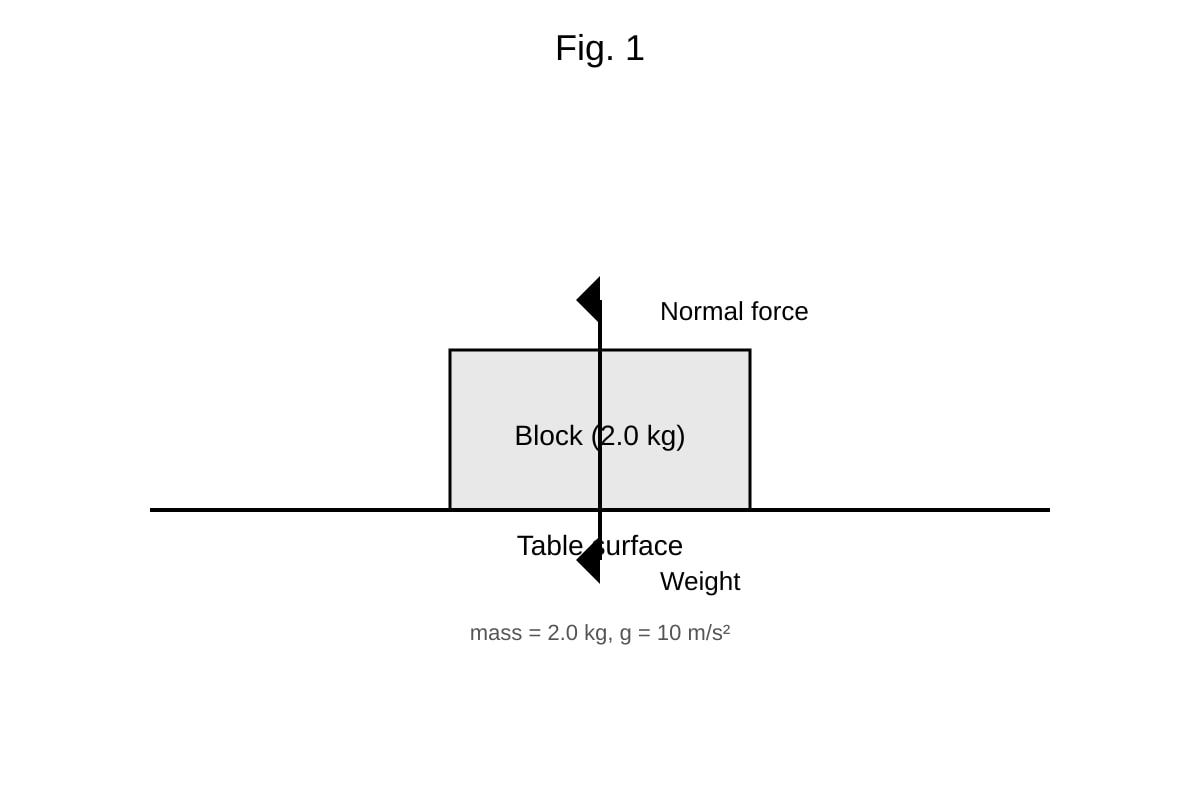
4. Fig. 1 shows a block of mass 2.0 kg resting on a horizontal table.
Image pending generation: diagram for Q4.
Draw a free-body diagram to show the forces acting on the block. Label the forces. [2]
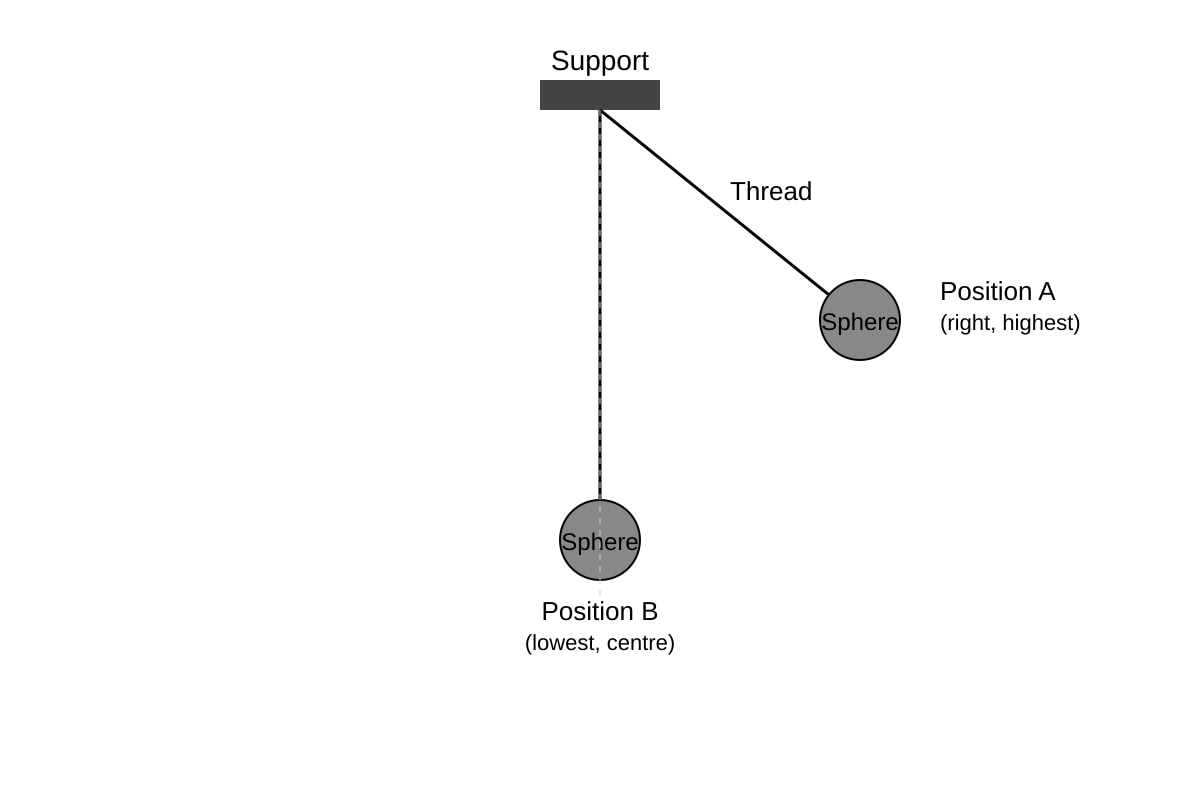
5. A pendulum consists of a metal sphere attached to a thin thread, as shown in Fig. 2. At position A, the sphere is at its highest point and momentarily at rest.
Image pending generation: diagram for Q5.
State the type of energy the sphere has at position A and at position B. [2]
A: ____________________
B: ____________________
6. Explain why metals are good conductors of heat. [2]
7. A 2.0 kg block rests on a 30° incline. Draw a free-body diagram and calculate the normal force acting on the block. Take g=10 m/s2. [4]
8. A crane lifts a load of weight 2000 N through a height of 8 m in 20 s. Calculate the useful work done and the power output of the crane. [3]
9. Sound waves of frequency 1000 Hz travel through air at 340 m/s. Calculate the wavelength and state one use of ultrasound. [3]
Section B: Thermal Physics and Waves (Marks: 20)
10. A metal rod is heated at one end. Describe how heat is transferred along the rod by conduction. [2]
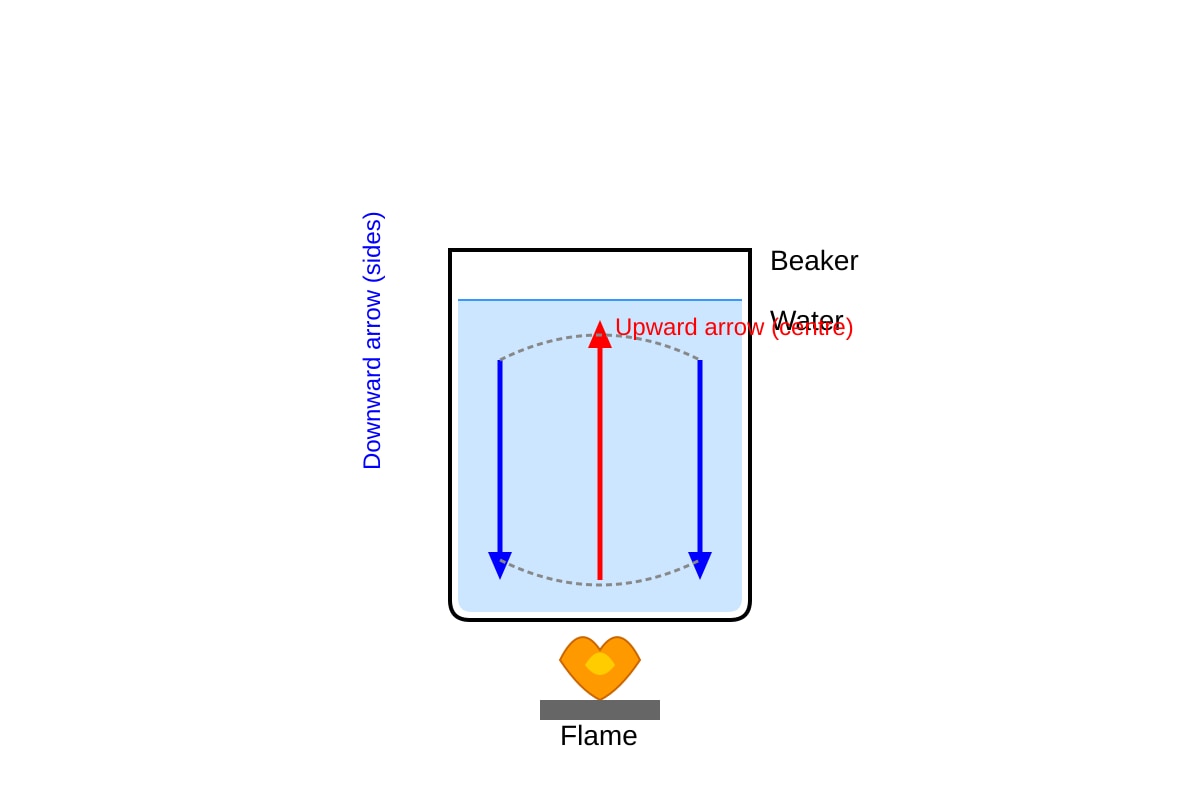
11. Fig. 3 shows a labelled container with water heated from below.
Image pending generation: diagram for Q11.
Name the process shown by the arrows and explain how it transfers heat. [3]
12. Light waves travel from air into glass. State what happens to the speed and direction of the waves. [2]
13. A radio wave has a frequency of 3.0×10⁶ Hz and travels at 3.0×10⁸ m/s in air. Calculate its wavelength. [2]
14. State one danger of exposure to ultraviolet radiation and one use of infrared radiation. [2]
15. A student places a drop of coloured dye in a beaker of cold water and another in hot water. After 5 minutes, the dye in hot water spreads further. Explain this observation using the kinetic particle model. [3]
16. A thin converging lens forms a real image of an object placed 30 cm from the lens. The image is formed 60 cm from the lens. Calculate the magnification of the image. [2]
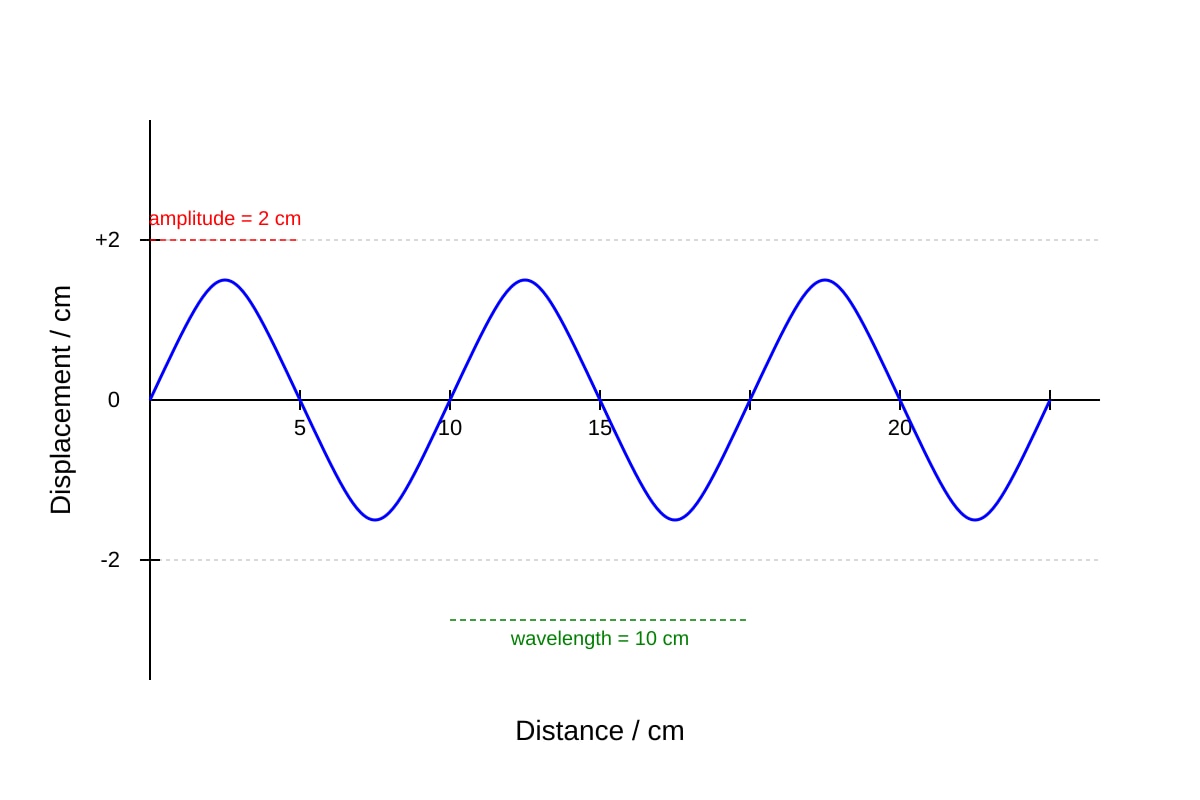
17. Fig. 4 shows a transverse wave drawn on a grid.
Image pending generation: graph for Q17.
Measure the wavelength and amplitude from the diagram. [2]
Wavelength = ____________
Amplitude = ____________
18. Explain why a vacuum flask reduces heat loss by radiation. [2]
19. A string is plucked to produce a wave of speed 80 m/s and wavelength 0.40 m. Calculate the frequency of the wave. [2]
Section C: Electricity and Magnetism (Marks: 20)
20. State Ohm's law. [2]
21. A resistor of resistance 10 Ω is connected to a 6 V battery. Calculate the current flowing through the resistor. [2]
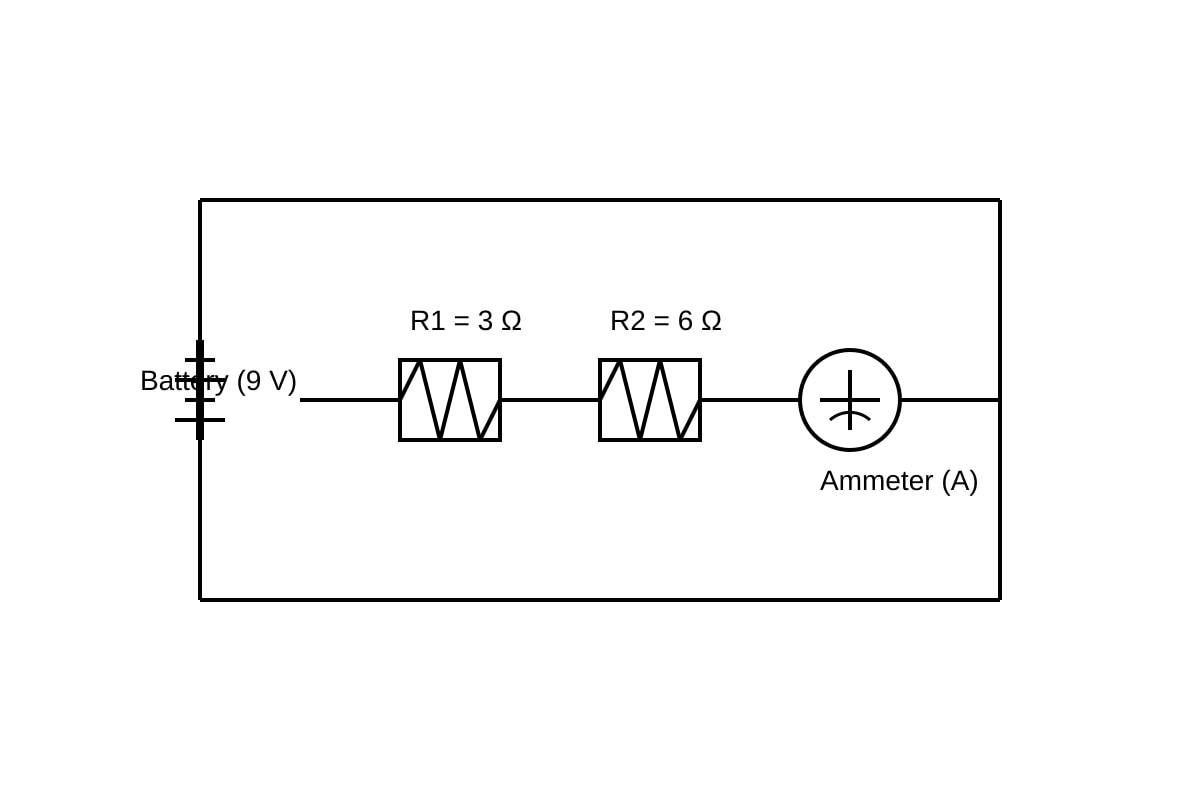
22. Fig. 5 shows a simple series circuit with a 9 V battery, a 3 Ω resistor and a 6 Ω resistor.
Image pending generation: circuit for Q22.
Calculate the total resistance and the current in the circuit. [3]
23. Two resistors of 4 Ω and 6 Ω are connected in parallel to a 12 V supply. Calculate the total resistance of the combination. [3]
24. A 12 V heater draws a current of 5 A. Calculate the electrical power used by the heater and the energy transferred in 10 minutes. [3]
25. Explain how an electromagnet works and state one household application. [3]
26. A transformer has 200 turns on the primary coil and 50 turns on the secondary coil. If the input voltage is 240 V, calculate the output voltage. State whether it is a step-up or step-down transformer. [3]
27. Fig. 6 shows a bar magnet with its magnetic field lines.
Image pending generation: diagram for Q27.
Describe the direction of the magnetic field lines outside the magnet. [1]
Total Marks for Paper: 65
Answers
TuitionGoWhere Practice Paper — Combined Science O-Level (Version 2) Answer Key
Subject: Combined Science
Level: O-Level
Paper: Practice Paper (Physical Sciences Focus)
Total Marks: 65
Section A: Energy and Forces (25 marks)
Q1 [2]
Energy cannot be created or destroyed, only converted from one form to another (or transformed). In a closed system, total energy is conserved.
Marking: 1 mark for "not created/destroyed", 1 mark for "converted/transformed". Common mistake: omitting transformation.
Q2 [4]
- Assumption: air resistance negligible, g=10 m/s2. [1]
- PE at top = mgh=0.4×10×12=48 J [2]
- By conservation of energy, KE at bottom = 48 J [1]
Teaching note: PE converts fully to KE when no air resistance. Mass used directly with weight equivalence via g.
Q3 [3]
- Total height = 15×0.15=2.25 m [1]
- Work = Weight × height = 480×2.25=1080 J [1]
- Power = Work / time = 1080/12=90 W [1]
Common trap: forgetting cm to m conversion (0.15 not 15).
Q4 [2]
Free-body diagram: weight arrow down (W = mg = 20 N), normal arrow up from table, equal length, from centre. [2]
Marking: 1 for correct forces, 1 for labelling/direction.
Q5 [2]
A: Gravitational potential energy [1]
B: Kinetic energy [1]
At A, highest point = max GPE, zero KE. At B, lowest = max KE.
Q6 [2]
Metals have free electrons that move and transfer kinetic energy rapidly through the material; also lattice vibrations. [2]
1 mark free electrons, 1 mark transfer mechanism.
Q7 [4]
- Diagram: weight down, normal perpendicular to slope, friction up slope. [2]
- W=mg=2.0×10=20 N [1]
- N=Wcos30∘=20×0.866=17.3 N [1]
Marking: diagram 2, calc 2.
Q8 [3]
- Work = F×d=2000×8=16000 J [2]
- Power = 16000/20=800 W [1]
Q9 [3]
- λ=v/f=340/1000=0.34 m [2]
- Use of ultrasound: medical scanning / imaging [1]
Section B: Thermal Physics and Waves (20 marks)
Q10 [2]
Heat transferred by vibration of particles and movement of free electrons from hotter to colder region. [2]
Q11 [3]
Process: convection [1]. Warm water rises (less dense), cool water sinks (denser), forming a circulation current transferring heat. [2]
Q12 [2]
Speed decreases [1]; direction bends towards normal (refraction) [1].
Q13 [2]
λ=v/f=(3.0×108)/(3.0×106)=100 m [2]
Q14 [2]
Danger of UV: skin cancer / eye damage [1]. Use of IR: remote controls / thermal imaging [1].
Q15 [3]
In hot water, particles have more kinetic energy, move faster, collide more often, so dye diffuses quicker. [3]
Marking: particles move faster (1), more collisions (1), faster spreading (1).
Q16 [2]
Magnification = v/u=60/30=2 (or 2×) [2]
Q17 [2]
Wavelength = 10 cm [1]; Amplitude = 2 cm [1] (from grid labels).
Q18 [2]
Shiny silvered walls reflect radiation back, reducing heat loss by radiation. [2]
Q19 [2]
f=v/λ=80/0.40=200 Hz [2]
Section C: Electricity and Magnetism (20 marks)
Q20 [2]
Current through a conductor is directly proportional to potential difference, provided temperature constant. [2]
Q21 [2]
I=V/R=6/10=0.6 A [2]
Q22 [3]
- Rtotal=3+6=9 Ω [1]
- I=V/R=9/9=1.0 A [2]
Q23 [3]
1/RT=1/4+1/6=3/12+2/12=5/12
RT=12/5=2.4 Ω [3]
Q24 [3]
- P=VI=12×5=60 W [2]
- E=Pt=60×(10×60)=36000 J [1]
Q25 [3]
Current through coil creates magnetic field; iron core intensifies it. Application: doorbell / relay. [3]
Q26 [3]
- Vs=Vp×(Ns/Np)=240×(50/200)=60 V [2]
- Step-down [1]
Q27 [1]
From north pole to south pole outside the magnet. [1]
Total Marks: 65 — matches paper declaration.
Free quiz and exam paper access
Enter your details to view this paper
Your access is remembered on this device.