AI Generated Exam Paper
O Level Combined Science Practice Paper 1
Free O Level Combined Sci Practice Paper 1, HY3 AI version, with questions, answers, and O Level-style practice for Singapore students.
These static practice materials are generated from the site's syllabus and paper-generation workflow, with source and model context shown so students and parents can evaluate the material before use.
Questions
TuitionGoWhere Practice Paper - Combined Science O-Level
TuitionGoWhere Practice Paper (AI) — Version 1 of 5
Subject: Combined Science (Physical Sciences focus)
Level: O-Level
Paper: Practice Paper (AI-generated, not official format)
Duration: 1 hour 15 minutes
Total Marks: 65
Name: ________________________
Class: ________________________
Date: ________________________
Instructions:
- This practice paper contains 20 questions on Physical Sciences topics drawn from the O-Level Combined Science syllabus.
- Section A: Questions 1–8 (20 marks)
- Section B: Questions 9–14 (25 marks)
- Section C: Questions 15–20 (20 marks)
- Show all working clearly where calculation is required.
- Use g=10 m/s2 unless stated otherwise.
Section A (20 marks)
1. State the principle of conservation of energy. [2]
2. A metal rod is heated at one end. Which statement best describes the conduction of heat through the metal rod? [1]
A. Heat is carried by moving particles of the metal from hot to cold end.
B. Free electrons transfer kinetic energy and ions vibrate, passing energy along.
C. The metal melts and flows from the hot end to the cold end.
D. Radiation travels through the rod without particle interaction.
3. Sound waves of frequency 500 Hz travel through air at 340 m/s. Calculate the wavelength. [2]
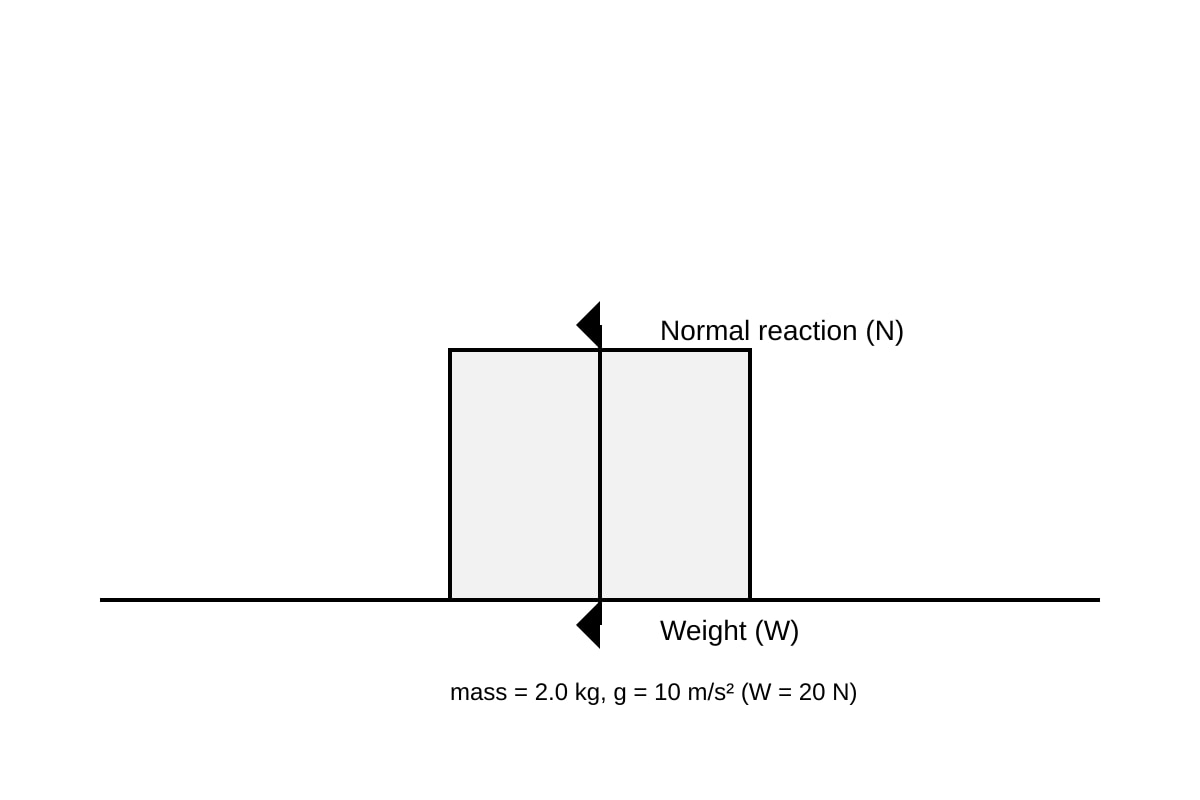
4. A 2.0 kg block rests on a horizontal table. Draw a free-body diagram showing the forces acting on the block. [2]
Image pending generation: diagram for Q4.
5. A pendulum bob is at the highest point of its swing. State the form of energy it has the most of at this point. [1]
6. A student runs up 15 steps, each of height 0.20 m, in 9.0 s. The student's weight is 600 N. Calculate the average power developed. [3]
7. Light of wavelength 0.40 \mum is part of the electromagnetic spectrum. State one use of light in this range and one danger. [2]
8. A metal sphere of mass 0.40 kg is dropped from a height of 5.0 m. Assuming air resistance is negligible, calculate the kinetic energy just before it hits the ground. [2]
Section B (25 marks)
9. Fig. Q9 shows a 3.0 kg block on a 30∘ incline.
(a) Draw a free-body diagram showing all forces. [2]
(b) Calculate the normal force acting on the block. [2]
Image pending generation: diagram for Q9.
10. A ball of mass 0.20 kg is thrown vertically upward with initial speed 15 m/s.
(a) Calculate its initial kinetic energy. [2]
(b) State the height it reaches (use g=10 m/s2). [2]
11. The table below shows the rate of reaction between zinc and hydrochloric acid.
| Temp (°C) | Volume of H2 in 1 min (cm³) |
|---|---|
| 20 | 10 |
| 40 | 22 |
| 60 | 40 |
(a) Calculate the rate at 40∘C in cm³/min. [1]
(b) Explain the trend using collision theory. [3]
12. A weak acid has pH 3. Explain what this means and predict what happens when it reacts with sodium hydroxide. [3]
13. Radio waves travel at 3.0×10⁸ m/s. A station broadcasts at 100 MHz. Calculate the wavelength. [2]
State one application of radio waves. [1]
14. A 450 N person climbs a ladder raising their centre of mass by 3.0 m in 6.0 s.
(a) Calculate work done. [2]
(b) Calculate power. [2]
(c) State one assumption. [1]
Section C (20 marks)
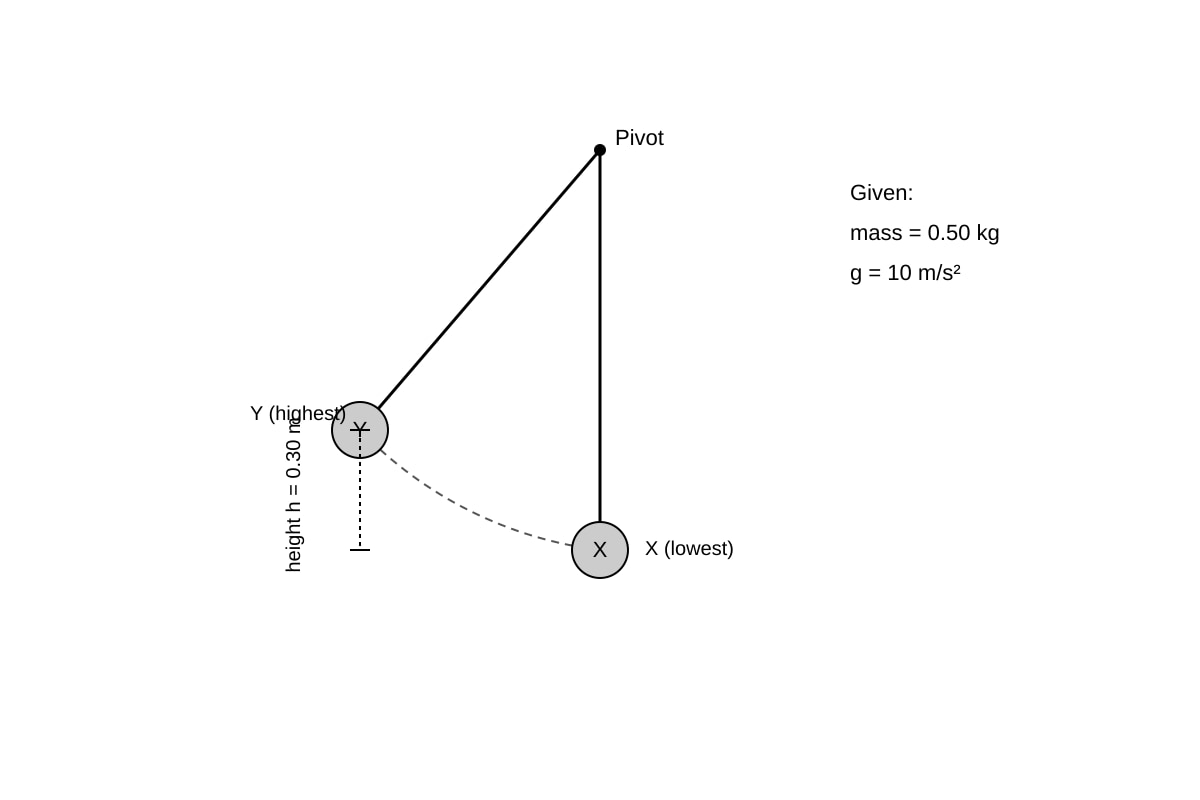
15. A pendulum is shown in Fig. Q15. At position X (lowest point) speed is max; at Y (highest) speed is zero.
(a) State energy change from Y to X. [2]
(b) If mass is 0.50 kg and height difference is 0.30 m, calculate KE at X. [3]
Image pending generation: diagram for Q15.
16. A 5.0 kg object is pulled with force 20 N on a rough surface with friction 5.0 N.
(a) Calculate resultant force. [1]
(b) Calculate acceleration. [2]
(c) State Newton's first law. [1]
17. Conduction, convection, radiation are three heat transfer methods.
(a) Define conduction. [1]
(b) Give one example of convection. [1]
(c) State how radiation differs from the other two. [1]
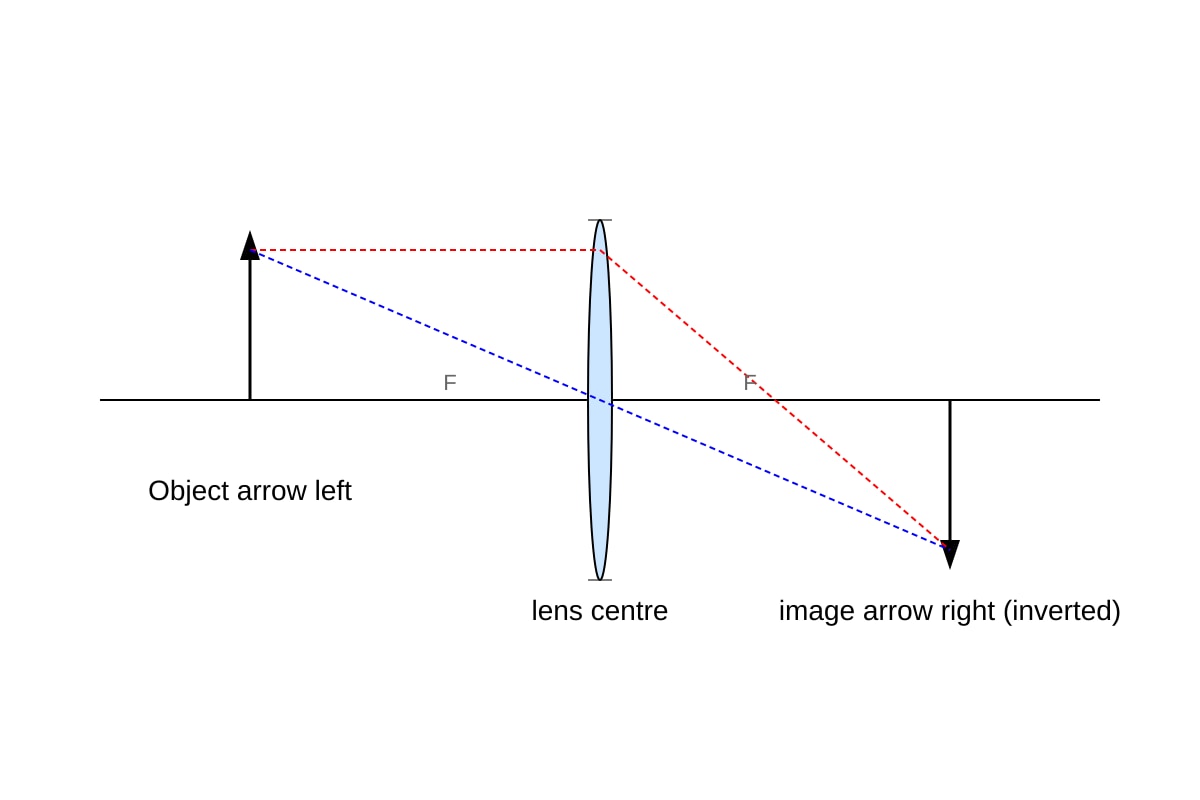
18. A lens forms an image as shown in Fig. Q18.
(a) Identify if it is convex or concave. [1]
(b) State one property of the image. [1]
Image pending generation: diagram for Q18.
19. A circuit has two resistors 4.0 Ω and 6.0 Ω in series with 10 V.
(a) Calculate total resistance. [1]
(b) Calculate current. [2]
(c) Calculate p.d. across 6.0 Ω. [2]
20. Explain why metals are good conductors of electricity and heat, using particle theory. [4]
Answers
TuitionGoWhere Practice Paper - Combined Science O-Level (Answers)
Version 1 of 5 — Answer Key with Teaching Notes
Section A
Q1 [2 marks]
Answer: Energy cannot be created or destroyed, but can be converted from one form to another (or total energy in a closed system is constant).
Teaching: This is the principle of conservation of energy. Students must mention both "not created/destroyed" and "converted/transformed" for full marks. Common mistake: stating only "cannot be destroyed" without transformation.
Q2 [1 mark]
Answer: B
Teaching: Conduction in metals occurs by free electrons moving and lattice ions vibrating, passing kinetic energy. A is wrong (no bulk movement), C is melting not conduction, D is radiation.
Q3 [2 marks]
v=fλ⇒λ=v/f=340/500=0.68 m
Teaching: Use wave equation. Show substitution and unit (m). Common error: invert fraction.
Q4 [2 marks]
Diagram: rectangle with upward N and downward W from centre, equal length.
Teaching: At rest on table, forces balanced: Weight = mg = 20 N down, Normal = 20 N up. Both arrows from centre, labelled.
Q5 [1 mark]
Answer: Gravitational potential energy
Teaching: At highest point, speed zero so KE zero; PE maximum.
Q6 [3 marks]
Total height = 15×0.20=3.0 m
Work = W=600×3.0=1800 J
Power = 1800/9.0=200 W
Teaching: Convert step height to m, multiply by steps, use weight directly (not mass). Divide by time. Mark: 1 for height, 1 for work, 1 for power.
Q7 [2 marks]
Use: vision / photography / fibre optics. Danger: eye damage from intense light.
Teaching: Visible light used for seeing; high intensity can harm retina.
Q8 [2 marks]
PE top = mgh=0.40×10×5.0=20 J
KE bottom = 20 J (by conservation, air resistance negligible)
Teaching: Drop means PE becomes KE. Assumption: no air resistance.
Section B
Q9 [4 marks]
(a) [2] Diagram: W down, N perpendicular to slope, F up slope from centre.
(b) [2] W=mg=30 N; N=Wcos30∘=30×0.866=26.0 N
Teaching: Normal is component perpendicular to plane. Use cos for angle with horizontal.
Q10 [4 marks]
(a) [2] KE=21mv2=0.5×0.20×152=22.5 J
(b) [2] mgh=KE⇒h=22.5/(0.20×10)=11.25 m
Teaching: Upward motion, KE converts to PE. Use energy conservation.
Q11 [4 marks]
(a) [1] 22 cm3/min
(b) [3] Rate increases with temperature because particles have more kinetic energy, collide more frequently and with greater energy, more successful collisions per unit time (collision theory).
Teaching: Link data to theory. Mark: 1 temp effect, 1 collision freq, 1 energy/success.
Q12 [3 marks]
pH 3 means [H+]=10−3 mol/dm3, acidic. Weak acid partially ionised. With NaOH: neutralisation forms salt + water, pH rises to ~7.
Teaching: pH scale, weak vs strong, neutralisation equation not needed but concept required.
Q13 [3 marks]
λ=v/f=3.0×108/100×106=3.0 m; application: broadcasting, communication.
Teaching: Convert MHz to Hz (106). Unit m.
Q14 [5 marks]
(a) [2] W=Fd=450×3.0=1350 J
(b) [2] P=1350/6.0=225 W
(c) [1] Assumption: constant speed / no energy loss to air resistance.
Teaching: Work against gravity = weight × height.
Section C
Q15 [5 marks]
(a) [2] PE → KE (gravitational potential to kinetic)
(b) [3] PE=mgh=0.50×10×0.30=1.5 J=KE at X
Teaching: Energy conserved, at lowest point all PE converted.
Q16 [4 marks]
(a) [1] 20−5=15 N
(b) [2] a=F/m=15/5.0=3.0 m/s2
(c) [1] Object stays at rest or uniform motion unless acted by resultant force.
Teaching: Newton's first law statement.
Q17 [3 marks]
(a) [1] Transfer of heat by particle vibration / free electrons, no bulk movement.
(b) [1] Boiling water convection currents / sea breeze.
(c) [1] Radiation needs no medium; travels as waves.
Teaching: Distinguish three methods.
Q18 [2 marks]
(a) [1] Convex
(b) [1] Real, inverted, diminished/enlarged depending (state inverted real)
Teaching: Ray diagram shows real inverted image → convex.
Q19 [5 marks]
(a) [1] R=4+6=10 Ω
(b) [2] I=V/R=10/10=1.0 A
(c) [2] V=IR=1.0×6.0=6.0 V
Teaching: Series resistors add. Ohm's law.
Q20 [4 marks]
Metals have free delocalised electrons; they move and carry charge (electricity) and kinetic energy (heat). Lattice ions vibrate but electrons transfer rapidly.
Teaching: 1 mark free electrons, 1 electricity, 1 heat, 1 compare to non-metals. Mark descriptors: clear particle reason = 4.
Free quiz and exam paper access
Enter your details to view this paper
Your access is remembered on this device.