From Real Exams Exam Paper
O Level Combined Science Practice Paper 5
Free O Level Combined Sci Practice Paper 5, HY3 Exam version, with questions, answers, and O Level-style practice for Singapore students.
These static practice materials are generated from the site's syllabus and paper-generation workflow, with source and model context shown so students and parents can evaluate the material before use.
Questions
Free quiz and exam paper access
Enter your details to view this paper
Your access is remembered on this device.
Answers
TuitionGoWhere Exam Practice (AI) - Combined Science O-Level
Practice Paper: Physical Sciences (Version 5 of 5) – Answer Key
Total Marks: 65
Section A: Energy, Forces and Motion (26 marks)
Q1 [2] Principle: Energy cannot be created or destroyed, only converted from one form to another (or total energy in a closed system is conserved).
- 1 mark for "cannot be created or destroyed"
- 1 mark for "converted / transformed from one form to another" or "total conserved" Teaching note: Students often miss the transformation idea; conservation of momentum is a different principle.
Q2 [3] Steps:
- Total height = 25 × 0.15 m = 3.75 m
- Work done = weight × height = 500 N × 3.75 m = 1875 J
- Power = Work / time = 1875 J / 12 s = 156.25 W ≈ 156 W Marks: 1 for height conversion, 1 for work, 1 for power. Common mistake: using cm directly without converting to m.
Q3 [2] Free-body diagram: arrow down labelled W = 4.0 N (weight), arrow up labelled T (tension) of equal length from centre of sphere.
- 1 mark for weight downward
- 1 mark for tension upward (balanced) Note: arrows from centre, correct labels.
Q4 [3]
- Net force = 10 N - 4.0 N = 6.0 N
- a = F_net / m = 6.0 N / 2.0 kg = 3.0 m/s² Marks: 1 net force, 1 formula, 1 answer with unit. Teaching: friction opposes motion, subtract from applied force.
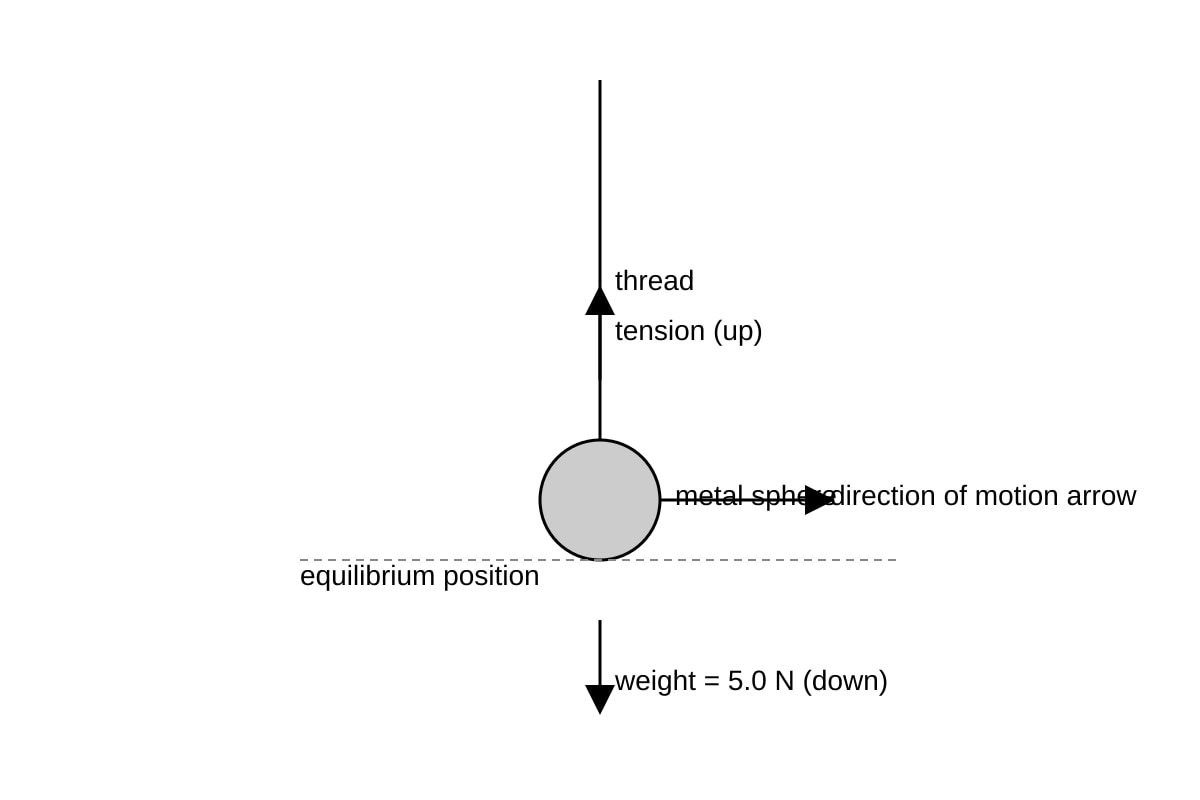
Q5 [2] Forces: (1) Weight acting downward (5.0 N), (2) Tension in thread acting upward.
- 1 mark each. Based on placeholder: sphere at lowest point, velocity horizontal, tension up, weight down.
Q6 [4]
- Weight = mg = 200 kg × 9.8 m/s² = 1960 N
- Work = F × d = 1960 N × 8.0 m = 15680 J
- Power = 15680 J / 20 s = 784 W Marks: 1 weight, 1 work, 1 power, 1 units/correct. Teaching: useful work = gain in G.P.E.
Q7 [2] As object falls, air resistance increases with speed. When air resistance equals weight, net force is zero, acceleration zero, constant terminal velocity reached.
- 1 for air resistance increases / equals weight
- 1 for net force zero / constant speed
Q8 [2]
- Initial speed u = 100 m / 5.0 s = 20 m/s
- v = u + at = 20 + (2.0 × 4.0) = 28 m/s Marks: 1 for u, 1 for v.
Section B: Thermal Physics and Waves (19 marks)
Q9 [2] Heat conducted by vibration of particles and movement of free electrons from hot to cold end.
- 1 vibration/particles, 1 free electrons (metals) Note: no bulk movement of material.
Q10 [1] Metals have free electrons that transfer kinetic energy quickly.
Q11 [1] 0 °C (during 2–5 min, temp constant at 0 while melting).
Q12 [2]
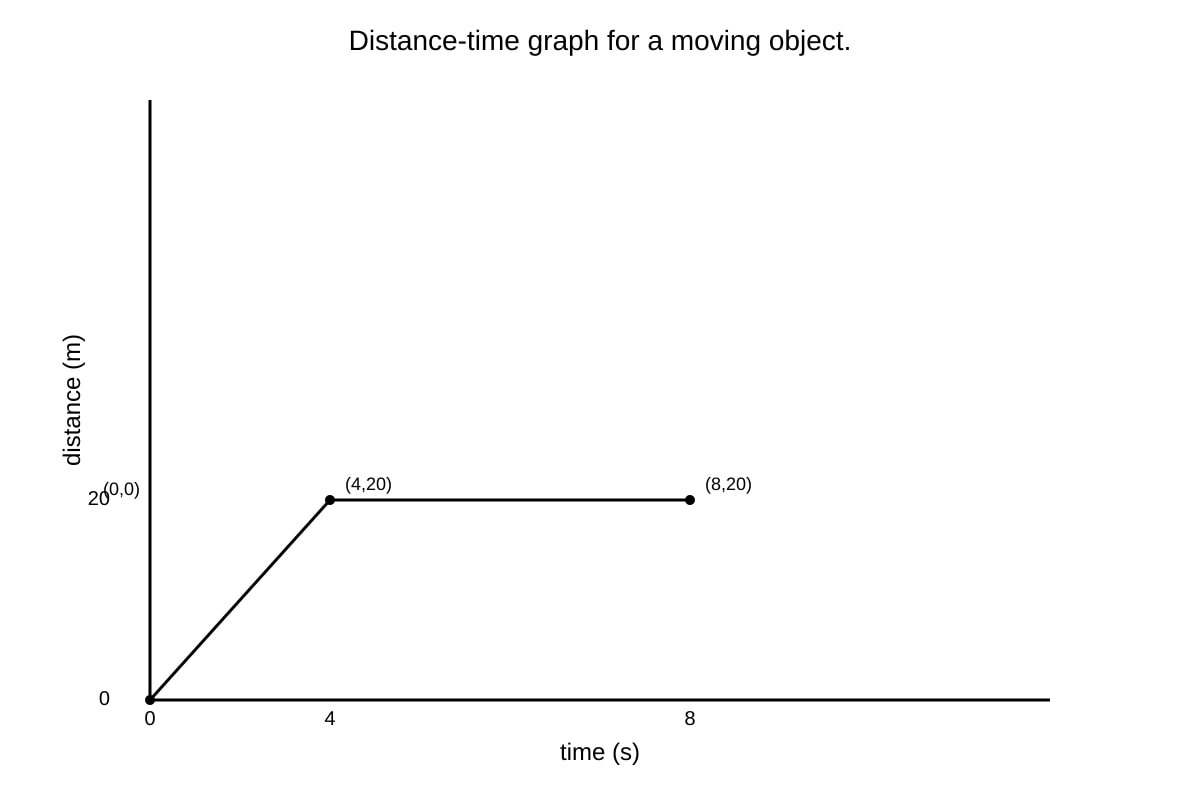
- Speed = distance / time = 20 m / 4 s = 5.0 m/s
- 1 for reading graph, 1 for answer. From placeholder: line (0,0)-(4,20).
Q13 [2] Transverse: oscillations perpendicular to direction of travel; Longitudinal: parallel.
- 1 each type described.
Q14 [2]
- v = fλ → λ = v/f = 340 / 340 = 1.0 m
- 1 formula, 1 answer.
Q15 [2] Speed decreases; direction bends towards normal (refraction).
- 1 speed, 1 direction.
Section C: Electricity and Magnetism (20 marks)
Q16 [1] Flow of electric charge (electrons) through a conductor.
Q17 [2]
- I = V/R = 12 / 6.0 = 2.0 A
- 1 formula, 1 answer.
Q18 [4]
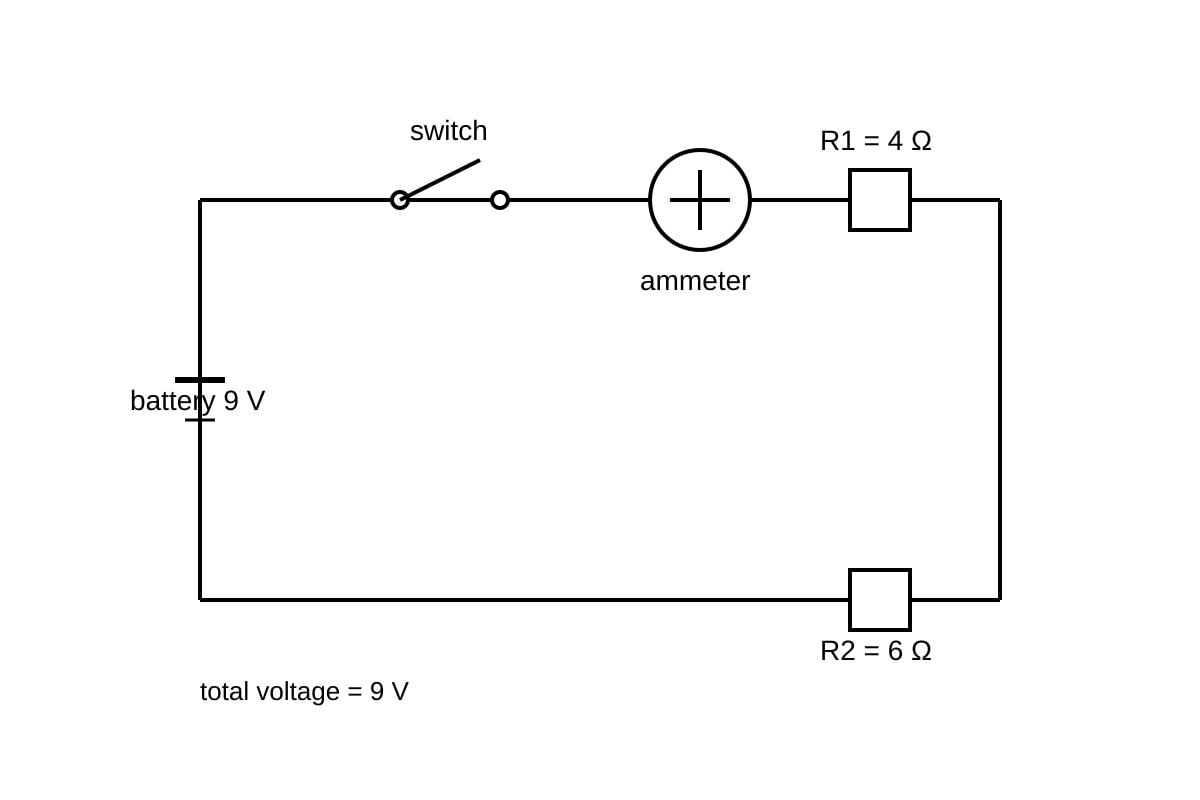
- R_total = 4 + 6 = 10 Ω
- I = V / R = 9 / 10 = 0.90 A Marks: 2 resistance, 2 current (1 formula each). From placeholder: series circuit, values labelled.
Q19 [2] Changes voltage level (steps up or down a.c.) using electromagnetic induction.
- 1 a.c., 1 step up/down.
Q20 [3]
- 1/R_total = 1/3 + 1/6 = 1/2 → R_total = 2.0 Ω
- 1 reciprocal formula, 1 calc, 1 answer. Teaching: parallel lowers total resistance.
Total: 26 + 19 + 20 = 65 marks ✓