From Real Exams Exam Paper
O Level Combined Science Practice Paper 3
Free O Level Combined Sci Practice Paper 3, HY3 Exam version, with questions, answers, and O Level-style practice for Singapore students.
These static practice materials are generated from the site's syllabus and paper-generation workflow, with source and model context shown so students and parents can evaluate the material before use.
Questions
Free quiz and exam paper access
Enter your details to view this paper
Your access is remembered on this device.
Answers
TuitionGoWhere Practice Paper - Combined Science O-Level (Physical Sciences) Answer Key
Version 3 of 5
Section A: Energy and Forces
1. [2 marks]
Principle: Energy cannot be created or destroyed, but can be converted from one form to another (or transferred). In a closed system, total energy is conserved.
Marking: 1 mark for "not created/destroyed", 1 mark for "converted/transformed". Common mistake: omitting transformation.
2. [3 marks]
Total height = 25 × 0.15 m = 3.75 m.
Work done = weight × height = 500 N × 3.75 m = 1875 J.
Power = Work / time = 1875 J / 12 s = 156.25 W ≈ 156 W.
Marks: 1 for height conversion, 1 for work, 1 for power. Teaching: convert cm to m first; use weight directly (W = mg).
3. [2 marks]
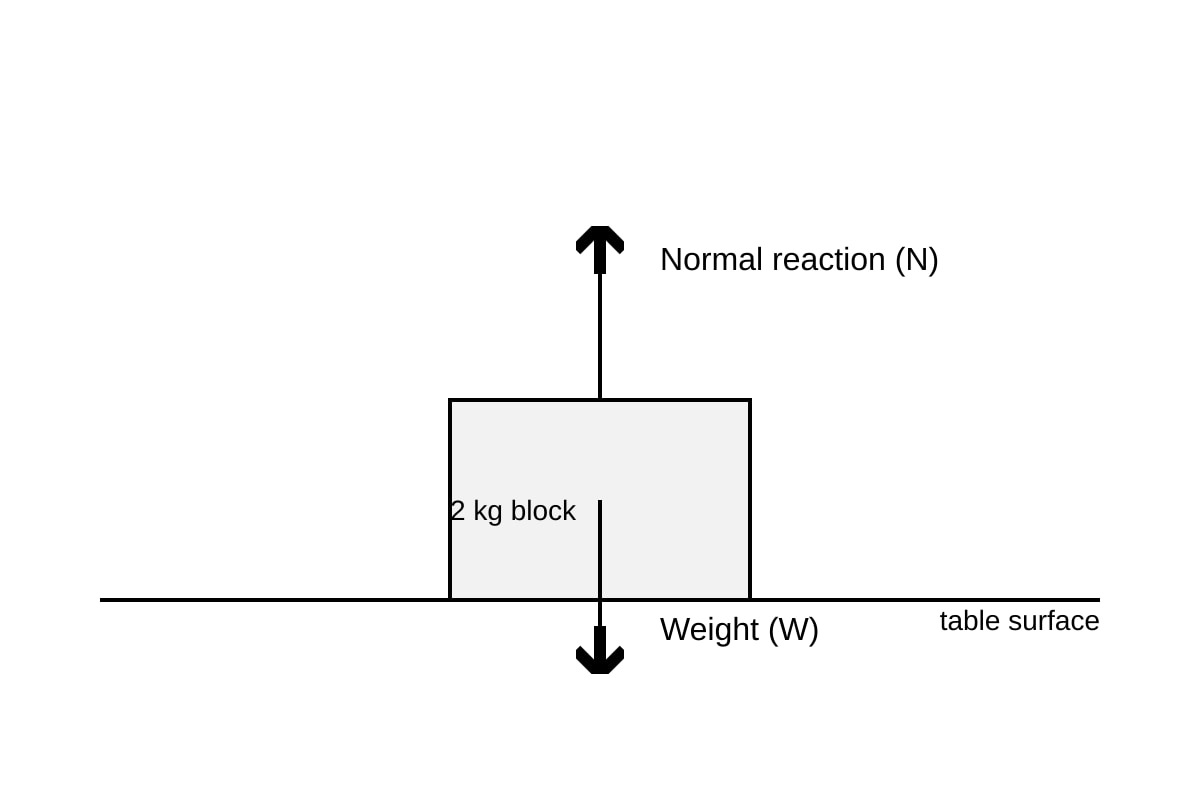
Diagram: rectangle (block) with downward arrow labelled W from centre, upward arrow labelled N from centre, equal length.
Marks: 1 for correct forces (W and N), 1 for correct directions/labels. No friction as surface horizontal and at rest.
4. [1 mark]
B. Heat is transferred by free electrons and vibration of atoms.
Note: A is wrong (no bulk movement), C is convection, D is radiation.
5. [3 marks]
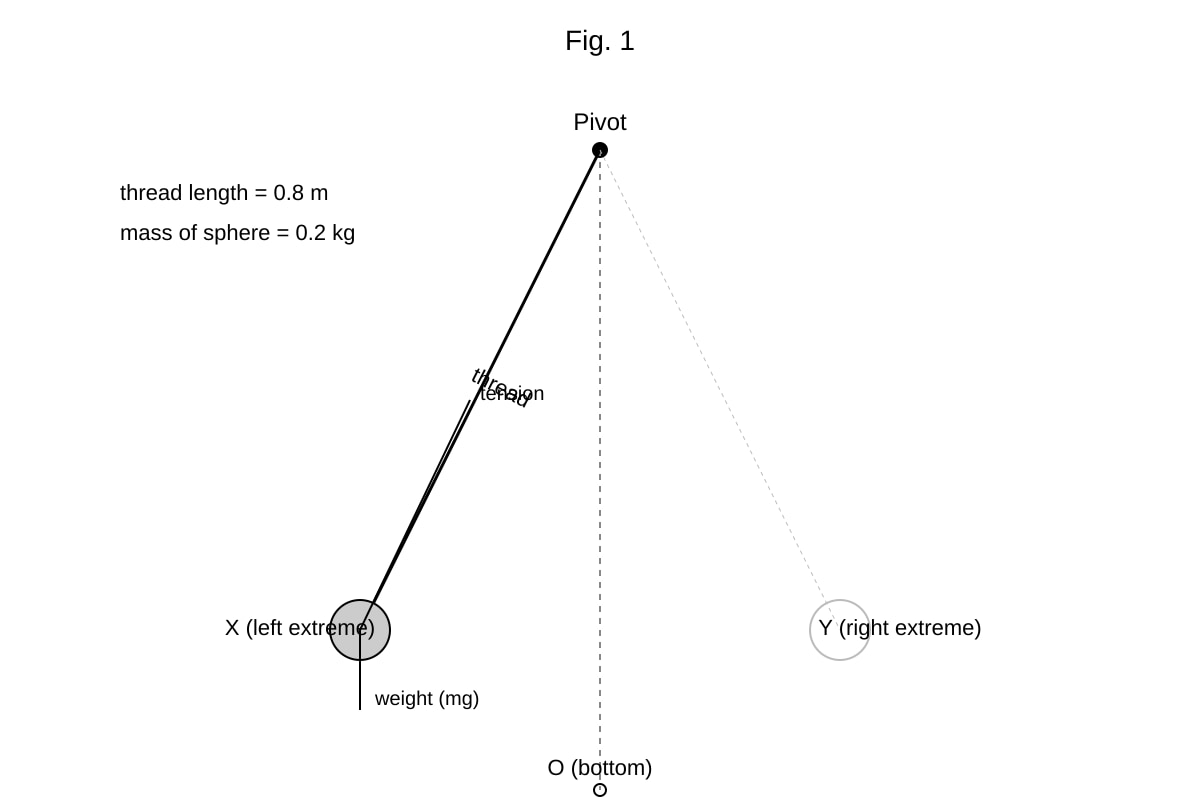
At X: gravitational potential energy (1 mark). Forces: weight (W) downward (1 mark), tension (T) along thread toward pivot (1 mark).
Teaching: At extreme, sphere momentarily at rest, KE=0, only GPE. Tension not zero.
6. [3 marks]
Useful work = mgh = 200 kg × 9.8 N/kg × 10 m = 19600 J (2 marks: 1 for method, 1 for value).
Power = 19600 J / 20 s = 980 W (1 mark).
Common: using weight = mg correctly; g taken as 9.8 or 10 acceptable.
7. [2 marks]
Metals have free electrons that move and transfer kinetic energy quickly (1). Wood lacks free electrons; energy passes only by slower atom vibrations (1).
Teaching: link to particle model.
8. [3 marks]
Constant velocity → net force = 0 (1). Resistive force = driving force = 500 N (1). Net force = 0 N (1).
Marks: 1 each. Newton's first law.
Section B: Thermal Physics and Waves
9. [1 mark]
Conduction: transfer without bulk movement of material; convection: transfer by movement of fluid (accept any correct difference).
10. [2 marks]
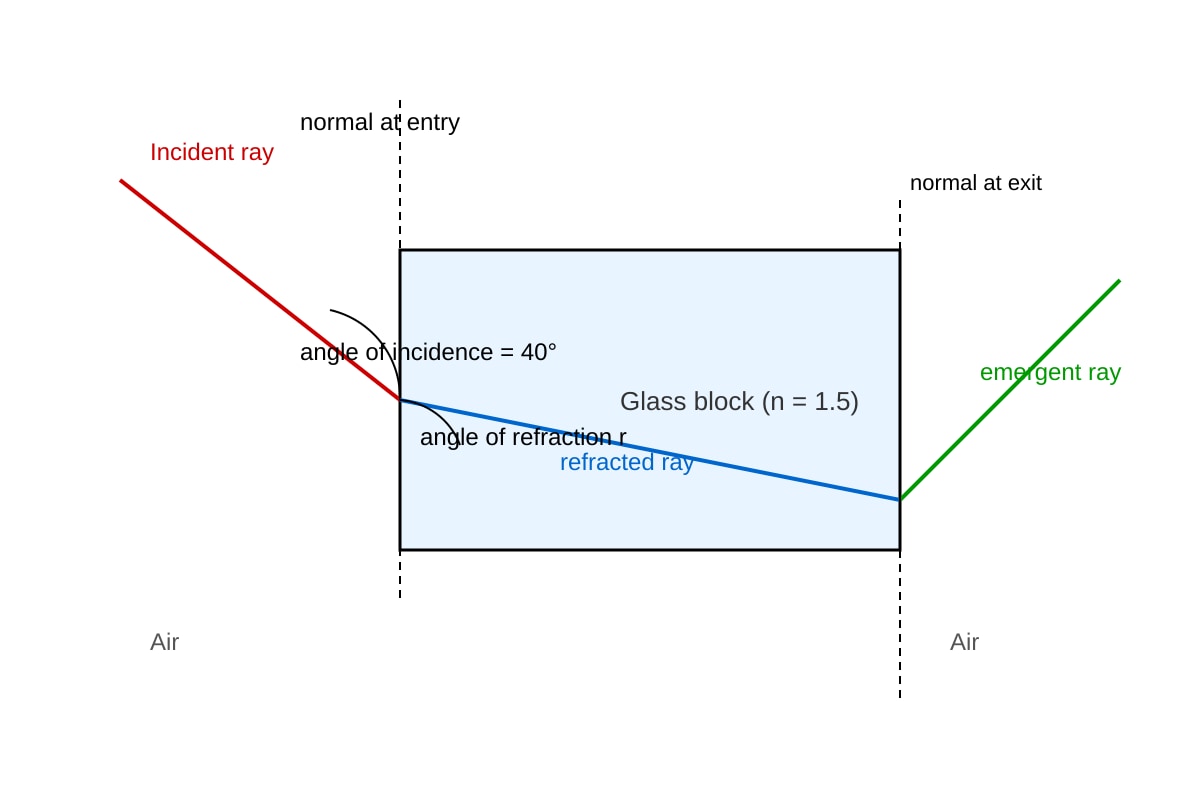
Using n = sin i / sin r → 1.5 = sin 40° / sin r → sin r = 0.6428/1.5 = 0.4285 → r ≈ 25.4° (1 for method, 1 for value).
Emergent parallel confirms refraction at entry only.
11. [2 marks]
Infrared (1). Danger: skin cancer / eye damage (1).
12. [2 marks]
Q = mcΔT = 0.5 × 4200 × (100-20) = 0.5 × 4200 × 80 = 168000 J (1 method, 1 value).
13. [3 marks]
Radio, microwave, infrared, visible, ultraviolet, X-ray, gamma (any 3 in correct order from long to short, 1 each).
14. [3 marks]
Metal has free electrons (1) that transfer thermal energy rapidly through spoon (1). Wood has no free electrons, slower vibration only (1). Hence metal handle hotter.
Section C: Electricity and Magnetism
15. [2 marks]
R = V/I = 6 / 0.5 = 12 Ω (1 method, 1 answer).
16. [3 marks]
R_total = 4 + 6 = 10 Ω (1). I = V/R = 10/10 = 1 A (2: 1 formula, 1 value).
17. [2 marks]
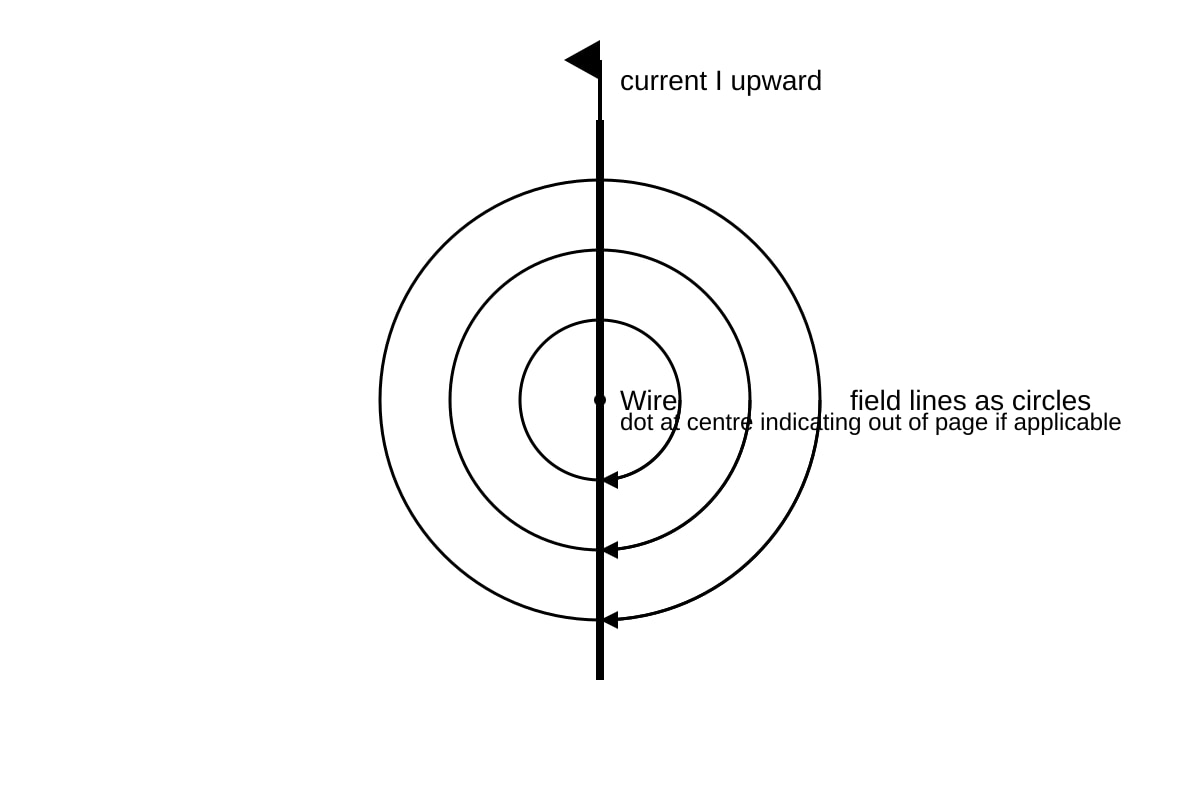
Concentric circles around wire, arrow anticlockwise for upward current (right-hand grip) (1 for circles, 1 for direction).
18. [4 marks]
1/R_total = 1/3 + 1/6 = 1/2 → R_total = 2 Ω (2 marks).
I_total = V/R = 12/2 = 6 A (2 marks).
19. [1 mark]
Induced emf is proportional to rate of change of magnetic flux.
20. [3 marks]
V_s/V_p = N_s/N_p → V_s = 12 × 400/100 = 48 V (2). Step-up (1) because V_s > V_p.
Total Marks Check: Section A 26 + B 20 + C 19 = 65 ✓