From Real Exams Exam Paper
O Level Combined Science Practice Paper 1
Free O Level Combined Sci Practice Paper 1, HY3 Exam version, with questions, answers, and O Level-style practice for Singapore students.
These static practice materials are generated from the site's syllabus and paper-generation workflow, with source and model context shown so students and parents can evaluate the material before use.
Questions


Free quiz and exam paper access
Enter your details to view this paper
Your access is remembered on this device.
Answers
TuitionGoWhere Practice Paper - Combined Science O-Level (Physical Sciences) Answer Key
Version 1 of 5
Section A: Energy, Forces and Motion
Q1 [2 marks]
Answer: Energy cannot be created or destroyed, but can be converted from one form to another (or total energy in a closed system is conserved).
Teaching note: This is the Principle of Conservation of Energy. Common mistake: stating only “energy cannot be created or destroyed” without mentioning conversion/transformation → award 1 mark only. Full 2 marks require both ideas.
Q2 [3 marks]
Step 1: Total height = 25 × 15 cm = 375 cm = 3.75 m. [1]
Step 2: Work done = weight × height = 500 N × 3.75 m = 1875 J. [1]
Step 3: Power = Work / time = 1875 J / 12 s = 156.25 W ≈ 156 W. [1]
Answer: 156 W.
Note: Must convert cm to m. Using mass instead of weight is a trap.
Q3 [2 marks]
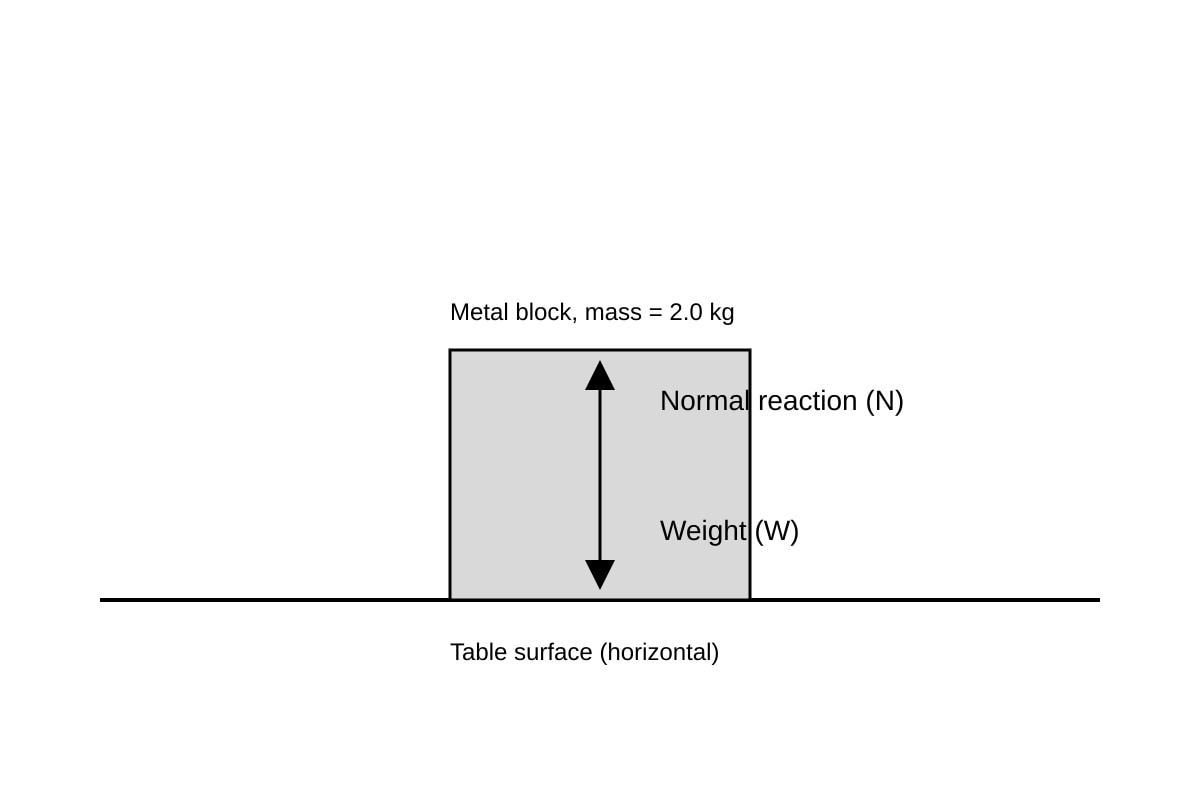
Answer: Diagram shows block with two equal vertical arrows from centre: Weight (W) down, Normal (N) up.
Marking: 1 mark for correct forces (W and N), 1 mark for correct directions and labelling.
Teaching: At rest on horizontal table, only gravity (weight) and normal reaction balance.
Q4 [1 mark]
Answer: Gravitational potential energy.
Teaching: At highest point, sphere is momentarily stationary → all energy is stored as GPE.
Q5 [2 marks]
Answer: Gravitational potential energy is converted to kinetic energy as it descends. [1] At O, KE is maximum and GPE minimum. [1]
Teaching: Energy transforms from potential to kinetic; total conserved.
Q6 [3 marks]
Step 1: a = (v - u)/t = (20 - 0)/10 = 2.0 m/s². [1]
Step 2: F = ma = 1200 kg × 2.0 m/s² = 2400 N. [2]
Answer: 2400 N.
Note: Use resultant force = ma (Newton’s 2nd law).
Q7 [2 marks]
Answer: Air resistance increases with speed. [1] When air resistance equals weight, resultant force is zero, so acceleration stops and constant terminal velocity is reached. [1]
Q8 [3 marks]
Step 1: Useful output = mgh = 800 N × 4.0 m = 3200 J. [1]
Step 2: Efficiency = (useful output / input) × 100% = (3200 / 4000) × 100% = 80%. [2]
Answer: 80%.
Section B: Thermal Physics and Waves
Q9 [1 mark]
Answer: B. Heat is transferred by vibration of particles and free electrons.
Teaching: Conduction in metals uses lattice vibration + free electrons; not convection/radiation.
Q10 [1 mark]
Answer: Metals have free electrons that transfer kinetic energy quickly.
(Any correct reason: free electrons / closely packed ions.)
Q11 [2 marks]
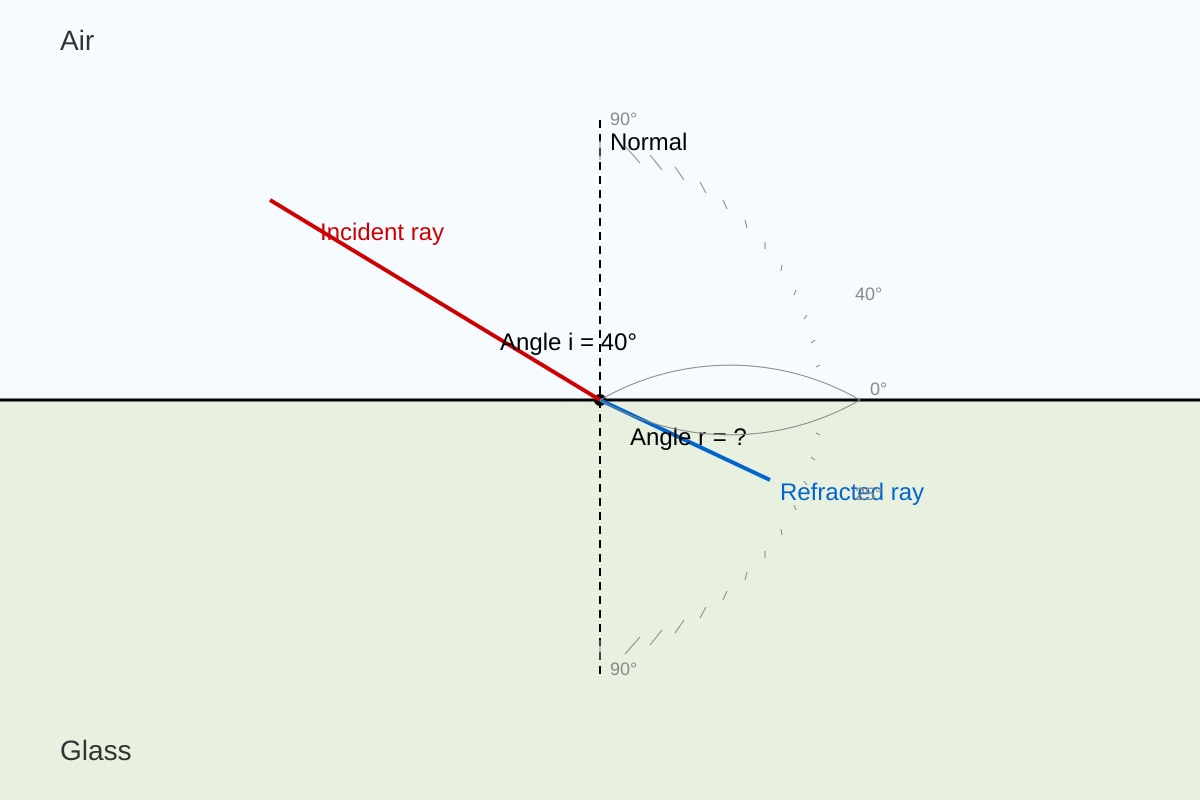
Answer: Angle r ≈ 25–26° (from scale). [1] for reading, [1] for stating with unit “°”.
Teaching: Light bends toward normal entering denser medium; measure from normal.
Q12 [1 mark]
Answer: Radiation.
Q13 [3 marks]
Answer: Hot water at top is less dense and rises; cooler water sinks to replace it. [1] This circulation transfers heat to surface and surroundings. [1] Eventually whole water reaches room temp. [1]
Teaching: Convection needs fluid movement due to density difference.
Q14 [2 marks]
Answer: Travel at speed of light (3×10⁸ m/s); transverse waves; can travel in vacuum. (any 2) [1+1]
Section C: Electricity and Magnetism
Q15 [2 marks]
Step: R = V/I = 6.0 / 0.50 = 12 Ω. [2]
Answer: 12 Ω.
Q16 [3 marks]
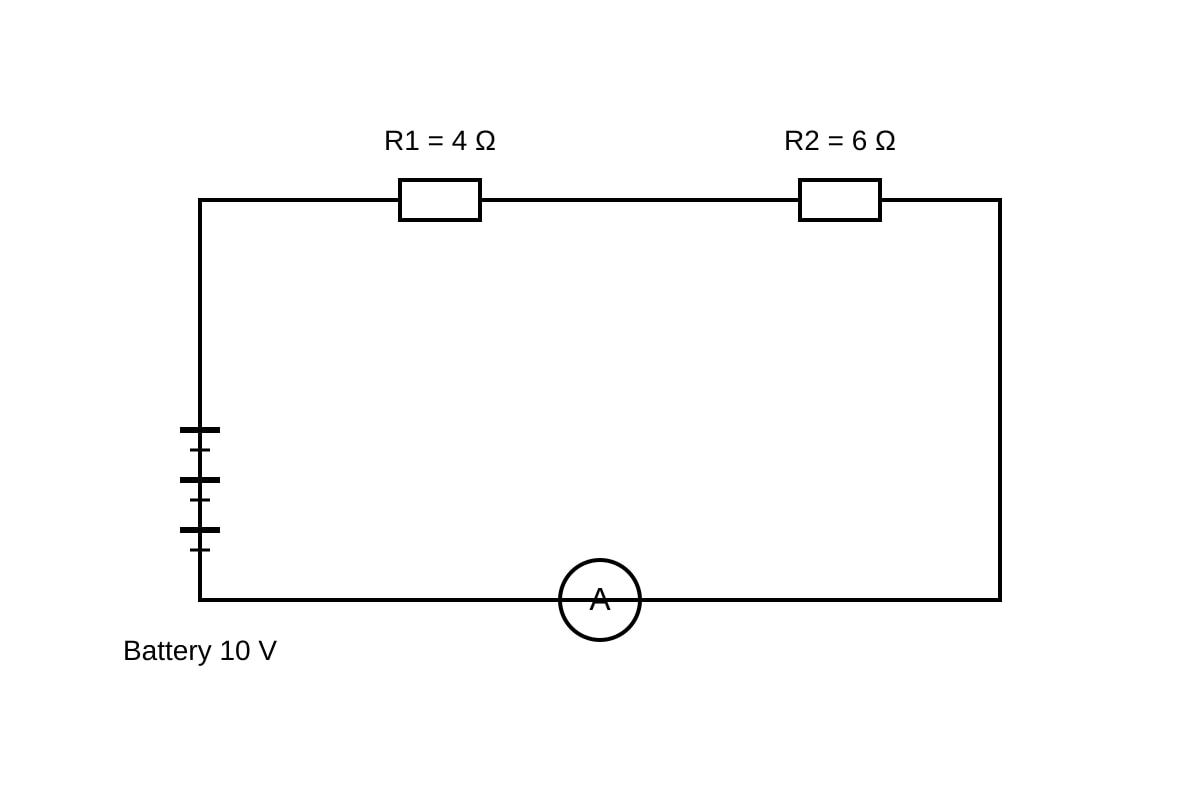
Step 1: R_total = R1 + R2 = 4 + 6 = 10 Ω. [1]
Step 2: I = V / R = 10 / 10 = 1.0 A. [2]
Answer: 10 Ω, 1.0 A.
Q17 [2 marks]
Answer: Concentric circles around wire with arrows showing direction (anticlockwise from top). [1 for circles, 1 for direction]
Teaching: Right-hand grip rule.
Q18 [3 marks]
Step 1: V_s / V_p = N_s / N_p. [1]
Step 2: V_s = 240 × (50/200) = 60 V. [2]
Answer: 60 V.
Q19 [2 marks]
Answer: Danger: electric shock / fire from overload. [1] Device: fuse / circuit breaker / earth wire. [1]
Q20 [3 marks]
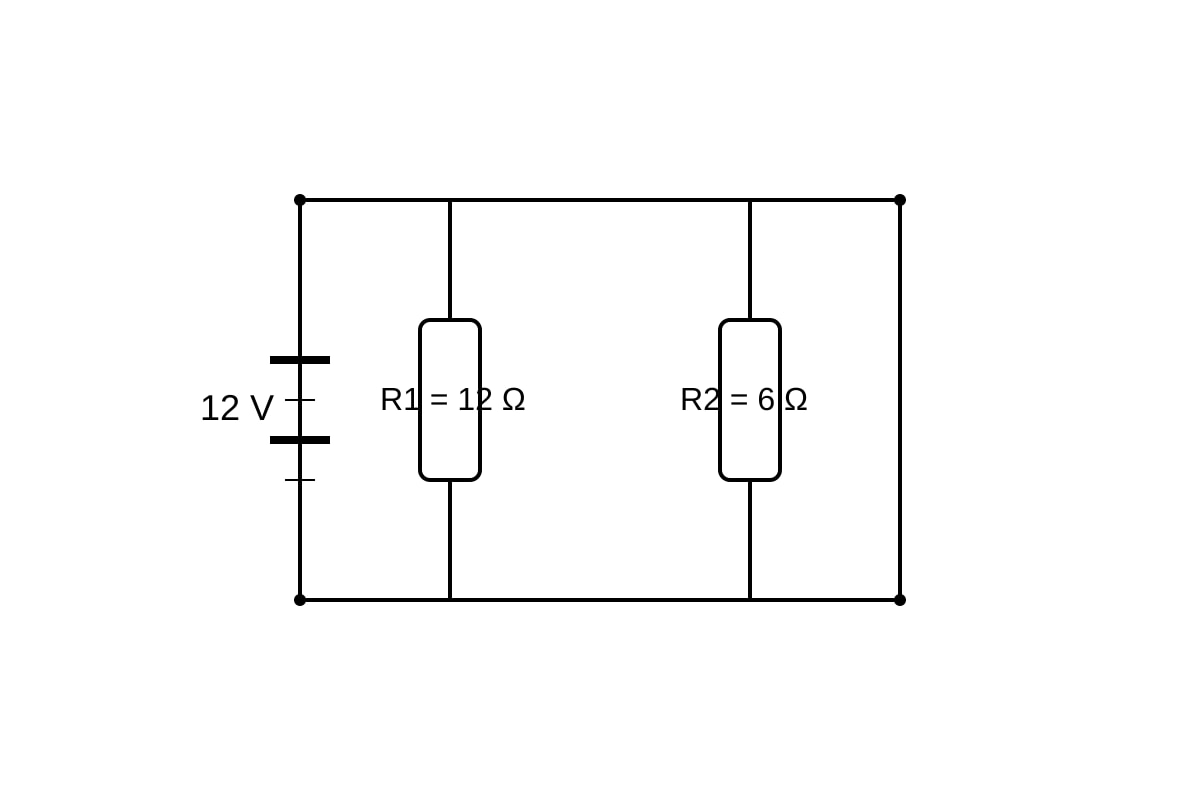
Step 1: 1/R_total = 1/12 + 1/6 = 1/12 + 2/12 = 3/12 = 1/4. [2]
Step 2: R_total = 4 Ω. [1]
Answer: 4 Ω.