From Real Exams Exam Paper

O Level Combined Science Practice Paper 1

Free Exam-Derived DeepSeek V4 Pro O Level Combined Science Practice Paper 1 practice paper with questions and answers for Singapore students. This page is rendered as a direct URL so the questions and answers can be discovered without pressing in-page buttons.

These static practice materials are generated from the site's syllabus and paper-generation workflow, with source and model context shown so students and parents can evaluate the material before use.

O Level Combined Science From Real Exams Generated by DeepSeek V4 Pro Updated 2026-06-03

Questions

<!-- TuitionGoWhere generation metadata: stage=3-1; model=deepseek/deepseek-v4-pro; model_label=DeepSeek V4 Pro; generated=2026-05-28; Sources: Stage 2-1 real exam-derived templates and Stage 2-2 exam-enriched syllabus. -->

TuitionGoWhere Practice Paper – Combined Science O-Level

Physical Sciences

TuitionGoWhere Secondary School (AI) PRACTICE PAPER – Version 1 of 5

Subject:Combined Science (Physics)
Level:O-Level
Paper:Practice Paper – Physical Sciences
Duration:1 hour 15 minutes
Total Marks:65

Name: _________________________ Class: _________________________ Date: _________________________


Instructions to Candidates

  1. This paper consists of three sections: Section A, Section B, and Section C.
  2. Answer all questions.
  3. Write your answers in the spaces provided.
  4. Show all working for calculation questions. Marks will be awarded for correct working even if the final answer is wrong.
  5. Take g = 10 m/s² unless otherwise stated.
  6. The number of marks is given in brackets [ ] at the end of each question or part question.
  7. You may use a calculator.

Section A: Multiple Choice (10 marks)

Answer all questions. Circle the correct answer (A, B, C, or D). Each question carries 1 mark.

1. Which of the following is a scalar quantity?

A. Velocity B. Acceleration C. Force D. Energy

[1]

2. A student measures the length of a metal rod using a metre rule. The reading is 25.3 cm. What is the uncertainty in this measurement?

A. ± 0.05 cm B. ± 0.1 cm C. ± 0.5 cm D. ± 1.0 cm

[1]

3. An object of mass 2 kg is lifted vertically through a height of 5 m. What is the work done against gravity?

A. 10 J B. 50 J C. 100 J D. 200 J

[1]

4. Which statement best describes the conduction of heat through a metal rod?

A. Heat is transferred by the bulk movement of particles from the hot end to the cold end. B. Heat is transferred by electromagnetic waves travelling through the metal. C. Heat is transferred by the vibration of particles and movement of free electrons. D. Heat is transferred by convection currents within the metal.

[1]

5. A force of 20 N is applied to an object, causing it to accelerate at 4 m/s². What is the mass of the object?

A. 0.2 kg B. 5 kg C. 24 kg D. 80 kg

[1]

6. Which of the following is an example of a longitudinal wave?

A. Light wave B. Water wave C. Sound wave D. Radio wave

[1]

7. A student investigates the refraction of light. Light travels from air into glass. Which statement is correct?

A. The light bends towards the normal and speeds up. B. The light bends towards the normal and slows down. C. The light bends away from the normal and speeds up. D. The light bends away from the normal and slows down.

[1]

8. An electric kettle has a power rating of 2000 W. How much energy does it use in 3 minutes?

A. 6000 J B. 36 000 J C. 360 000 J D. 6 000 000 J

[1]

9. A transformer has 500 turns on its primary coil and 50 turns on its secondary coil. The primary voltage is 240 V. What is the secondary voltage?

A. 24 V B. 48 V C. 120 V D. 2400 V

[1]

10. Which of the following correctly states the principle of conservation of energy?

A. Energy can be created but not destroyed. B. Energy cannot be created or destroyed, only transferred or converted from one form to another. C. The total energy in a system always decreases over time. D. Energy is always lost as heat in any process.

[1]


Section B: Structured Questions (35 marks)

Answer all questions in the spaces provided.

11. A student investigates the motion of a pendulum. The pendulum consists of a metal sphere attached to a thin thread of length 0.80 m. The sphere is pulled to one side and released.

(a) At which position in its swing does the sphere have maximum kinetic energy? Explain your answer. [2]

(b) The sphere has a mass of 0.050 kg. At its highest point, the sphere is 0.10 m above its lowest point. Calculate the maximum speed of the sphere during its swing. [3]

(c) State one reason why the pendulum eventually comes to rest. [1]


12. A girl of weight 500 N runs up a flight of 25 steps in 8.0 s. Each step has a height of 12 cm.

(a) Calculate the total vertical height the girl has climbed. [1]

(b) Calculate the work done by the girl against gravity. [2]

(c) Calculate the average power developed by the girl. [2]

(d) Explain why the actual power developed by the girl's muscles is greater than the value calculated in (c). [2]


13. A metal rod is heated at one end using a Bunsen burner. Thermometers are attached at equal distances along the rod.

(a) Describe and explain how heat is conducted from the hot end to the cold end of the metal rod. [3]

(b) The metal rod is replaced with a glass rod of the same dimensions. Explain why the glass rod conducts heat more slowly than the metal rod. [2]


14. A siren produces a sound of frequency 500 Hz. The siren is placed 85 m from a large building. The speed of sound in air is 340 m/s.

(a) Calculate the wavelength of the sound produced by the siren. [2]

(b) An observer standing near the siren hears an echo. Explain how the echo is produced. [2]

(c) Calculate the time taken for the echo to be heard by the observer after the siren produces a sound. [2]


15. A student investigates the refraction of light using a semicircular glass block. A ray of light is directed at the centre of the flat surface of the block.

(a) The angle of incidence in air is 40°. The angle of refraction in glass is 25°. Calculate the refractive index of the glass. [2]

(b) The student increases the angle of incidence. At a certain angle, the refracted ray travels along the boundary between the glass and air. State the name of this angle. [1]

(c) Explain what happens if the angle of incidence is increased beyond the angle named in (b). [2]


Section C: Data-Based and Extended Response (20 marks)

Answer all questions in the spaces provided.

16. A group of students investigates the relationship between the force applied to a spring and its extension. They record the following results:

Force / NExtension / cm
0.00.0
1.02.5
2.05.0
3.07.5
4.010.0
5.012.5

(a) Plot a graph of force (y-axis) against extension (x-axis) on the grid below. Label both axes with quantities and units. [4]

[Grid space for graph – draw axes, plot points, draw best-fit line]

(b) Using your graph, determine the spring constant of the spring. Show your working. [3]

(c) The students add a mass of 0.30 kg to the spring. Calculate the extension produced. (Take g = 10 m/s²) [3]

(d) The students repeat the experiment with a stiffer spring. On the same axes, sketch the graph you would expect for the stiffer spring. Label this line clearly. [2]


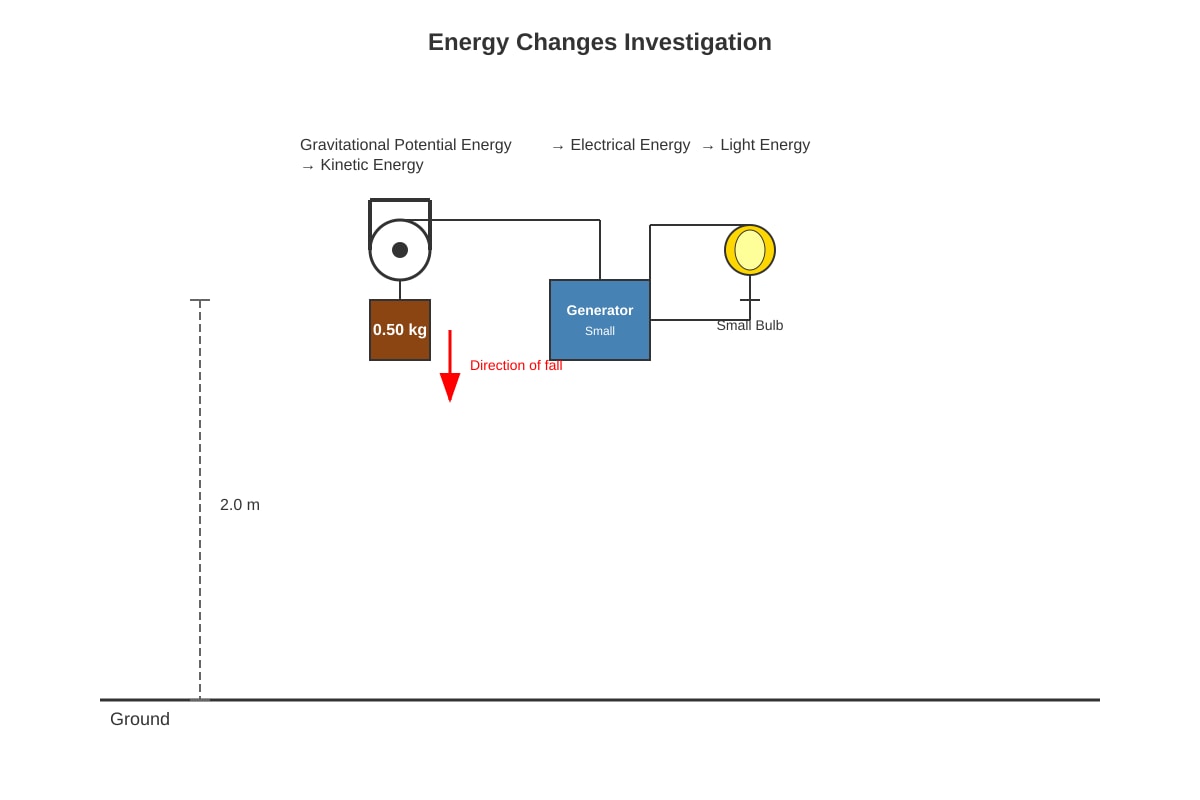
17. A student sets up the apparatus shown below to investigate energy changes in a falling object.

[Diagram: A mass of 0.50 kg is suspended 2.0 m above the ground. It is attached to a string that passes over a pulley and is connected to a small generator. When the mass falls, the generator lights a small bulb.]

The mass is released from rest and falls to the ground.

(a) Calculate the gravitational potential energy of the mass before it is released. [2]

(b) State the main energy conversion that takes place as the mass falls. [1]

(c) When the mass hits the ground, the bulb has been lit for 4.0 s. The bulb has a power rating of 1.5 W. Calculate the total energy output of the bulb. [2]

(d) Compare the energy calculated in (a) with the energy calculated in (c). Explain why these values are different. [3]

(e) Suggest two modifications to the apparatus that would increase the time for which the bulb stays lit. Explain your reasoning for each suggestion. [4]


18. A student reads the following statement in a textbook:

"A transformer is a device that can change the voltage of an alternating current supply."

(a) Explain why a transformer only works with alternating current and not with direct current. [3]

(b) A step-down transformer is used to reduce the mains voltage of 240 V to 12 V for a low-voltage lamp. The primary coil has 1200 turns. Calculate the number of turns on the secondary coil. [2]

(c) The lamp connected to the secondary coil has a power rating of 24 W. Assuming the transformer is 100% efficient, calculate the current in the primary coil. [3]


END OF PAPER


Check your work carefully. Ensure all questions are answered.

Answers

<!-- TuitionGoWhere generation metadata: stage=3-1; model=deepseek/deepseek-v4-pro; model_label=DeepSeek V4 Pro; generated=2026-05-28; Sources: Stage 2-1 real exam-derived templates and Stage 2-2 exam-enriched syllabus. -->

TuitionGoWhere Practice Paper – Combined Science O-Level

Physical Sciences – ANSWER KEY AND MARKING SCHEME

PRACTICE PAPER – Version 1 of 5 Total Marks: 65


Section A: Multiple Choice (10 marks)

QuestionAnswerMark
1D – Energy[1]
2B – ± 0.1 cm[1]
3C – 100 J (W = mgh = 2 × 10 × 5 = 100 J)[1]
4C – Heat is transferred by the vibration of particles and movement of free electrons[1]
5B – 5 kg (m = F/a = 20/4 = 5 kg)[1]
6C – Sound wave[1]
7B – The light bends towards the normal and slows down[1]
8C – 360 000 J (E = Pt = 2000 × 180 = 360 000 J)[1]
9A – 24 V (Vs/Vp = Ns/Np; Vs = 240 × 50/500 = 24 V)[1]
10B – Energy cannot be created or destroyed, only transferred or converted from one form to another[1]

Section B: Structured Questions (35 marks)

Question 11 – Pendulum (6 marks)

(a) Maximum kinetic energy at the lowest point of the swing. [1] At this position, the sphere is moving fastest / all gravitational potential energy has been converted to kinetic energy. [1]

(b)

  • GPE at highest point = mgh = 0.050 × 10 × 0.10 = 0.050 J [1]
  • At lowest point, all GPE converted to KE: KE = ½mv² [1]
  • 0.050 = ½ × 0.050 × v²
  • v² = 2.0; v = 1.41 m/s (accept 1.4 m/s) [1]

(c) Air resistance / friction at the pivot causes energy to be transferred to the surroundings as heat/sound. [1]


Question 12 – Power Calculation (7 marks)

(a) Total height = 25 × 0.12 = 3.0 m [1]

(b) Work done = Weight × height = 500 × 3.0 = 1500 J [2] (Award [1] for correct formula, [1] for correct answer with unit)

(c) Power = Work / Time = 1500 / 8.0 = 187.5 W (accept 188 W or 190 W) [2] (Award [1] for correct formula, [1] for correct answer with unit)

(d) The girl's muscles also do work to move her limbs / overcome internal friction in her body. [1] Some energy is also converted to heat in her muscles / not all chemical energy is converted to useful work against gravity. [1]


Question 13 – Heat Conduction (5 marks)

(a)

  • Particles at the hot end gain kinetic energy and vibrate more vigorously. [1]
  • These vibrations are passed to neighbouring particles through collisions. [1]
  • In metals, free electrons also move from the hot end to the cold end, transferring kinetic energy as they collide with atoms. [1]

(b) Glass is an insulator / does not have free electrons. [1] Heat transfer in glass occurs only through particle vibration, which is slower than transfer via free electrons in metals. [1]


Question 14 – Sound and Echo (6 marks)

(a) v = fλ → λ = v/f = 340/500 = 0.68 m [2] (Award [1] for correct formula, [1] for correct answer with unit)

(b) Sound waves from the siren travel to the building and are reflected off its surface. [1] The reflected sound waves travel back to the observer, who hears the echo as a distinct repetition of the original sound. [1]

(c)

  • Total distance travelled by sound = 2 × 85 = 170 m [1]
  • Time = distance/speed = 170/340 = 0.50 s [1]

Question 15 – Refraction (5 marks)

(a) n = sin i / sin r = sin 40° / sin 25° [1] n = 0.643 / 0.423 = 1.52 (accept 1.5) [1]

(b) Critical angle [1]

(c) Total internal reflection occurs. [1] All the light is reflected back into the glass; no light is refracted into the air. [1]


Section C: Data-Based and Extended Response (20 marks)

Question 16 – Spring Investigation (12 marks)

(a) Graph marking:

  • Correctly labelled axes: Force/N on y-axis, Extension/cm on x-axis [1]
  • Appropriate scales chosen (linear, covering data range) [1]
  • All 6 points plotted correctly (±½ small square) [1]
  • Best-fit straight line drawn through origin and points [1]

(b)

  • Spring constant k = F/x (gradient of graph) [1]
  • Using any point on line: k = 4.0 N / 10.0 cm = 0.40 N/cm [1]
  • Converting to N/m: k = 0.40 × 100 = 40 N/m [1] (Accept 0.40 N/cm or 40 N/m)

(c)

  • Weight of mass = mg = 0.30 × 10 = 3.0 N [1]
  • Extension = F/k = 3.0 / 0.40 = 7.5 cm [1]
  • (or using graph: read extension at 3.0 N) [1]

(d)

  • Line drawn with steeper gradient (greater slope) than original line [1]
  • Line clearly labelled "stiffer spring" [1]

Question 17 – Energy Changes (12 marks)

(a) GPE = mgh = 0.50 × 10 × 2.0 = 10 J [2] (Award [1] for correct formula, [1] for correct answer with unit)

(b) Gravitational potential energy → kinetic energy (→ electrical energy → light + heat in bulb) [1] (Accept: GPE to KE, or GPE to electrical energy)

(c) E = Pt = 1.5 × 4.0 = 6.0 J [2] (Award [1] for correct formula, [1] for correct answer with unit)

(d)

  • The GPE (10 J) is greater than the electrical energy output of the bulb (6.0 J). [1]
  • Energy is lost/transferred due to friction in the pulley / air resistance on the falling mass. [1]
  • The generator is not 100% efficient; some energy is converted to heat/sound in the generator and wires. [1]

(e) Award up to [4] marks for two valid suggestions with explanations:

Suggestion 1: Increase the height from which the mass is dropped. [1] Explanation: Greater height means greater initial GPE, so more energy is available to keep the bulb lit for longer. [1]

Suggestion 2: Use a larger mass. [1] Explanation: A larger mass has greater GPE at the same height, providing more energy to power the bulb for a longer time. [1]

(Also accept: reduce friction in the pulley system; use a more efficient generator; use a bulb with lower power rating – with appropriate explanations.)


Question 18 – Transformers (8 marks)

(a)

  • A transformer works by electromagnetic induction, which requires a changing magnetic field. [1]
  • Alternating current produces a continuously changing magnetic field in the primary coil. [1]
  • Direct current produces a constant magnetic field, so no changing flux links the secondary coil and no emf is induced. [1]

(b) Vs/Vp = Ns/Np → 12/240 = Ns/1200 [1] Ns = (12 × 1200) / 240 = 60 turns [1]

(c)

  • Power in secondary = Power in primary (100% efficiency) = 24 W [1]
  • Pp = Vp × Ip → 24 = 240 × Ip [1]
  • Ip = 24/240 = 0.10 A [1]

END OF ANSWER KEY

Marking notes:

  • Award marks for correct working even if final answer contains arithmetic error (error carried forward does not apply unless specified).
  • Accept alternative correct phrasings for explanation questions.
  • For graph plotting, tolerance of ±½ small square on grid.
  • Units must be included for full marks on calculation answers unless already stated.