AI Generated Quiz
O Level Chinese Comprehension Quiz
Free O Level Chinese Comprehension quiz, AI version, with questions, answers, and O Level-style practice for Singapore students.
These static practice materials are generated from the site's syllabus and paper-generation workflow, with source and model context shown so students and parents can evaluate the material before use.
Questions
Free quiz and exam paper access
Enter your details to view this paper
Your access is remembered on this device.
Answers
O-Level Chinese Quiz - Comprehension (Answer Key)
Total Marks: 70
Section A: Cloze Passage (综合填空) [5 marks]
1. A. 忽视 [1 mark]
- Explanation: The sentence says people "neglect" their health for work. "忽视" (hūshì) means to neglect or ignore, which fits the context of sacrificing health. "重视" (zhòngshì) means to value, which is the opposite. "发现" (fāxiàn) means to discover, and "改善" (gǎishàn) means to improve, neither of which fits the negative consequence described.
- Common mistake: Students might choose "重视" because it sounds positive, but the context is about a negative trade-off for work.
2. C. 如此 [1 mark]
- Explanation: "长期如此" (chángqī rúcǐ) means "if this continues for a long time." "如此" (rúcǐ) refers back to the unhealthy habits mentioned. "以来" (yǐlái) means "since," "以后" (yǐhòu) means "after," and "因此" (yīncǐ) means "therefore" — none of these fit the structure "长期___" which requires a word meaning "like this."
3. A. 平衡 [1 mark]
- Explanation: "平衡工作和休息" (pínghéng gōngzuò hé xiūxí) means "balance work and rest." The context is about maintaining a healthy lifestyle, so "平衡" (balance) is the most appropriate. "比较" (bǐjiào) means compare, "增加" (zēngjiā) means increase, and "减少" (jiǎnshǎo) means reduce — none of these convey the idea of finding a healthy middle ground.
4. B. 缓解 [1 mark]
- Explanation: "缓解压力" (huǎnjiě yālì) means "relieve stress." Exercise is commonly recommended for stress relief. "增加" (zēngjiā) means increase, "制造" (zhìzào) means create, and "寻找" (xúnzhǎo) means seek — all of which would have the opposite or wrong effect on stress.
5. B. 面对 [1 mark]
- Explanation: "面对挑战" (miànduì tiǎozhàn) means "face challenges." The sentence talks about being healthy enough to handle life's challenges. "逃避" (táobì) means escape, "放弃" (fàngqì) means give up, and "忽略" (hūlüè) means ignore — all of which suggest avoidance rather than the positive action implied by the context.
Section B: Reading Comprehension 1 (阅读理解一) [20 marks]
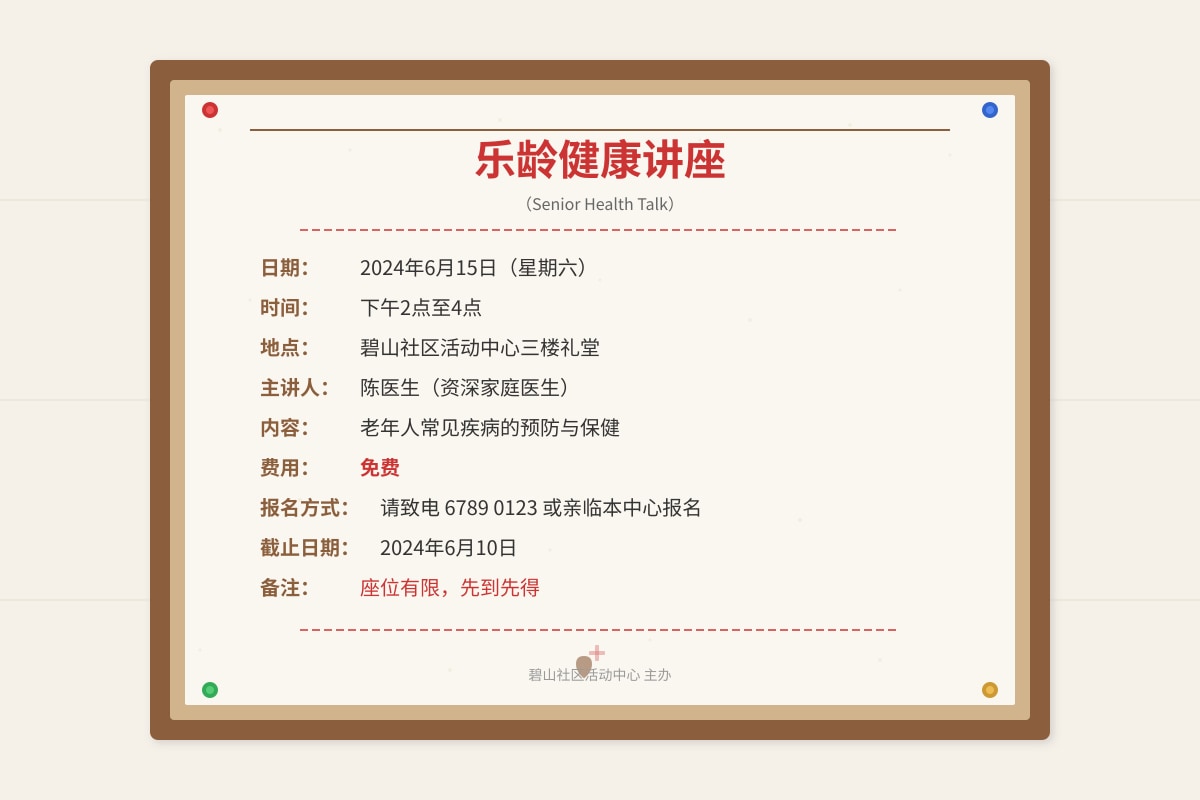
Passage 1: 社区活动通知
6. 讲座的主题是“乐龄健康讲座”,内容是关于老年人常见疾病的预防与保健。[2 marks]
- Marking notes: Award 1 mark for mentioning "乐龄健康讲座" or "老年人健康", and 1 mark for mentioning "疾病预防与保健" or similar.
7. 讲座将在碧山社区活动中心三楼礼堂举行。[2 marks]
- Marking notes: Award 1 mark for "碧山社区活动中心" and 1 mark for "三楼礼堂". Partial answer with only the centre name gets 1 mark.
8. 不需要付费,因为通知中注明“费用:免费”。[2 marks]
- Marking notes: Award 1 mark for stating "不需要付费" or "免费", and 1 mark for citing the source text "费用:免费".
9. 最迟可以在2024年6月10日之前报名,因为这是通知中注明的截止日期。[2 marks]
- Marking notes: Award 1 mark for the date "2024年6月10日" and 1 mark for explaining it's the deadline.
10. 因为座位数量有限,如果报名人数超过座位数,先报名的人才能参加。这句话提醒人们尽早报名。[2 marks]
- Marking notes: Award 1 mark for explaining the limited seats, and 1 mark for explaining the implication (register early or may not get a seat).
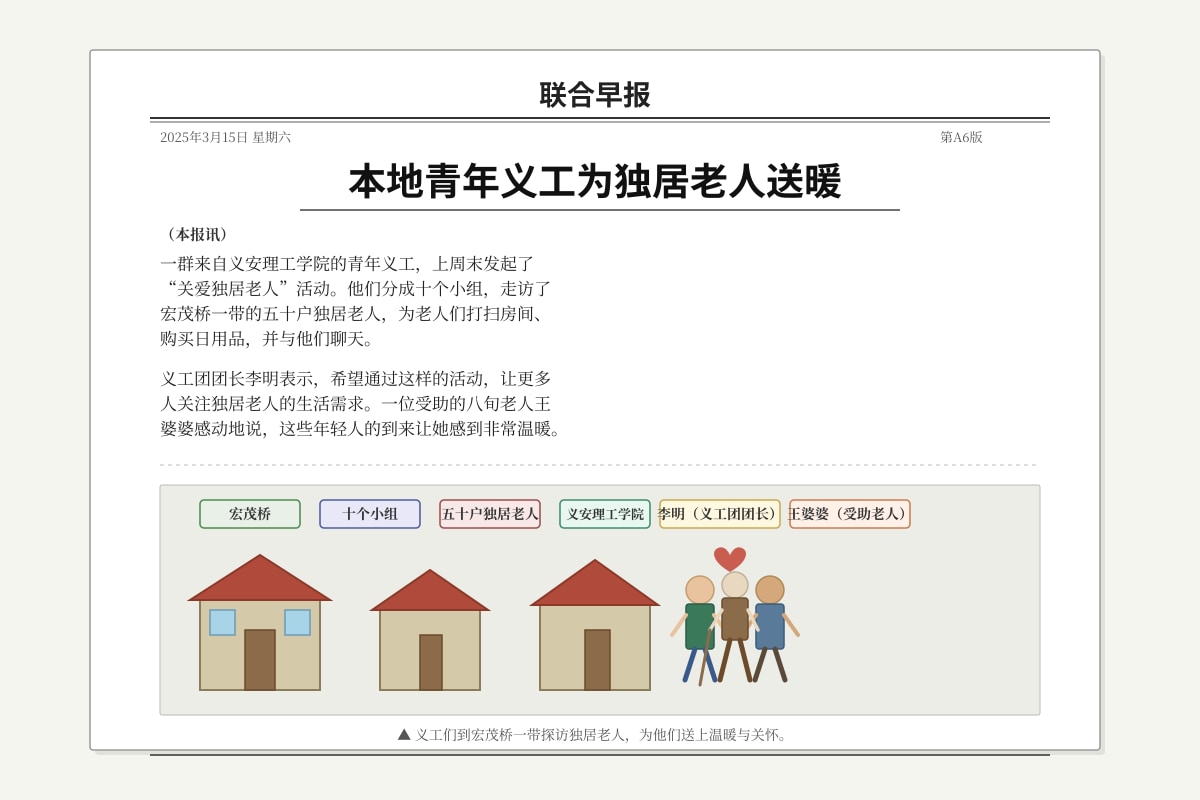
Passage 2: 新闻报道
11. 这群青年义工来自义安理工学院。[2 marks]
- Marking notes: Must mention "义安理工学院" for full marks. "理工学院" alone is insufficient.
12. 他们一共走访了五十户独居老人。[2 marks]
- Marking notes: Must give the exact number "五十户" or "50户".
13. 义工们为老人们打扫房间、购买日用品,并与他们聊天。(列出其中两项即可)[2 marks]
- Marking notes: Award 1 mark for each correctly identified activity, up to 2 marks. Accept any two from: 打扫房间、购买日用品、聊天.
14. 义工团团长李明希望通过这个活动,让更多人关注独居老人的生活需求。[2 marks]
- Marking notes: Must mention "让更多人关注独居老人的生活需求" or similar wording about raising awareness.
15. 王婆婆感到非常温暖,她很感动。[2 marks]
- Marking notes: Award 1 mark for "温暖" (warm) and 1 mark for "感动" (touched). Accept synonyms like "开心" (happy) or "感激" (grateful).
Section C: Reading Comprehension 2 (阅读理解二) [45 marks]
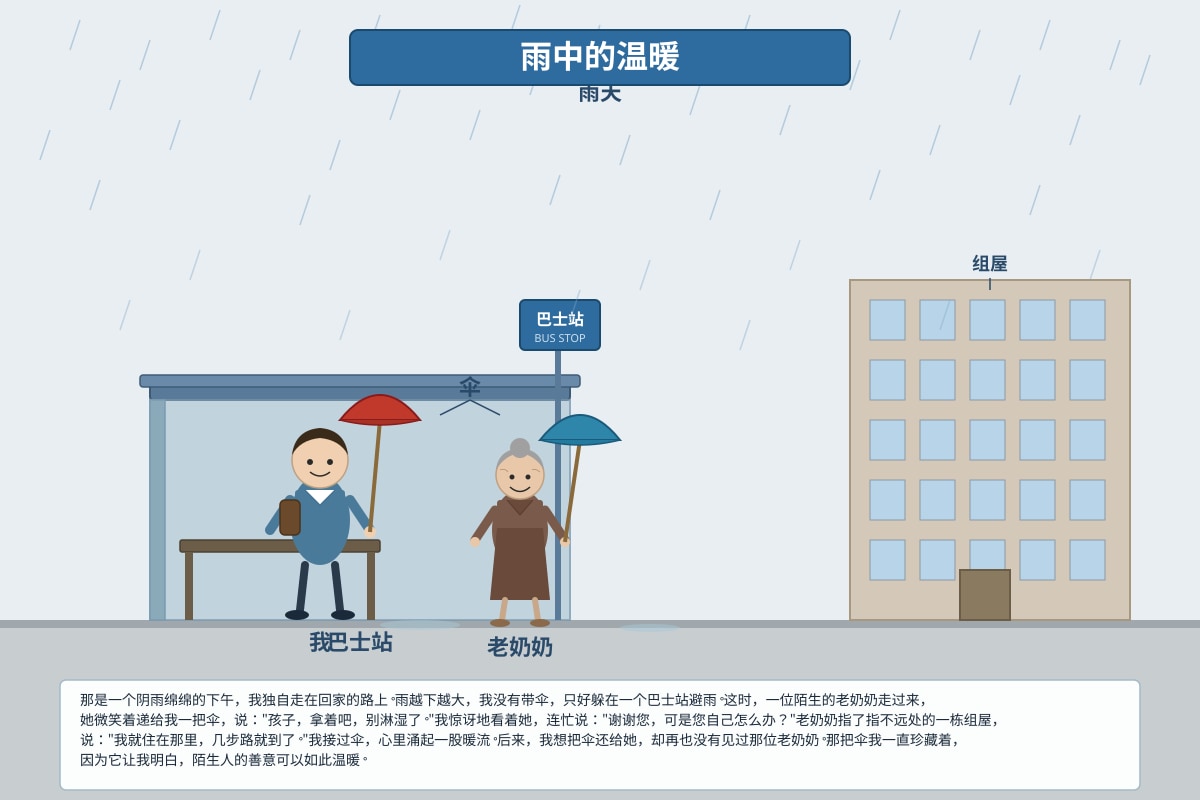
Passage 3: 雨中的温暖
16. 因为那天下午下着雨,而且雨越下越大,作者没有带伞,所以只好在巴士站避雨。[4 marks]
- Marking notes:
- 1 mark: Mentioning it was raining / 下雨
- 1 mark: Mentioning the rain got heavier / 雨越下越大
- 1 mark: Mentioning the author had no umbrella / 没有带伞
- 1 mark: Mentioning the author took shelter at the bus stop / 在巴士站避雨
- Teaching note: This is a straightforward retrieval question. Students should look for the cause-and-effect chain in the first two sentences of the passage.
17. 老奶奶说她住在不远处的一栋组屋,几步路就到了,所以她不需要伞也能回家。[4 marks]
- Marking notes:
- 1 mark: Mentioning the old lady pointed to a nearby HDB block / 指了指不远处的组屋
- 1 mark: Mentioning "几步路就到了" or similar (very short distance)
- 1 mark: Explaining she didn't need the umbrella because she was close to home
- 1 mark: Clear and complete sentence structure
- Teaching note: This is an inference question. The passage doesn't explicitly say "she walked home without getting wet," but the context implies it because her home was very close.
18. 作者一直珍藏着那把伞,因为那把伞让他想起老奶奶的善意,让他感受到陌生人的温暖。这说明作者是一个懂得感恩的人,也说明一个小小的善举可以给人留下深刻的印象。[6 marks]
- Marking notes:
- 2 marks: Mentioning the umbrella reminds the author of the old lady's kindness / 老奶奶的善意
- 2 marks: Mentioning the warmth from a stranger / 陌生人的温暖
- 2 marks: Explaining the significance (gratitude, lasting impact of kindness)
- Teaching note: This is a higher-order thinking question requiring inference and evaluation. Students need to go beyond the literal meaning and explain the symbolic value of the umbrella. The answer should connect the physical object (umbrella) to the abstract concept (kindness, gratitude).
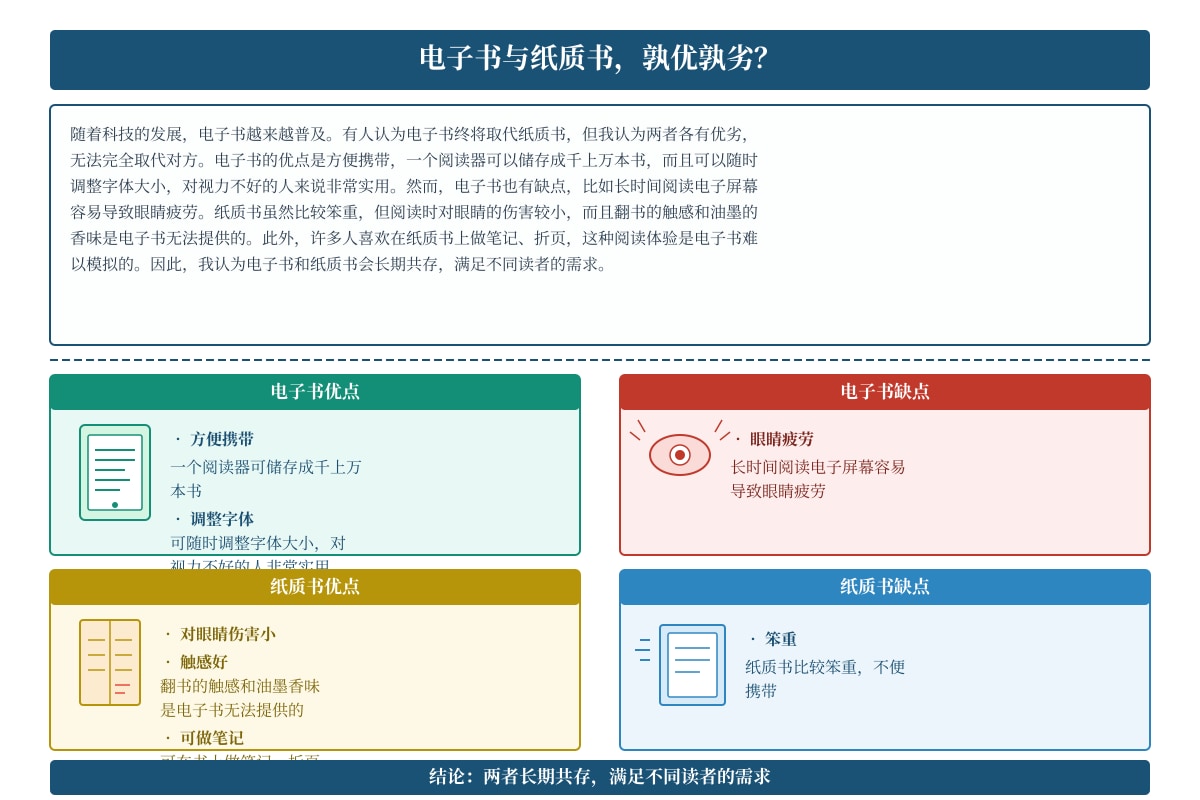
Passage 4: 电子书与纸质书,孰优孰劣?
19. 电子书的优点是方便携带,一个阅读器可以储存成千上万本书,而且可以随时调整字体大小。缺点是长时间阅读电子屏幕容易导致眼睛疲劳。[6 marks]
- Marking notes:
- 2 marks: Stating one clear advantage with explanation (e.g., 方便携带 / 可调整字体)
- 2 marks: Stating one clear disadvantage with explanation (e.g., 眼睛疲劳)
- 2 marks: Using complete sentences and citing specific details from the passage
- Teaching note: Students should extract information from the passage that presents both sides. The passage clearly lists pros and cons in separate sentences. Award partial marks if only one side is mentioned.
20. 作者认为纸质书不会被电子书完全取代,因为两者各有优劣。纸质书对眼睛的伤害较小,而且翻书的触感和油墨的香味是电子书无法提供的。此外,许多人喜欢在纸质书上做笔记、折页,这种阅读体验是电子书难以模拟的。因此,电子书和纸质书会长期共存,满足不同读者的需求。[6 marks]
- Marking notes:
- 2 marks: Stating the main argument (两者各有优劣 / 长期共存)
- 2 marks: Providing at least two specific reasons from the passage (e.g., 对眼睛伤害小、触感好、可做笔记)
- 2 marks: Clear explanation connecting the reasons to the conclusion
- Teaching note: This question tests the ability to identify and explain the author's argument. Students should not just list points but show how they support the conclusion. The phrase "长期共存" (long-term coexistence) is the key conclusion to identify.
— 答案结束 —