AI Generated Quiz
O Level Chemistry Stoichiometry Moles Quiz
Free O Level Chemistry Stoichiometry Moles quiz, HY3 AI version, with questions, answers, and O Level-style practice for Singapore students.
These static practice materials are generated from the site's syllabus and paper-generation workflow, with source and model context shown so students and parents can evaluate the material before use.
Questions
O-Level Chemistry Quiz - Stoichiometry Moles
Name: ___________________________
Class: ___________________________
Date: ___________________________
Score: ___________ / 40
Duration: 50 minutes
Total Marks: 40
Instructions:
- Answer all 20 questions.
- Show all working clearly for calculation questions.
- Use the Data Sheet if needed (Ar values: H=1, C=12, N=14, O=16, Na=23, Mg=24, S=32, Cl=35.5, Ca=40, Cu=64, Zn=65).
- Molar gas volume at r.t.p. = 24 dm³/mol.
- Write units where required.
Section A: Mole Concept and Basic Calculations (Questions 1–5)
1. [1 mark] What is the relative molecular mass, Mr, of carbon dioxide, CO2?
2. [2 marks] Calculate the number of moles in 8.0 g of methane, CH4. (Ar: C=12, H=1)
3. [2 marks] What is the mass of 0.50 mol of sodium chloride, NaCl? (Ar: Na=23, Cl=35.5)
4. [1 mark] How many atoms are present in 1 mole of oxygen molecules, O2? (Use Avogadro constant = 6.0×10²³)
5. [2 marks] Calculate the concentration, in g/dm³, of a solution containing 4.0 g of sodium hydroxide, NaOH, dissolved in 250 cm³ of water.
Section B: Chemical Equations and Stoichiometry (Questions 6–10)
6. [2 marks] Write the balanced equation with state symbols for the reaction between hydrochloric acid and sodium hydroxide.
7. [3 marks] Calculate the mass of magnesium oxide formed when 2.4 g of magnesium burns in excess oxygen. 2Mg+O2→2MgO (Ar: Mg=24, O=16)
8. [2 marks] In the reaction CaCO3→CaO+CO2, calculate the volume of CO2 produced at r.t.p. from 10.0 g of CaCO3. (Ar: Ca=40, C=12, O=16; 1 mol gas = 24 dm³ at r.t.p.)
9. [2 marks] Calculate the empirical formula of a compound containing 40.0% carbon, 6.7% hydrogen, and 53.3% oxygen by mass.
10. [3 marks] A sample of hydrated copper(II) sulfate, CuSO4⋅xH2O, has a molar mass of 250 g/mol. Given CuSO4 = 160 g/mol, find x and the percentage mass of water in the hydrate.
Section C: Concentrations, Limiting Reactants, Yield (Questions 11–15)
11. [2 marks] Calculate the number of moles of HCl in 50.0 cm³ of 0.200 mol/dm³ hydrochloric acid.
12. [3 marks] 25.0 cm³ of 0.100 mol/dm³ Na2CO3 reacts with excess HCl: Na2CO3+2HCl→2NaCl+H2O+CO2 Calculate the volume of CO2 produced at r.t.p.
13. [3 marks] 5.0 g of zinc reacts with 50.0 cm³ of 2.0 mol/dm³ sulfuric acid. Zn+H2SO4→ZnSO4+H2 Determine the limiting reactant and the volume of H2 at r.t.p. (Ar: Zn=65; 1 mol gas = 24 dm³)
14. [2 marks] In an experiment, the theoretical yield of CaCO3 is 10.0 g but only 8.0 g is obtained. Calculate the percentage yield.
15. [2 marks] A 5.0 g impure sample of CaCO3 (only impurity inert) produces 2.0 g of CO2 on complete reaction. Calculate the percentage purity of the sample. (Ar: Ca=40, C=12, O=16)
Section D: Data Interpretation and Applied Stoichiometry (Questions 16–20)
16. [2 marks] A student titrates 20.0 cm³ of 0.100 mol/dm³ H2SO4 with 0.200 mol/dm³ NaOH. 2NaOH+H2SO4→Na2SO4+2H2O Calculate the volume of NaOH required.
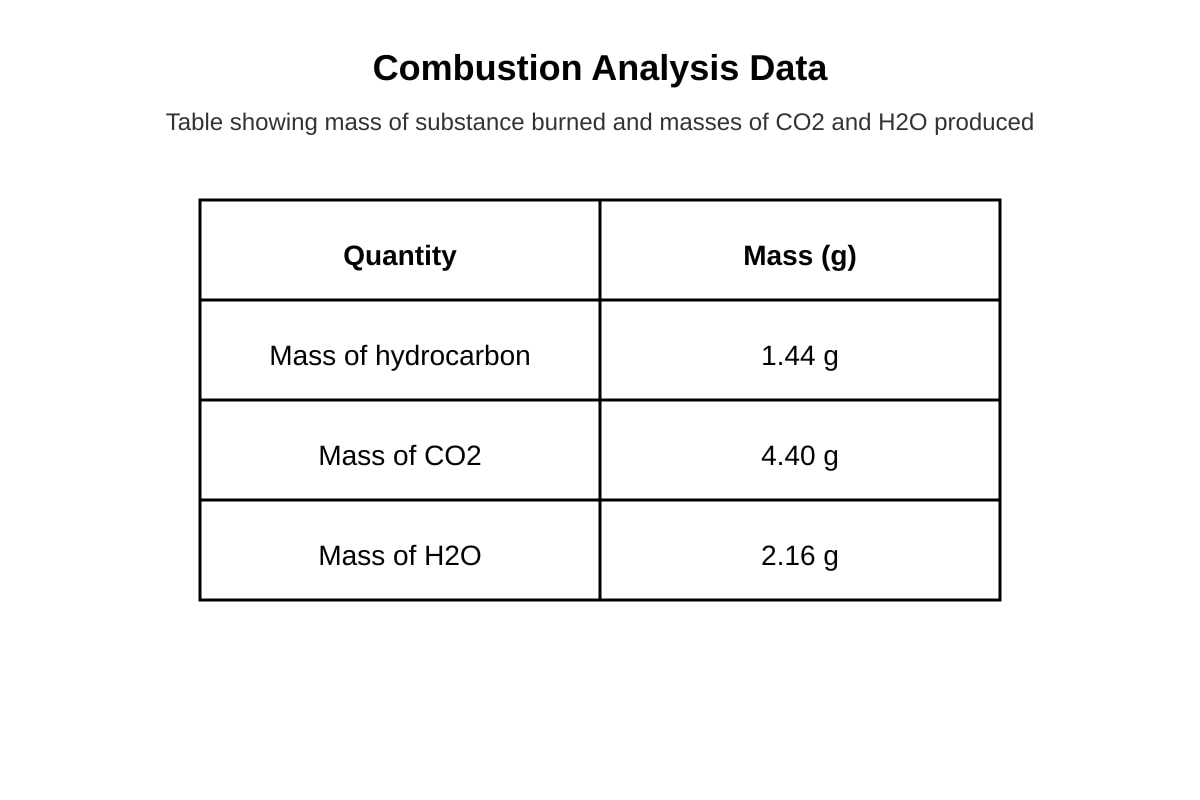
17. [3 marks] The following results were obtained from a combustion analysis:
Image pending generation: table for Q17.
A hydrocarbon (contains C and H only) burns completely. Use the data to find its empirical formula.
18. [2 marks] A fertilizer label states 15% nitrogen by mass. What mass of nitrogen is present in a 2.0 kg bag of this fertilizer?
19. [3 marks] 10.0 g of CuO is heated with 0.50 mol of H2. CuO+H2→Cu+H2O (Ar: Cu=64, O=16) Determine the limiting reactant and the mass of copper produced.
20. [3 marks] A student prepares BaSO4 by mixing BaCl2 and Na2SO4 solutions. BaCl2+Na2SO4→BaSO4+2NaCl If 20.8 g of BaCl2 (Ar: Ba=137, Cl=35.5) is used and excess Na2SO4, calculate the mass of BaSO4 (Ar: S=32, O=16) formed.
Answers
O-Level Chemistry Quiz - Stoichiometry Moles (Answer Key)
Total Marks: 40
Topic: Stoichiometry & Moles (Syllabus 4.2)
Section A: Mole Concept and Basic Calculations
1. [1 mark] Mr of CO2 = 12 + 2(16) = 44
Teaching note: Relative molecular mass is sum of atomic masses. C=12, O=16. Common mistake: forgetting to multiply O by 2.
2. [2 marks]
Mr of CH4 = 12 + 4(1) = 16
Moles = mass / Mr = 8.0 / 16 = 0.50 mol
Marking: 1 mark for Mr, 1 mark for correct moles.
3. [2 marks]
Mr of NaCl = 23 + 35.5 = 58.5
Mass = moles × Mr = 0.50 × 58.5 = 29.25 g
Marking: 1 mark Mr, 1 mark answer.
4. [1 mark] 1 mole O2 contains 6.0×10²³ molecules; each has 2 atoms → 1.2×1024 atoms
Note: Avogadro constant gives molecules, not atoms.
5. [2 marks]
Volume = 250 cm³ = 0.250 dm³
Concentration = mass / volume = 4.0 / 0.250 = 16 g/dm³
Marking: 1 mark conversion, 1 mark answer.
Section B: Chemical Equations and Stoichiometry
6. [2 marks]
HCl(aq)+NaOH(aq)→NaCl(aq)+H2O(l)
Marking: 1 mark balanced equation, 1 mark state symbols. Common error: missing (aq)/(l).
7. [3 marks]
Mr Mg = 24, MgO = 24+16 = 40
Moles Mg = 2.4/24 = 0.10 mol
From eq: 2Mg → 2MgO, so 1:1 → 0.10 mol MgO
Mass MgO = 0.10 × 40 = 4.0 g
Marking: 1 mole Mg, 1 mole ratio, 1 mass.
8. [2 marks]
Mr CaCO₃ = 40+12+48 = 100
Moles = 10.0/100 = 0.10 mol
1 mol CaCO₃ → 1 mol CO₂ → 0.10 mol CO₂
Volume = 0.10 × 24 = 2.4 dm³
Marking: 1 mole, 1 volume.
9. [2 marks]
Assume 100 g: C=40g, H=6.7g, O=53.3g
Moles: C=40/12=3.33, H=6.7/1=6.7, O=53.3/16=3.33
Ratio = 1 : 2 : 1 → CH2O
Marking: 1 mark moles, 1 mark formula.
10. [3 marks]
Mr CuSO₄·xH₂O = 250, CuSO₄ = 160 → xH₂O = 90
x = 90/18 = 5
% water = 90/250 × 100 = 36%
Marking: 1 x, 1 % calc, 1 answer.
Section C: Concentrations, Limiting Reactants, Yield
11. [2 marks]
Vol = 50/1000 = 0.0500 dm³
Moles = 0.200 × 0.0500 = 0.0100 mol
Marking: 1 conversion, 1 answer.
12. [3 marks]
Moles Na₂CO₃ = 0.100 × 25/1000 = 0.00250 mol
From eq 1:1 → 0.00250 mol CO₂
Vol = 0.00250 × 24 = 0.0600 dm³ (60.0 cm³)
Marking: 1 moles, 1 ratio, 1 volume.
13. [3 marks]
Moles Zn = 5.0/65 = 0.0769 mol
Moles H₂SO₄ = 2.0 × 50/1000 = 0.10 mol
Eq 1:1 → Zn limiting (less moles)
Moles H₂ = 0.0769 mol → Vol = 0.0769 × 24 = 1.85 dm³
Marking: 1 each for limiting, moles H₂, volume.
14. [2 marks]
% yield = (8.0/10.0) × 100 = 80%
Marking: 1 formula, 1 answer.
15. [2 marks]
Moles CO₂ = 2.0/44 = 0.0455 mol → moles CaCO₃ = 0.0455
Mass pure CaCO₃ = 0.0455 × 100 = 4.55 g
% purity = 4.55/5.0 × 100 = 91%
Marking: 1 calc, 1 %.
Section D: Data Interpretation and Applied Stoichiometry
16. [2 marks]
Moles H₂SO₄ = 0.100 × 20/1000 = 0.00200 mol
From eq 2NaOH:1H₂SO₄ → moles NaOH = 0.00400
Vol NaOH = 0.00400/0.200 = 0.0200 dm³ = 20.0 cm³
Marking: 1 moles, 1 volume.
17. [3 marks]
Moles C = 4.40/44 = 0.100 mol
Moles H = 2 × (2.16/18) = 0.240 mol
Ratio C:H = 0.100:0.240 = 1:2.4 → ×5 = 5:12 → C5H12
Marking: 1 C, 1 H, 1 ratio. (Image shows table values used.)
18. [2 marks]
Mass N = 15% of 2000 g = 0.15 × 2000 = 300 g
Marking: 1 conversion, 1 answer.
19. [3 marks]
Moles CuO = 10.0/80 = 0.125 mol
H₂ given = 0.50 mol → CuO limiting
Mass Cu = 0.125 × 64 = 8.0 g
Marking: 1 limiting, 1 moles Cu, 1 mass.
20. [3 marks]
Mr BaCl₂ = 137+71 = 208; moles = 20.8/208 = 0.100 mol
Mr BaSO₄ = 137+32+64 = 233
1:1 → mass = 0.100 × 233 = 23.3 g
Marking: 1 BaCl₂ moles, 1 BaSO₄ Mr, 1 mass.
Free quiz and exam paper access
Enter your details to view this paper
Your access is remembered on this device.