AI Generated Quiz
O Level Chemistry Redox Electrochemistry Quiz
Free O Level Chemistry Redox Electrochemistry quiz, HY3 AI version, with questions, answers, and O Level-style practice for Singapore students.
These static practice materials are generated from the site's syllabus and paper-generation workflow, with source and model context shown so students and parents can evaluate the material before use.
Questions
O-Level Chemistry Quiz - Redox Electrochemistry
Name: ________________________
Class: ________________________
Date: ________________________
Score: ________________________
Duration: 50 minutes
Total Marks: 40
Instructions:
- This quiz contains 20 questions on Redox Electrochemistry.
- Section A: Multiple-choice (1 mark each). Section B: Short structured questions (1–3 marks each). Section C: Data and extended response (2–4 marks each).
- Write your answers in the spaces provided.
- Show all working for calculation questions.
- Use proper chemical notation.
Section A: Multiple-Choice (Questions 1–5)
1. Which of the following processes is oxidation?
A. Gain of electrons
B. Loss of oxygen
C. Loss of electrons
D. Gain of hydrogen
____ (1 mark)
2. In the reaction Zn(s)+Cu2+(aq)→Zn2+(aq)+Cu(s), which species is the reducing agent?
A. Zn2+
B. Cu2+
C. Zn
D. Cu
____ (1 mark)
3. During electrolysis of molten lead(II) bromide, PbBr2(l), at the cathode:
A. Bromide ions lose electrons
B. Lead ions gain electrons
C. Bromine is produced
D. Oxygen is produced
____ (1 mark)
4. Which metal is extracted by electrolysis of its molten ore because it is too reactive for carbon reduction?
A. Iron
B. Copper
C. Aluminium
D. Zinc
____ (1 mark)
5. In a simple hydrogen–oxygen fuel cell, the overall reaction is:
A. 2H2+O2→2H2O
B. H2+Cl2→2HCl
C. CH4+2O2→CO2+2H2O
D. 2H2O→2H2+O2
____ (1 mark)
Section B: Short Structured Questions (Questions 6–15)
6. State the oxidation state of manganese in KMnO4.
____ (1 mark)
7. Write the half-equation for the oxidation of iodide ions to iodine.
____ (1 mark)
8. Explain, in terms of electron transfer, why magnesium is a reducing agent when it reacts with copper(II) ions.
________________________________________________________________________ (2 marks)
9. Aqueous copper(II) sulfate is electrolysed using carbon electrodes. State the substance produced at the cathode and the anode.
Cathode: ________________________
Anode: ________________________ (2 marks)
10. Balance the redox equation (acidic medium):
MnO4−+Fe2++H+→Mn2++Fe3++H2O
________________________________________________________________________ (2 marks)
11. In the electrochemical series, zinc is above copper. Predict what happens when a zinc rod is placed in copper(II) sulfate solution.
________________________________________________________________________ (2 marks)
12. State two reasons why aluminium is extracted by electrolysis rather than heating with carbon.
-
- ____________________________________________________________________ (2 marks)
13. Write the ionic half-equation at the anode during electrolysis of concentrated aqueous sodium chloride.
____ (1 mark)
14. Calculate the charge transferred when 0.020 mol of electrons flow during an electrolysis experiment. (1 F = 96500 C/mol)
Working:
Answer: ________________________ C (2 marks)
15. A student electrolyses molten sodium chloride. Name the products at the anode and cathode and state their physical states.
Anode: ________________________
Cathode: ________________________ (2 marks)
Section C: Data and Extended Response (Questions 16–20)
16. The table shows standard electrode potentials:
| Half-cell | E∘ / V |
|---|---|
| Zn2+/Zn | -0.76 |
| Cu2+/Cu | +0.34 |
| Fe2+/Fe | -0.44 |
(a) Construct the cell notation for a cell using zinc and copper electrodes.
(b) Calculate the standard cell potential.
(c) State which electrode is the negative terminal.
(a) ________________________________________________________ (1 mark)
(b) Working: ________________________________________________ (2 marks)
(c) ________________________________________________________ (1 mark)
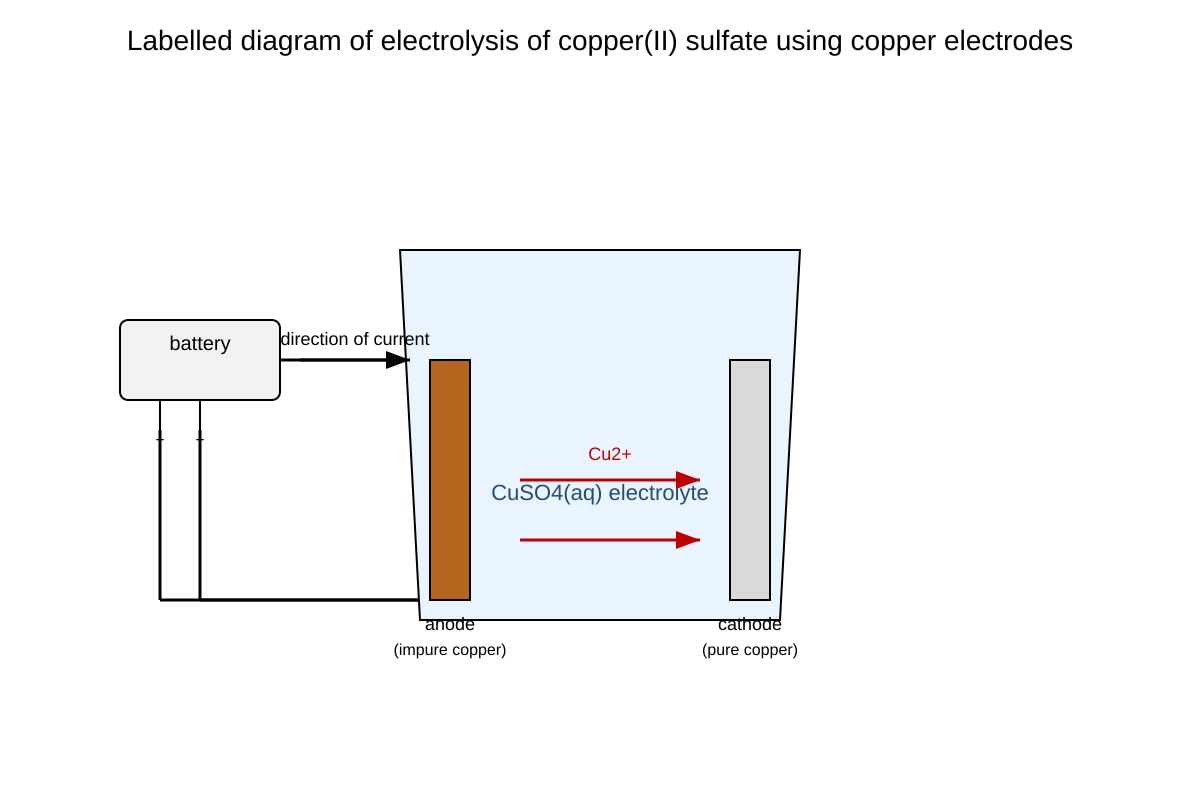
17.
Image pending generation: experimental_setup for Q17.
Using the diagram, explain how electrolysis purifies copper. Include equations.
________________________________________________________________________ (3 marks)
18. A fuel cell uses hydrogen and oxygen.
(a) Write the half-equation at the anode.
(b) State one environmental advantage over a petrol engine.
(c) Give one limitation of fuel cells for widespread use.
(a) ________________________________________________________ (1 mark)
(b) ________________________________________________________ (1 mark)
(c) ________________________________________________________ (1 mark)
19. 25.0 cm³ of 0.10 mol/dm³ Fe2+ is oxidised by acidified MnO4− according to:
MnO4−+5Fe2++8H+→Mn2++5Fe3++4H2O
Calculate the moles of MnO4− required.
Working:
Answer: ________________________ mol (3 marks)
20. Compare electrolysis of molten lead(II) bromide and concentrated aqueous sodium chloride. For each, state the cathode product and explain the difference in cathode product using reactivity.
________________________________________________________________________ (4 marks)
Answers
O-Level Chemistry Quiz - Redox Electrochemistry (Answer Key)
Total Marks: 40
Topic: Redox Electrochemistry
Level: O-Level
Section A: Multiple-Choice
1. C (1 mark)
Oxidation is loss of electrons (OIL RIG: Oxidation Is Loss, Reduction Is Gain). Gain of electrons is reduction; loss of oxygen and gain of hydrogen are reduction in classical terms.
2. C (1 mark)
Zn loses electrons to become Zn2+, so it is oxidised and therefore the reducing agent (it reduces Cu2+ to Cu).
3. B (1 mark)
At cathode (negative), Pb2+ gains electrons: Pb2++2e−→Pb. Bromide is oxidised at anode.
4. C (1 mark)
Aluminium is too reactive (above carbon in reactivity series) to be reduced by carbon; extracted by electrolysis of molten alumina.
5. A (1 mark)
Hydrogen–oxygen fuel cell overall: 2H2+O2→2H2O.
Section B: Short Structured
6. +7 (1 mark)
K is +1, O is -2 × 4 = -8; sum = 0 → Mn = +7.
7. 2I−→I2+2e− (1 mark)
Iodide loses electrons (oxidation); balance charge with 2e⁻.
8. (2 marks)
- Mg loses 2 electrons: Mg→Mg2++2e− (1 mark)
- These electrons are gained by Cu2+: Cu2++2e−→Cu (1 mark)
Mg donates electrons, so it is a reducing agent.
9. (2 marks)
Cathode: Cu (copper deposited, Cu2++2e−→Cu) (1 mark)
Anode: O2 (oxygen from water oxidation, 4OH−→O2+2H2O+4e− or 2H2O→O2+4H++4e−) (1 mark)
Note: With carbon electrodes, sulfate not discharged.
10. MnO4−+5Fe2++8H+→Mn2++5Fe3++4H2O (2 marks)
Half-eq: MnO4−+8H++5e−→Mn2++4H2O and Fe2+→Fe3++e−; multiply Fe by 5 and add.
11. (2 marks)
- Zn displaces Cu: Zn+Cu2+→Zn2++Cu (1 mark)
- Reddish-brown Cu deposits on Zn rod; blue colour fades (1 mark)
12. (2 marks)
- Aluminium is more reactive than carbon, so carbon cannot reduce its ore. (1 mark)
- Alumina has very high melting point; dissolved in cryolite to lower energy cost but electrolysis still needed. (1 mark)
13. 2Cl−→Cl2+2e− (1 mark)
Concentrated NaCl: chloride preferentially discharged over OH⁻.
14. (2 marks)
Working: Q = n × F = 0.020 × 96500 = 1930 C (1 mark for method, 1 for answer)
Answer: 1930 C
15. (2 marks)
Anode: Cl2(g) (chlorine gas) (1 mark)
Cathode: Na(l) (molten sodium) (1 mark)
Molten NaCl: no water, so Na⁺ reduced, Cl⁻ oxidised.
Section C: Data and Extended
16. (4 marks total)
(a) Zn∣Zn2+∣∣Cu2+∣Cu (1 mark)
(b) Ecell∘=Ecathode∘−Eanode∘=0.34−(−0.76)=1.10 V (2 marks: 1 for correct subtraction, 1 for value)
(c) Zn electrode is negative terminal (anode, oxidation) (1 mark)
17. (3 marks)
- Impure Cu at anode dissolves: Cu→Cu2++2e− (1 mark)
- Pure Cu at cathode gains mass: Cu2++2e−→Cu (1 mark)
- Impurities fall as anode mud; Cu transferred from impure to pure electrode (1 mark)
18. (3 marks)
(a) 2H2→4H++4e− (or H2→2H++2e−) (1 mark)
(b) Only water produced, no CO₂/SO₂ pollutants (1 mark)
(c) High cost, H₂ storage difficulty, needs catalyst (1 mark)
19. (3 marks)
Moles Fe2+ = 0.10 × 25.0/1000 = 0.00250 mol (1 mark)
Ratio MnO4−:Fe2+=1:5 (1 mark)
Moles MnO4− = 0.00250 / 5 = 0.000500 mol (1 mark)
20. (4 marks)
- Molten PbBr2: cathode = Pb (from Pb2++2e−→Pb). Pb is less reactive than Na/K, reduced directly. (2 marks)
- Concentrated aq NaCl: cathode = H2 (from 2H2O+2e−→H2+2OH−) because Na⁺ is too reactive to be reduced in water; water/H⁺ discharged instead. (2 marks)
Difference due to metal reactivity relative to hydrogen.
Free quiz and exam paper access
Enter your details to view this paper
Your access is remembered on this device.