AI Generated Quiz
O Level Chemistry Periodic Table Quiz
Free O Level Chemistry Periodic Table quiz, HY3 AI version, with questions, answers, and O Level-style practice for Singapore students.
These static practice materials are generated from the site's syllabus and paper-generation workflow, with source and model context shown so students and parents can evaluate the material before use.
Questions
Free quiz and exam paper access
Enter your details to view this paper
Your access is remembered on this device.
Answers
O-Level Chemistry Quiz - Periodic Table (Answer Key)
Total Marks: 40
Topic: Periodic Table (syllabus Topic 8, O-Level 6092)
Note: Content generated from LLM-inferred templates (Stage 4/5). Not claimed as past-year exam derived.
Section A: Multiple Choice (1 mark each)
1. A (Mg)
Teaching note: Mg has proton number 12 → electronic config 2,8,2 → Group 2, Period 3. Ca is Period 4; Na is Group 1; Al is Group 3.
2. B (increases)
Teaching note: Down Group 1, outer electron is further from nucleus and shielding increases, so easier to lose electron → more reactive.
3. C (Number of valence electrons)
Teaching note: Across a period, group number increases 1→8, so valence electrons increase. Atomic radius and metallic character decrease.
4. B (Group 7)
Teaching note: Proton number 17 → 2,8,7 → 7 valence electrons → Group 7 (halogens).
5. B (Ar)
Teaching note: Ar (argon) is Group 0 noble gas. Cl is halogen, S and P are non-noble.
Section B: Short Structured (2 marks each)
6. Trend: decreases (1 mark). Explanation: Across Period 3, proton number increases, same shell, stronger nuclear pull pulls electrons closer (1 mark).
Teaching: Atomic radius shrinks left to right due to increased effective nuclear charge.
7. 2,8 (2 marks for correct config).
Teaching: O has 8 protons → 8 electrons → fill shells 2 then 6.
8. Charge: –1 (1 mark). Electronic config: 2,8,8 (1 mark).
Teaching: Cl (2,8,7) gains 1e⁻ to achieve 2,8,8 stable noble gas config → Cl⁻.
9. Good conductor of heat/electricity OR malleable OR low density (any one, 2 marks if stated clearly).
Teaching: Group 1 metals are typical metals with metallic bonding (sea of electrons).
10. They have full outer electron shell (octet) (1 mark); do not need to lose/gain/share electrons (1 mark).
Teaching: Stable electronic config → no tendency to react.
11. Group 2, Period 3 (2 marks).
Teaching: Mg proton 12 → 2,8,2 → 2 valence (Group 2), 3 shells (Period 3).
12. Increases (2 marks).
Teaching: Down Group 7, molecules larger (more electrons), stronger van der Waals forces → higher melting point.
13. 4 (2 marks).
Teaching: Group number = valence electrons for main groups.
14. Cl⁻ (or M⁺ general; for Group 1 chloride ion is Cl⁻ from chlorine; if asking chloride ion from Group 1 metal it is M⁺, but “chloride ion formed by element in Group 1” is ambiguous — correct is Cl⁻ as non-metal ion; award 2 marks for Cl⁻).
Teaching: Group 1 metals form M⁺; chlorine forms Cl⁻. Question means chloride ion = Cl⁻.
15. Group number = number of valence electrons (2 marks).
Teaching: For main group elements (1–7, 0), group number tells outer electrons.
Section C: Data and Extended
16. (a) Decreases down group (1 mark).
(b) Metallic bond weakens because atoms larger, delocalised electrons further from nucleus, less attraction (2 marks).
Teaching: Bigger atomic radius down group → weaker metallic bonding → less energy to melt.
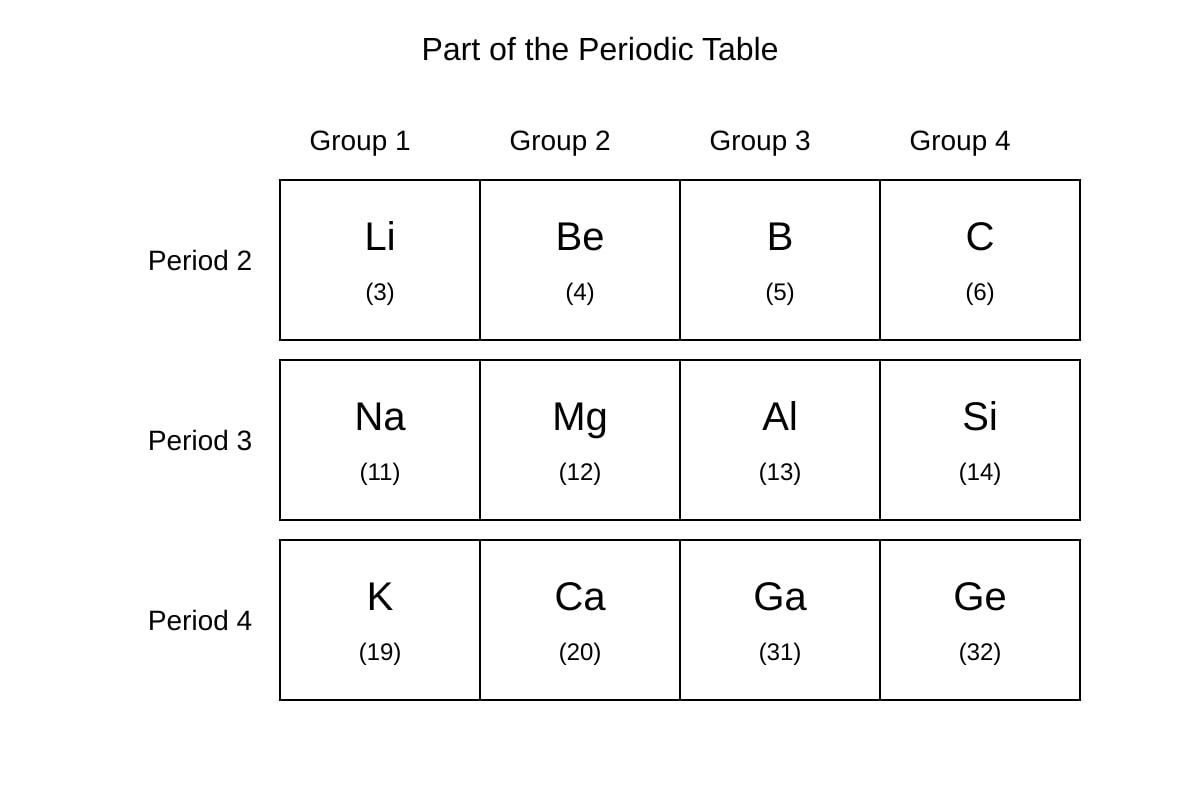
17. (a) Mg (1 mark).
(b) 4 valence electrons (1 mark).
(c) Mg smaller than Na (1 mark); Mg has more protons, same shell, stronger pull (1 mark).
Teaching: From image, Period 3 Group 2 = Mg; across period radius drops.
18. (a) Greenish-yellow (1 mark).
(b) F smaller, electron closer to nucleus, easier to gain e⁻ (2 marks).
(c) F⁻ (1 mark).
Teaching: Halogens gain 1e⁻; reactivity decreases down group.
19. (a) Correct (1 mark).
(b) Basic: Na₂O or MgO; Acidic: SO₂/SO₃ or P₄O₁₀ (2 marks, one each).
(c) More valence e⁻ → covalent/acidic oxides (1 mark).
Teaching: Metals left → basic oxides; non-metals right → acidic.
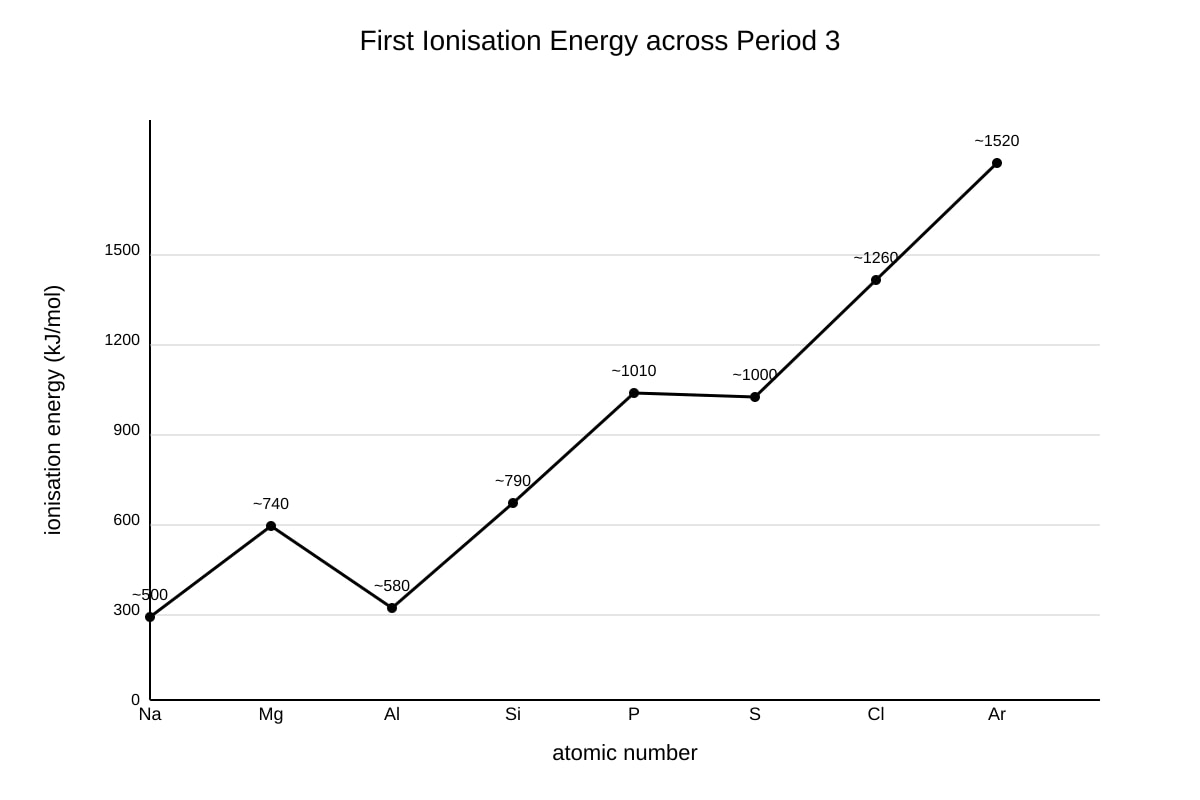
20. (a) Generally increases (1 mark).
(b) Al outer e⁻ in p-subshell, higher energy, easier to remove than Mg s-subshell (2 marks).
(c) Ar full shell, very stable (1 mark).
Teaching: From graph, dips at Al/S due to subshell/electron pairing.