AI Generated Quiz
O Level Chemistry Atomic Structure Bonding Quiz
Free O Level Chemistry Atomic Structure Bonding quiz, HY3 AI version, with questions, answers, and O Level-style practice for Singapore students.
These static practice materials are generated from the site's syllabus and paper-generation workflow, with source and model context shown so students and parents can evaluate the material before use.
Questions
O-Level Chemistry Quiz - Atomic Structure Bonding
Name: ___________________________
Class: ___________________________
Date: ___________________________
Score: _______ / 40
Duration: 50 minutes
Total Marks: 40
Instructions: Answer all 20 questions. Section A is multiple-choice (1 mark each). Section B is short structured questions. Section C requires extended working and explanations. Use the spaces provided. Show working where marks are awarded for method.
Section A: Multiple Choice (Questions 1–5, 1 mark each)
1. An atom of sodium has proton number 11 and nucleon number 23. How many neutrons does it have?
A. 11
B. 12
C. 23
D. 34
2. Which of the following is an isotope of carbon-12 (612C)?
A. 613C
B. 712N
C. 714N
D. 612B
3. Which type of bonding involves a "sea of delocalised electrons"?
A. Ionic
B. Covalent
C. Metallic
D. Hydrogen
4. A dot-and-cross diagram of a water molecule shows how many shared electron pairs?
A. 1
B. 2
C. 3
D. 4
5. Which substance has a giant covalent structure?
A. Methane
B. Diamond
C. Sodium chloride
D. Iodine
Section B: Short Structured Questions (Questions 6–15)
6. State the relative charge and relative mass of a proton, neutron, and electron. [3]
Proton: charge ______, mass ______
Neutron: charge ______, mass ______
Electron: charge ______, mass ______
7. Element X has atomic number 12. Write its electronic configuration. [1]
8. Explain how the atom in Q7 forms a positive ion. [2]
9. Magnesium reacts with oxygen to form magnesium oxide. Write the equation using nuclide-style notation for the ions formed. [2]
10. Draw a dot-and-cross diagram to show the bonding in a molecule of hydrogen, H₂. Show only the outer shell electrons. [2]
11. State two physical properties of ionic compounds and explain one in terms of structure. [3]
Explanation: ___________________________
12. Diamond and graphite are both forms of carbon. State one difference in their structure and one difference in property. [2]
Structure: ___________________________
Property: ___________________________
13. An alloy is a mixture of a metal with another element. Give one reason why alloys are often harder than pure metals. [1]
14. A sample of chlorine has two isotopes: 35Cl (75%) and 37Cl (25%). Calculate the relative atomic mass of chlorine to 1 decimal place. [2]
Working: ___________________________
Answer: ______
15. State the type of structure of iodine (I₂) and why it has a low melting point. [2]
Structure: ______
Reason: ______
Section C: Extended Questions (Questions 16–20)
16. Compare ionic and metallic bonding. In your answer, include the particles present, how they are held together, and one property resulting from each type of bonding. [5]
17. Element Y has electronic configuration 2,8,7.
(a) State the group and period of Y in the Periodic Table. [2]
(b) Draw the dot-and-cross diagram for the compound formed between Y and sodium. [3]
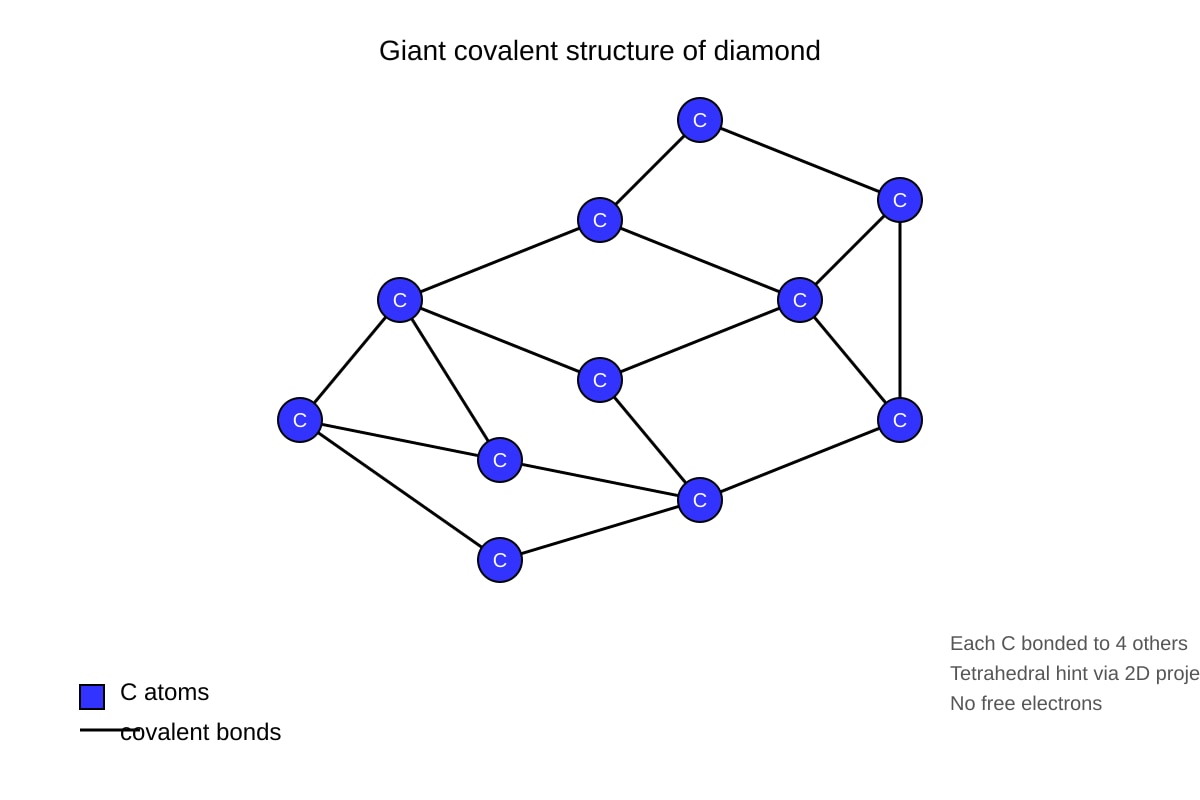
18. The diagram below shows the arrangement of atoms in a giant covalent structure.
Image pending generation: diagram for 18.
(a) Name the structure shown. [1]
(b) Explain why this substance is very hard. [2]
(c) Why does it not conduct electricity? [2]
19. A student says: "Isotopes of an element have different chemical properties because they have different numbers of neutrons." Evaluate this statement. [4]
20. Explain, using ideas about particles and bonding, why sodium chloride solution conducts electricity but solid sodium chloride does not. [5]
Answers
O-Level Chemistry Quiz - Atomic Structure Bonding (Answer Key)
Total Marks: 40
Level: O-Level
Topic: Atomic Structure Bonding
Q1. B [1]
Neutrons = nucleon number − proton number = 23 − 11 = 12.
Teaching note: Nucleon number is total protons + neutrons. Proton number is just protons.
Q2. A [1]
Isotopes have same proton number, different nucleon number. 613C has same proton number 6 as carbon-12.
Common mistake: choosing different element (different proton number).
Q3. C [1]
Metallic bonding = positive metal ions in sea of delocalised electrons.
Q4. B [1]
H₂O has two O−H covalent bonds = 2 shared pairs.
Q5. B [1]
Diamond is giant covalent. Methane and iodine are simple molecular; NaCl is giant ionic.
Q6. [3]
Proton: +1, 1
Neutron: 0, 1
Electron: −1, ~0
(1 mark each correct pair)
Q7. [1]
2,8,2
Teaching: atomic number 12 → 12 electrons fill shells 2,8,2.
Q8. [2]
X loses 2 electrons from outer shell → X²⁺.
Marks: 1 for "loses 2 electrons", 1 for ion formed (stable 2,8).
Q9. [2]
21224Mg+816O2→21224Mg2+ 816O2−
(or simpler ionic: Mg → Mg²⁺ + 2e⁻; O + 2e⁻ → O²⁻)
Award 1 for correct ions, 1 for combining to MgO.
Q10. [2]
H:• + •H → H••H (crosses/dots show shared pair).
1 mark for two H with 1 mark for shared pair shown.
Q11. [3]
e.g. high melting point, conducts when molten/dissolved.
Explanation: strong electrostatic forces between ions need lots of energy to break.
(1+1+1)
Q12. [2]
Structure: diamond has 3D network, graphite has layers.
Property: diamond hardest, graphite soft/slippery.
(1+1)
Q13. [1]
Different sized atoms distort layers, making it harder to slide.
Q14. [2]
RAM = (35×0.75)+(37×0.25)=26.25+9.25=35.5
1 for working, 1 for 35.5.
Q15. [2]
Simple molecular; weak intermolecular forces need little energy to overcome.
Q16. [5]
Ionic: oppositely charged ions, electrostatic attraction, high m.p. [3]
Metallic: ions in sea of e⁻, attraction, malleable/conducts [2]
Marking: particles 1+1, holding 1+1, property 1.
Q17. [5]
(a) Group 17, Period 3 [2]
(b) Na⁺ [•••••••]⁻ (Cl with 8, Na none) cross diagram NaCl [3]
Q18. [5]
(a) Diamond [1]
(b) Network of strong covalent bonds in all directions [2]
(c) No delocalised electrons [2]
Q19. [4]
Statement false: isotopes have same e⁻ config so same chemical properties. Neutrons affect mass/physical only.
Marks: identify false 1, reason e⁻ 2, physical diff 1.
Q20. [5]
Solid: ions fixed, no mobile charge [2]. Solution: ions free to move, carry current [3].
Free quiz and exam paper access
Enter your details to view this paper
Your access is remembered on this device.