AI Generated Quiz
O Level Chemistry Acids Bases Salts Quiz
Free O Level Chemistry Acids Bases Salts quiz, HY3 AI version, with questions, answers, and O Level-style practice for Singapore students.
These static practice materials are generated from the site's syllabus and paper-generation workflow, with source and model context shown so students and parents can evaluate the material before use.
Questions
O-Level Chemistry Quiz - Acids Bases Salts
Name: ___________________________
Class: ___________________________
Date: ___________________________
Score: _______ / 40
Duration: 50 minutes
Total Marks: 40
Instructions: Answer all 20 questions. Section A is multiple-choice (1 mark each). Section B is short structured questions. Section C requires longer responses with working. Use pen and show all steps where calculation is needed.
Section A: Multiple Choice (Questions 1–5, 1 mark each)
-
Which of the following equations represents a neutralisation reaction?
A. 2Na+2H2O→2NaOH+H2
B. HCl+NaOH→NaCl+H2O
C. CaCO3→CaO+CO2
D. Zn+CuSO4→ZnSO4+Cu
Answer: ______ -
A solution has pH = 3. It is most likely:
A. a strong alkali
B. a weak alkali
C. a strong acid
D. a neutral substance
Answer: ______ -
Which metal does NOT react with dilute hydrochloric acid?
A. Magnesium
B. Zinc
C. Copper
D. Iron
Answer: ______ -
To prepare a pure dry sample of barium sulfate (an insoluble salt), the best method is:
A. titration of acid and alkali
B. adding excess base to acid
C. mixing solutions of barium chloride and sodium sulfate
D. evaporation of a salt solution
Answer: ______ -
Universal Indicator turns green in a solution. This shows the solution is:
A. strongly acidic
B. neutral
C. strongly alkaline
D. weakly acidic
Answer: ______
Section B: Short Structured Questions (Questions 6–15)
-
(a) State the ion produced by all acids in aqueous solution. [1]
(b) State the ion produced by all alkalis in aqueous solution. [1]
-
Explain what is meant by the term "weak acid". [2]
-
Write a balanced chemical equation for the reaction between ethanoic acid and zinc. Include state symbols. [2]
-
A student adds dilute hydrochloric acid to a sample of copper(II) oxide. Describe what she would observe. [2]
-
Write the ionic equation for the neutralisation of an acid by an alkali. [1]
-
A solution of ethanoic acid and a solution of hydrochloric acid both have concentration 0.1 mol/dm³. Explain why ethanoic acid has a higher pH. [2]
-
Give one test to distinguish between sodium carbonate and sodium oxide. State the observation for each. [2]
Test: __________________________________________________________
Sodium carbonate: ______________________________________________
Sodium oxide: __________________________________________________ -
A student prepared magnesium sulfate by adding excess magnesium carbonate to dilute sulfuric acid. State two steps after the reaction to obtain pure dry crystals. [2]
-
Name the salt formed from the reaction of nitric acid and potassium hydroxide. [1]
-
A sample of ink was separated by chromatography using water as solvent. Only one spot appeared. Explain why this does NOT prove the ink is a single pure compound. [2]
Section C: Extended Response (Questions 16–20)
-
A student wants to prepare a pure, dry sample of zinc sulfate from zinc oxide and dilute sulfuric acid. Describe a suitable method. [3]
-
In a titration, 25.0 cm³ of 0.100 mol/dm³ sodium hydroxide neutralises 20.0 cm³ of sulfuric acid. Calculate the concentration of the sulfuric acid. Suggest a suitable indicator. [4]
Working:
Concentration = ______ mol/dm³
Indicator: ______ -
A mixture of zinc and copper is added to dilute sulfuric acid. Explain why zinc reacts but copper remains. Write the equation for the reaction of zinc. [3]
Equation: ______________________________________________________
-
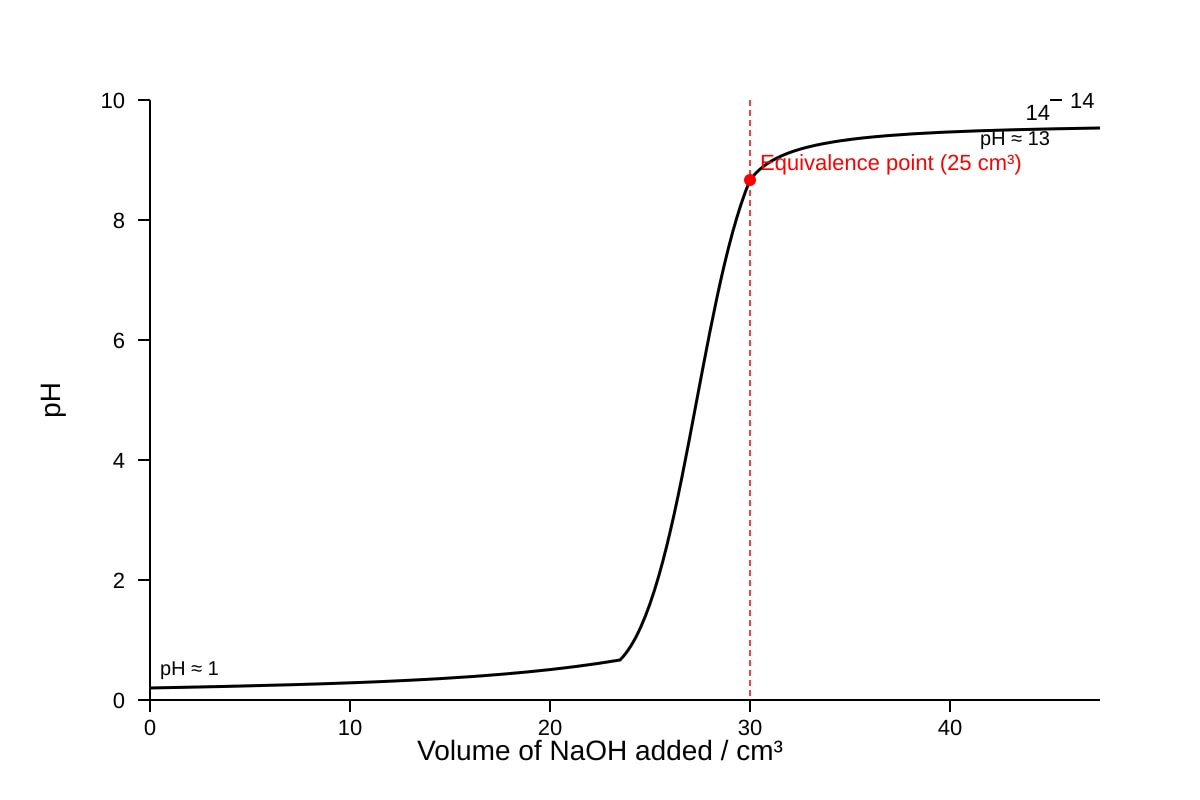
The diagram shows a pH curve for the titration of an acid with an alkali.
Image pending generation: graph for Q19.
(a) State whether the acid is strong or weak. Give a reason. [2]
______
(b) What pH is at the equivalence point region? [1]
______
20. A farmer finds his soil is too acidic for crops. He decides to add calcium oxide. Explain how this improves the soil and write the equation for the reaction with acid (use H⁺ to represent acid). [3]
__________________________________________________________________
__________________________________________________________________
Equation: ______________________________________________________
Answers
O-Level Chemistry Quiz - Acids Bases Salts (Answer Key)
Total Marks: 40
Topic: Acids, Bases & Salts (syllabus-first, Stage 4/5 inferred; not claimed as past-year derived)
Section A (1 mark each)
-
B [1]
Teaching note: Neutralisation is acid + base → salt + water. Option B is HCl+NaOH→NaCl+H2O. Others are redox or decomposition. -
C [1]
pH 3 is low, meaning high H+ concentration; strong acid (e.g., pH 1–3 for dilute strong acid). Not alkali (pH >7). -
C [1]
Copper is below hydrogen in reactivity series; cannot displace H+ from acid. -
C [1]
Insoluble salt prepared by precipitation: mix soluble barium chloride + sodium sulfate → BaSO4(s). -
B [1]
Universal Indicator green = pH ~7 = neutral.
Section B
-
(a) H+ (hydrogen ion) [1]
(b) OH− (hydroxide ion) [1]
Teaching: Acids ionise in water to give H+; alkalis give OH−. -
A weak acid is an acid that only partially ionises in aqueous solution. [1] Only some acid molecules release H+ ions. [1]
Marking: 1 for partial ionisation, 1 for fewer H+ than strong acid of same concentration. -
2CH3COOH(aq)+Zn(s)→Zn(CH3COO)2(aq)+H2(g) [2]
Marks: 1 for correct formulae and products, 1 for balancing and state symbols. Common trap: missing 2 before acid or wrong salt formula. -
Black powder (CuO) dissolves / disappears [1]; solution turns blue (copper(II) sulfate formed) [1].
-
H+(aq)+OH−(aq)→H2O(l) [1]
-
Ethanoic acid is weak so partially ionises, fewer H+ [1]; hydrochloric is strong, fully ionises, more H+ [1]. Higher H+ → lower pH, so ethanoic has higher pH.
-
Test: Add dilute acid (e.g., HCl) to each. [1]
Sodium carbonate: effervescence (CO₂ gas) [0.5]; sodium oxide: no gas, may dissolve/warm [0.5]. -
Filter to remove excess solid [1]; heat filtrate to evaporate then cool to crystallise, filter, wash, dry [1]. (Any two clear steps)
-
Potassium nitrate (KNO3) [1]
-
One spot means one component moved, but solvent may not separate all compounds [1]; need Rf comparison with known substances to confirm purity [1].
Section C
-
[3]
- Add excess ZnO to dilute H2SO4 until no more dissolves (1)
- Filter off excess ZnO (1)
- Evaporate filtrate, cool to crystallise, filter, wash, dry (1)
Teaching: Soluble salt from insoluble base uses excess base method.
-
[4]
Equation: 2NaOH+H2SO4→Na2SO4+2H2O
Moles NaOH = 0.100×25.0/1000=0.00250 mol (1)
Moles H2SO4 = 0.00250/2=0.00125 mol (1)
Conc H2SO4 = 0.00125/(20.0/1000)=0.0625 mol/dm³ (1)
Indicator: methyl orange or phenolphthalein (strong acid–strong base) (1) -
[3]
Zinc is above hydrogen in reactivity series, so displaces H+ (1); copper is below, unreactive with acid (1).
Zn(s)+H2SO4(aq)→ZnSO4(aq)+H2(g) (1) -
(a) Strong acid [1]; initial pH very low (~1) shows complete ionisation [1].
(b) Equivalence around pH 7 (neutral point for strong–strong) [1]; from graph steep rise centred at 25 cm³. -
[3]
Calcium oxide is basic, neutralises soil acid [1]; raises pH to near neutral for crops [1].
CaO+2H+→Ca2++H2O (or with acid formula) [1]
Free quiz and exam paper access
Enter your details to view this paper
Your access is remembered on this device.